
Deck Stain Calculator: How Many Gallons Do You Actually Need?
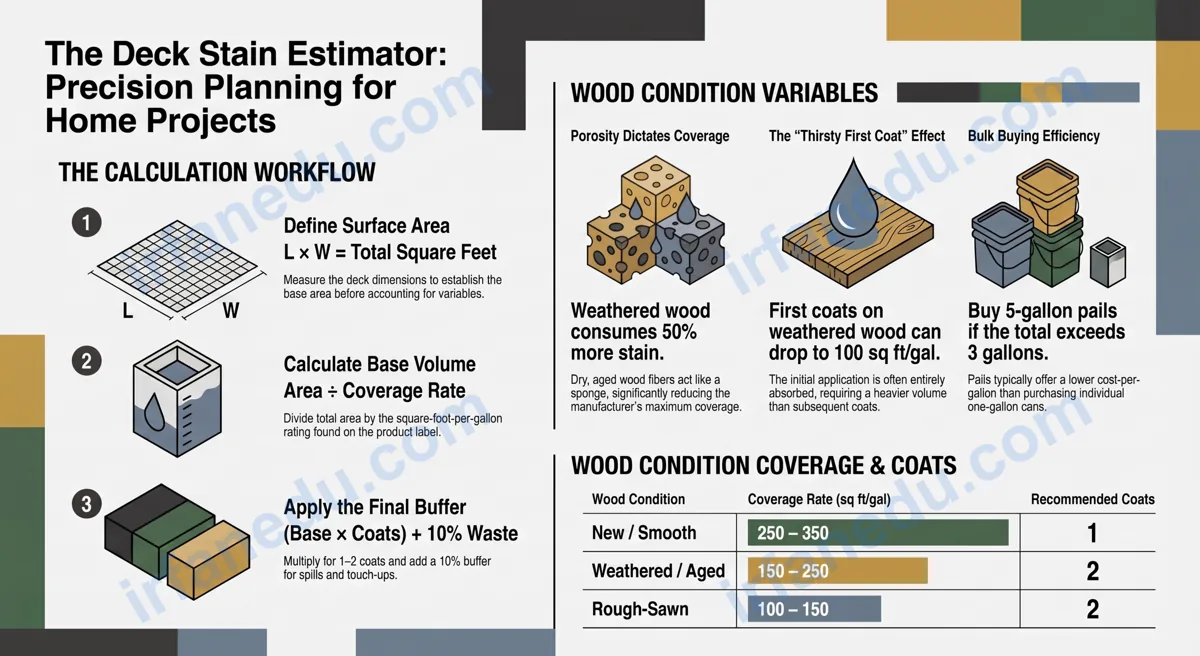
Table of Contents
Contractors who stain decks professionally use a simple formula before they ever open a can: deck area divided by coverage rate, multiplied by coats, plus a waste buffer. Get this wrong and you either run out mid-project or waste money on gallons you’ll never use. This calculator does that math for you in seconds.
A deck stain calculator estimates the number of gallons of stain required to coat a deck by dividing the total deck area (in square feet) by the stain’s coverage rate (square feet per gallon), then multiplying by the number of coats and adding a 10% waste buffer for spills and touch-ups.
TL;DR – Quick Summary
- Divide deck area (sq ft) by coverage rate (sq ft/gal) to get base gallons.
- Multiply by number of coats (usually 1 or 2).
- Add 10% waste buffer — always buy a little extra.
- Wood condition matters: rough or weathered wood needs 30-50% more stain.
- Check the product label for the manufacturer’s actual coverage rate.
- Use the calculator below before buying — it takes under 30 seconds.
| Wood Condition | Typical Coverage Rate | Coats Recommended |
|---|---|---|
| New / Smooth | 250 – 350 sq ft / gal | 1 |
| Weathered / Aged | 150 – 250 sq ft / gal | 2 |
| Rough-Sawn / Very Porous | 100 – 150 sq ft / gal | 2 |
Deck Stain Calculator
Get exact gallons needed — no guesswork
ft
ft
Step-by-Step Solution
How to Use This Deck Stain Calculator
The calculator handles the math in under 30 seconds. Here is the exact process:
- Choose your input mode. Select “By Dimensions” if you know length and width, or “I Know My Area” if you already have the square footage.
- Enter your deck’s length and width in feet (or your total area directly).
- Select wood condition. New smooth wood absorbs less stain than weathered or rough-sawn boards. Pick the closest match, or choose “Custom” and enter the rate from your product label.
- Choose number of coats. One coat for new wood; two coats for weathered or previously stripped surfaces.
- Set the waste buffer. Use 10% for a simple rectangular deck, 15% for complex shapes with lots of spindles or cutouts.
- Click Calculate. The result shows total gallons, how many 1-gallon cans or 5-gallon pails to buy, and a numbered step-by-step breakdown of the math.
What Is Deck Stain Coverage, and Why Does It Vary?
Deck stain coverage is the number of square feet one gallon of stain can coat in a single application. It varies because wood porosity is not uniform.
New pressure-treated pine fresh from the lumber yard has a dense, closed grain. One gallon can cover 300 sq ft or more. A deck that has weathered for three seasons without maintenance has open, dried-out wood fibers that act like a sponge. The same gallon might only cover 150 sq ft.
Rough-sawn cedar or redwood has an even larger surface area per square foot of deck board because of the texture. Coverage can drop to 100-125 sq ft per gallon.
In my experience helping students and homeowners work through home improvement math, the single biggest mistake people make is using a generic “300 sq ft per gallon” rule without checking the actual product. I have seen premium penetrating stains rated at 150 sq ft/gal on weathered wood right on the can. If you ignore that and use 300, you will buy half the stain you actually need.
The Deck Stain Formula Explained
The governing formula is straightforward and gives you the exact gallons to purchase:
Core Formula
Gallons = (Deck Area ÷ Coverage Rate) × Number of Coats × Waste Factor
Where Waste Factor = 1.10 for 10% extra, or 1.15 for 15% extra.
| Symbol / Variable | Meaning | Typical Unit |
|---|---|---|
| A | Deck area (length x width) | sq ft (ft²) |
| C | Coverage rate (from product label) | sq ft per gallon |
| N | Number of coats | dimensionless (1, 2, or 3) |
| W | Waste factor | dimensionless (1.10 or 1.15) |
| G | Gallons to buy | US gallons |
SI note: In metric, replace sq ft with square meters (m²) and gallons with liters. 1 US gallon = 3.785 liters; 1 sq ft = 0.0929 m².
Visual: How the Formula Flows
  Deck Length (ft)
       x
  Deck Width (ft)
       =
  Deck Area (sq ft)
       |
       v
  Deck Area / Coverage Rate (sq ft/gal)
       =
  Gallons per Coat
       |
       v
  Gallons per Coat x Number of Coats
       =
  Total Gallons (no buffer)
       |
       v
  Total Gallons x Waste Factor (1.10)
       =
  FINAL GALLONS TO BUY
Worked Examples That Match the Calculator’s Steps
Example 1: New 20 x 12 ft Deck, 1 Coat
- Deck area = 20 ft x 12 ft = 240 sq ft
- Coverage rate (new smooth wood) = 300 sq ft/gal
- Base gallons (1 coat) = 240 / 300 = 0.800 gal
- For 1 coat: 0.800 x 1 = 0.800 gal
- Add 10% waste: 0.800 x 1.10 = 0.880 gal
- Round up: Buy 1 gallon
Example 2: Weathered 16 x 20 ft Deck, 2 Coats
- Deck area = 16 ft x 20 ft = 320 sq ft
- Coverage rate (weathered wood) = 200 sq ft/gal
- Base gallons (1 coat) = 320 / 200 = 1.600 gal
- For 2 coats: 1.600 x 2 = 3.200 gal
- Add 10% waste: 3.200 x 1.10 = 3.520 gal
- Round up: Buy 3.6 gallons (4 x 1-gal cans or 1 x 5-gal pail)
Example 3: Rough-Sawn 24 x 14 ft Deck, 2 Coats, 15% Buffer
- Deck area = 24 ft x 14 ft = 336 sq ft
- Coverage rate (rough-sawn) = 125 sq ft/gal
- Base gallons (1 coat) = 336 / 125 = 2.688 gal
- For 2 coats: 2.688 x 2 = 5.376 gal
- Add 15% waste: 5.376 x 1.15 = 6.182 gal
- Round up: Buy 6.2 gallons (2 x 5-gal pails is the most economical)
Common Mistakes When Calculating Deck Stain
| Wrong Approach | Right Approach |
|---|---|
| Using 400 sq ft/gal (paint coverage) for stain | Use 100-350 sq ft/gal depending on wood porosity |
| Ignoring wood condition | Always factor in whether wood is new, weathered, or rough |
| Forgetting the waste buffer | Add 10-15% to every estimate |
| Not measuring railings separately | Add railing area if you plan to stain them |
| Buying exact calculated amount | Round up to the next standard can size |
Most deck stain guides give you a single coverage rate and call it done. What they don’t tell you is that the first coat on weathered wood is almost entirely absorbed by the wood fibers and does almost nothing for appearance. The second coat is what actually provides color and protection. This means the effective coverage rate of your first coat on a 3-year-old weathered deck can be as low as 100 sq ft/gal even if the label says 200. In my experience, the safest approach for weathered decks is to calculate both coats at the lower end of the coverage range, not the upper end.
A 5-gallon pail of deck stain almost always costs less per gallon than five individual 1-gallon cans. For any deck over 300 sq ft needing two coats, I always recommend pricing out the 5-gallon option first. The savings are real, and leftover stain stores well in a sealed pail for touch-ups next season.
Quick Quiz: Test Your Deck Stain Knowledge
1. A 300 sq ft deck needs 2 coats at 200 sq ft/gal. How many gallons (no waste buffer)?
2. Which wood condition requires the most stain per square foot?
Sources & ReferencesWritten and fact-checked by Dr Irfan Mansuri. External links open in a new tab and are provided for further reading and verification.