
🏠 Flooring Computation Calculator: Area, Boxes & Cost
🤔 How much flooring do you actually need? How do you avoid buying too little — or wasting money on too many boxes? And why does the “waste factor” matter so much more than most guides admit?
Those are the three questions I hear most from homeowners before a flooring project. In my experience helping students and readers tackle real-world math, flooring computation is one of the most practical geometry applications you’ll ever use. This calculator gives you a precise answer in under 30 seconds.
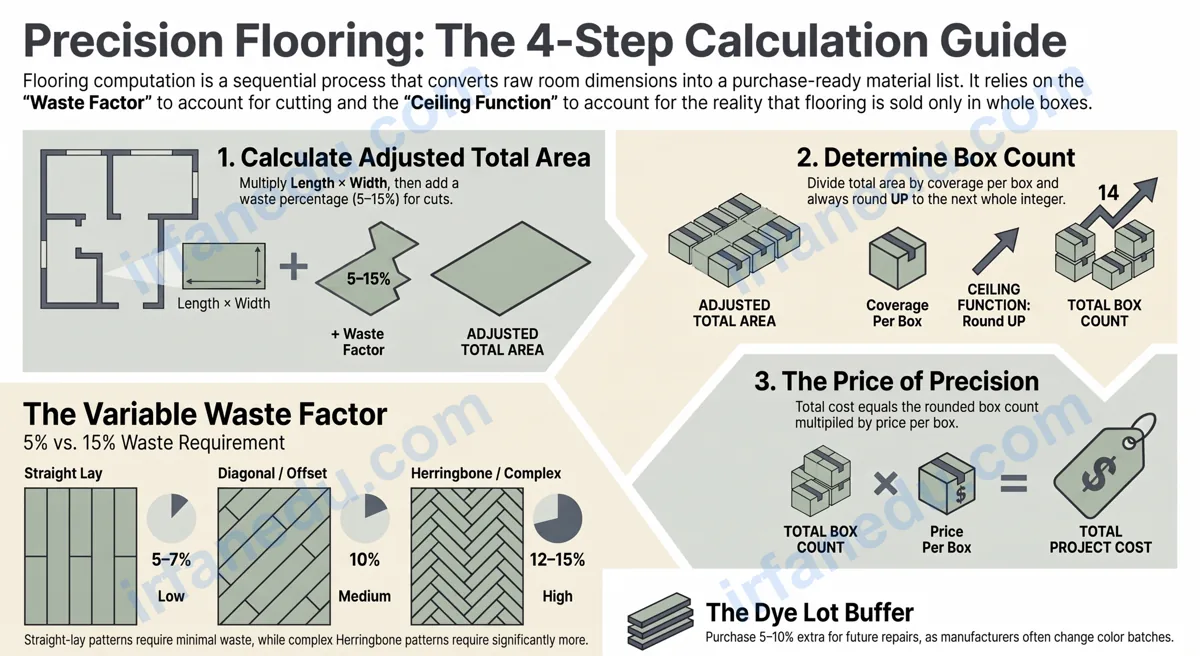
Flooring computation is the process of measuring a room’s floor area, applying a waste factor for cuts and installation errors, then calculating the number of material boxes and total cost needed for a project. The core formula is: Total Area = Room Area × (1 + Waste %), then Boxes = Total Area ÷ Coverage per Box (rounded up).
- ✅ Calculate exact square footage for any rectangular room
- ✅ Apply the correct waste factor for your installation pattern
- ✅ Find how many boxes to buy (never under- or over-order)
- ✅ Estimate total material cost instantly
- ✅ Understand the step-by-step math behind every result
⚡ Quick Answer: To compute flooring, multiply room length by width to get the net area. Add a waste factor (5% for straight lay, 10–15% for diagonal/herringbone). Divide the adjusted total by the coverage per box, then round up to the nearest whole box. Multiply boxes by price per box for total cost. Always round up — you cannot buy a fraction of a box.
- 🟢 Net Area = Room Length × Room Width (in the same unit)
- 🟢 Total Area = Net Area × (1 + Waste % ÷ 100)
- 🟢 Boxes Needed = Total Area ÷ Coverage per Box (round UP always)
- 🟢 Total Cost = Boxes × Price per Box
- 🟢 Use 5–7% waste for straight lay; 10–15% for diagonal or complex rooms
- 🟢 Buy 5–10% extra for future repairs — dye lots change
🧮 Interactive Flooring Computation Calculator
Flooring Computation Calculator
Area · Boxes · Cost · Step-by-step solution
ft
ft
Split your L-shaped room into two rectangles (A and B) and enter each:
ft
ft
ft
ft
sq ft
$
Boxes to Buy
📋 Step-by-Step Solution
| Symbol | Meaning | Unit |
|---|---|---|
| L | Room Length | ft, m, or yd |
| W | Room Width | ft, m, or yd |
| Anet | Net Floor Area | sq ft, m², or sq yd |
| w% | Waste Factor | % (5–15% typical) |
| Atotal | Total Area to Purchase | sq ft, m², or sq yd |
| C | Coverage per Box | sq ft or m² per box |
| ⌈ ⌉ | Ceiling (round up) | — |
| P | Price per Box | $ (or local currency) |
Flooring computation is the process of calculating the total quantity of flooring material needed for a room or space. It combines geometric area calculation with practical adjustments (waste factor, box rounding) to produce a purchase-ready quantity and cost estimate.
The waste factor accounts for material lost during cutting, pattern alignment, and installation errors. It is expressed as a percentage of the net floor area and added before calculating box quantities.
Box rounding (ceiling function) is mandatory because flooring is sold in whole boxes — you cannot buy a fraction of a box. Always round up, never down.
🟢 How to Use This Flooring Calculator
- Choose your room shape — Rectangle/Square for a standard room, or L-Shape to split a complex room into two rectangles.
- Enter your room dimensions in feet, meters, or yards. Use a tape measure for accuracy.
- Select your installation pattern — the calculator auto-sets the recommended waste percentage. Choose “Custom” to override.
- Enter the coverage per box from your flooring product’s label (e.g. “20.5 sq ft per box”).
- Enter the price per box (optional, but needed for cost estimate).
- Click Calculate — your result shows boxes to buy, total area, and a full step-by-step breakdown.
❓ What Is Flooring Computation?
Flooring computation is the systematic process of determining how much flooring material to purchase for a given space. It starts with geometry (area = length × width), then adds real-world adjustments that pure math ignores.
The two critical adjustments are: (1) a waste factor for material lost to cuts, breakage, and pattern matching, and (2) box rounding because flooring is sold in whole boxes. Skip either step and your estimate will be wrong.
In my experience, the single most common flooring mistake I see is people calculating the exact room area, buying exactly that many boxes, and then running short by one box mid-installation — only to find the product is out of stock or the dye lot has changed. The waste factor is not optional padding; it is the difference between finishing your floor and having a visible patch that doesn’t match.
📐 The Flooring Formula Explained
The full flooring computation formula has four sequential steps:
  ┌─────────────────────────────────────────────────────┐
  │  STEP 1: Net Area                                   │
  │  A_net = Length × Width                             │
  │  (for L-shape: A_net = A1 + A2)                     │
  ├─────────────────────────────────────────────────────┤
  │  STEP 2: Waste Adjustment                           │
  │  A_total = A_net × (1 + waste% ÷ 100)              │
  │  e.g. 10% waste → multiply by 1.10                  │
  ├─────────────────────────────────────────────────────┤
  │  STEP 3: Boxes Needed (always round UP)             │
  │  Boxes = ⌈ A_total ÷ Coverage per Box ⌉            │
  ├─────────────────────────────────────────────────────┤
  │  STEP 4: Total Cost                                 │
  │  Cost = Boxes × Price per Box                       │
  └─────────────────────────────────────────────────────┘
Waste Factor Guide
| Installation Pattern | Recommended Waste % | Why |
|---|---|---|
| Straight lay (parallel to walls) | 5–7% | Minimal cuts, simple edges |
| Offset / brick pattern | 8–10% | Half-plank cuts at each row end |
| Diagonal (45°) | 10–15% | All perimeter cuts are angled |
| Herringbone / chevron | 12–15% | Complex angles, high cut waste |
| Irregular room (many alcoves) | 10–15% | Multiple short cuts per alcove |
Most flooring guides tell you to “add 10% for waste” as a universal rule. That is wrong for two reasons. First, a simple rectangular room with straight-lay LVP planks needs only 5–7% — buying 10% wastes money. Second, a diagonal herringbone in a room with four doorways and a bay window can need 15–18% waste. The pattern and room complexity matter far more than any single rule. In my experience, the correct approach is to use the pattern-based table above and add an extra 5% if the room has more
Sources & References
Reviewed by Dr. Irfan Mansuri. External links open in a new tab and are provided for further reading and verification.