
🔥 Furnace Size Calculator: Find the Exact BTU Your Home Needs
Buying a furnace that’s the wrong size is one of the most expensive HVAC mistakes a homeowner can make. Too small and your house never gets warm enough. Too large and the furnace short-cycles, wears out faster, and wastes fuel every single winter. This free furnace size calculator gives you a reliable BTU estimate in under 60 seconds — no HVAC degree required.
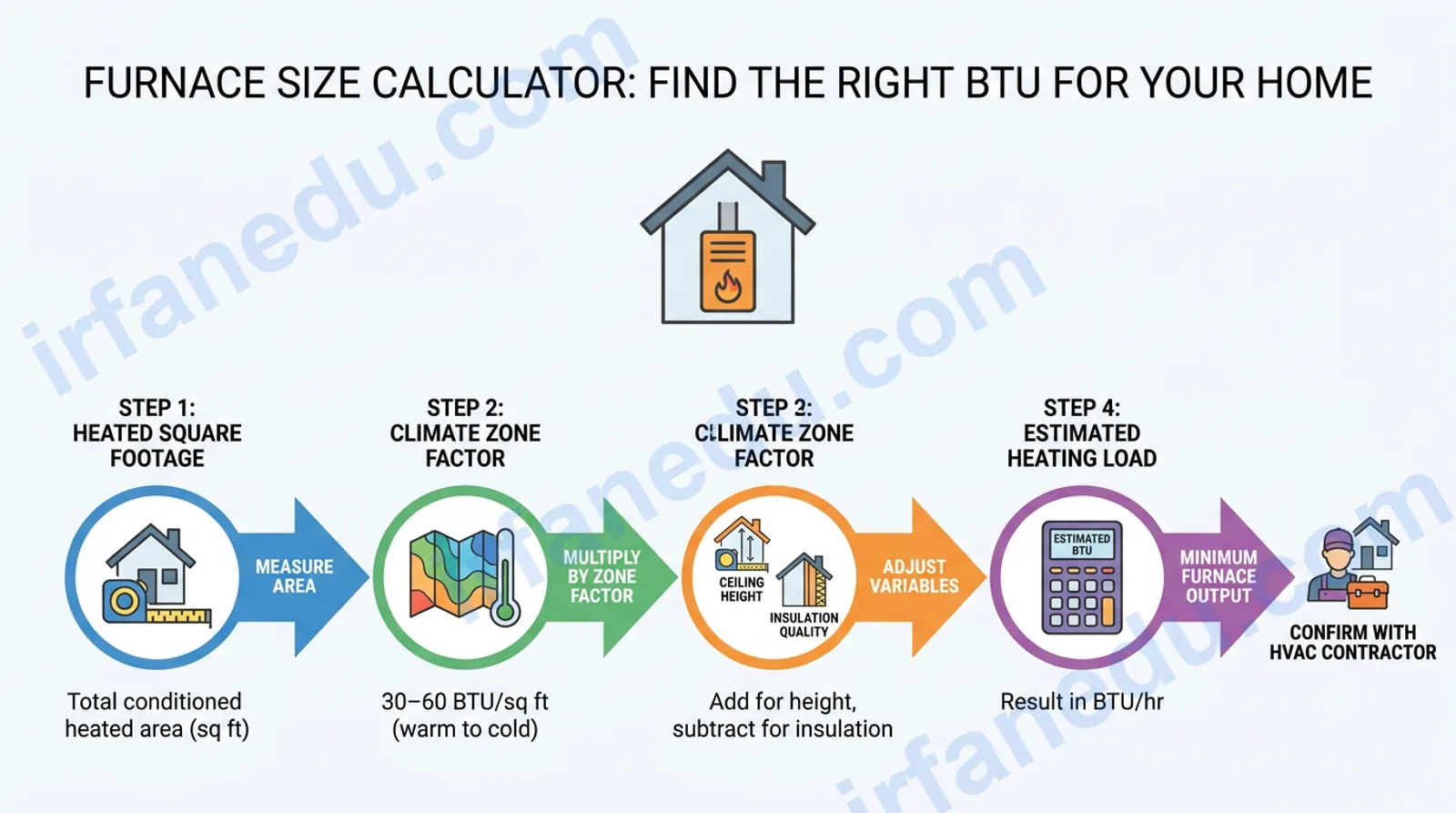
To size a furnace correctly, multiply your home’s heated square footage by a climate-zone BTU factor (30–60 BTU/sq ft), then adjust for ceiling height and insulation quality. The result is your estimated heating load in BTU/hr — the minimum output your new furnace must deliver.
📌 Quick Summary
- 🌡️ Furnace size = square footage × climate factor × ceiling factor × insulation factor
- 📐 Climate factors range from 30 BTU/sq ft (warm) to 60 BTU/sq ft (very cold)
- 🏠 8 ft ceilings = baseline; add ~12.5% per extra foot of ceiling height
- 🧱 Good insulation can reduce your BTU need by up to 20%
- ⚠️ Oversizing by more than 25% causes short-cycling and higher bills
- ✅ Always verify with a Manual J calculation before purchasing
Furnace Size Calculator
Estimate your home’s heating load in BTU/hr instantly
sq ft
Total conditioned (heated) square footage of your home. Exclude unheated garage, basement, or attic.
Choose the zone that best matches your location’s winter severity.
ft
Standard is 8 ft. Vaulted or two-story ceilings increase the volume of air to heat.
Better insulation means less heat loss and a smaller required furnace.
BTU/hr
Estimated heating load (recommended minimum furnace output)
📐 Step-by-step calculation
How to use this furnace size calculator
- Enter your heated floor area in square feet. Include all conditioned rooms but exclude unheated garages, crawl spaces, and unfinished attics.
- Select your climate zone. Pick the option that best matches your region’s typical winter severity. When in doubt, go one zone colder — it’s better to have a little extra capacity than not enough.
- Enter your ceiling height. The standard is 8 ft. If you have vaulted ceilings or a two-story open plan, measure or estimate the average height.
- Select your insulation quality. Honest self-assessment here matters. A drafty 1970s home with single-pane windows is “Poor.” A recently renovated home with spray foam and double-pane windows is “Good.”
- Click Calculate. Your result shows the required BTU/hr, unit conversions (kW, MBH, tons), the nearest standard furnace size, and a numbered step-by-step breakdown of the math.
What is furnace sizing and why does it matter?
Furnace sizing is the process of calculating the minimum heating output — measured in BTU per hour (BTU/hr) — that a furnace must deliver to keep a home comfortable during the coldest days of the year. Get it wrong in either direction and you pay for it.
A furnace that’s too small runs constantly and still can’t heat the home on a cold night. A furnace that’s too large heats the space so fast it shuts off before the air circulates properly — a problem called short-cycling. Short-cycling increases wear, creates cold spots, and can raise your annual heating bill by 10–30% compared to a correctly sized unit.
In my experience reviewing HVAC decisions with homeowners, the single most common mistake is “sizing up for safety.” People assume a bigger furnace is always better. It isn’t. I’ve seen 2,000 sq ft homes fitted with 120,000 BTU furnaces that short-cycle every 4 minutes in mild weather. The homeowner paid more upfront, more in gas, and replaced the heat exchanger in year 7. Correct sizing is not about comfort margin — it’s about efficiency and equipment life.
The furnace sizing formula explained
The formula this calculator uses is a simplified but industry-aligned version of the full Manual J heating load calculation. It is the same approach recommended by the Air Conditioning Contractors of America (ACCA) for quick estimates.
BTU/hr = Area (sq ft) × Climate Factor × Ceiling Factor × Insulation Factor
Where Ceiling Factor = Ceiling Height (ft) ÷ 8 and Insulation Factor is a multiplier based on your home’s thermal envelope quality.
Variables & symbols table
| Symbol / Input | Meaning | Unit | Typical range |
|---|---|---|---|
| Area | Total heated floor area | sq ft | 500–5,000 sq ft |
| Climate Factor | BTU needed per sq ft based on winter severity | BTU / sq ft | 30–60 |
| Ceiling Factor | Ratio of actual ceiling height to standard 8 ft | dimensionless | 0.75–1.5 |
| Insulation Factor | Multiplier for thermal envelope quality | dimensionless | 0.70–1.20 |
| BTU/hr | British Thermal Units per hour — furnace output | BTU/hr | 30,000–160,000 |
| kW | Kilowatts (1 kW = 3,412 BTU/hr) | kW | 9–47 kW |
| MBH | Thousands of BTU/hr (industry shorthand) | MBH | 30–160 MBH |
SI units note: 1 BTU = 1,055 joules. 1 BTU/hr = 0.293 watts. HVAC in North America uses BTU/hr; European markets use kW. The calculator displays both.
  FURNACE SIZING — HEAT LOSS CONCEPT
  ====================================

  Outside (cold)           Inside (warm)
  ─────────────────────────────────────
       ↑ Roof loss (~25%)
  ─────────────────────────────────────
  ←    Wall loss (~35%)   [LIVING SPACE]   Wall loss →
  ─────────────────────────────────────
       ↓ Floor loss (~15%)
  ─────────────────────────────────────
       Window/door loss (~25%)

  Total heat loss = sum of all arrows
  Furnace BTU/hr must replace this loss
  on the coldest design day of the year.

  FORMULA:
  ┌────────────────────────────────────────────────────┐
  │  BTU/hr = Area × Climate Factor                    │
  │           × (Ceiling ÷ 8)                          │
  │           × Insulation Factor                      │
  └────────────────────────────────────────────────────┘
3 fully worked examples
Example 1 — Small home in a warm climate
Inputs: 900 sq ft | Very Warm climate (30 BTU/sq ft) | 8 ft ceilings | Average insulation (×1.00)
- Base load: 900 × 30 = 27,000 BTU/hr
- Ceiling factor: 27,000 × (8 ÷ 8) = 27,000 × 1.00 = 27,000 BTU/hr
- Insulation factor: 27,000 × 1.00 = 27,000 BTU/hr
- Nearest standard furnace: 40,000 BTU/hr
A 40,000 BTU/hr furnace is the smallest standard size and provides a healthy 48% safety margin for this mild climate.
Example 2 — Mid-size home in a cold climate
Inputs: 1,800 sq ft | Cold climate (50 BTU/sq ft) | 9 ft ceilings | Good insulation (×0.85)
- Base load: 1,800 × 50 = 90,000 BTU/hr
- Ceiling factor: 90,000 × (9 ÷ 8) = 90,000 × 1.125 = 101,250 BTU/hr
- Insulation factor: 101,250 × 0.85 = 86,063 BTU/hr → rounded to 86,100 BTU/hr
- Nearest standard furnace: 100,000 BTU/hr
Good insulation brought the load down from 101,250 to 86,100 BTU/hr — saving the homeowner from needing a 120,000 BTU unit.
Example 3 — Large home in a very cold climate
Inputs: 3,200 sq ft | Very Cold climate (60 BTU/sq ft) | 10 ft ceilings | Poor insulation (×1.20)
- Base load: 3,200 × 60 = 192,000 BTU/hr
- Ceiling factor: 192,000 × (10 ÷ 8) = 192,000 × 1.25 = 240,000 BTU/hr
- Insulation factor: 240,000 × 1.20 = 288,000 BTU/hr
- Nearest standard furnace: This exceeds a single residential unit. Two 160,000 BTU/hr furnaces or a zoned system is recommended.
This example shows why large, poorly insulated homes in extreme climates often need zoned heating systems rather than a single furnace.
Climate zone BTU reference table
The table below shows the standard BTU/sq ft multipliers used by HVAC professionals for quick load estimates. These align with the ACCA Manual J climate zone classifications.
| Climate zone | BTU/sq ft | Example regions | Typical design temp |
|---|---|---|---|
| Very Warm | 30 | Southern Florida, Gulf Coast, tropical | Above 20°F design low |
| Warm | 35 | Mild coastal, Mediterranean, Pacific NW | 10–20°F design low |
| Mixed / Temperate | 40 | Mid-Atlantic US, central Europe, UK | 0–10°F design low |
| Cold | 50 | Northern US, Canada, northern Europe | -10 to 0°F design low |
| Very Cold | 60 | Alaska, northern Canada, Scandinavia | Below -10°F design low |
5 things nobody tells you about furnace sizing
Most guides stop at “multiply by BTU/sq ft.” Here are the five points that actually change the outcome — and that most HVAC articles skip entirely.
1. 🏗️ Your floor plan shape matters more than square footage alone
A long, narrow ranch house has far more exterior wall area per square foot than a compact two-story home of the same size. More wall area means more heat loss. The BTU/sq ft method assumes a reasonably compact floor plan. If your home is L-shaped or has many exterior corners, add 5–10% to your calculated load.
2. 🪟 Windows are the biggest wildcard
A single-pane window loses heat roughly 10 times faster than a well-insulated wall. A home with large picture windows or a sunroom can have a heating load 20–30% higher than the formula predicts. If you have more than 15% of your wall area in glass, bump your insulation quality down one tier in the calculator.
3. 📍 Duct losses are invisible but real
If your ductwork runs through an unheated attic or crawl space, you can lose 20–30% of the furnace’s output before it reaches the living area. A 100,000 BTU furnace with leaky attic ducts may deliver only 70,000–80,000 BTU to the rooms. Seal and insulate ducts before sizing a replacement furnace.
4. 🔄 AFUE efficiency changes the gas bill, not the BTU requirement
Annual Fuel Utilization Efficiency (AFUE) tells you how much of the gas burned becomes useful heat. A 96% AFUE furnace wastes only 4% up the flue. But your heating load — the BTU/hr your home needs — is the same regardless of AFUE. AFUE affects operating cost, not furnace size. Don’t confuse the two.
5. 🌬️ Infiltration (air leakage) is the hidden load multiplier
Cold air leaking in through gaps around doors, electrical outlets, and pipe penetrations adds a significant hidden load. A well-sealed modern home might have 0.35 air changes per hour (ACH); a drafty older home can exceed 1.5 ACH. The “Poor insulation” setting in this calculator partially accounts for this, but a blower door test gives the real number.
Sizing a furnace based only on the old furnace’s nameplate BTU, assuming the previous installer got it right. Many older homes
Sources & References
Written and fact-checked by Dr Irfan Mansuri. External links open in a new tab and are provided for further reading and verification.