
California DMV Permit Practice Test
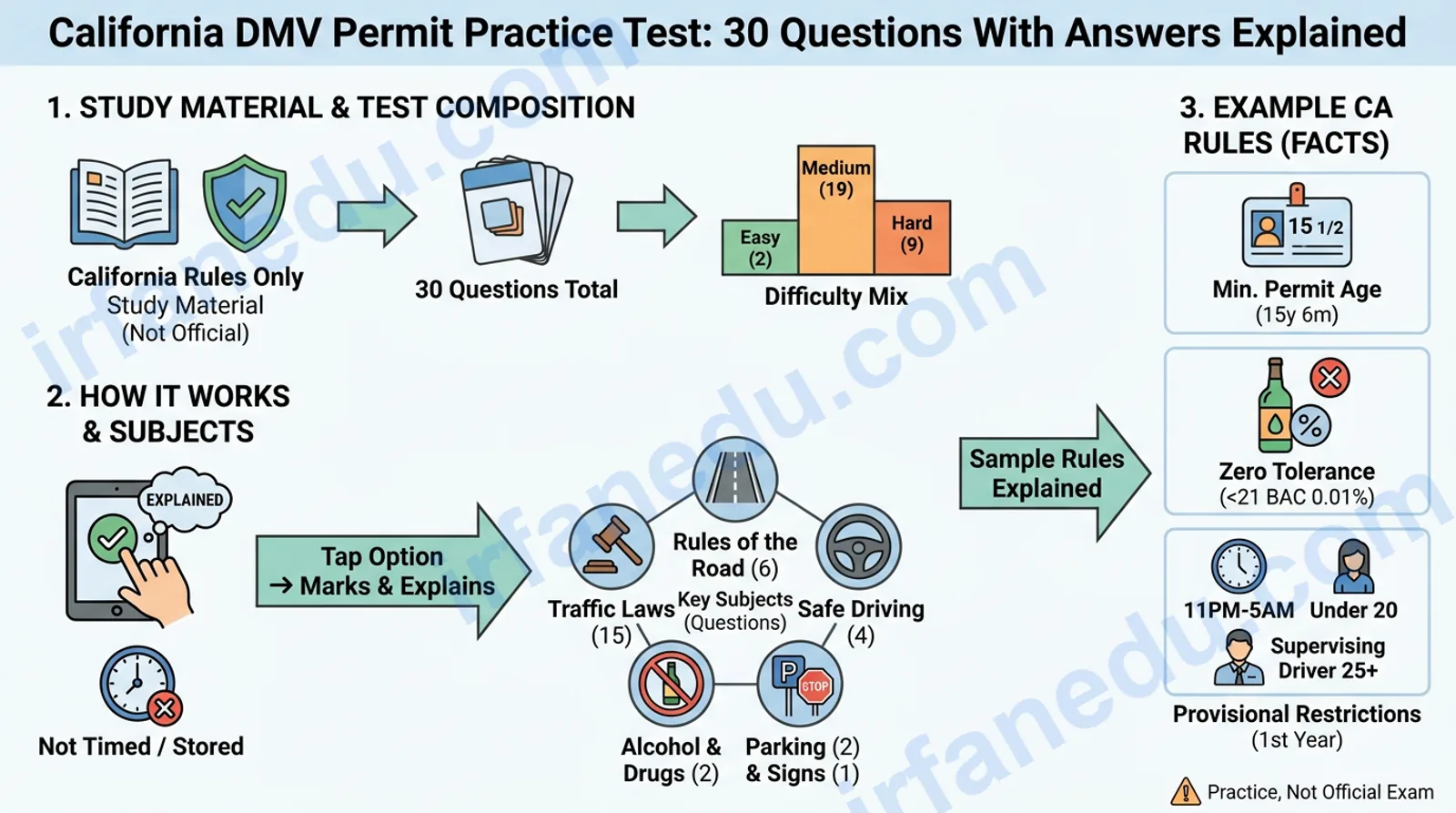
What is in this test
Tap an option and the page marks it and opens the explanation. Nothing is timed and nothing is stored, so you can work through it in one sitting or come back to it. If you would rather not tap through, every answer is also listed in the answer key at the bottom.
| Subject | Questions |
|---|---|
| Traffic laws | 15 |
| Rules of the road | 6 |
| Safe driving | 4 |
| Alcohol and drugs | 2 |
| Parking rules | 2 |
| Traffic signs | 1 |
Difficulty mix: 2 easy, 19 medium, 9 hard. The questions run easiest first.
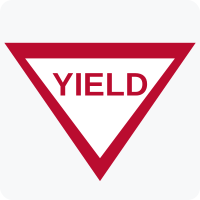
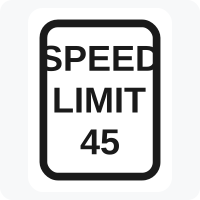
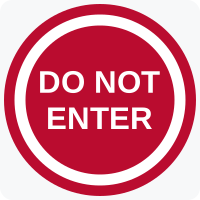
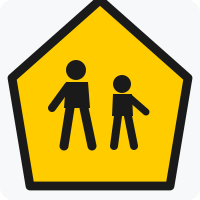
Signs come up on every state paper. These six account for more of them than any others:


The 30 questions
In California, the minimum age to apply for a provisional instruction permit is:
Show the answer
Correct answer: B. 15 years and 6 months
California allows a provisional instruction permit from 15 and a half, provided you have started driver education. The permit is not valid for driving until you have completed at least six hours of professional training or turned 17 and a half.
In California, a driver under 21 commits a zero tolerance offense at a BAC of:
Show the answer
Correct answer: A. 0.01% or higher
California’s zero tolerance law applies at 0.01% for drivers under 21, which a single drink can exceed. At 0.05% or above an under-21 driver faces additional penalties, and 0.08% is the limit for drivers 21 and over.
For the first 12 months after getting a provisional license in California, a driver under 18 may not:
Show the answer
Correct answer: A. Drive between 11 p.m. and 5 a.m., or carry passengers under 20, without a licensed driver 25 or older
California’s graduated licensing rules impose both a night-time restriction from 11 p.m. to 5 a.m. and a ban on carrying passengers under 20, for the first twelve months. Both lift only if a licensed driver aged 25 or older is supervising.
California’s Basic Speed Law means:
Show the answer
Correct answer: C. You may never drive faster than is safe for current conditions
Under the Basic Speed Law you can be cited for driving too fast for conditions even when you are below the posted limit. Rain, fog, traffic density, and road surface all lower the legal safe speed.
Unless otherwise posted, the speed limit in a California residential or business district is:
Show the answer
Correct answer: B. 25 mph
The prima facie limit is 25 mph in residential and business districts. It drops to 25 mph in a school zone when children are present, and to 15 mph at blind intersections, blind railroad crossings, and in alleys.
A California driver under 21 who refuses or fails a preliminary alcohol screening test faces:
Show the answer
Correct answer: A. A one-year license suspension
Under-21 drivers must submit to a preliminary alcohol screening test on request. Refusing it, or testing at 0.01% or above, brings a one-year suspension of driving privileges administratively, separate from any court case.
Under California law, a driver under 18 may use a mobile phone while driving:
Show the answer
Correct answer: C. Not at all, even hands-free, except in a genuine emergency
Drivers under 18 may not use a wireless phone or any electronic device at all while driving, including hands-free, except to call emergency services. Adult drivers may use a phone only hands-free.
You are on a two-lane road in California and a school bus stops ahead with its red lights flashing. You must:
Show the answer
Correct answer: A. Stop and remain stopped until the red lights stop flashing
Traffic in both directions must stop on an undivided road and stay stopped until the lights go off. Passing a school bus with flashing red lights carries a fine of several hundred dollars and a point on your record.
California’s Move Over law requires you to change lanes or slow down for:
Show the answer
Correct answer: D. Stopped emergency vehicles, tow trucks, and Caltrans vehicles displaying flashing amber lights
The law covers stopped emergency vehicles, tow trucks, and Caltrans maintenance vehicles showing flashing amber warning lights. Move over a lane if you safely can; if not, slow to a reasonable and prudent speed.
In California, a white curb means:
Show the answer
Correct answer: C. Loading and unloading of passengers or mail only, for a brief period
California uses a color code: white for brief passenger or mail loading, green for limited-time parking, yellow for freight loading, red for no stopping, and blue for disabled permit holders.
In California you may not park within how many feet of a fire hydrant?
Show the answer
Correct answer: B. 15 feet
Fifteen feet is the California clearance. You also may not park in front of a driveway, on a sidewalk, within an intersection, on a crosswalk, or within 15 feet of a fire station driveway.
California requires headlights to be turned on:
Show the answer
Correct answer: D. 30 minutes after sunset until 30 minutes before sunrise, and whenever conditions require windshield wipers
California also requires headlights whenever weather makes continuous wiper use necessary, and when visibility is under 1,000 feet. Daytime running lights alone do not satisfy the wiper rule because they leave the tail lights off.
When passing a bicyclist on a California road, you must:
Show the answer
Correct answer: B. Give at least three feet of clearance, or slow down and pass only when safe if three feet is not possible
The Three Feet for Safety Act requires at least three feet between your vehicle and the cyclist. If road conditions make that impossible, you must slow down and pass only when it will not endanger the cyclist.
A solid white line to the right of a California carpool (HOV) lane means:
Show the answer
Correct answer: C. You may enter or exit only at designated broken-line openings
Crossing a solid line into or out of an HOV lane is a violation. Wait for the dashed section provided for entry and exit, and check the posted signs for the hours and occupancy requirement, which vary by corridor.
California child restraint law requires children to ride in the back seat in a car seat or booster until they are:
Show the answer
Correct answer: D. At least 8 years old or 4 feet 9 inches tall
Children must use an appropriate child restraint in the back seat until age 8 or a height of 4 feet 9 inches. Children under 2 must ride rear-facing unless they exceed 40 pounds or 40 inches.
You are driving in California and encounter dense fog. The safest action is to:
Show the answer
Correct answer: A. Slow down, use low beams, and if visibility becomes too poor, leave the road entirely and stop with lights on
Following tail lights in fog is how chain collisions start, because you inherit the other driver’s mistakes with no time to react. If you must stop, get completely clear of the traffic lanes before you do.
At an unmarked crosswalk in California, a pedestrian:
Show the answer
Correct answer: B. Has the right-of-way, just as in a marked crosswalk
Unmarked crosswalks exist at most intersections in California. Drivers must yield to pedestrians in them and must not pass a vehicle stopped at any crosswalk, because it is likely yielding to someone you cannot see.
The minimum liability insurance a California driver must carry includes:
Show the answer
Correct answer: A. Bodily injury and property damage liability at the state minimum limits
California requires proof of financial responsibility, normally liability insurance covering injury to others and damage to their property. Driving without it can bring fines, vehicle impoundment, and suspension of your driving privilege.
In California, a flashing red traffic signal means:
Show the answer
Correct answer: D. Stop, then proceed when it is safe, as at a stop sign
A flashing red has the same effect as a stop sign: come to a full stop, yield to traffic and pedestrians, then go when the way is clear. A flashing yellow means slow down and proceed with care.
In California, you may make a U-turn in a residential district:
Show the answer
Correct answer: C. When no vehicle is approaching within 200 feet, unless a sign prohibits it
U-turns in a residential district are permitted when no vehicle is approaching within 200 feet and no sign forbids the turn. U-turns are prohibited on a divided highway across the median and where visibility is limited.
California requires you to reduce speed and use extra caution when:
Show the answer
Correct answer: C. Approaching and crossing an intersection, a curve, a hill crest, or a narrow or winding roadway
These are the situations the Vehicle Code names specifically because sight distance is limited. The Basic Speed Law then requires a speed appropriate to what you can actually see and stop within.
In California, the speed limit at a blind intersection or an alley is:
Show the answer
Correct answer: B. 15 mph
Fifteen miles per hour applies at blind intersections, blind railroad crossings, and in alleys. An intersection counts as blind if you cannot see 100 feet in either direction during the last 100 feet before crossing.
In California you may drive in a bicycle lane:
Show the answer
Correct answer: D. Only within 200 feet of an intersection when preparing to make a right turn
You may enter a bike lane only to prepare for a right turn, and only within 200 feet of the intersection. Signal, check for cyclists, and merge into the lane rather than turning across it.
You must report a collision to the California DMV on form SR-1 within 10 days if:
Show the answer
Correct answer: B. Anyone was injured or killed, or property damage exceeds $1,000
An SR-1 must be filed within ten days when anyone is injured or killed, or damage to any one person’s property exceeds $1,000. This applies regardless of fault and in addition to any police report.
On a California road with a bike lane, when making a right turn you should:
Show the answer
Correct answer: B. Merge into the bike lane within 200 feet of the corner after yielding to cyclists, then turn
Merging into the bike lane before turning removes the right-hook conflict, because a cyclist can no longer be alongside you as you turn. Check your mirror and blind spot before merging, and signal throughout.
In California, lane splitting by motorcycles is:
Show the answer
Correct answer: C. Legal, and drivers must not intentionally block a motorcyclist doing it
California is the state that expressly permits motorcycles to ride between lanes of slow or stopped traffic. Deliberately blocking or crowding a lane-splitting rider is illegal, so check your mirrors before changing lanes in slow traffic.
Under California law, driving with an open container of alcohol in the passenger area is:
Show the answer
Correct answer: A. Illegal for both driver and passengers, and the container must be stored in the trunk
California prohibits open containers anywhere in the passenger compartment, including a recapped bottle. Store any opened alcohol in the trunk, or if the vehicle has no trunk, somewhere not normally occupied by the driver or passengers.
When driving in California mountains and meeting a vehicle on a narrow road where neither can pass, the driver who must back up is:
Show the answer
Correct answer: A. The one going downhill
The downhill driver yields, because reversing uphill risks loss of traction and control. This is a specific rule in the California Vehicle Code, not merely a courtesy.
In California, a driver under 18 convicted of two or more traffic violations within 12 months may face:
Show the answer
Correct answer: D. Restriction or suspension of their driving privilege
The DMV can restrict a provisional driver to essential trips after two convictions or one at-fault collision in twelve months, and suspend the privilege if the pattern continues. Provisional drivers are held to a stricter standard than adults.
In California, a first conviction for driving under the influence typically brings:
Show the answer
Correct answer: D. Fines, a license suspension, a DUI program, possible jail, and usually an ignition interlock requirement
Even a first DUI in California brings court fines and fees running into thousands of dollars, a suspension, a mandatory education program, possible jail, and an ignition interlock requirement, with insurance costs rising sharply for years.
Answer key
Every answer in one place, in question order.
| No. | Ans | The correct option |
|---|---|---|
| 1 | B | 15 years and 6 months |
| 2 | A | 0.01% or higher |
| 3 | A | Drive between 11 p.m. and 5 a.m., or carry passengers under 20, without a licensed driver 25 or older |
| 4 | C | You may never drive faster than is safe for current conditions |
| 5 | B | 25 mph |
| 6 | A | A one-year license suspension |
| 7 | C | Not at all, even hands-free, except in a genuine emergency |
| 8 | A | Stop and remain stopped until the red lights stop flashing |
| 9 | D | Stopped emergency vehicles, tow trucks, and Caltrans vehicles displaying flashing amber lights |
| 10 | C | Loading and unloading of passengers or mail only, for a brief period |
| 11 | B | 15 feet |
| 12 | D | 30 minutes after sunset until 30 minutes before sunrise, and whenever conditions require windshield wipers |
| 13 | B | Give at least three feet of clearance, or slow down and pass only when safe if three feet is not possible |
| 14 | C | You may enter or exit only at designated broken-line openings |
| 15 | D | At least 8 years old or 4 feet 9 inches tall |
| 16 | A | Slow down, use low beams, and if visibility becomes too poor, leave the road entirely and stop with lights on |
| 17 | B | Has the right-of-way, just as in a marked crosswalk |
| 18 | A | Bodily injury and property damage liability at the state minimum limits |
| 19 | D | Stop, then proceed when it is safe, as at a stop sign |
| 20 | C | When no vehicle is approaching within 200 feet, unless a sign prohibits it |
| 21 | C | Approaching and crossing an intersection, a curve, a hill crest, or a narrow or winding roadway |
| 22 | B | 15 mph |
| 23 | D | Only within 200 feet of an intersection when preparing to make a right turn |
| 24 | B | Anyone was injured or killed, or property damage exceeds $1,000 |
| 25 | B | Merge into the bike lane within 200 feet of the corner after yielding to cyclists, then turn |
| 26 | C | Legal, and drivers must not intentionally block a motorcyclist doing it |
| 27 | A | Illegal for both driver and passengers, and the container must be stored in the trunk |
| 28 | A | The one going downhill |
| 29 | D | Restriction or suspension of their driving privilege |
| 30 | D | Fines, a license suspension, a DUI program, possible jail, and usually an ignition interlock requirement |
More permit test practice
Everything on this site tagged DMV lives in the DMV category.
Sources