
Flashcards Elements Periodic Table: The Complete Student Study Guide 🧪
If the periodic table has ever felt like a wall of random symbols you’re expected to magically memorize, you’re not alone. I hear this from students every single semester — and the truth is, the periodic table is overwhelming when you approach it the wrong way.
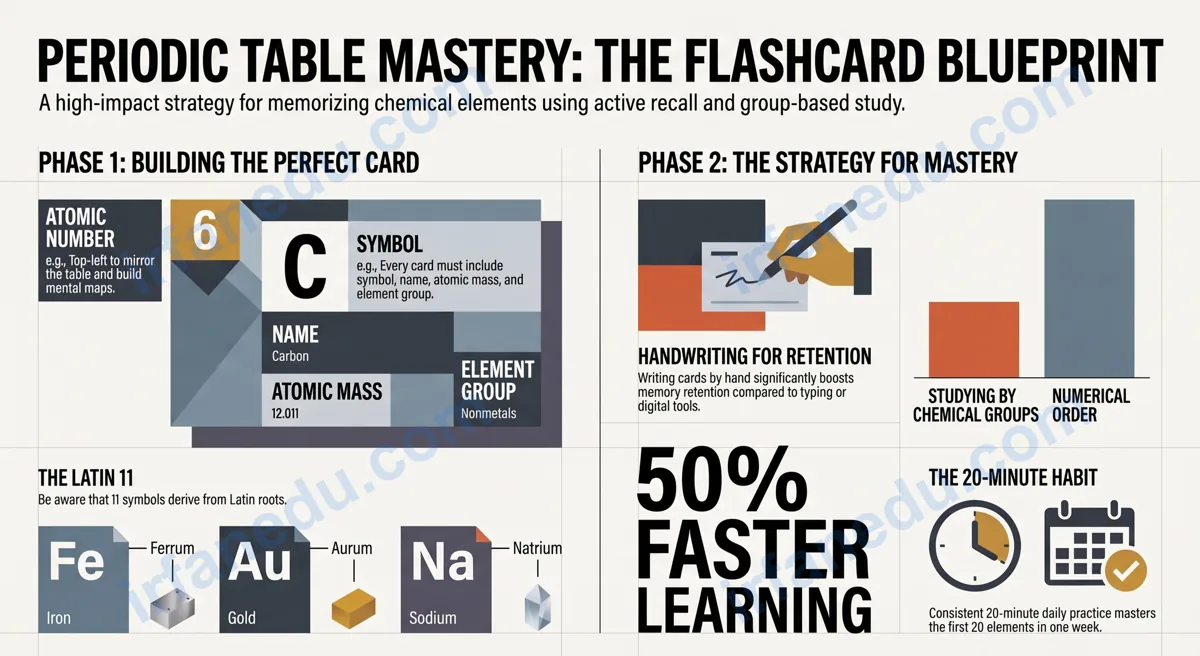
Periodic table flashcards are the single most effective low-tech tool for memorizing element names, symbols, and atomic numbers. When you make them yourself and study by group rather than by number, you cut memorization time in half and actually understand what you’re learning.
In this guide, I’m going to walk you through exactly what to put on each flashcard, give you a complete reference chart of all 118 elements, and share the study strategy that I’ve seen work for hundreds of students. By the end, you’ll have a clear, confident system — not just a pile of cards.
- What information belongs on each element flashcard
- A full printable-style reference chart of all 118 elements
- How to read and use a periodic table card correctly
- The group-first study strategy that cuts memorization time
- Why 11 element symbols don’t match their English names
- The most common flashcard mistakes (and how to avoid them)
⚡ TL;DR – Quick Summary
- 🃏 Each flashcard needs: atomic number, symbol, name, atomic mass, and group.
- 📊 The periodic table has 118 confirmed elements across 18 groups and 7 periods.
- 🎯 Study by group first — elements in the same group share properties.
- 🔤 11 symbols come from Latin names (Fe = Ferrum, Au = Aurum, etc.).
- ⏱ 15-20 min/day with spaced repetition = first 20 elements in one week.
- 🖊 Writing cards by hand beats typing — the act of writing boosts retention.
What Is a Periodic Table Flashcard? 🃏
A periodic table flashcard is a study card with exactly one chemical element per card, designed for active recall practice. The front shows the element symbol; the back reveals the name, atomic number, atomic mass, and group.
Active recall — the act of retrieving information from memory rather than just re-reading it — is one of the most evidence-backed study techniques in cognitive science. A 2013 study published in Psychological Science in the Public Interest ranked practice testing as the highest-utility learning strategy, above re-reading, highlighting, and summarizing. Flashcards are a direct application of that principle.
Here’s what a well-made element flashcard looks like:
H
Hydrogen
1.008
C
Carbon
12.011
O
Oxygen
15.999
Fe
Iron
55.845
Au
Gold
196.967
Notice how the atomic number sits in the top-left corner — exactly as it appears on the real periodic table. Matching the card layout to the table layout means your brain builds a spatial memory map, not just a list of isolated facts.
🖱 Hover over a card to flip it (desktop) — or tap on mobile:
At. Mass: 22.990
Group 1 – Alkali Metal
Period 3
At. Mass: 35.453
Group 17 – Halogen
Period 3
At. Mass: 39.948
Group 18 – Noble Gas
Period 3
Interactive demo — hover/tap to flip
Full Reference Chart: All 118 Elements 📊
This is the centrepiece of this guide — a complete, scannable reference table of all 118 elements. Use it to check your flashcards, spot gaps in your knowledge, and understand the group structure at a glance.
The table is sorted by atomic number. The Group column tells you which element family each belongs to — this is the key to group-based study (explained in the strategy section below).
| # | Symbol | Name | Atomic Mass | Group / Category | Period |
|---|---|---|---|---|---|
| 1 | H | Hydrogen | 1.008 | Nonmetal | 1 |
| 2 | He | Helium | 4.003 | Noble Gas | 1 |
| 3 | Li | Lithium | 6.941 | Alkali Metal | 2 |
| 4 | Be | Beryllium | 9.012 | Alkaline Earth Metal | 2 |
| 5 | B | Boron | 10.811 | Metalloid | 2 |
| 6 | C | Carbon | 12.011 | Nonmetal | 2 |
| 7 | N | Nitrogen | 14.007 | Nonmetal | 2 |
| 8 | O | Oxygen | 15.999 | Nonmetal | 2 |
| 9 | F | Fluorine | 18.998 | Halogen | 2 |
| 10 | Ne | Neon | 20.180 | Noble Gas | 2 |
| 11 | Na | Sodium | 22.990 | Alkali Metal | 3 |
| 12 | Mg | Magnesium | 24.305 | Alkaline Earth Metal | 3 |
| 13 | Al | Aluminum | 26.982 | Post-Transition Metal | 3 |
| 14 | Si | Silicon | 28.086 | Metalloid | 3 |
| 15 | P | Phosphorus | 30.974 | Nonmetal | 3 |
| 16 | S | Sulfur | 32.065 | Nonmetal | 3 |
| 17 | Cl | Chlorine | 35.453 | Halogen | 3 |
| 18 | Ar | Argon | 39.948 | Noble Gas | 3 |
| 19 | K | Potassium | 39.098 | Alkali Metal | 4 |
| 20 | Ca | Calcium | 40.078 | Alkaline Earth Metal | 4 |
| 21 | Sc | Scandium | 44.956 | Transition Metal | 4 |
| 22 | Ti | Titanium | 47.867 | Transition Metal | 4 |
| 23 | V | Vanadium | 50.942 | Transition Metal | 4 |
| 24 | Cr | Chromium | 51.996 | Transition Metal | 4 |
| 25 | Mn | Manganese | 54.938 | Transition Metal | 4 |
| 26 | Fe | Iron | 55.845 | Transition Metal ★ | 4 |
| 27 | Co | Cobalt | 58.933 | Transition Metal | 4 |
| 28 | Ni | Nickel | 58.693 | Transition Metal | 4 |
| 29 | Cu | Copper | 63.546 | Transition Metal ★ | 4 |
| 30 | Zn | Zinc | 65.38 | Transition Metal | 4 |
| 31 | Ga | Gallium | 69.723 | Post-Transition Metal | 4 |
| 32 | Ge | Germanium | 72.630 | Metalloid | 4 |
| 33 | As | Arsenic | 74.922 | Metalloid | 4 |
| 34 | Se | Selenium | 78.971 | Nonmetal | 4 |
| 35 | Br | Bromine | 79.904 | Halogen | 4 |
| 36 | Kr | Krypton | 83.798 | Noble Gas | 4 |
| 37 | Rb | Rubidium | 85.468 | Alkali Metal | 5 |
| 38 | Sr | Strontium | 87.62 | Alkaline Earth Metal | 5 |
| 39 | Y | Yttrium | 88.906 | Transition Metal | 5 |
| 40 | Zr | Zirconium | 91.224 | Transition Metal | 5 |
| 41 | Nb | Niobium | 92.906 | Transition Metal | 5 |
| 42 | Mo | Molybdenum | 95.96 | Transition Metal | 5 |
| 43 | Tc | Technetium | (98) | Transition Metal | 5 |
| 44 | Ru | Ruthenium | 101.07 | Transition Metal | 5 |
| 45 | Rh | Rhodium | 102.906 | Transition Metal | 5 |
| 46 | Pd | Palladium | 106.42 | Transition Metal | 5 |
| 47 | Ag | Silver | 107.868 | Transition Metal ★ | 5 |
| 48 | Cd | Cadmium | 112.411 | Transition Metal | 5 |
| 49 | In | Indium | 114.818 | Post-Transition Metal | 5 |
| 50 | Sn | Tin | 118.710 | Post-Transition Metal ★ | 5 |
| 51 | Sb | Antimony | 121.760 | Metalloid ★ | 5 |
| 52 | Te | Tellurium | 127.60 | Metalloid | 5 |
| 53 | I | Iodine | 126.904 | Halogen | 5 |
| 54 | Xe | Xenon | 131.293 | Noble Gas | 5 |
| 55 | Cs | Cesium | 132.905 | Alkali Metal | 6 |
| 56 | Ba | Barium | 137.327 | Alkaline Earth Metal | 6 |
| 57 | La | Lanthanum | 138.905 | Lanthanide | 6 |
| 58 | Ce | Cerium | 140.116 | Lanthanide | 6 |
| 59 | Pr | Praseodymium | 140.908 | Lanthanide | 6 |
| 60 | Nd | Neodymium | 144.242 | Lanthanide | 6 |
| 61 | Pm | Promethium | (145) | Lanthanide | 6 |
| 62 | Sm | Samarium | 150.36 | Lanthanide | 6 |
| 63 | Eu | Europium | 151.964 | Lanthanide | 6 |
| 64 | Gd | Gadolinium | 157.25 | Lanthanide | 6 |
| 65 | Tb | Terbium | 158.925 | Lanthanide | 6 |
| 66 | Dy | Dysprosium | 162.500 | Lanthanide | 6 |
| 67 | Ho | Holmium | 164.930 | Lanthanide | 6 |
| 68 | Er | Erbium | 167.259 | Lanthanide | 6 |
| 69 | Tm | Thulium | 168.934 | Lanthanide | 6 |
| 70 | Yb | Ytterbium | 173.054 | Lanthanide | 6 |
| 71 | Lu | Lutetium | 174.967 | Lanthanide | 6 |
| 72 | Hf | Hafnium | 178.49 | Transition Metal | 6 |
| 73 | Ta | Tantalum | 180.948 | Transition Metal | 6 |
| 74 | W | Tungsten | 183.84 | Transition Metal ★ | 6 |
| 75 | Re | Rhenium | 186.207 | Transition Metal | 6 |
| 76 | Os | Osmium | 190.23 | Transition Metal | 6 |
| 77 | Ir | Iridium | 192.217 | Transition Metal | 6 |
| 78 | Pt | Platinum | 195.084 | Transition Metal | 6 |
| 79 | Au | Gold | 196.967 | Transition Metal ★ | 6 |
| 80 | Hg | Mercury | 200.592 | Transition Metal ★ | 6 |
| 81 | Tl | Thallium | 204.383 | Post-Transition Metal | 6 |
| 82 | Pb | Lead | 207.2 | Post-Transition Metal ★ | 6 |
| 83 | Bi | Bismuth | 208.980 | Post-Transition Metal | 6 |
| 84 | Po | Polonium | (209) | Post-Transition Metal | 6 |
| 85 | At | Astatine | (210) | Halogen | 6 |
| 86 | Rn | Radon | (222) | Noble Gas | 6 |
| 87 | Fr | Francium | (223) | Alkali Metal | 7 |
| 88 | Ra | Radium | (226) | Alkaline Earth Metal | 7 |
| 89 | Ac | Actinium | (227) | Actin
Sources & ReferencesReviewed by Dr. Irfan Mansuri. External links open in a new tab and are provided for further reading and verification. |