
Periodic Table of Elements Worksheet: Free Printable PDF with Answer Key
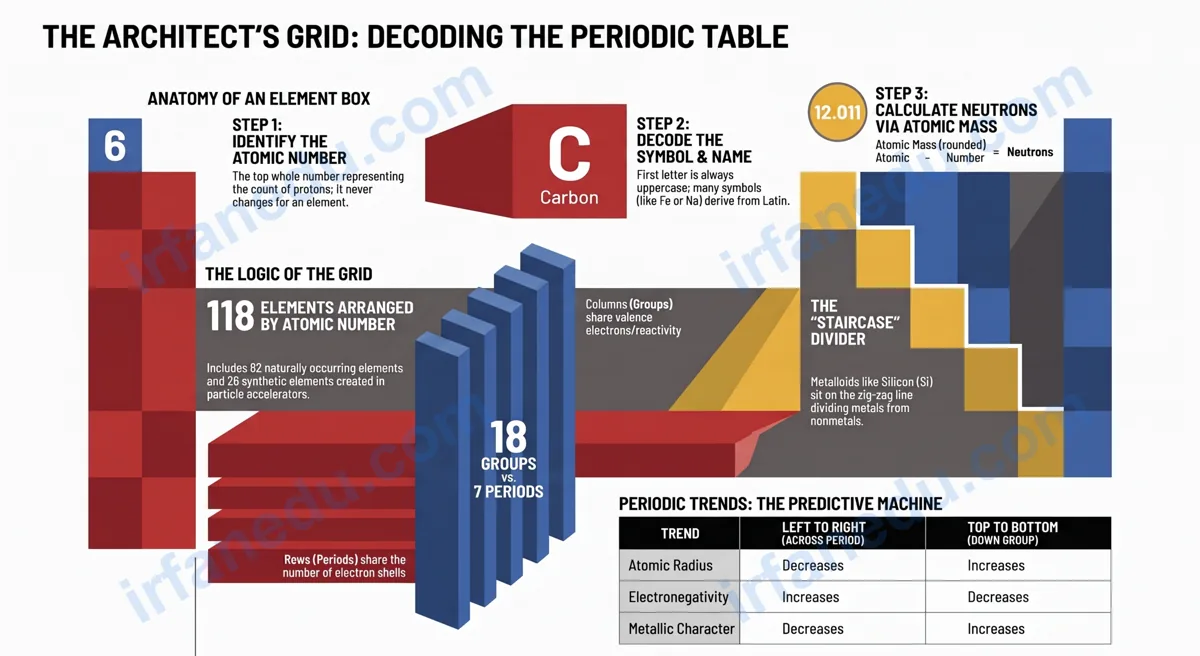
The periodic table of elements is the single most important reference tool in chemistry. It organizes all 118 known elements by atomic number into 18 groups and 7 periods, revealing patterns in reactivity, atomic size, and bonding that explain almost every chemical reaction you will ever study.
Most students treat the periodic table like a wall poster — something to glance at during a test. That is a mistake. In my experience teaching chemistry, the students who score highest are the ones who can actively read the table: they extract atomic numbers, predict trends, and locate elements by position without hesitation. This worksheet and lesson will get you there.
- A clear, step-by-step lesson on reading the periodic table
- 3 fully worked examples with explanations
- 10 graded practice problems (easy to hard) with a full answer key
- A free downloadable PDF worksheet you can print and use right away
A periodic table of elements worksheet helps students practice reading element symbols, atomic numbers, atomic masses, and group/period positions. The table covers all 118 elements organized by increasing atomic number into 18 groups and 7 periods. Use it to memorize key elements, understand periodic trends, and build the foundation for every chemistry topic that follows.
Free printable PDF worksheet — 10 graded problems + full answer key, ready to print.
TL;DR – Quick Summary
- The periodic table has 118 elements arranged by atomic number.
- Each element box shows atomic number, symbol, name, and atomic mass.
- Groups (columns) share valence electrons; periods (rows) share electron shells.
- Atomic radius decreases left to right; electronegativity increases left to right.
- Neutrons = rounded atomic mass minus atomic number.
- This page includes a free 10-problem worksheet PDF with a full answer key.
| Feature | Detail |
|---|---|
| Total elements | 118 (confirmed) |
| Number of groups (columns) | 18 |
| Number of periods (rows) | 7 |
| Most electronegative element | Fluorine (F, atomic number 9) |
| Least electronegative element | Francium (Fr, atomic number 87) |
| Most abundant element in Earth’s crust | Oxygen (O, ~46% by mass) |
| First element (atomic number 1) | Hydrogen (H) |
| Last confirmed element | Oganesson (Og, atomic number 118) |
| Original table designer | Dmitri Mendeleev, 1869 |
The Periodic Table Is a Prediction Machine — Not Just a List
The periodic table does far more than list elements alphabetically. It is organized so that position predicts behavior. Every element in Group 1 (the alkali metals) reacts violently with water. Every element in Group 18 (the noble gases) is almost completely unreactive. You do not need to memorize these facts separately — the table’s structure tells you.
Dmitri Mendeleev published the first recognizable periodic table in 1869. His key insight was to arrange elements by atomic mass and leave gaps for elements not yet discovered. He correctly predicted the properties of gallium, scandium, and germanium before they were found. That predictive power is exactly why chemists still use the same organizational logic today, now updated to use atomic number instead of atomic mass.
I have seen students spend hours memorizing element names in isolation. That effort is largely wasted. In my experience, spending 20 minutes understanding the table’s structure — groups, periods, and trends — is worth more than two hours of rote memorization. The structure does the remembering for you.
The modern table has 118 confirmed elements. Elements 1-92 occur naturally; elements 93-118 are synthetic, created in particle accelerators. For most chemistry courses, you need to know elements 1-36 well and recognize the symbols of common metals and nonmetals beyond that range.
How to Read an Element Box: A Step-by-Step Guide That Most Textbooks Skip
Reading one element’s box correctly unlocks every calculation that follows. Here is the standard layout and what each number means.
  +---------------------------+
  |           26              |  <-- Atomic Number (protons)
  |           Fe              |  <-- Chemical Symbol
  |          Iron             |  <-- Element Name
  |          55.85            |  <-- Atomic Mass (amu)
  +---------------------------+

  Protons    = 26      (= atomic number)
  Electrons  = 26      (neutral atom)
  Neutrons   = 56 - 26 = 30  (mass number - atomic number)
  Group      = 8       (transition metal)
  Period     = 4
The 5 Steps to Read Any Element Box
- Top number = Atomic Number. Count of protons. This never changes for a given element. Iron always has 26 protons.
- Center letters = Chemical Symbol. One or two letters. First letter is always uppercase. Second (if present) is always lowercase. Fe, not FE or fe.
- Full name. Printed below the symbol. Use it to confirm you have the right element, especially for symbols derived from Latin (Fe = Ferrum, Na = Natrium).
- Bottom decimal = Atomic Mass. The weighted average mass across all stable isotopes, in atomic mass units (amu). Round it to the nearest whole number to get the mass number of the most common isotope.
- Position = Group and Period. Count the column (1-18) for the group. Count the row (1-7) for the period. Both reveal electron configuration and chemical behavior.
Several symbols come from the element's Latin name, not its English name. The most tested ones: Fe (Ferrum = Iron), Na (Natrium = Sodium), K (Kalium = Potassium), Au (Aurum = Gold), Ag (Argentum = Silver), Pb (Plumbum = Lead), Cu (Cuprum = Copper), Hg (Hydrargyrum = Mercury). Learn these 8 and you will never lose a point to a symbol question.
Groups and Periods Explain Chemical Behavior — Here Is the Proof
Groups and periods are not arbitrary labels. They encode the electron configuration of every element, and electron configuration determines how elements react.
| Group | Common Name | Valence Electrons | Key Property | Example |
|---|---|---|---|---|
| 1 | Alkali Metals | 1 | Highly reactive, soft metals | Sodium (Na) |
| 2 | Alkaline Earth Metals | 2 | Reactive, harder than Group 1 | Calcium (Ca) |
| 3-12 | Transition Metals | 1-2 (d-block) | Conduct electricity, form colored compounds | Iron (Fe), Copper (Cu) |
| 17 | Halogens | 7 | Very reactive nonmetals, form salts | Chlorine (Cl) |
| 18 | Noble Gases | 8 (full shell) | Nearly inert, colorless gases | Argon (Ar) |
Periodic Trends: What Changes as You Move Across or Down the Table
| Trend | Left to Right (across period) | Top to Bottom (down group) |
|---|---|---|
| Atomic Radius | Decreases | Increases |
| Electronegativity | Increases | Decreases |
| Ionization Energy | Increases | Decreases |
| Metallic Character | Decreases | Increases |
| Reactivity (metals) | Decreases | Increases |
| Reactivity (nonmetals) | Increases | Decreases |
Periodic trends are the most under-taught part of introductory chemistry. Most worksheets drill symbol memorization but skip trends entirely. In my experience, trend questions appear on nearly every standardized chemistry test — and students who understand the "why" (nuclear charge vs. shielding) answer them in seconds, while those who memorized answers get confused by unfamiliar elements. Teach the trend, not the table.
Three Worked Examples That Show Exactly How to Solve Worksheet Problems
These examples mirror the problems in the worksheet below. Work through each one before attempting the practice problems.
Question: What element has the symbol "Na"? What group does it belong to?
Step 1: Recognize that Na comes from the Latin "Natrium." The English name is Sodium.
Step 2: Locate Na on the periodic table. It sits in column 1, row 3. Group = 1 (Alkali Metals). Period = 3.
Answer: Sodium (Na), Group 1 (Alkali Metals).
Question: How many neutrons does the most common isotope of Iron (Fe) have?
Step 1: Find Iron on the periodic table. Atomic number = 26. Atomic mass = 55.85 amu.
Step 2: Round atomic mass to nearest whole number: 56. This is the mass number.
Step 3: Neutrons = Mass Number - Atomic Number = 56 - 26 = 30.
Answer: 30 neutrons.
Question: Arrange Na, Cl, F, and O in order of increasing electronegativity. Explain your reasoning.
Step 1: Electronegativity increases left to right across a period and bottom to top up a group.
Step 2: Na is in Group 1, Period 3 — lowest electronegativity of the four.
Step 3: Cl is in Group 17, Period 3 — much higher than Na (same period, far right).
Step 4: O is in Group 16, Period 2 — higher than Cl because it is in a higher period (closer to nucleus, less shielding).
Step 5: F is in Group 17, Period 2 — the most electronegative element on the entire table.
Answer: Na < Cl < O < F.
Another free printable reference sheet from IrfanEdu
Common Mistakes Students Make on Periodic Table Worksheets — and the Correct Approach
These errors appear on nearly every graded worksheet I have reviewed. Avoiding them is straightforward once you know what to watch for.
| Wrong Approach | Correct Approach |
|---|---|
| Writing "FE" or "fe" for iron | Write "Fe" — first letter uppercase, second lowercase. Always. |
| Confusing atomic number with atomic mass | Atomic number = protons (whole number, top of box). Atomic mass = average mass (decimal, bottom of box). |
| Using atomic mass directly as neutron count | Round atomic mass to get mass number, then subtract atomic number: Neutrons = Mass Number - Atomic Number. |
| Assuming all elements in a period have similar properties | Elements in the same GROUP share properties. Elements in the same PERIOD share the same number of electron shells. |
| Thinking atomic radius increases left to right | Atomic radius DECREASES left to right (more protons pull electrons closer). It INCREASES top to bottom. |
| Memorizing electronegativity values instead of the trend | Know the trend: increases right and up. F is highest. You can then rank any pair without memorizing numbers. |
Silicon (Si) is one of the most commonly misclassified elements. It sits on the "staircase" dividing metals from nonmetals, making it a metalloid — it has properties of both. Other metalloids on that staircase: B, Ge, As, Sb, Te. Misclassifying them is a frequent test error.
Almost every periodic table worksheet focuses on symbol memorization and stops there. But the skill that actually separates strong chemistry students from average ones is reading the table relationally — using an element's position to infer properties you have never explicitly memorized. For example: if a test gives you "Element X is in Period 3, Group 2," you should immediately know it is a metal, has 2 valence electrons, forms 2+ ions, is less reactive than the element directly below it, and has a smaller atomic radius than the element to its left. None of that requires memorization — it all follows from position. In my teaching, I call this "reading the address." The worksheet problems at Level 3 (questions 9-10) are specifically designed to test this relational reading, not just recall. That is the skill gap most competing worksheets never close.
On-Page Practice Worksheet: 10 Problems, Easy to Hard
Use a periodic table to answer each question. Work through the problems in order — they progress from basic identification to applying periodic trends. Check your answers with the key below.
How to use this worksheet: Print the PDF (button above or below), work through all 10 problems without looking at the answer key, then self-check. For any problem you got wrong, re-read the relevant worked example above before moving on.
- What is the chemical symbol for Gold?
- What is the atomic number of Carbon?
- Which element has the symbol "Na" and what group does it belong to?
- How many protons does an atom of Oxygen have?
- Name the element in Period 3, Group 17.
- What is the atomic mass of Iron (Fe), rounded to the nearest whole number?
- Is Silicon (Si) a metal, nonmetal, or metalloid?
- Which element has atomic number 79, and what category does it belong to?
- As you move left to right across Period 2, does atomic radius increase or decrease? Name one element from Period 2 to support your answer.
- Arrange the following elements in order of increasing electronegativity: Na, Cl, F, O. Explain your reasoning using periodic trends.
Show Answer Key
- Au
- 6
- Sodium (Na); Group 1 (Alkali Metals)
- 8
- Chlorine (Cl)
- 56
- Metalloid
- Gold (Au); Transition Metal
- Decreases. Example: Lithium (Li, atomic number 3) has a larger atomic radius than Fluorine (F, atomic number 9) in the same period, because F has more protons pulling electrons closer to the nucleus.
- Na < Cl < O < F. Electronegativity increases across a period (left to right) and up a group (bottom to top). F is the most electronegative element on the table.
Bonus Challenge: How many neutrons does Chlorine-35 have?
Solution: Chlorine has atomic number 17. The isotope Cl-35 has a mass number of 35.
Neutrons = Mass Number - Atomic Number = 35 - 17 = 18 neutrons.
Bonus Challenge: An element is in Period 4, Group 1. Name it and predict one property.
Solution: Period 4, Group 1 = Potassium (K).
As a Group 1 alkali metal, it has 1 valence electron, is highly reactive with water, is a soft silver-white metal, and forms K+ ions in solution. Its reactivity is greater than sodium (Na), which is directly above it in Group 1.
Get the full worksheet as a print-ready PDF — includes all 10 problems and the complete answer key.
Quick Quiz: Test Your Periodic Table Knowledge
1. What does the atomic number of an element represent?
2. Which element is the most electronegative on the periodic table?
3. Silicon (Si) is best classified as a:
Another expert-written science lesson on IrfanEdu
Frequently Asked Questions About the Periodic Table
What is the periodic table of elements?
What does the atomic number tell you?
What is the difference between atomic number and atomic mass?
How do you find the number of neutrons from the periodic table?
What are groups and periods on the periodic table?
What is electronegativity and how does it trend across the periodic table?
Sources & References
Reviewed by Dr. Irfan Mansuri. External links open in a new tab and are provided for further reading and verification.