
Organic Chemistry Practice Problems: The Step-by-Step Method That Actually Works
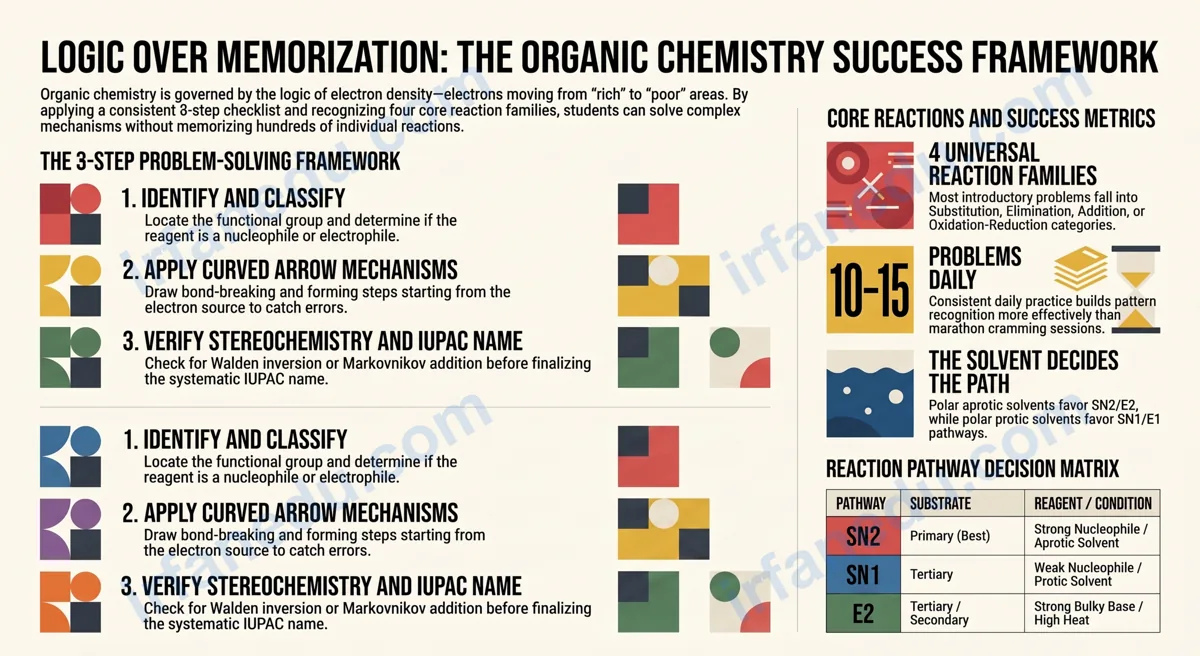
Organic chemistry practice problems test your ability to predict products, draw mechanisms, and name compounds using systematic rules. The fastest way to improve is to follow a repeatable 6-step problem-solving framework — identify the functional group, classify the reagent, pick the reaction type, draw the mechanism with curved arrows, check stereochemistry, and name or draw the product.
- A 6-step method to tackle any organic chemistry problem
- How to distinguish SN1, SN2, E1, and E2 reactions
- Fully worked examples with mechanisms
- IUPAC naming rules in plain English
- The most common mistakes and how to avoid them
⚡ TL;DR – Quick Summary
- 🧪 Always identify the functional group before anything else in a problem.
- 🔁 SN2 = primary substrate + strong nucleophile; SN1 = tertiary + weak nucleophile/polar protic.
- 🌡️ High temperature + bulky base = elimination wins over substitution.
- ✏️ Draw curved arrows every time — mechanisms are not meant to be memorised.
- 📛 IUPAC naming: longest chain → lowest locants → alphabetical substituents → functional-group suffix.
- 📅 10–15 focused problems daily beats marathon cramming sessions every time.
| Topic | Key Fact |
|---|---|
| Subject area | Organic chemistry (carbon-based compounds) |
| Core reaction families | Substitution, Elimination, Addition, Oxidation-Reduction |
| Most tested mechanism | SN2 (bimolecular nucleophilic substitution) |
| Naming system | IUPAC (International Union of Pure and Applied Chemistry) |
| Key skill | Drawing curved arrows to show electron flow |
| Recommended daily practice | 10–15 problems with active mistake review |
| Stereochemistry rule (SN2) | Walden inversion — configuration flips 180° |
How Do You Solve Any Organic Chemistry Problem? (6-Step Method)
The single biggest reason students struggle with organic chemistry practice problems is that they jump straight to “what’s the product?” without a system. Here is the 6-step framework I teach first — before any theory — because it works on every problem type.
-
Identify the functional group
Look at the structural formula and locate the reactive site: a halide (C–X), alcohol (–OH), alkene (C=C), carbonyl (C=O), or amine (–NH₂). The functional group tells you what chemistry is possible. -
Classify the reagent
Is the reagent a nucleophile (electron-rich, attacks positive centres), an electrophile (electron-poor, attacks negative centres), a base, an acid, or an oxidising/reducing agent? This single classification narrows your options dramatically. -
Determine the reaction type
Match substrate + reagent to a reaction family. Alkyl halide + strong nucleophile → substitution. Alkyl halide + strong base + heat → elimination. Alkene + HBr → addition. Alcohol + oxidising agent → carbonyl compound. -
Apply the mechanism with curved arrows
Draw every bond-breaking and bond-forming step. Each curved arrow starts at an electron source (lone pair or bond) and points to where the electrons go. Never skip this step — it is how you catch errors. -
Check stereochemistry
SN2 reactions invert configuration (Walden inversion). Electrophilic addition to alkenes is anti (Br₂) or syn (H₂/Pd). E2 requires anti-periplanar geometry. Ignoring this costs marks even when the connectivity is correct. -
Name or draw the product
Apply IUPAC rules or draw the full structural formula. Include wedge-dash notation for stereochemistry where the problem requires it.
What Are the Core Organic Chemistry Reaction Types?
There are four major reaction families in introductory organic chemistry. Every practice problem you encounter belongs to one of them — or combines two in a multi-step synthesis.
| Reaction Family | What Happens | Classic Example | Key Reagent Clue |
|---|---|---|---|
| Nucleophilic Substitution (SN1/SN2) | A nucleophile replaces a leaving group | CH₃Br + NaOH → CH₃OH + NaBr | Alkyl halide + nucleophile |
| Elimination (E1/E2) | A base removes H and a leaving group to form a double bond | CH₃CH₂Br + KOH/heat → CH₂=CH₂ | Alkyl halide + strong base + heat |
| Electrophilic Addition | A reagent adds across a double bond | CH₂=CH₂ + HBr → CH₃CH₂Br | Alkene + HX, Br₂, H₂O/H⁺ |
| Oxidation-Reduction | Oxidation state of carbon changes | RCH₂OH + [O] → RCHO → RCOOH | KMnO₄, PCC, LiAlH₄, NaBH₄ |
In my experience teaching organic chemistry to hundreds of students, the single most valuable thing I tell them is this: you do not need to memorise 200 reactions. You need to understand four electron-flow patterns. Once you see that SN2, E2, and electrophilic addition are all just variations of “electrons move from rich to poor,” the subject transforms from a memorisation nightmare into a logic puzzle. That shift — from memorising to reasoning — is the real unlock.
Worked Examples: SN2, Elimination, and Electrophilic Addition
The best way to build problem-solving skill is to watch a complete solution, then attempt a similar problem yourself. Here are three fully worked examples — one per major reaction type.
🧪 Worked Example 1 — SN2 Reaction
Problem: What is the product when 1-bromopropane reacts with sodium hydroxide (NaOH) in DMSO?
Step 1 — Functional group: Alkyl halide (primary, C–Br).
Step 2 — Reagent: NaOH is a strong nucleophile (OH⁻) and a weak base. DMSO is a polar aprotic solvent — it does not solvate the nucleophile, so OH⁻ is “naked” and highly reactive.
Step 3 — Reaction type: Primary substrate + strong nucleophile + polar aprotic solvent = SN2.
Step 4 — Mechanism: OH⁻ attacks the carbon bearing Br from the back side in a single concerted step. Br⁻ leaves simultaneously.
Step 5 — Stereochemistry: Walden inversion occurs (configuration inverts 180°). For a primary substrate, this is less visible but still happens.
Product: 1-propanol (CH₃CH₂CH₂OH) + NaBr.
  HO⁻  ----→  C  ←----  Br
  (nucleophile)  (back-side attack)  (leaving group)

  Transition State:
  HO --- C --- Br   (trigonal bipyramidal, pentacoordinate)
         |
      [δ⁻]  [δ⁻]

  Product:
  HO–CH₂CH₂CH₃   +   Br⁻
  (1-propanol)        (bromide ion)

  KEY: Configuration INVERTS (Walden Inversion)
🧪 Worked Example 2 — E2 Elimination
Problem: Predict the major product when 2-bromobutane reacts with potassium tert-butoxide (KOtBu) in tert-butanol.
Step 1 — Functional group: Secondary alkyl halide (C–Br at C2).
Step 2 — Reagent: KOtBu is a strong, bulky base. tert-Butanol is a polar protic solvent, but the bulky base dominates.
Step 3 — Reaction type: Strong bulky base + secondary halide = E2 elimination (Zaitsev’s rule applies — more substituted alkene is major product).
Step 4 — Mechanism: The base abstracts a β-hydrogen anti-periplanar to the leaving group. C–H and C–Br bonds break simultaneously as the π bond forms.
Step 5 — Stereochemistry: Anti-periplanar geometry required — the H and Br must be 180° apart in the transition state.
Major product: But-2-ene (CH₃CH=CHCH₃) — the more substituted (Zaitsev) alkene.
Minor product: But-1-ene (CH₂=CHCH₂CH₃) — less substituted (Hofmann product).
🧪 Worked Example 3 — Electrophilic Addition (Markovnikov)
Problem: What is the product when propene (CH₃CH=CH₂) reacts with HBr?
Step 1 — Functional group: Alkene (C=C).
Step 2 — Reagent: HBr — a Brønsted acid and electrophile (H⁺ adds first).
Step 3 — Reaction type: Electrophilic addition (Markovnikov’s rule — H adds to the carbon with more hydrogens).
Step 4 — Mechanism: H⁺ protonates the alkene at C1 (less substituted) to form the more stable secondary carbocation at C2. Br⁻ then attacks C2.
Step 5 — Stereochemistry: Carbocation intermediate → racemic mixture at C2 (no stereocontrol).
Product: 2-bromopropane (CH₃CHBrCH₃) — Markovnikov product.
SN1 vs SN2 vs E1 vs E2: How Do You Choose the Right Pathway?
Choosing the correct reaction pathway is the most tested skill in organic chemistry practice problems. The decision depends on three factors: substrate structure, nucleophile/base strength, and solvent.
| Factor | SN2 | SN1 | E2 | E1 |
|---|---|---|---|---|
| Substrate | Primary (best), Secondary | Tertiary, Secondary (benzylic/allylic) | Secondary, Tertiary | Tertiary, Secondary |
| Nucleophile/Base | Strong nucleophile | Weak nucleophile | Strong, bulky base | Weak base |
| Solvent | Polar aprotic (DMSO, DMF, acetone) | Polar protic (water, ethanol) | Polar aprotic or protic | Polar protic |
| Temperature | Room temperature | Room temperature | High temperature | High temperature |
| Stereochemistry | Inversion (Walden) | Racemisation | Anti-periplanar H and LG | No stereo requirement |
| Kinetics | Bimolecular (rate depends on both) | Unimolecular (rate = k[substrate]) | Bimolecular | Unimolecular |
How Do You Name Organic Compounds Using IUPAC Rules?
IUPAC naming problems appear in almost every organic chemistry exam. The system is logical — four rules cover 90% of cases you will encounter.
- Find the parent chain: Identify the longest continuous carbon chain that includes the principal functional group. Count the carbons: 1=meth, 2=eth, 3=prop, 4=but, 5=pent, 6=hex, 7=hept, 8=oct.
- Number the chain: Number from the end that gives the lowest locant to the principal functional group. If two numbering schemes give the same locant for the functional group, choose the one giving lower numbers to substituents.
- Name substituents: List all substituents as prefixes in alphabetical order (ignoring multiplying prefixes like di-, tri-). Use locant numbers: 2-methyl, 3-chloro, etc.
- Add the functional group suffix: -ane (alkane), -ene (alkene), -yne (alkyne), -ol (alcohol), -al (aldehyde), -one (ketone), -oic acid (carboxylic acid), -amine (amine).
🧪 IUPAC Naming Example
Structure: CH₃–CH(OH)–CH₂–CH₃
Step 1: Longest chain with the –OH group = 4 carbons → parent chain = butane.
Step 2: Number from the end nearest –OH → –OH is on C2 (not C3).
Step 3: No other substituents.
Step 4: Alcohol suffix = -ol.
IUPAC Name: butan-2-ol
What Are the Most Common Organic Chemistry Mistakes (and How Do You Fix Them)?
After reviewing thousands of student answers, I see the same errors appear over and over. Here are the top five — with the exact fix for each.
| Mistake | Why It Happens | The Fix |
|---|---|---|
| Drawing arrows from the wrong atom | Confusing nucleophile and electrophile | Always start the curved arrow at the electron source (lone pair or bond), never at the atom receiving electrons |
| Ignoring solvent in SN1/SN2 decisions | Only looking at substrate structure | Check solvent first: polar aprotic → SN2 favoured; polar protic → SN1/E1 favoured |
| Forgetting Walden inversion in SN2 | Focusing only on connectivity | After drawing the product, flip the three non-leaving substituents to show inversion |
| Applying Markovnikov’s rule backwards | Memorising “H goes to the more substituted carbon” | Remember the reason: H⁺ adds to form the MORE STABLE carbocation — which is on the more substituted carbon |
| Numbering the parent chain from the wrong end | Not checking both directions | Always number from both ends, compare the locant sets, and choose the lower set |
The mistake I see most often — even from students who have studied hard — is treating organic chemistry like a vocabulary test. They memorise “SN2 = inversion” without understanding why. When the exam changes the substrate slightly, they freeze. The students who score highest are the ones who can explain every step in plain English. If you cannot explain why SN2 gives inversion to a 10-year-old, you have memorised it but not learned it. That is the real difference between a B and an A in organic chemistry.
Most guides teach reaction types as separate topics. They give you a chapter on SN2, then a chapter on E2, then a chapter on addition — as if these are unrelated. But every single one of these reactions is governed by the same underlying principle: electrons flow from regions of high density to regions of low density.
The real skill in organic chemistry is not knowing which reaction to apply — it is recognising the electron density landscape of the molecule. A nucleophile is just an electron-rich species. An electrophile is just an electron-poor species. A leaving group is just a stable anion waiting to take electrons and leave.
Once you internalise this, you stop asking “which reaction is this?” and start asking “where are the electrons, and where do they want to go?” That question answers itself — and it works on problems you have never seen before. This is the insight that separates students who ace organic chemistry from those who just pass it.
🧠 Quick Quiz: Test Your Organic Chemistry Knowledge
Click “Reveal Answer” after each question to check yourself.
1. 1-Bromobutane reacts with NaCN in DMSO. What type of reaction occurs?
Reveal Answer
2. What is the major product when 2-methylbut-2-ene reacts with HBr?
Reveal Answer
3. Name this compound using IUPAC rules: CH₃–C(=O)–CH₂–CH₂–CH₃
Reveal Answer
🔬 Reveal-on-Click Practice Problems
Try each problem on paper first, then click to reveal the full solution.
Practice Problem 1: Predict the product — 2-bromopropane + KOtBu in tert-butanol at 80°C
Answer: Propene (CH₃CH=CH₂) — E2 elimination product.
Reasoning: 2-Bromopropane is a secondary alkyl halide. KOtBu is a strong, bulky base. High temperature (80°C) strongly favours elimination over substitution. The bulky base cannot easily attack the carbon bearing Br (steric hindrance), so it abstracts a β-hydrogen instead. E2 mechanism: anti-periplanar H and Br are removed simultaneously. Since there is only one type of β-hydrogen, the only product is propene.
Practice Problem 2: Name this compound — CH₃CH₂CH(Cl)CH₂CH₃
Answer: 3-chloropentane.
Reasoning: Longest chain = 5 carbons → pentane. Number from either end — Cl is at C3 from both ends (symmetric). Substituent = chloro at C3. No other substituents. Full IUPAC name: 3-chloropentane.
Practice Problem 3: What reagent converts a primary alcohol to an aldehyde without over-oxidising to a carboxylic acid?
Answer: PCC (pyridinium chlorochromate) in dichloromethane (CH₂Cl₂).
Reasoning: PCC is a mild oxidising agent that oxidises primary alcohols (RCH₂OH) to aldehydes (RCHO) and stops there — it cannot oxidise the aldehyde further to a carboxylic acid because it is used in anhydrous conditions. KMnO₄ or K₂Cr₂O₇ in aqueous acid would over-oxidise to the carboxylic acid. Secondary alcohols → ketones with PCC (ketones cannot be oxidised further under these conditions).