
How to Write an Argumentative Essay: The Exact Mechanism Behind Every Strong Argument
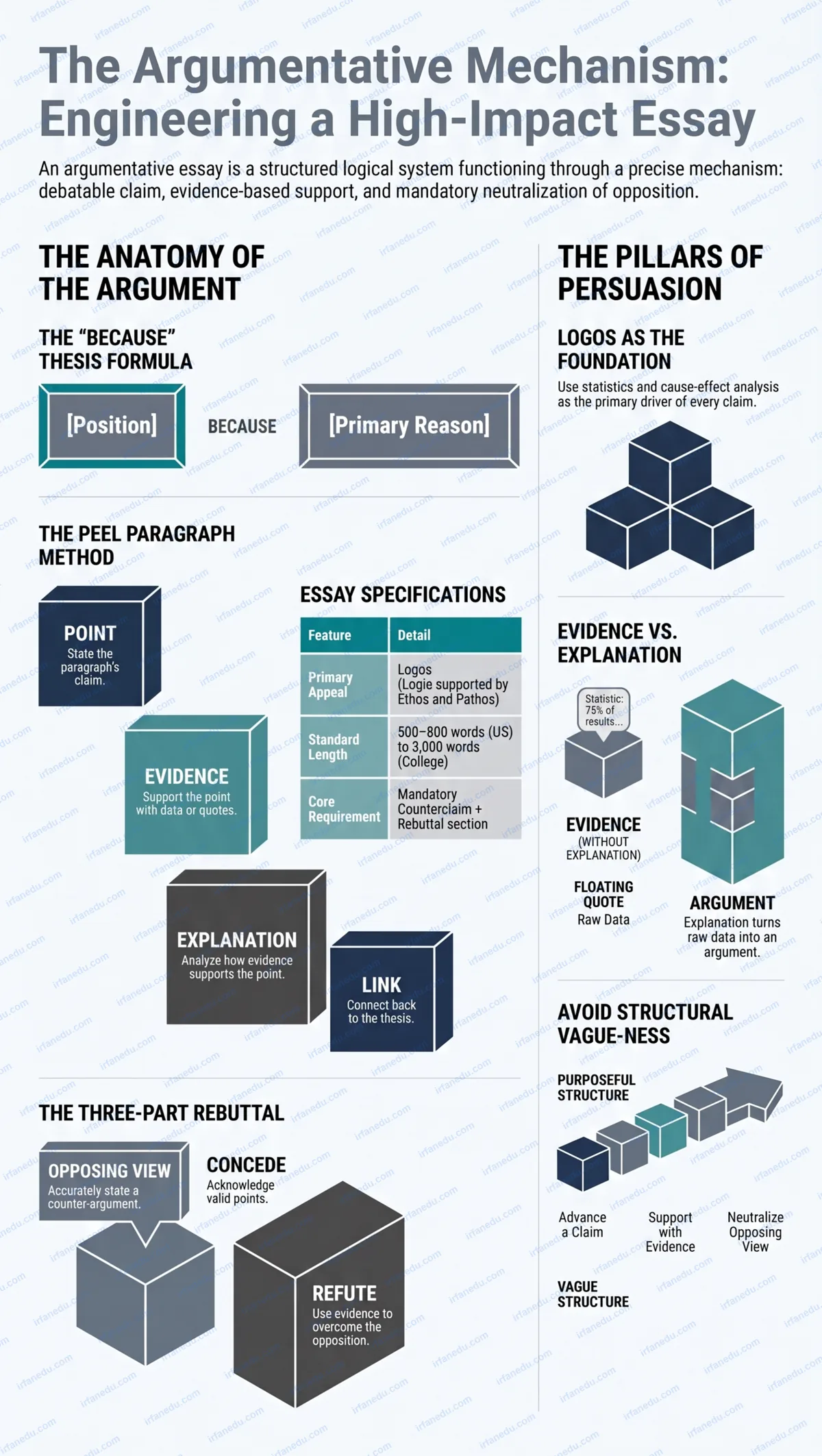
An argumentative essay is not simply an opinion piece. It is a structured logical mechanism — a system that presents a claim, supports it with evidence, anticipates opposition, and defeats that opposition with reasoning. Understanding the mechanism first is what separates students who score well from those who write a lot but prove little.
In my experience reviewing thousands of student essays, the most common failure is not poor vocabulary or grammar — it is structural. Students write paragraphs that feel like arguments but never actually prove anything. This guide fixes that by showing you the internal logic of each section before asking you to write it.
By the end of this guide, you will be able to:
- Identify the mechanical purpose of each section in an argumentative essay
- Write a thesis statement that is specific, debatable, and provable
- Build body paragraphs using the PEEL structure
- Handle counterarguments without weakening your own position
- Avoid the six most common structural errors
⚡ TL;DR – Quick Summary
- An argumentative essay works through a logical mechanism: claim, evidence, counterclaim, rebuttal, conclusion.
- Your thesis must be debatable, specific, and state the primary reason behind your position.
- Each body paragraph follows PEEL: Point, Evidence, Explanation, Link.
- The counterclaim paragraph is not optional — it is where credibility is built or lost.
- Use Logos (logic) as your primary appeal; support with Ethos and Pathos.
- Revise for logical gaps, not just grammar — structure errors cost more marks than typos.
What an Argumentative Essay Actually Does
An argumentative essay makes a claim about a debatable topic and defends that claim using evidence and reasoning. The key word is debatable — a topic only qualifies if a reasonable, informed person could hold the opposite view.
| Feature | Detail |
|---|---|
| Primary goal | Convince the reader through logic and evidence |
| Core structure | Intro + Thesis / Body Paragraphs / Counterclaim / Conclusion |
| Key appeal type | Logos (logic) — supported by Ethos and Pathos |
| Mandatory section | Counterclaim + Rebuttal (often missing in weak essays) |
| Typical length | 500–800 words (high school) / 1,000–3,000 words (college) |
| Tone | Formal, objective, evidence-driven |
| Differs from persuasive essay | Requires opposing view acknowledgment and factual evidence |
The essay does not just express what you believe — it builds a case that a skeptical reader would find logically difficult to dismiss. Think of it as a structured debate on paper, where you control both the argument and the response to opposition.
The Mechanism: How Argumentation Works
Before writing a single word, understand the internal logic driving each part of the essay. Every section has a specific job in the overall argument machine.
+--------------------------------------------------+
|  INTRODUCTION                                    |
|  Hook --> Background Context --> THESIS          |
|  [Sets the problem and declares your position]   |
+--------------------------------------------------+
           |
           v
+--------------------------------------------------+
|  BODY PARAGRAPH 1                                |
|  Claim 1 --> Evidence --> Explanation --> Link   |
|  [Proves the first reason your thesis is true]   |
+--------------------------------------------------+
           |
           v
+--------------------------------------------------+
|  BODY PARAGRAPH 2                                |
|  Claim 2 --> Evidence --> Explanation --> Link   |
|  [Proves the second reason your thesis is true]  |
+--------------------------------------------------+
           |
           v
+--------------------------------------------------+
|  BODY PARAGRAPH 3 (optional but recommended)     |
|  Claim 3 --> Evidence --> Explanation --> Link   |
+--------------------------------------------------+
           |
           v
+--------------------------------------------------+
|  COUNTERCLAIM PARAGRAPH                          |
|  Opposing View --> Concession (if any) -->       |
|  Rebuttal Evidence --> Link to Thesis            |
|  [Shows you understand the full debate]          |
+--------------------------------------------------+
           |
           v
+--------------------------------------------------+
|  CONCLUSION                                      |
|  Restate Thesis (new words) --> Summary -->      |
|  Broader Significance / Call to Action           |
+--------------------------------------------------+
Notice that the counterclaim sits before the conclusion, not at the start. This placement is intentional: by the time you address the opposition, you have already built a strong foundation of evidence. The rebuttal then lands with more force.
I have seen students place their counterclaim at the very beginning, thinking it shows balance. It usually backfires. When you open with the opposing view before establishing your own position, you inadvertently give the other side the most memorable real estate in the essay — the opening. Build your case first, then dismantle the opposition.
Full Structure Breakdown (Part by Part)
Each section of the argumentative essay has a precise function. Knowing that function tells you exactly what to write — and what to leave out.
The Introduction
The introduction does three things in order: it hooks the reader, provides brief background context, and ends with the thesis statement. The hook can be a surprising statistic, a short scenario, or a direct question. Keep the background to 2-3 sentences — its only job is to make the thesis understandable to someone unfamiliar with the topic.
Schools in over 70 countries require students to wear uniforms, yet the debate about their value continues. Proponents argue uniforms reduce distraction; critics say they suppress individuality. Thesis: Mandatory school uniforms improve academic focus and reduce socioeconomic visible inequality, making them a net positive for learning environments.
Body Paragraphs
Each body paragraph advances one specific claim that supports the thesis. One paragraph, one claim. Mixing two claims in a single paragraph dilutes both. Use the PEEL structure (covered in detail below).
The Counterclaim Paragraph
This paragraph acknowledges the strongest opposing argument, concedes any valid part of it, and then refutes it with evidence. It is the most intellectually honest — and most persuasive — section of the essay.
The Conclusion
The conclusion restates the thesis in different words, briefly summarizes the key evidence, and ends with a statement about the broader significance of the argument. Do not introduce new evidence here. The conclusion closes the logical loop opened by the introduction.
Writing a Thesis Statement That Works
The thesis is the single most important sentence in the essay. A weak thesis produces a weak essay regardless of how good the body paragraphs are. A strong thesis has three qualities: it is debatable, specific, and reason-linked.
“Social media affects teenagers.”
Why it fails: Not debatable (everyone agrees), not specific, no reason given.
“Unrestricted social media access during school hours reduces academic performance because it fragments sustained attention during critical learning periods.”
Why it works: Debatable, specific, includes the causal mechanism.
The formula I use with my students: [Your position] because [primary reason / mechanism]. The “because” forces you to include the reasoning, not just the stance.
- Identify the topic and the two main sides of the debate.
- Choose the side you can support with the most evidence.
- Write your position in one clause: “X should / should not / does / does not…”
- Add “because” and state the primary mechanism or reason.
- Check: Is it debatable? Is it specific? Does it preview the argument? Revise if any answer is no.
Building Body Paragraphs with PEEL
PEEL is the most reliable paragraph structure for argumentative writing. It ensures every paragraph both makes a claim and proves it — the two things most weak paragraphs fail to do simultaneously.
| Letter | Stands For | What to Write | Approx. Sentences |
|---|---|---|---|
| P | Point (Claim) | State the specific claim this paragraph proves | 1 |
| E | Evidence | Cite a statistic, study, expert quote, or case | 1-2 |
| E | Explanation | Explain how the evidence proves your claim | 2-3 |
| L | Link | Connect back to the thesis statement | 1 |
P: School uniforms reduce visible socioeconomic differences among students.
E: A 2019 study published in the Journal of Educational Research found that schools with uniform policies reported a 23% reduction in peer-reported bullying related to clothing and appearance.
E: When students cannot signal wealth through branded clothing, one major source of social stratification is removed from the daily school environment.
E: This reduction in visible inequality allows students from lower-income families to participate in school culture without the social penalty of wearing less expensive clothing.
L: This directly supports the thesis that uniforms create a more equitable learning environment.
Notice that the explanation section is the longest — it is where your thinking is displayed. Evidence without explanation is just a quote floating in space. The explanation is what turns data into an argument.
Counterclaim and Rebuttal: The Section Most Students Skip
The counterclaim paragraph is where intellectual credibility is either earned or lost. Skipping it signals to the reader — and the examiner — that you either do not know the opposing arguments or are afraid of them.
The Three-Part Rebuttal Formula
- State the opposing view accurately. Do not exaggerate or distort it. Use phrases like “Critics argue that…” or “Opponents of this view contend that…”
- Concede any valid part (optional but powerful). “While it is true that X in some cases…” This shows intellectual honesty and makes your rebuttal more credible.
- Refute with specific evidence. “However, this overlooks the fact that [evidence]. Therefore, the opposing view does not hold in the majority of cases.”
Counterclaim: Critics argue that school uniforms suppress individual expression, which is a vital part of adolescent identity development.
Concession: This concern has merit — self-expression through clothing does play a role in how teenagers construct identity.
Rebuttal: However, research from the American Psychological Association indicates that identity formation in adolescents is driven primarily by peer relationships, academic achievement, and extracurricular involvement — not clothing choices. Schools with uniform policies consistently report that students express individuality through other channels. The benefit to equity and focus therefore outweighs the marginal restriction on clothing-based expression.
The concession step is the one most students skip because it feels like admitting weakness. In reality, it does the opposite. When you acknowledge a valid point in the opposing argument before refuting it, you demonstrate that your position has survived scrutiny — not just avoided it. Examiners notice this distinction, and it consistently separates a B-grade essay from an A-grade one.
Evidence Types and How to Use Them
Not all evidence carries equal weight. Understanding the three classical appeals — Logos, Ethos, and Pathos — helps you choose the right type of evidence for each claim.
| Appeal Type | What It Is | Best Evidence Sources | When to Use |
|---|---|---|---|
| Logos | Logic and reason | Statistics, studies, data, cause-effect analysis | Primary appeal — use in every body paragraph |
| Ethos | Credibility and authority | Expert quotes, institutional reports, credentials | To establish that your sources are trustworthy |
| Pathos | Emotional resonance | Case studies, real-world stories, vivid scenarios | Sparingly — to make abstract data feel real |
When citing evidence, always name the source in the sentence — not just in a footnote. “According to a 2022 Harvard study” is stronger than a bare statistic because it invokes Ethos at the same time as Logos.
[IMAGE: Three-column visual showing Logos, Ethos, and Pathos as pillars supporting an argument | ALT: Logos Ethos Pathos three appeals in argumentative essay writing]
Common Mistakes and How to Fix Them
These six errors appear in the majority of weak argumentative essays. Recognizing them in your own draft is the fastest way to improve your score.
“Climate change is a serious issue.” — This is a fact, not a debatable claim.
“Governments must impose carbon taxes because market incentives alone have failed to reduce industrial emissions at the required rate.”
Dropping a statistic and moving on. The reader does not know what to conclude from it.
After every piece of evidence, write 2-3 sentences explaining exactly how it supports your claim.
Misrepresenting the opposing view to make it easier to defeat. Examiners recognize this immediately.
If you cannot defeat the strongest version, your argument needs more evidence — not a weaker opponent.
Introducing a new statistic or claim in the final paragraph confuses the reader and weakens the closing.
Restate the thesis in new words, summarize the key evidence already presented, then close with significance.
Two claims in one paragraph means neither gets enough evidence to be convincing.
If you find yourself writing “also” or “another reason” mid-paragraph, start a new paragraph.
“Everyone knows that…” or “It is obvious that…” — These phrases signal weak reasoning, not confidence.
Replace assertion phrases with specific evidence. If it were obvious, you would not need to argue it.
Where You Will Use This Skill
Argumentative writing is not limited to English class. The same structure — claim, evidence, counterclaim, rebuttal — appears across academic and professional contexts.
| Context | How Argumentative Structure Applies |
|---|---|
| Standardized tests (SAT, ACT, IELTS, TOEFL) | Essay sections explicitly score on claim, evidence, and counterargument |
| University research papers | Thesis-driven structure with literature review as evidence base |
| Legal writing | Brief = thesis; case law = evidence; opposing counsel’s argument = counterclaim |
| Business proposals | Recommendation = thesis; ROI data = evidence; risk section = counterclaim |
| Journalism and op-eds | Opinion pieces follow the same logical structure for credibility |
| Science reports | Hypothesis = thesis; experimental data = evidence; limitations = counterclaim |
Mastering this structure now means you are building a transferable reasoning skill — not just completing an assignment. Every field that requires decision-making under uncertainty uses some version of this framework.
Quick Knowledge Check (3 Questions)
Select your answer, then click “Show Answer” to check.
1. Which part of the argumentative essay acknowledges and then refutes the opposing view?
Show Answer
Correct Answer: C — Counterclaim Paragraph
The counterclaim paragraph is specifically designed to state the opposing view, optionally concede any valid part, and then refute it with evidence. This is what separates an argumentative essay from a one-sided opinion piece.
2. In the PEEL paragraph structure, what does the second “E” stand for?
Show Answer
Correct Answer: B — Explanation
PEEL stands for Point, Evidence, Explanation, Link. The Explanation step is where you analyze how the evidence proves your claim. Without it, evidence is just a floating quote with no argumentative function.
3. Which of the following is the strongest type of thesis statement?
Show Answer
Correct Answer: C
Option C is debatable, specific, and includes the causal mechanism (“because it eliminates time for restorative activities”). Options A and D are not debatable. Option B is too vague — it does not state a reason or mechanism.
Practice Problems
Work through each prompt on your own, then click to reveal a model response.
Practice 1: Identify the flaw in this thesis — “Technology is changing education.”
Flaw: This is a statement of fact, not a debatable claim. It has no position and no reason. A reasonable person cannot disagree with it.
Revised thesis: “Schools should integrate AI-based tutoring tools into core curricula because personalized feedback loops accelerate skill acquisition faster than uniform classroom instruction.”
This version is debatable (someone could argue AI tools create dependency or widen the digital divide), specific (AI tutoring in core curricula), and reason-linked (because of personalized feedback loops).
Practice 2: Write a PEEL paragraph on this claim — “Access to clean water is a human right that governments must legally guarantee.”
Point: Governments have a legal and moral obligation to guarantee access to clean water as a fundamental human right.
Evidence: The United Nations officially recognized access to safe drinking water as a human right in Resolution 64/292 (2010), and as of 2023, over 2 billion people still lack safely managed drinking water services, according to WHO/UNICEF Joint Monitoring Programme data.
Explanation: When governments treat water as a commodity rather than a right, pricing mechanisms exclude the poorest populations — the very people most dependent on public infrastructure. Legal guarantees create enforceable obligations, shifting water policy from discretionary spending to constitutional duty. Countries with constitutional water rights, such as South Africa, have demonstrated measurable improvements in rural water access within a decade of enacting such protections.
Link: This evidence confirms that legal frameworks — not market forces alone — are the most reliable mechanism for ensuring universal water access, directly supporting the thesis that government guarantee is necessary.
Practice 3: Write a counterclaim + rebuttal for the school uniforms argument.
Counterclaim: Opponents argue that school uniforms place an additional financial burden on low-income families who must purchase specific, often expensive, uniform items in addition
Sources & References
Reviewed by Dr. Irfan Mansuri. External links open in a new tab and are provided for further reading and verification.