
How to Analyze a Poem Step by Step: The Complete Student Guide
The Part Most Students Miss
Here is the part most people miss when they try to analyze a poem: they start hunting for literary devices before they have actually read the poem. They scan for metaphors the way a tourist photographs a city without ever walking its streets. The result is a list of techniques with no understanding of why any of them matter.
Poetry analysis is not a scavenger hunt. It is a conversation between you and a text — a careful, layered process of asking questions and letting the poem answer them on its own terms.
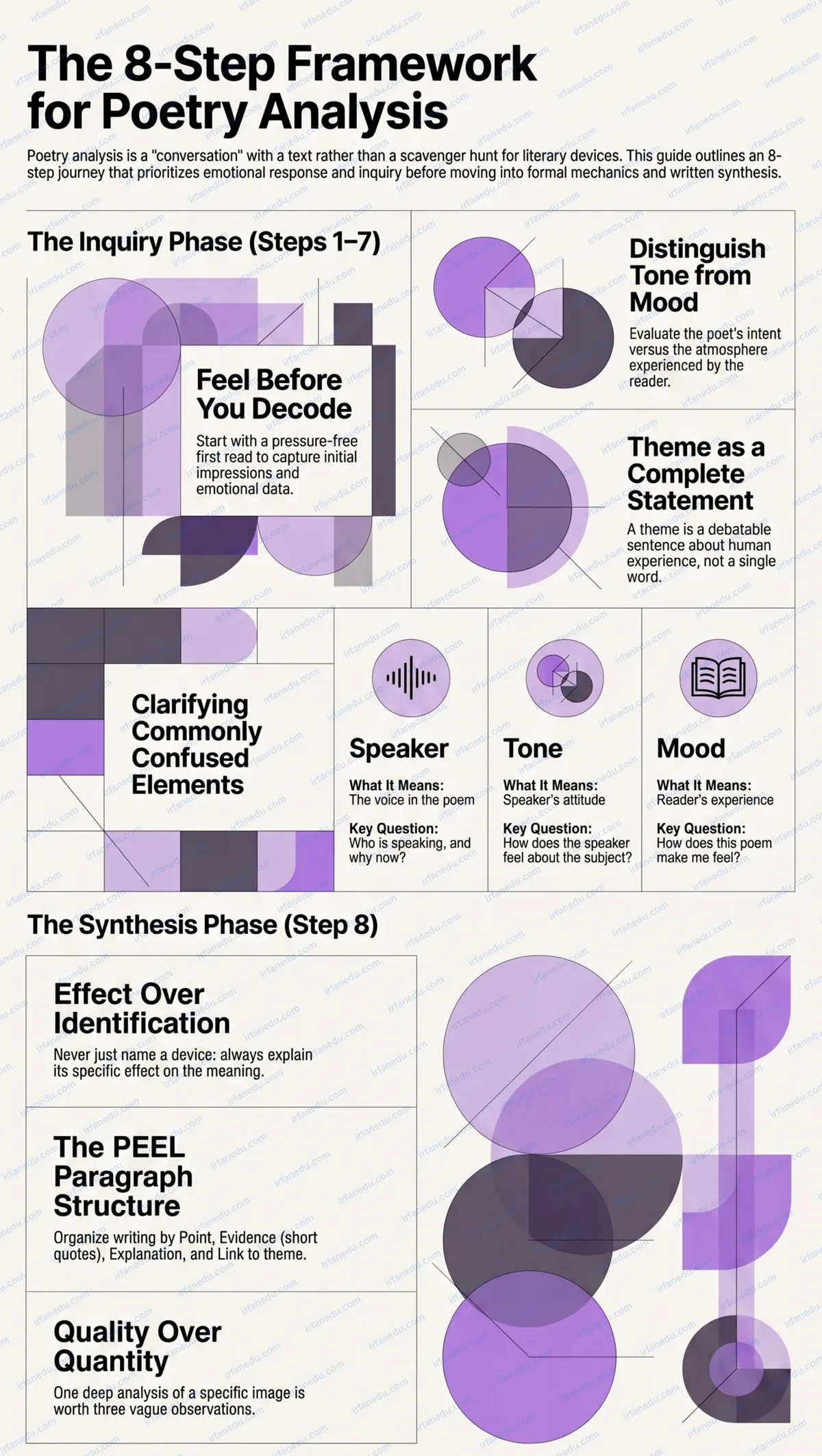
To analyze a poem step by step, you follow eight stages: a pressure-free first read, examination of the title, identification of the speaker and situation, analysis of structure and form, recognition of tone and mood, close reading of imagery and figurative language, determination of theme, and finally, synthesis into a written analysis. Each step builds on the last.
I have helped hundreds of students move from confusion to confidence with poetry, and the single biggest shift happens when they stop treating analysis as a checklist and start treating it as genuine inquiry. This guide gives you the exact process I teach — with worked examples, a visual map, and a practice quiz at the end.
- The 8-step process for analyzing any poem
- How to distinguish tone from mood (most students confuse these)
- How to write a strong analytical paragraph using PEE/PEEL structure
- The most common mistakes in poetry analysis — and how to avoid them
⚡ TL;DR – Quick Summary
- Start with a relaxed first read — feel the poem before you analyze it
- The title is your first clue; never skip it
- Tone = speaker’s attitude; mood = reader’s emotional response
- Literary devices only matter when you explain their effect
- Theme is a complete statement about human experience, not a single word
- Use PEE/PEEL structure to write every analytical paragraph
| Aspect | What It Means | Key Question to Ask |
|---|---|---|
| Title | First interpretive clue | What does this title promise or withhold? |
| Speaker | The voice in the poem | Who is speaking, and why now? |
| Form | Physical shape of the poem | Does the structure reinforce the meaning? |
| Tone | Speaker’s attitude | How does the speaker feel about the subject? |
| Mood | Reader’s emotional experience | How does this poem make me feel? |
| Imagery | Sensory language | What pictures does this create, and why? |
| Theme | Central insight about life | What does this poem say about being human? |
Step 1: The First Read — Feel Before You Analyze
Your first read should be completely pressure-free. Read the poem once, aloud if possible, without stopping to decode anything. Let the sounds, rhythms, and images wash over you. Notice what you feel — curiosity, unease, sadness, joy — because that emotional response is data.
After your first read, jot down three things: your overall impression, any words or phrases you did not understand, and the image or line that stayed with you longest. These notes become the raw material for everything that follows.
Read the poem a second time, this time with a pencil. Circle unfamiliar words and look them up. Mark any lines that feel surprising, contradictory, or unusually vivid. Do not try to interpret yet — just annotate.
Step 2: Examine the Title — Your First Clue
The title is the poet’s first deliberate choice, and it rewards close attention. Before re-reading the poem, write down what the title alone suggests to you — the subject, the speaker’s situation, or the emotional register.
Some titles name the subject directly (“Ode to a Nightingale”). Others withhold information to create tension (“Nothing Gold Can Stay”). A few titles are ironic — they mean the opposite of what the poem delivers. Recognizing that gap between title and content is often the key to understanding the poem’s central argument.
Consider a poem titled “Homecoming.” Before reading a single line, you might expect warmth, reunion, relief. If the poem turns out to be about returning to a place that no longer feels familiar, the title creates irony — and that irony is the theme. The title set up an expectation the poem deliberately subverts.
After finishing the poem, return to the title. Ask: does it mean something different now? Has its meaning expanded, shifted, or become ironic? This before-and-after comparison is one of the most productive moves in poetry analysis.
Step 3: Identify the Speaker and Situation
The speaker is the voice inside the poem — not the poet. This distinction matters enormously. A poet can create a speaker who is a grieving widow, a soldier, a child, or even an inanimate object. Assuming the speaker is always the poet leads to biographical readings that miss the poem’s craft.
To identify the speaker, ask: Who is speaking? What do they want? What are they responding to? What do they know, and what are they hiding from themselves? The last question is particularly rich — unreliable or self-deceiving speakers are common in poetry, and recognizing them unlocks the poem’s deeper irony.
The situation is the dramatic context: where is the speaker, when, and what has just happened or is about to happen? Poetry often captures a single charged moment — a departure, a death, a realization. Identifying that moment grounds your entire analysis.
In my experience, the speaker question is where most students do their weakest work. They write “the poet says” when they should write “the speaker says.” This is not pedantry — it is the difference between reading a poem as a personal diary entry and reading it as a crafted artistic object. The moment you separate speaker from poet, the poem opens up in ways that genuinely surprise you.
Step 4: Analyze Structure and Form
Structure and form are the skeleton of a poem, and they are never accidental. Form refers to the poem’s overall shape — the number of stanzas, line length, and whether it follows a named pattern. Structure refers to how the poem develops its argument or narrative across that shape.
Key formal elements to examine
- Stanza pattern: Regular stanzas suggest control or order; irregular stanzas can mirror chaos or emotional instability.
- Rhyme scheme: Note the pattern (ABAB, ABBA, free verse). Does rhyme create a sense of inevitability or closure? Does a broken rhyme signal a break in the speaker’s composure?
- Meter: Iambic pentameter (da-DUM x5 per line) is the most common formal meter in English poetry. Variations — a stressed syllable where an unstressed one is expected — create emphasis.
- Enjambment vs. end-stopping: Enjambment (a line that runs into the next without pause) creates momentum and can create irony when the line break falls in a surprising place. End-stopping creates finality.
- Caesura: A strong pause within a line, often marked by punctuation. It can create a dramatic hesitation or a shift in thought.
  ┌─────────────────────────────────────────────────────────┐
  │           8-STEP POETRY ANALYSIS FRAMEWORK              │
  └─────────────────────────────────────────────────────────┘

  STEP 1 ──► FIRST READ          Feel the poem. No pressure.
      │                          Mark confusing words.
      ▼
  STEP 2 ──► TITLE               What does it promise?
      │                          Return after reading — has it shifted?
      ▼
  STEP 3 ──► SPEAKER/SITUATION   Who speaks? To whom? When? Why?
      │                          Speaker ≠ Poet.
      ▼
  STEP 4 ──► STRUCTURE/FORM      Stanzas · Rhyme · Meter
      │                          Enjambment · Caesura
      ▼
  STEP 5 ──► TONE / MOOD         Tone = speaker's attitude
      │                          Mood = reader's feeling
      ▼
  STEP 6 ──► IMAGERY/DEVICES     Metaphor · Simile · Personification
      │                          Alliteration · Assonance · Irony
      ▼
  STEP 7 ──► THEME               Complete statement about human experience
      │                          Not just a word — a sentence.
      ▼
  STEP 8 ──► WRITE IT            PEE / PEEL paragraph structure
                                 Point → Evidence → Explanation → Link
Named forms carry their own conventions and expectations. A sonnet’s volta (turn) at line 9 or 13 is a structural promise the poet either keeps or deliberately breaks. A villanelle’s repeating refrains create obsession and inevitability. Knowing these conventions lets you spot when a poet is working with or against tradition — and that tension is always meaningful.
Step 5: Identify Tone and Mood — and the Difference Between Them
Tone and mood are the two most commonly confused concepts in poetry analysis, and getting them right immediately elevates your writing. Tone is the speaker’s attitude toward the subject — it belongs to the voice inside the poem. Mood is the emotional atmosphere the poem creates in you, the reader.
A poem can have a detached, clinical tone (the speaker is deliberately unemotional) yet produce a deeply unsettling mood in the reader. That gap between tone and mood is itself a technique — and analyzing it shows sophisticated critical thinking.
| Feature | Tone | Mood |
|---|---|---|
| Belongs to | The speaker | The reader |
| Shaped by | Word choice, syntax, irony | Imagery, rhythm, setting |
| Example | Bitter, reverent, sardonic | Melancholic, tense, peaceful |
| Key question | How does the speaker feel? | How do I feel reading this? |
To identify tone, focus on word choice (diction). Formal, elevated diction suggests reverence or solemnity. Colloquial, casual diction suggests intimacy or irony. Short, clipped sentences create urgency. Long, winding sentences create contemplation or confusion.
Step 6: Spot Imagery and Figurative Language
Imagery is language that appeals to the senses — sight, sound, touch, taste, smell. Figurative language uses comparison, substitution, or exaggeration to create meaning beyond the literal. Together, they are the primary tools poets use to make abstract ideas felt rather than just understood.
The critical rule: never just identify a device — always explain its effect. Saying “the poet uses a metaphor” earns no marks. Saying “the metaphor of the heart as a locked room suggests the speaker’s emotional inaccessibility, reinforcing the poem’s theme of isolation” earns full marks.
Key devices and their effects
- Metaphor: Direct comparison without “like” or “as.” Creates identity between two things, often revealing hidden truth.
- Simile: Comparison using “like” or “as.” Slightly more tentative than metaphor — the comparison is offered, not asserted.
- Personification: Giving human qualities to non-human things. Often used to project the speaker’s inner state onto the external world.
- Alliteration: Repetition of initial consonant sounds. Creates rhythm, emphasis, or a sense of connection between words.
- Assonance: Repetition of vowel sounds within words. Long vowels (moon, gloom) slow the pace; short vowels (bit, click) quicken it.
- Anaphora: Repetition of a word or phrase at the start of successive lines. Creates emphasis, urgency, or incantatory power.
- Irony: A gap between what is said and what is meant. Verbal irony, situational irony, and dramatic irony all appear in poetry.
- Symbolism: An object, person, or place that carries meaning beyond its literal identity. A rose is not just a rose.
Line: “The fog comes on little cat feet.” (Carl Sandburg, “Fog”)
Device: Extended metaphor (fog as a cat).
Effect: The comparison gives fog the qualities of a cat — silent, graceful, self-possessed, and temporary. The word “little” miniaturizes something vast and atmospheric, making it feel intimate rather than threatening. The brevity of the poem mirrors the cat’s quick, quiet departure.
The single most powerful upgrade I see in student writing is when they stop writing “the poet uses imagery to create a vivid picture” and start writing “the image of X does Y because Z.” That three-part move — identify, explain effect, connect to meaning — is the engine of all strong literary analysis. Practice it on every device you find, and your essays will improve immediately.
Step 7: Determine the Theme
Theme is the central insight the poem offers about human experience. It is not a topic (love, death, nature) — it is a complete statement about that topic. “Love” is a topic. “Love is most visible in the moments we try to hide it” is a theme.
To arrive at the theme, synthesize everything you have observed: the speaker’s situation, the emotional arc, the dominant images, the form’s contribution to meaning, and the final lines. Ask: what does this poem ultimately argue, reveal, or question about being human?
Strong themes are specific, debatable, and grounded in textual evidence. A theme statement you could argue against is a good theme statement — it has a point of view. A theme statement everyone would automatically agree with (“death is sad”) is too vague to be useful.
| Topic (Too Vague) | Theme (Specific and Arguable) |
|---|---|
| War | War strips soldiers of individual identity, reducing them to instruments of collective violence. |
| Nature | Nature’s indifference to human suffering exposes the limits of self-pity. |
| Memory | Memory is not a record of the past but a reconstruction shaped by present grief. |
Step 8: Write Your Analysis Using PEE/PEEL Structure
Once you have completed your close reading, you are ready to write. The most reliable paragraph structure for poetry analysis is PEE or its extended version PEEL: Point, Evidence, Explanation, Link.
- Point: State your analytical claim clearly in one sentence.
- Evidence: Quote directly from the poem. Keep quotes short — one to three words is often enough.
- Explanation: Explain what the quote shows and how the language creates that effect. This is the longest part.
- Link: Connect your point back to the poem’s theme or to the question you are answering.
Point: The speaker presents grief as a physical weight rather than an emotion.
Evidence: The image of “stones in the chest” suggests grief has mass and density.
Explanation: By making grief tangible and physical, the poet bypasses the reader’s intellectual defenses — we feel the heaviness in our own bodies before we process it as metaphor. The word “chest” is precise: it is both the location of the heart and a container, suggesting grief is something stored and carried, not released.
Link: This image reinforces the poem’s central theme that unspoken grief accumulates rather than fades.
One strong PEE paragraph is worth three weak ones. Resist the urge to mention every device you found. Select the two or three that most powerfully support your theme argument, and analyze them in depth.
Common Mistakes in Poetry Analysis — and How to Fix Them
Even strong students make predictable errors in poetry analysis. Knowing them in advance is a significant advantage.
| Mistake | Why It Weakens Your Analysis | Fix |
|---|---|---|
| Listing devices without explanation | Shows recognition, not understanding | Always follow identification with “this creates the effect of…” |
| Confusing speaker with poet | Reduces craft to biography | Write “the speaker” unless you have strong contextual evidence |
| Paraphrasing instead of analyzing | Retells the poem; adds no insight | Ask “how” and “why” after every observation |
| Vague theme statements | Cannot be supported with specific evidence | Make your theme a complete, debatable sentence |
| Ignoring form and structure | Misses half the poem’s meaning | Always ask: does the form reinforce or contradict the content? |
| Quoting too much | Fills space without analysis | Quote the specific words that carry the most weight |
Quick Knowledge Check
Test Your Understanding
1. A poem’s speaker describes a battlefield in calm, detached language, but the reader feels deeply disturbed. Which statement is correct?
Show Answer
2. Which of the following is a theme statement (not just a topic)?
Show Answer
3. In the PEE structure, what comes after the Evidence (quote)?
Show Answer
Reveal-on-Click Practice Problems
Practice 1: Identify the tone of this excerpt and explain your reasoning.
“I have wasted my life. / I have lain in the sun / and let the soft animal of my body / love what it loves.”
Suggested analysis: The opening line “I have wasted my life” appears self-critical, but the lines that follow reframe “wasting” as sensory presence and self-acceptance. The tone shifts from apparent regret to quiet defiance — the speaker reclaims the word “wasted” by showing that a life of embodied pleasure is not waste at all. The phrase “soft animal” is key: it removes shame from physical desire by connecting it to natural, innocent instinct.
Practice 2: How does enjambment create meaning in this line?
“I grow old / I grow old / I shall wear the bottoms of my trousers rolled.”
Suggested analysis: The repetition of “I grow old” across two lines creates a slow, inevitable rhythm that mirrors the process of aging itself — each line is one more step forward in time. The enjambment between “old” and “I” refuses closure, suggesting that aging is continuous, not episodic. The bathetic drop to “trousers rolled” after the weight of “I grow old” creates ironic deflation — the speaker’s response to mortality is a trivial fashion choice, which is itself a comment on the limits of human agency.
Practice 3: Write a theme statement for a poem about a soldier returning home.
Weak attempt: “The poem is about a soldier coming home from war.”
Stronger attempt: “War permanently alters a person’s relationship to home, making the familiar feel foreign and the safe feel threatening.”
Why it works: The stronger statement makes a specific, arguable claim about what the homecoming reveals. It could be supported with evidence about imagery (the house described in military terms, perhaps) and tone (unease where warmth was expected). It connects the personal experience to a broader truth about trauma and displacement.
Frequently Asked Questions
What is the first step in analyzing a poem?
How do you identify the theme of a poem?
What is the difference between tone and mood in poetry?
Do I need to know the poet’s biography to analyze a poem?
What literary devices should I look for in a poem?
How long should a poem analysis essay be?
What does ‘form’ mean in poetry analysis?
Key Takeaways
- Start every analysis with a pressure-free first read — your emotional response is data.
- The title is your first interpretive clue; return to it after reading to see if its meaning has shifted.
- The speaker is not the poet — keep them separate to read the poem as craft, not diary.
- Form and structure are never accidental; always ask whether they reinforce or contradict the content.
- Tone (speaker’s attitude) and mood (reader’s feeling) are distinct — analyzing the gap between them shows sophisticated thinking.
- Never just identify a literary device; always explain its effect and connect it to theme.
- Theme is a complete, arguable statement about human experience — not a single word.
- Use PEE/PEEL structure for every analytical paragraph: Point, Evidence, Explanation, Link.
About Dr. Irfan Mansuri
Dr. Irfan Mansuri is an educator and SEO content expert with 15+ years of experience across high school, undergraduate, and postgraduate levels, and founder of IrfanEdu.com.
Sources & References
Reviewed by Dr. Irfan Mansuri. External links open in a new tab and are provided for further reading and verification.