
Read these two lines from Shakespeare’s Sonnet 18:
“Shall I compare thee to a summer’s day? / Thou art more lovely and more temperate.”
What is the meter, and what does the rhyme scheme letter for these two lines tell you?
Tap to reveal the answer
Structure in a poem: the complete guide every student needs 📖
Most students read a poem for its words. The best students read it for its shape. Structure in a poem is the invisible architecture that makes a reader slow down, speed up, feel a punch of emotion, or sit in silence. Once you can see it, you cannot un-see it — and your analysis will never be the same.
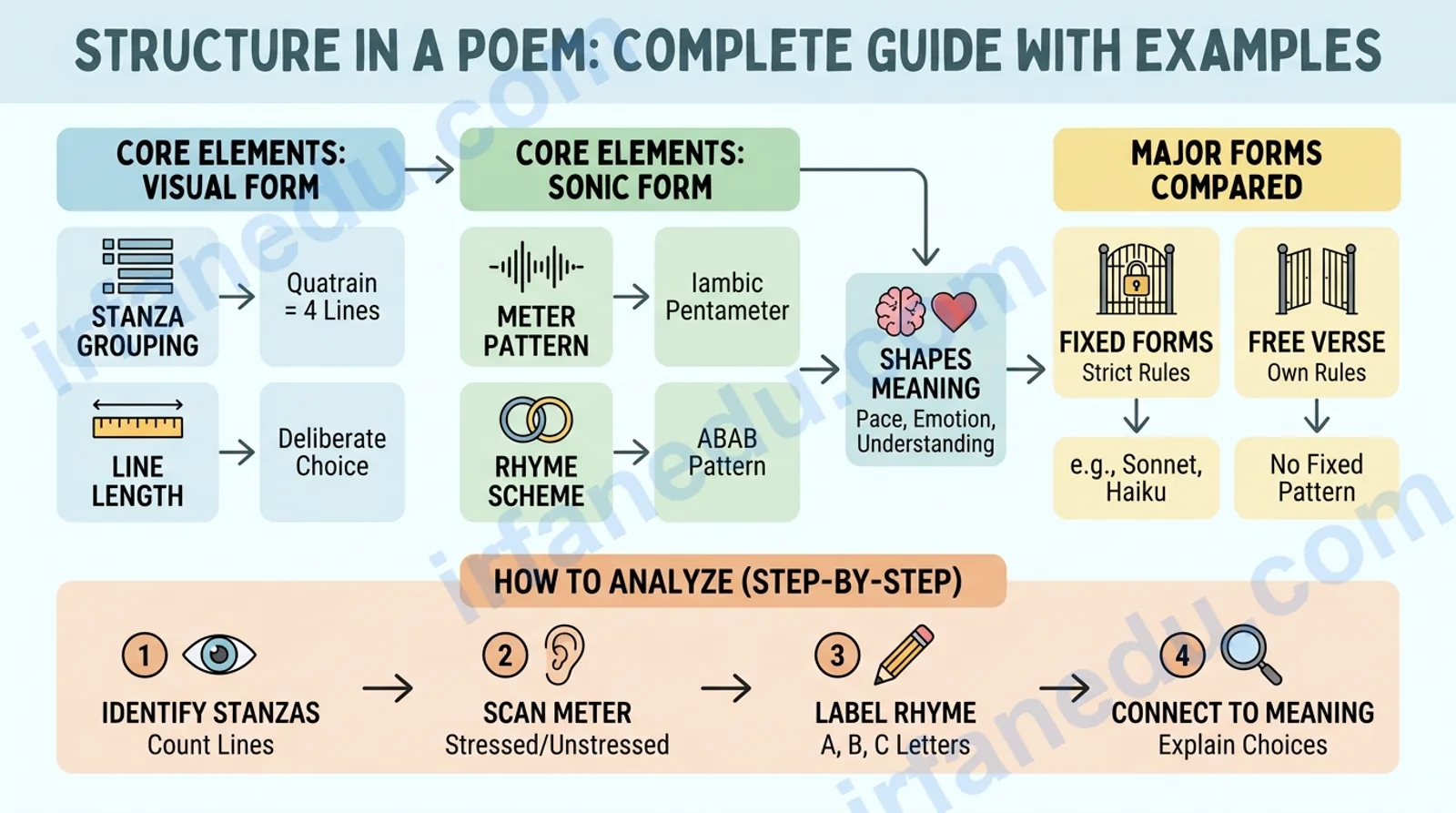
Structure in a poem is the deliberate arrangement of lines, stanzas, meter, and rhyme that controls how a poem looks on the page and sounds when read aloud. It includes both visual form (line length, stanza grouping) and sonic form (rhythm, rhyme scheme). Structure shapes meaning — a poet’s structural choices are never accidental; they guide the reader’s pace, emotion, and understanding.
In this guide, I cover every element of poetic structure with real worked examples, a step-by-step analysis method, and one insight that most classroom guides completely miss. By the end, you will be able to identify and discuss structure in any poem — from a Shakespearean sonnet to a modern free-verse piece.
After reading this guide, you will be able to:
- 🔹 Name and explain every core element of poem structure
- 🔹 Label a rhyme scheme and scan a line for meter
- 🔹 Identify major poetic forms (sonnet, haiku, villanelle, ode, free verse)
- 🔹 Analyze how structure creates meaning in any poem
- 🔹 Write precise, exam-ready commentary on structural choices
Structure in a poem is the deliberate arrangement of lines, stanzas, meter, and rhyme that controls how a poem looks on the page and sounds when read aloud. It includes both visual form (line length, stanza grouping) and sonic form (rhythm, rhyme scheme). Structure shapes meaning — a poet’s structural choices are never accidental; they guide the reader’s pace, emotion, and understanding.
🎯 The Short Version
- 📌 Structure = the framework of form, stanza, meter, and rhyme in a poem.
- 📌 A stanza groups lines together — like a paragraph in prose.
- 📌 Meter is the pattern of stressed and unstressed syllables per line.
- 📌 Rhyme scheme is labeled with letters (ABAB, AABB, etc.).
- 📌 Fixed forms (sonnet, haiku) follow strict rules; free verse makes its own.
- 📌 Every structural choice — even a line break — is a deliberate meaning-making decision.
| Element | What it is | Example |
|---|---|---|
| Stanza | A grouped set of lines, separated by white space | Quatrain = 4 lines |
| Meter | Pattern of stressed/unstressed syllables | Iambic pentameter (5 iambs/line) |
| Rhyme scheme | Pattern of end rhymes, labeled A/B/C | ABAB CDCD (Shakespearean sonnet) |
| Line length | Number of syllables or feet per line | Pentameter = 5 feet |
| Form | The overall structural template | Sonnet, haiku, villanelle, ode |
| Free verse | No fixed meter or rhyme; structure from line breaks | Walt Whitman’s “Song of Myself” |
| Volta | A structural turn or shift in argument/emotion | Line 9 of a Petrarchan sonnet |
The core elements of poem structure 🏗️
Poem structure has four interlocking layers. Understanding each one separately — then seeing how they work together — is the key to strong poetry analysis.
The four layers are: visual form (how the poem looks), stanza structure (how lines are grouped), sonic structure (meter and rhythm), and rhyme pattern (end and internal rhymes). A poet controls all four simultaneously, and every choice is intentional.
🔵 Key definition: Structure in a poem is not just about rhyme. It is the complete system of formal decisions — line length, stanza grouping, meter, and rhyme — that shapes how meaning is built and delivered.
Think of structure as a poem’s skeleton. You do not always see it, but it holds everything up. A poet who writes a 14-line sonnet is making a structural promise to the reader: expect a logical argument, a turn, and a resolution. A poet who shatters that form mid-poem is making an equally powerful structural statement.
In my experience teaching poetry analysis, students who struggle with exam questions almost always focus entirely on language (metaphor, simile) and ignore structure. But structure is often where the deepest meaning lives. When a poet breaks a regular rhyme scheme in the final couplet, that break IS the meaning — and most students walk right past it. I always tell my students: read the poem twice. First for words, second for shape.
What is a stanza and why does it matter? 📐
A stanza is a grouped set of lines in a poem, separated from other groups by a blank line — it functions like a paragraph in prose. Stanzas control pacing, signal topic shifts, and create visual rhythm on the page.
Here are the most common stanza types you will encounter:
- 🔸 Couplet — 2 lines (often rhymed: AA)
- 🔸 Tercet / Triplet — 3 lines
- 🔸 Quatrain — 4 lines (the most common stanza in English poetry)
- 🔸 Cinquain — 5 lines
- 🔸 Sestet — 6 lines
- 🔸 Septet — 7 lines
- 🔸 Octave — 8 lines
From William Blake’s “The Tyger” (1794):
“Tyger Tyger, burning bright, (A)
In the forests of the night; (A)
What immortal hand or eye, (B)
Could frame thy fearful symmetry?” (B)
This is a quatrain with an AABB rhyme scheme (couplet rhyme). The short, punchy lines mirror the explosive energy of the tiger. Notice how the stanza feels tight and contained — that containment is itself a structural comment on the tiger’s power being “framed.”
Stanza breaks also create silence. The white space between stanzas is a pause — a breath — that the reader takes whether they want to or not. Poets use this to let an image land before moving on.
How does meter work in poetry? 🎵
Meter is the pattern of stressed and unstressed syllables in a line of poetry. It is the heartbeat of a poem — regular meter creates a sense of order, control, or inevitability; broken meter signals disruption or emotion.
Meter is measured in feet — a foot is a small unit of stressed and unstressed syllables. The most important feet in English poetry are:
- ⚡ Iamb (u /) — unstressed then stressed: “be-CAUSE”, “a-LONE”
- ⚡ Trochee (/ u) — stressed then unstressed: “TI-ger”, “HUN-gry”
- ⚡ Anapest (u u /) — two unstressed then stressed: “un-der-STAND”
- ⚡ Dactyl (/ u u) — stressed then two unstressed: “HAP-pi-ly”
- ⚡ Spondee (/ /) — two stressed: “HEART-BREAK”
The number of feet per line gives the line its name: monometer (1), dimeter (2), trimeter (3), tetrameter (4), pentameter (5), hexameter (6).
Shakespeare’s Sonnet 18, line 1:
“Shall I | com-PARE | thee TO | a SUM | mer’s DAY?”
Mark it: u / | u / | u / | u / | u / — five iambs. That is iambic pentameter. The regularity creates a conversational, almost spoken quality — which is exactly the tone Shakespeare wants for a love poem addressed directly to a person.
🟢 Pro tip: When you scan a line and find a foot that breaks the pattern — a trochee in an otherwise iambic poem, for example — that irregularity almost always falls on the most emotionally important word. Poets break meter on purpose to force stress.
I have seen students panic when they encounter meter for the first time. My advice: stop trying to count syllables in your head and start by clapping the rhythm instead. Read the line aloud and clap on the beats you naturally stress. That physical act makes the pattern obvious in seconds. Meter is something you feel before you analyze it.
What is a rhyme scheme and how do you label it? 🔤
A rhyme scheme is the pattern of end rhymes across the lines of a poem. You label it by assigning a letter to each new end sound — the first line gets A, the next new sound gets B, and so on. Lines that share a letter rhyme with each other.
Common rhyme schemes and what they signal:
- 🔹 AABB — couplet rhyme; feels sing-song, direct, often used in ballads and children’s verse
- 🔹 ABAB — alternating rhyme; feels balanced and controlled; used in Shakespearean sonnets
- 🔹 ABBA — enclosed rhyme; creates a sense of enclosure or entrapment; used in Petrarchan sonnets
- 🔹 ABCABC — terza rima; interlocking rhyme; creates forward momentum (Dante used this)
- 🔹 AAAA — monorhyme; rare; creates obsessive or hypnotic effect
Robert Frost, “Stopping by Woods on a Snowy Evening” (1923), stanza 1:
“Whose woods these are I think I know. (A)
His house is in the village though; (A)
He will not see me stopping here (B)
To watch his woods fill up with snow.” (A)
Scheme: AABA. The B line (“here”) is the odd one out — it does not rhyme with the others. Frost then uses that B sound as the rhyme anchor for the next stanza. This interlocking pattern (called the Rubaiyat stanza) creates a sense of inevitability and forward pull — you keep moving through the poem just as the speaker keeps moving through the woods.
Major poetic forms compared 📊
Poetic form is the overall structural template a poem follows. Fixed forms have strict rules about line count, meter, and rhyme. Here is a comparison of the forms students encounter most often:
| Form | Lines | Meter | Rhyme scheme | Key feature |
|---|---|---|---|---|
| Shakespearean sonnet | 14 | Iambic pentameter | ABAB CDCD EFEF GG | Volta before final couplet |
| Petrarchan sonnet | 14 | Iambic pentameter | ABBAABBA + CDECDE | Volta at line 9 (octave/sestet split) |
| Haiku | 3 | 5-7-5 syllables | None | Seasonal reference (kigo); juxtaposition |
| Villanelle | 19 | Typically iambic pentameter | ABA (x5) + ABAA | Two refrains repeat throughout |
| Ode | Variable | Variable | Variable | Elevated address to a subject |
| Ballad | Variable (quatrains) | Alternating tetrameter/trimeter | ABCB or ABAB | Narrative; often oral tradition |
| Free verse | Variable | None fixed | None fixed | Structure from line breaks and repetition |
🔵 Note on the sonnet: The Shakespearean and Petrarchan sonnets are both 14 lines in iambic pentameter, but their structural split is different. The Shakespearean form divides 12+2 (three quatrains + a couplet); the Petrarchan divides 8+6 (octave + sestet). That difference changes where the argument turns — and that turn is called the volta.
Does free verse have structure? (Yes — here’s how) ✂️
Free verse absolutely has structure — it just builds that structure from different tools than fixed forms. Free verse uses line breaks, white space, repetition, anaphora, and stanza grouping to control pace and meaning.
The biggest misconception I encounter is students writing that a free verse poem “has no structure.” That statement will cost marks every time. Every line break in free verse is a deliberate choice. Where a line ends controls what the reader emphasizes and what they carry into the next line.
Walt Whitman, “O Captain! My Captain!” (1865), opening lines:
“O Captain! my Captain! our fearful trip is done,
The ship has weather’d every rack, the prize we sought is won,
The port is near, the bells I hear, the people all exulting,”
No fixed meter, but notice the structural tools at work: anaphora (“O Captain!”), internal rhyme (“near/hear”), and parallel syntax (“The port is near, the bells I hear, the people all exulting”). These create rhythm and momentum without a fixed metrical pattern.
🔴 Common mistake: Never write “this poem has no structure because it is free verse.” Instead, write: “This poem uses free verse, which means structure is created through line breaks, repetition, and white space rather than a fixed metrical pattern.”
How do you analyze the structure of a poem? (Step-by-step) 🔍
Analyzing poem structure is a five-step process. Follow these steps in order and you will produce precise, exam-ready commentary every time.
- Step 1 — Count lines and stanzas. How many lines total? How are they grouped? Are all stanzas the same length, or do some break the pattern? A stanza that is shorter or longer than the others is a structural signal worth commenting on.
- Step 2 — Label the rhyme scheme. Read the end word of each line and assign letters. Write the scheme out (e.g., ABAB CDCD EFEF GG). Then ask: does the rhyme scheme stay consistent, or does it break? Where it breaks, why might the poet have chosen that?
- Step 3 — Scan the meter. Read a few lines aloud and mark stressed (/) and unstressed (u) syllables. Identify the dominant foot (iamb, trochee, etc.) and the line length (tetrameter, pentameter, etc.). Note any lines that break the pattern.
- Step 4 — Identify the form. Does the poem fit a known template? Use the comparison table above. If it does, you can reference the conventions of that form and comment on where the poet follows or subverts them.
- Step 5 — Connect structure to meaning. This is the most important step and the one most students skip. Ask: Why did the poet make these structural choices? How does the form reinforce, contrast, or complicate the poem’s theme? A love poem in a rigid sonnet form might suggest that love is orderly; the same poem in fractured free verse might suggest love is chaotic.
Step 5 is where the real marks live in any exam. I have read hundreds of student essays that correctly identify “iambic pentameter” and then stop. The question is always: so what? What does that regular rhythm do to the reader? Does it create calm, authority, inevitability? Does it make the one line that breaks the meter feel like a punch? That connection between structural observation and interpretive meaning is what separates a B answer from an A.
Visual breakdown: anatomy of a Shakespearean sonnet 🗺️
Below is a pure HTML/CSS diagram showing how a Shakespearean sonnet is structured. Each section is labeled with its rhyme scheme, metrical pattern, and function.
┌─────────────────────────────────────────────────────────────────┐
│ SHAKESPEAREAN SONNET — 14 lines, iambic pentameter │
├─────────────────────────────────────────────────────────────────┤
│ QUATRAIN 1 (lines 1-4) │ Rhyme: A B A B │
│ ───────────────────── │ Function: Introduces the theme │
│ Line 1 ──────────── (A) │ or problem │
│ Line 2 ──────────── (B) │ │
│ Line 3 ──────────── (A) │ Meter: u / u / u / u / u / │
│ Line 4 ──────────── (B) │ (5 iambs per line) │
├─────────────────────────────────────────────────────────────────┤
│ QUATRAIN 2 (lines 5-8)Sources & References
Written and fact-checked by Dr Irfan Mansuri. External links open in a new tab and are provided for further reading and verification.