
Thematic Statement Examples: From Easiest to Hardest
Most students can name a theme in thirty seconds. Writing a thematic statement that actually earns full marks — that is the skill teachers are really testing. The gap between “this story is about friendship” and a polished, arguable thematic statement is wider than most guides admit.
In this guide, I rank thematic statement examples from the simplest you will ever write to the most complex a university-level essay demands. Each level builds on the last, so you can see exactly where your current writing sits and what to do next.
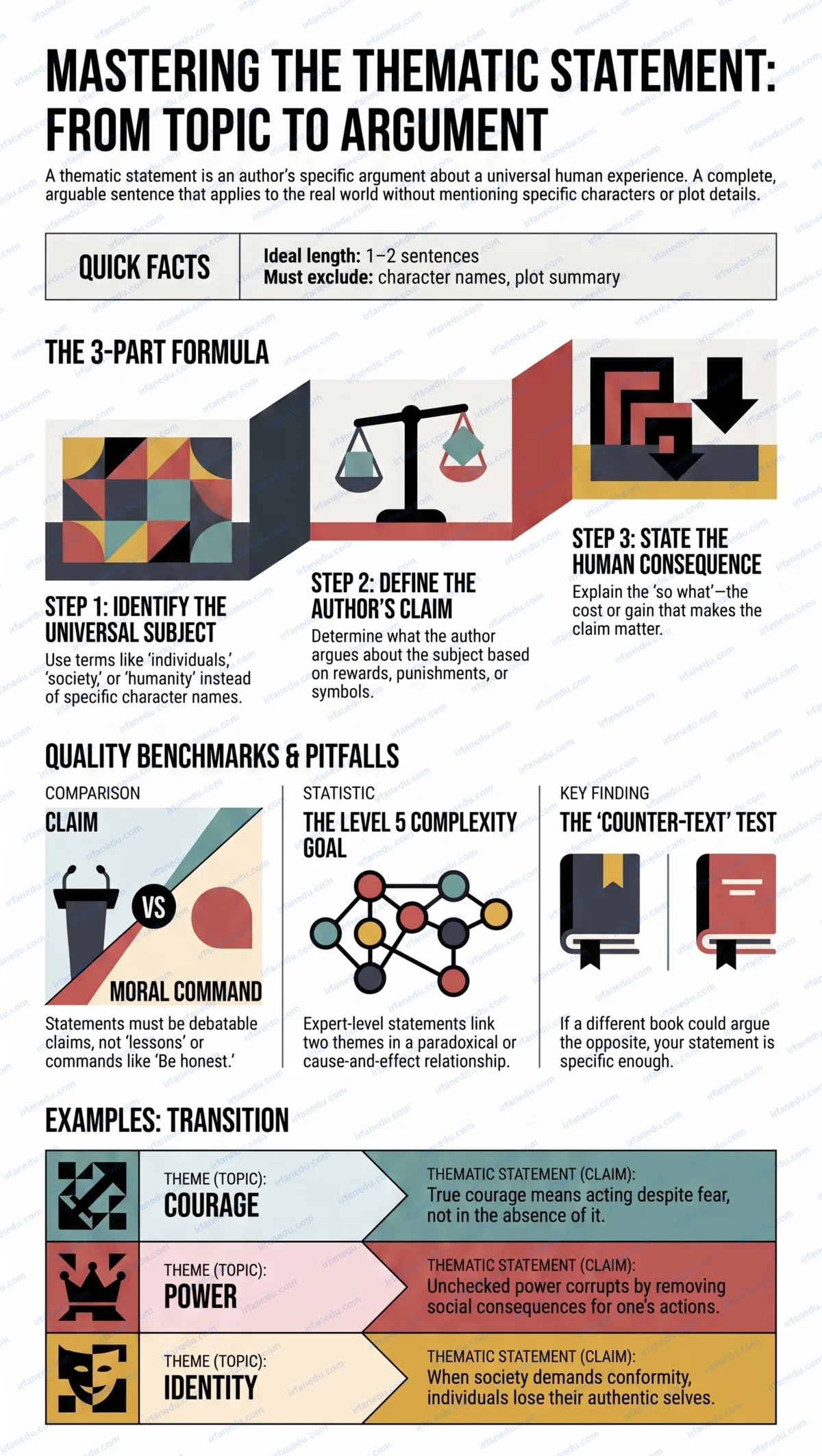
A thematic statement is a complete sentence that expresses the central message of a literary work. It names a universal subject, states the author’s specific claim about it, and implies a human consequence — all without mentioning character names or plot details.
- The exact difference between a theme and a thematic statement
- A 3-part formula you can apply to any text
- Real examples ranked from beginner to advanced difficulty
- The single most common mistake students make (and how to fix it)
TL;DR – Quick Summary
- A theme is one word; a thematic statement is a full, arguable sentence.
- Strong statements are universal — no character names, no plot spoilers.
- Use the formula: Universal Subject + Author’s Claim + Human Consequence.
- Difficulty increases when themes conflict, overlap, or require textual proof.
- The hardest statements link two themes in a cause-and-effect relationship.
- Test any statement: Is it a sentence? Is it debatable? Is it universal?
| Feature | Details |
|---|---|
| Also called | Theme statement, central message, author’s message |
| Ideal length | 1–2 complete sentences |
| Must include | Universal subject, specific claim, human consequence |
| Must exclude | Character names, plot summary, personal opinion (“I think”) |
| Tested in | Literary essays, reading comprehension, standardized exams |
| Common error | Confusing the topic with the statement |
What Is a Thematic Statement?
A thematic statement is the author’s argument about a universal human experience, expressed as a single complete sentence. It is not a plot summary. It is not a moral lesson told as a command (“Be honest”). It is a claim — something a reader could agree with or push back on.
Think of it as the answer to this question: “What does this text say about how the world works?” The author never writes this sentence directly in the text. You infer it from character choices, consequences, symbols, and structure.
Topic (not a statement): Loyalty
Moral command (not a statement): “Always be loyal to your friends.”
Thematic statement: “Blind loyalty to a group can silence an individual’s moral judgment and lead to collective harm.”
Notice the difference. The thematic statement makes a specific, debatable claim. It tells you what happens when loyalty goes wrong — and that insight applies to any group, any era, any culture.
Theme vs. Thematic Statement: The Exact Difference
A theme is a single word or short phrase that names a subject. A thematic statement is a full sentence that argues a position about that subject. Every thematic statement contains a theme, but a theme alone is never a thematic statement.
| Theme (Topic Only) | Thematic Statement (Claim About the Topic) |
|---|---|
| Courage | True courage means acting despite fear, not in the absence of it. |
| Power | Unchecked power corrupts those who hold it and silences those who do not. |
| Identity | When society demands conformity, individuals lose the self they were meant to become. |
| Loss | Grief, when faced honestly, becomes the path through which people rediscover their purpose. |
In my experience teaching literary analysis, the theme-vs-thematic-statement confusion is the single biggest source of lost marks on essays. Students write “the theme is courage” and stop there, thinking they have answered the question. They have not. They have named the subject. The teacher is waiting for the argument — what does the text say courage actually is, costs, or requires? That is the thematic statement, and it is worth far more points.
The 3-Part Formula for Any Thematic Statement
After years of marking student essays, I developed a formula that works for any text at any level. It has three parts, and you can combine them in any order once you understand what each one does.
  PART 1: UNIVERSAL SUBJECT
  +-----------------------------------------+
  | Who does this apply to?                 |
  | Use: people / humans / individuals /    |
  |      society / those who...             |
  +-----------------------------------------+
              |
              v
  PART 2: AUTHOR'S CLAIM
  +-----------------------------------------+
  | What does the author argue about it?    |
  | Look at: rewards, punishments,          |
  |          character arcs, symbols        |
  +-----------------------------------------+
              |
              v
  PART 3: HUMAN CONSEQUENCE
  +-----------------------------------------+
  | What happens as a result?               |
  | The "so what" — the cost or gain        |
  | that makes the claim matter             |
  +-----------------------------------------+
              |
              v
  THEMATIC STATEMENT
  +-----------------------------------------+
  | One complete, arguable, universal       |
  | sentence. No character names.           |
  | No "I think." No moral command.         |
  +-----------------------------------------+
Here is the formula applied step by step to a familiar story:
Step 1 — Universal Subject: “Young people in love”
Step 2 — Author’s Claim: “act impulsively when passion overrides reason”
Step 3 — Human Consequence: “and pay a price that outlasts the feeling itself”
Combined: “When passion overrides reason, even the deepest love can become the instrument of its own destruction.”
Notice I removed the character names and made the claim universal. That is what separates a literary insight from a plot summary.
From Easiest to Hardest: The Difficulty Ladder
Below I rank five levels of thematic statement difficulty. Each level shows a weak version (crossed out) and a strong version. Work through them in order — each rung teaches you something the previous one cannot.
The theme is friendship.
True friendship survives hardship because shared struggle builds trust that good times alone cannot create.
What makes it work: one clear claim, one consequence, universal nouns, complete sentence.
The story is about how greed is bad.
The relentless pursuit of wealth isolates individuals from the relationships that give life meaning, leaving them rich in possessions but poor in purpose.
What makes it harder: “relentless pursuit” is more precise than “greed”; the consequence is layered (isolation + loss of meaning).
Power corrupts people.
Power corrupts not by changing a person’s character, but by removing the social consequences that once kept their worst impulses in check.
What makes it harder: the qualifier (“not by… but by”) adds a specific mechanism that requires deeper textual analysis to support.
The novel is about freedom and responsibility.
The freedom individuals crave is only meaningful when it is voluntarily constrained by responsibility to others; without that constraint, freedom collapses into selfishness.
What makes it harder: two themes interact causally. You must find evidence for both and show how they define each other.
The text explores identity and society.
Societies that demand conformity in the name of unity ultimately destroy the individual diversity that makes collective progress possible — a self-defeating cycle the text traces through each generation’s silent capitulation.
What makes it hardest: the statement is paradoxical (unity destroys unity), historically resonant, and contains a structural claim (“each generation”) that requires sustained close reading to prove.
Worked Examples by Genre
The formula works across every genre. Below I apply it to five common text types students encounter. For each one, I show the theme, the weak attempt, and the polished thematic statement.
Classic Novel
Theme: Surveillance / Control
Weak: “The government watches everyone.”
Strong: “When a state monitors its citizens without limit, it does not merely control behavior — it colonizes thought itself, until people can no longer imagine the freedom they have lost.”
Short Story
Theme: Regret
Weak: “People regret their choices.”
Strong: “Regret is most corrosive not when people make the wrong choice, but when they never make a choice at all — allowing fear to decide for them.”
Drama / Play
Theme: Ambition
Weak: “Ambition leads to downfall.”
Strong: “Unchecked ambition, divorced from moral restraint, transforms a person’s greatest strength into the very force that dismantles everything they sought to build.”
Poem
Theme: Memory
Weak: “Memory is important.”
Strong: “Memory does not preserve the past — it reshapes it, filtering experience through the emotions of the present until what is remembered says more about who we are now than who we were then.”
Film / Screenplay
Theme: Redemption
Weak: “The character finds redemption.”
Strong: “Redemption is not granted by others but claimed through the willingness to face the harm one has caused without excusing it — a reckoning that transforms guilt into growth.”
I have noticed that students struggle most with poetry thematic statements, not novels. The reason is that poems rarely show consequences through plot — they show them through imagery and tone. My advice: treat the poem’s final image or turn (the volta) as the “human consequence” in your formula. That single shift in the poem is usually where the author’s argument lands. Once students see that, their poetry thematic statements improve immediately.
Common Mistakes: Wrong vs. Right
These are the five errors I see most often. Each one has a clear fix.
“This story is about how Atticus fights for justice.”
Uses a character name. Describes plot, not theme.
“Moral courage demands that individuals defend the truth even when society punishes them for it.”
Universal, arguable, no character names.
“Don’t judge people by their appearance.”
A moral command, not a thematic statement.
“Prejudice based on appearance blinds people to the humanity of others, perpetuating cycles of injustice that harm both the judged and the judge.”
A claim with a consequence, not a command.
“I think the author wants us to know that love is powerful.”
Uses “I think” and is too vague.
“Love, when it demands sacrifice, reveals the depth of a person’s character more honestly than any other human experience.”
Objective, specific, arguable.
“The theme of the novel is survival.”
Names the topic only. No claim, no consequence.
“Survival strips away social pretense and forces individuals to confront the values they will — and will not — abandon to stay alive.”
Makes a specific claim about what survival reveals.
The most common error is writing a thematic statement that is technically a sentence but still just names the topic: “The book shows that war is terrible.” That is a fact, not a claim. A strong thematic statement must be debatable — someone could argue the opposite. “War, despite its horror, forces societies to clarify what they value enough to defend” is debatable. That is the level you are aiming for.
Most thematic statement guides teach you to avoid character names. That is correct but incomplete. The deeper rule is this: a thematic statement should be falsifiable by a different text. If your statement is so broad that it fits every story ever written (“people face challenges”), it is not a thematic statement — it is a truism. The test I use with students is the “counter-text test”: name a well-known book that would argue the opposite of your statement. If you can name one, your statement is specific enough to be genuinely analytical. If you cannot, it is still too vague.
For example: “Isolation destroys the human spirit” can be countered by texts that argue solitude is necessary for self-discovery. That tension proves your statement is doing real analytical work. Guides that only say “be universal and avoid character names” miss this entirely — and students who follow only that advice still write statements that earn partial credit, not full marks.
When writing a thematic statement for an exam under time pressure, use this sentence starter: “When [condition], [universal subject] [consequence].” It forces you to include a condition (the author’s claim) and a consequence in one move. Example: “When individuals prioritize belonging over honesty, they gradually surrender the identity that makes belonging meaningful in the first place.”
Quick Quiz: Test Your Understanding
3-Question Thematic Statement Quiz
Q1. Which of the following is a thematic statement?
Q2. Which element is REQUIRED in every thematic statement?
Q3. Which thematic statement is at the highest difficulty level?
Practice Problems
Read each scenario and write your own thematic statement before revealing the model answer.
Practice 1: A character sacrifices personal happiness to care for a sick parent, and the story ends with them finding unexpected peace.
Model Answer: “Selfless sacrifice, though it demands the surrender of personal ambition, often opens individuals to a depth of meaning that self-focused pursuits could never provide.”
Why it works: Universal subject (individuals), specific claim (sacrifice opens meaning), consequence (what self-focus cannot provide), no character names, arguable.
Practice 2: A society in a novel punishes anyone who questions authority, and the one character who speaks up is exiled but survives with their integrity intact.
Model Answer: “When institutions silence dissent to preserve order, they may maintain surface stability while eroding the moral foundation that makes a society worth preserving.”
Why it works: Conditional structure (“When…”), paradoxical consequence (stability vs. erosion), universal, arguable — a Level 4 statement.
Practice 3: A poem describes a person returning to their childhood home and finding it smaller and less magical than they remembered.
Model Answer: “Nostalgia distorts memory by preserving the emotional intensity of the past while stripping away the context that made those feelings possible — leaving adults mourning a place that never quite existed.”
Why it works: Addresses the poem’s core mechanism (distortion of memory), uses the “human consequence” structure, and makes a claim that is genuinely debatable.
Frequently Asked Questions
What is a thematic statement?
What is the difference between a theme and a thematic statement?
Can a thematic statement mention character names?
How long should a thematic statement be?
Can a book have more than one thematic statement?
Is a thematic statement the same as a thesis statement?
How do I know if my thematic statement is strong enough?
Sources & References
Reviewed by Dr. Irfan Mansuri. External links open in a new tab and are provided for further reading and verification.