
Annotated Bibliography Example: The Complete Student Guide (MLA, APA & Chicago)
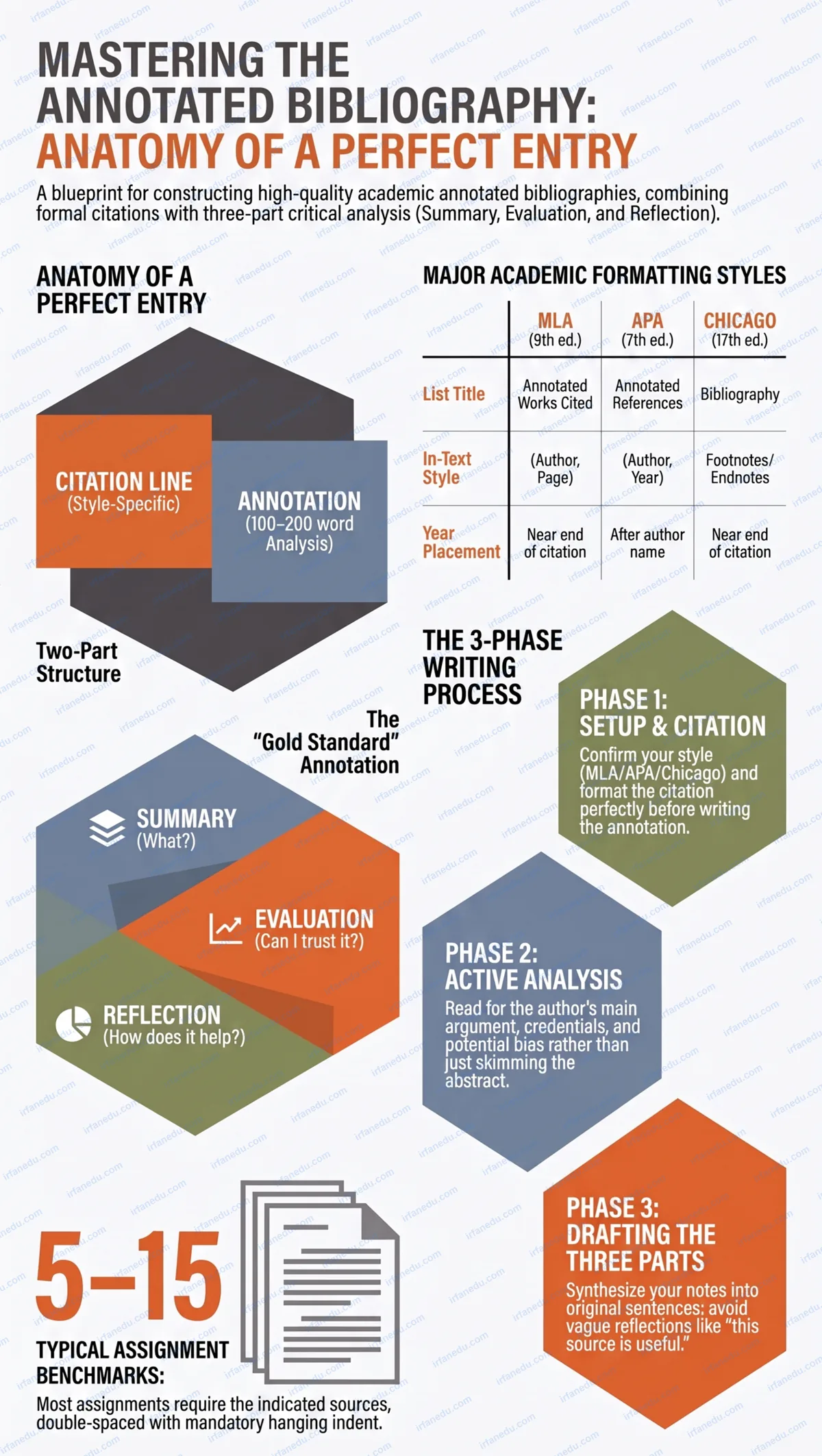
Think about the last time a friend recommended a book to you. They probably said something like: “It’s about climate change, written by a scientist at MIT, very well-researched, and it changed how I think about carbon taxes.” That three-part recommendation — what it is, who wrote it and why they’re credible, and why it matters to you — is exactly what an annotated bibliography entry does, just in formal academic language.
An annotated bibliography is a list of sources (books, articles, websites) formatted as citations, each followed by a short paragraph called an annotation that summarizes the source, evaluates its credibility, and explains its relevance to your research topic.
If you have ever stared at a blank page wondering where to start, you are not alone. In my experience tutoring students across multiple grade levels, the annotated bibliography is one of the most misunderstood assignments in academic writing — mostly because students confuse it with a plain Works Cited page. They are not the same thing, and this guide will show you exactly why.
By the end of this guide, you will be able to:
- Explain what an annotated bibliography is and why it is assigned
- Write a complete annotation using the three-part structure (summary, evaluation, reflection)
- Format entries correctly in MLA, APA, and Chicago styles
- Spot and fix the seven most common student mistakes
- Apply the skill to real research projects immediately
⚡ TL;DR – Quick Summary
- 📌 An annotation = citation + summary + evaluation + reflection (3 parts, ~150 words)
- 📌 MLA calls it “Annotated Works Cited”; APA calls it “Annotated References”
- 📌 Each annotation answers: What? Who? So what?
- 📌 Hanging indent applies to the citation line, not the annotation paragraph
- 📌 Avoid copying the abstract — write the summary in your own words
- 📌 Always check your instructor’s word-count and format requirements first
📊 Quick Facts: Annotated Bibliography at a Glance
| Feature | Detail |
|---|---|
| Typical annotation length | 100–200 words per source |
| Number of sources (typical assignment) | 5–15 sources |
| Most common formats | MLA 9th ed., APA 7th ed., Chicago 17th ed. |
| Three annotation parts | Summary · Evaluation · Reflection |
| Indent style | Hanging indent on citation line |
| Spacing | Double-spaced (MLA/APA); single or double (Chicago) |
| First-person allowed? | MLA: sometimes; APA: generally no; Chicago: context-dependent |
📖 What Is an Annotated Bibliography?
An annotated bibliography is a research document that lists your sources in citation format and adds a critical paragraph after each one. The word “annotated” comes from the Latin annotare, meaning “to note down.” The word “bibliography” means a list of writings.
Put those together and you get: a list of writings, each with a note attached. Simple in concept, powerful in practice.
There are three main types of annotations:
- Descriptive (Indicative): Summarizes what the source covers without evaluating it. Useful for quick reference lists.
- Evaluative (Critical): Summarizes AND assesses the quality, bias, and reliability of the source. Most common in academic assignments.
- Combination (Analytical): Summarizes, evaluates, AND reflects on how the source fits your specific research question. The gold standard for university-level work.
When your assignment sheet just says “annotated bibliography” without specifying a type, default to the combination/analytical style. It covers all bases and shows the most critical thinking.
🎯 Why Professors Assign It (and Why It Helps You)
Professors assign annotated bibliographies because they want proof that you actually read your sources — not just skimmed the abstract. It is a built-in accountability tool for the research process.
But here is the part students often miss: the annotated bibliography helps you more than it helps your professor. When you sit down to write your actual paper, you already have a mini-summary and evaluation of every source in front of you. You spend less time re-reading and more time writing.
In my experience, students who write strong annotated bibliographies consistently write stronger papers. The annotation forces you to ask “why does this source matter?” before you start drafting. That question is the heart of good academic argument. I have seen students completely change their thesis after writing annotations — because the process revealed gaps and contradictions in their sources they had not noticed before.
Beyond grades, annotated bibliographies build a skill that matters in professional life too: the ability to quickly evaluate the quality of information. Journalists, lawyers, doctors, and researchers all do a version of this every day.
🔬 Anatomy of One Perfect Entry
Every annotated bibliography entry has two distinct parts: the citation and the annotation. The citation follows your required style guide exactly. The annotation is your original writing — three focused sentences to three focused paragraphs.
┌─────────────────────────────────────────────────────────────────┐
│  CITATION LINE (hanging indent, style-guide format)             │
│  ─────────────────────────────────────────────────────────────  │
│  Author Last, First. "Title of Article." Journal Name,          │
│       vol. X, no. Y, Year, pp. 00–00. DOI or URL.              │
├─────────────────────────────────────────────────────────────────┤
│  ANNOTATION PARAGRAPH (indented block, ~150 words)              │
│                                                                 │
│  [PART 1 – SUMMARY]                                             │
│  "This article argues that... The author examines...            │
│   The main finding is..."                                       │
│                                                                 │
│  [PART 2 – EVALUATION]                                          │
│  "Published in a peer-reviewed journal, this source is          │
│   credible. The author is a professor at... One limitation      │
│   is that the data is from 2015..."                             │
│                                                                 │
│  [PART 3 – REFLECTION]                                          │
│  "This source directly supports my argument that...             │
│   It will be most useful in the section on..."                  │
└─────────────────────────────────────────────────────────────────┘
Notice how the three parts answer three questions: What does this source say? Can I trust it? How does it help my paper? Keep those three questions in mind every time you write an annotation.
🛠️ Step-by-Step: How to Write an Annotated Bibliography
Follow these six steps in order. Skipping steps is the number-one reason students lose marks on this assignment.
- Step 1 – Confirm your format. Ask your instructor: MLA, APA, or Chicago? Each has different punctuation, capitalization, and order rules for the citation line. Getting this wrong costs easy marks.
- Step 2 – Write the full citation first. Use a reliable citation tool or your style guide’s official manual. Double-check author names, publication years, volume/issue numbers, and DOIs. The citation must be perfect before you write a single word of annotation.
- Step 3 – Read the source actively. As you read, highlight the main argument, key evidence, and the author’s credentials. Note any obvious bias or limitations. This reading becomes your annotation material.
- Step 4 – Write the summary (2-3 sentences). Describe the source’s main purpose, argument, and key findings. Do not copy the abstract. Use your own words.
- Step 5 – Write the evaluation (2-3 sentences). Comment on the author’s qualifications, the publication’s credibility, the currency of the data, and any notable bias or limitation.
- Step 6 – Write the reflection (1-2 sentences). Explain specifically how this source supports, challenges, or adds nuance to your research question or thesis.
Do NOT write the reflection as “This source will be useful for my paper.” That is too vague. Instead write: “This source supports my argument in Section 3 that renewable energy subsidies reduce consumer costs, providing the 2023 cost data I need to counter the opposition’s claim.”
📝 MLA Annotated Bibliography Example
MLA format is most common in humanities subjects — literature, history, philosophy, and languages. The citation list is titled “Annotated Works Cited” and uses the author-page (Author, Page) in-text citation system.
Annotated Works Cited
Kolbert, Elizabeth. The Sixth Extinction: An Unnatural History. Henry Holt and Company, 2014.
In this Pulitzer Prize-winning book, Kolbert argues that human activity is driving a sixth mass extinction event, drawing on fieldwork across five continents and interviews with leading biologists. She traces the history of extinction science from Cuvier’s early discoveries to present-day species collapse. The book is written for a general audience but grounded in peer-reviewed science, making it both accessible and credible. Kolbert is a staff writer for The New Yorker with decades of environmental reporting experience; the book’s claims are well-supported by primary scientific sources. This source provides essential background for my paper’s opening section on the scale of current biodiversity loss and helps establish the urgency of my argument for stronger international conservation policy.
Key MLA formatting rules to notice above:
- Book title is in italics
- Hanging indent on the citation line (second line indented)
- Annotation paragraph is indented as a block below the citation
- No title for the annotation — it flows directly after the citation
[IMAGE: MLA annotated bibliography page layout showing hanging indent and annotation block | ALT: MLA annotated bibliography example format with hanging indent and annotation paragraph]
📝 APA Annotated Bibliography Example
APA format is standard in social sciences, psychology, education, and nursing. The list is titled “Annotated References” and uses the author-date (Author, Year) in-text citation system.
Annotated References
Twenge, J. M., & Campbell, W. K. (2019). The narcissism epidemic: Living in the age of entitlement. Atria Books.
Twenge and Campbell examine the sharp rise in narcissistic personality traits among younger generations in the United States, presenting longitudinal survey data collected over three decades. The authors argue that cultural shifts — including social media, permissive parenting, and celebrity culture — have accelerated this trend. Both authors are professors of psychology at major research universities, and the book synthesizes peer-reviewed studies, lending it strong academic credibility. One limitation is that the data is primarily drawn from one country, which may limit its generalizability to global populations. For my research on social media’s effect on adolescent self-image, this source provides the foundational psychological framework and key statistical benchmarks I will reference throughout the literature review.
Key APA differences from MLA:
- Year appears in parentheses immediately after the author’s name
- Only the first word of the title and proper nouns are capitalized
- Book title is in italics; article titles are NOT italicized
- Ampersand (&) used between multiple authors in the reference list
📝 Chicago Annotated Bibliography Example
Chicago style is used in history, fine arts, and some social sciences. It comes in two systems: Notes-Bibliography (NB) and Author-Date. The bibliography-style version is most common for annotated bibliographies.
Bibliography
Harari, Yuval Noah. Sapiens: A Brief History of Humankind. New York: Harper, 2015.
Harari presents a sweeping narrative of human history from the cognitive revolution 70,000 years ago to the present, arguing that shared myths and collective imagination are the defining feature that allowed Homo sapiens to dominate the planet. The book synthesizes archaeology, biology, economics, and philosophy into a readable, interdisciplinary account. While Harari is a professor of history at the Hebrew University of Jerusalem, some historians have criticized the book for oversimplification and speculative claims. Readers should treat it as a thought-provoking framework rather than a definitive historical record. For my paper on the role of storytelling in political movements, this source offers a compelling theoretical lens, particularly Harari’s concept of “imagined realities” as the foundation of human cooperation.
📊 MLA vs APA vs Chicago: Quick Comparison
Choosing the wrong format is one of the fastest ways to lose marks. Use this table as your quick reference before you start writing.
| Feature | MLA (9th ed.) | APA (7th ed.) | Chicago (17th ed.) |
|---|---|---|---|
| List title | Annotated Works Cited | Annotated References | Bibliography |
| In-text citation | (Author, Page) | (Author, Year) | Footnote / Endnote |
| Author format | Last, First | Last, F. M. | Last, First |
| Year placement | Near end of citation | After author name | Near end of citation |
| Title capitalization | Title Case | Sentence case | Title Case |
| Book title style | Italics | Italics | Italics |
| Article title style | Quotation marks | No special style | Quotation marks |
| Common subjects | Humanities | Social sciences | History, arts |
🚫 7 Common Mistakes (and How to Fix Them)
These are the exact errors I see most often when reviewing student annotated bibliographies. Knowing them in advance saves you from losing easy marks.
| # | Mistake | Why It Hurts | Fix |
|---|---|---|---|
| 1 | Copying the abstract | Plagiarism risk; shows no critical thinking | Read the full source; summarize in your own words |
| 2 | Missing the evaluation | Drops the annotation to “descriptive” level | Always comment on author credentials and source reliability |
| 3 | Vague reflection (“useful for my paper”) | Shows no connection to your actual argument | Name the specific section or claim the source supports |
| 4 | Wrong citation format | Loses formatting marks; confuses readers | Use your style guide’s official manual; check every field |
| 5 | Annotation too long or too short | Suggests poor editing or insufficient reading | Target 150 words; cut padding, add substance |
| 6 | Including unreliable sources | Undermines your paper’s credibility | Prefer peer-reviewed journals, academic books, .edu/.gov sites |
| 7 | Forgetting the hanging indent | Looks unprofessional; loses formatting marks | In Word: Format > Paragraph > Indentation > Special > Hanging |
Mistake #3 — the vague reflection — is the one that separates a B paper from an A paper. When I read “this source will be helpful,” I know the student has not yet figured out exactly how the source fits their argument. That is a thinking problem, not a writing problem. The fix is to draft your thesis first, then write your annotations. When you know what you are arguing, you know exactly how each source serves that argument.
🌍 Real-World Uses Beyond the Classroom
An annotated bibliography is not just an academic exercise. The skill transfers directly to professional and real-world contexts.
- Journalism: Reporters maintain annotated source lists to track which experts said what and how credible they are before publishing.
- Law: Legal researchers annotate case law and statutes to track which precedents support which arguments.
- Medicine: Doctors reviewing clinical guidelines annotate studies to note sample sizes, limitations, and applicability to their patient population.
- Policy research: Think tanks and government agencies annotate research reports to brief decision-makers quickly.
- Graduate school: Literature reviews — a core part of every thesis and dissertation — are essentially extended annotated bibliographies organized by theme.
Learning to write a tight, critical annotation in school is practice for evaluating information critically in every professional context you will ever enter.
[IMAGE: Student writing annotated bibliography on laptop in a library setting | ALT: Student writing annotated bibliography example for a research paper in a university library]
🧠 Quick Quiz: Test Your Knowledge
📝 Annotated Bibliography Quiz (3 Questions)
Q1. What are the three parts of a combination (analytical) annotation?
Show Answer
✅ B) Summary, Evaluation, Reflection. These three parts answer: What does the source say? Can I trust it? How does it help my research?
Q2. In APA 7th edition, where does the publication year appear in a reference list entry?
Show Answer
✅ C) Immediately after the author’s name. APA format: Author, A. A. (Year). Title. Publisher.
Q3. Which annotation type ONLY describes what a source covers without assessing its quality?
Show Answer
✅ A) Descriptive. A descriptive annotation summarizes the source’s scope and purpose without evaluating its quality or credibility.
✏️ Practice Problems: Write Your Own Annotation
Use the three-part structure (summary, evaluation, reflection) to write an annotation for each scenario below. Click to reveal a model answer.
Practice 1: You found a 2022 peer-reviewed journal article about the effects of screen time on children’s sleep. Write a 3-sentence evaluative annotation.
Model Answer:
Summary: This article examines the relationship between evening screen use and sleep duration in children aged 6-12, finding that each additional hour of screen time correlates with a 20-minute reduction in sleep.
Evaluation: Published in a peer-reviewed pediatric health journal in 2022, the study draws on a sample of 1,400 children across four countries, lending it strong statistical credibility; however, the self-reported nature of screen-time data introduces potential measurement error.
Reflection: This source directly supports my thesis that digital device policies in schools should include evening screen-time guidelines, providing the quantitative data I need for my argument in Section 2.
Practice 2: You found a popular magazine article (no author listed) about climate change from 2019. Write a 3-sentence evaluative annotation noting its limitations.
Model Answer:
Summary: This article provides an overview of projected global temperature increases by 2050, summarizing findings from several recent climate reports and quoting multiple environmental scientists.
Evaluation: The source lacks a named author, which reduces its academic credibility, and as a popular magazine article it has not undergone peer review; the data cited is also now five years old, which is a limitation given the rapid pace of climate research.
Reflection: I will use this source only for introductory background context in my paper, supplementing it with more recent peer-reviewed studies for any specific claims about temperature projections.
Practice 3: Convert this plain Works Cited entry into an MLA annotated bibliography entry by adding a full annotation. Source: A 2021 book on artificial intelligence ethics by a professor at Stanford University.
Model Answer:
Russell, Stuart. Human Compatible: Artificial Intelligence and the Problem of Control. Penguin Books, 2021.
Russell argues that the central challenge of artificial intelligence is not building smarter machines but ensuring those machines remain aligned with human values and preferences. He proposes a new framework for AI design based on uncertainty about human objectives rather than fixed goal optimization. Russell is a professor of computer science at the University of California, Berkeley, and one of the world’s leading AI researchers; his arguments are grounded in decades of technical expertise and are widely cited in the field. The book’s main limitation is that it is written for a general audience, so some technical nuances are simplified. For my paper on AI governance policy, this source provides the foundational ethical framework I will use to evaluate proposed international AI regulations.
❓ Frequently Asked Questions
What is an annotated bibliography?
How long should an annotation be?
What is the difference between MLA and APA annotated bibliography format?
Do I need to include every source I read in an annotated bibliography?
Can I use first-person in an annotation?
What is the difference between a bibliography and an annotated bibliography?
How do I evaluate a source in my annotation?
🏆 Key Takeaways
- An annotated bibliography = citation + annotation (summary + evaluation + reflection)
- The three annotation types are descriptive, evaluative, and analytical (combination)
- MLA uses “Annotated Works Cited”; APA uses “Annotated References”
- Always write the citation first, then read the source, then write the annotation
- The reflection must name a specific section or argument in your paper — not just “this will be useful”
-
Sources & References
Reviewed by Dr. Irfan Mansuri. External links open in a new tab and are provided for further reading and verification.