
Multiplication as Repeated Addition Worksheets 🟢 Free Printable PDF
✍ Written & fact-checked by Dr. Irfan Mansuri | Last Updated:
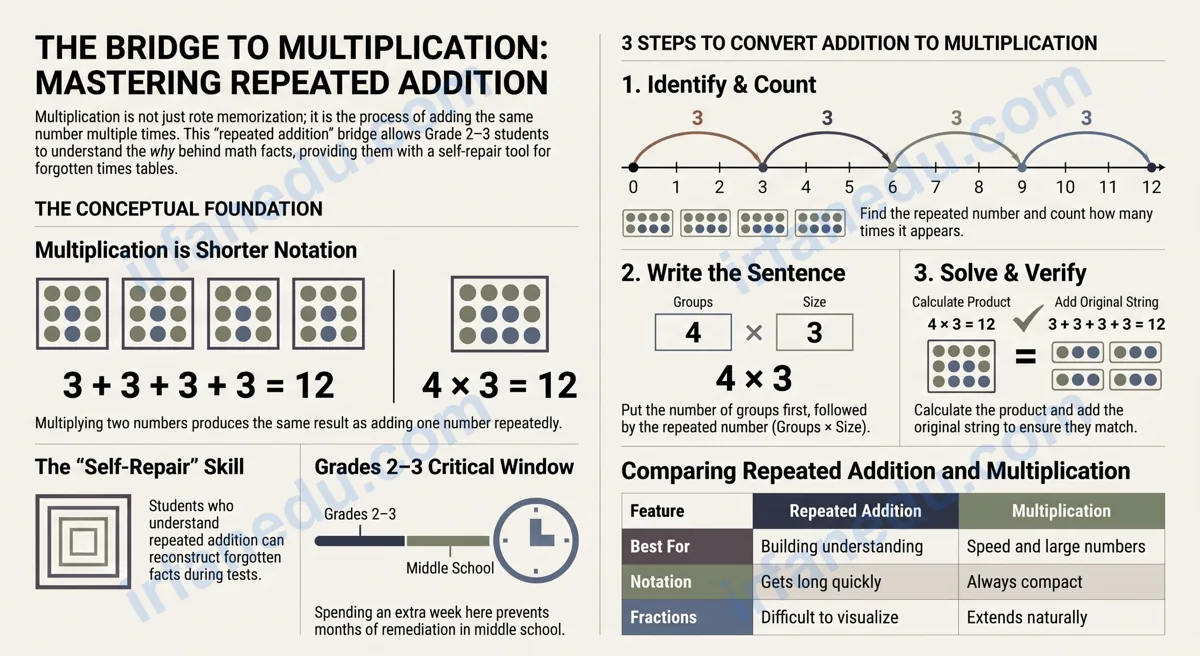
🤔 Quick question: Can you add your way to multiplication? Yes — and that’s exactly the point. Before a child memorizes 3 × 4 = 12, they need to feel why it equals 12. Repeated addition is that bridge.
🤔 Another one: Why do so many students hit a wall with times tables in Grade 3? In my experience teaching elementary math, it’s almost always because they skipped the equal-groups stage and went straight to rote memorization.
🤔 One more: What makes a worksheet actually useful instead of just busywork? A clear lesson first, problems that build in difficulty, and an answer key so students can self-check immediately.
Multiplication as repeated addition is the concept that multiplying two numbers gives the same result as adding one of those numbers repeatedly. For example, 4 × 3 equals 3 + 3 + 3 + 3 = 12. This page gives you a full lesson, worked examples, and a free printable worksheet with answer key for Grades 2–3.
On this page you will:
- ✅ Understand what multiplication as repeated addition really means (and why it matters)
- ✅ Follow a step-by-step method with 2 fully worked examples
- ✅ Spot and fix the most common mistakes students make
- ✅ Practice with 10 on-page problems and check your answers instantly
- ✅ Download a free printable PDF worksheet with a full answer key
⬇ Download Free PDF Worksheet
🎯 The Short Version
- Multiplication is repeated addition — same answer, shorter notation.
- The first factor = number of groups; second factor = size of each group.
- A number line makes equal jumps visual and easy to check.
- Most mistakes happen when students mix up which factor counts groups.
- Practice 10 problems below, then download the printable PDF for offline use.
- Works for Grade 2 (equal groups) and Grade 3 (formal multiplication).
1. What Is Multiplication as Repeated Addition?
Multiplication as repeated addition is the idea that multiplying two whole numbers produces the same result as adding one of those numbers to itself a set number of times. It is the foundational definition of multiplication for whole numbers.
The formal way to say it: a × b = b + b + b + … (a times). The factor a tells you how many groups there are. The factor b tells you how many are in each group.
Here are three quick examples to make it concrete:
- 2 × 6 = 6 + 6 = 12 (2 groups of 6)
- 4 × 3 = 3 + 3 + 3 + 3 = 12 (4 groups of 3)
- 5 × 7 = 7 + 7 + 7 + 7 + 7 = 35 (5 groups of 7)
Notice that 2 × 6 and 4 × 3 both equal 12 — but they represent different physical situations. Two groups of six objects is not the same arrangement as four groups of three, even though the total is the same. This distinction matters when students move into word problems.
2. Why Does This Concept Matter? 🌱
Understanding repeated addition is the single most important step between counting and formal multiplication. Students who skip it tend to treat times tables as a random list of facts to memorize — and when they forget one fact, they have no way to reconstruct it.
Students who understand repeated addition can always rebuild a forgotten fact. If a child blanks on 6 × 7, they can think “six sevens” and add: 7 + 7 = 14, + 7 = 21, + 7 = 28, + 7 = 35, + 7 = 42. That self-repair skill is priceless under test pressure.
According to the Common Core State Standards (3.OA.A.1), Grade 3 students should “interpret products of whole numbers as the total number of objects in groups.” Repeated addition is the direct, concrete way to build that interpretation.
In my 15+ years of teaching math, I have seen the same pattern over and over: students who struggle with fractions and algebra in middle school often have a shaky multiplication foundation. When I trace it back, the gap almost always starts here — at the equal-groups stage. Spending an extra week on repeated addition in Grade 2 saves months of remediation in Grade 6. It is one of the highest-leverage investments a parent or teacher can make.
3. How to Convert Repeated Addition to Multiplication (Step-by-Step) 🔢
Converting a repeated addition sentence to a multiplication sentence takes exactly four steps. Follow them in order every time.
- Step 1 — Identify the repeated number. Look at the addition sentence and find the number that appears over and over. In 8 + 8 + 8 + 8, the repeated number is 8.
- Step 2 — Count the groups. Count how many times that number appears. In 8 + 8 + 8 + 8, it appears 4 times, so there are 4 groups.
- Step 3 — Write the multiplication sentence. Put the number of groups first, then the multiplication sign, then the repeated number: 4 × 8.
- Step 4 — Solve and verify. Calculate the product: 4 × 8 = 32. Then add up the original sentence to confirm: 8 + 8 + 8 + 8 = 32. ✅ They match.
To go the other direction — from multiplication to repeated addition — simply reverse the process: write the second factor as many times as the first factor says, connected by plus signs.
4. Worked Examples 📝
Problem: Write 5 + 5 + 5 as a multiplication sentence and solve.
Step 1: The repeated number is 5.
Step 2: It appears 3 times → 3 groups.
Step 3: Multiplication sentence: 3 × 5.
Step 4: 3 × 5 = 15. Check: 5 + 5 + 5 = 15. ✅
Problem: A shelf holds 6 books. There are 4 shelves. Write a repeated addition sentence and a multiplication sentence to find the total number of books.
Repeated addition: 6 + 6 + 6 + 6 = 24 (add 6 books four times, once per shelf).
Multiplication sentence: 4 × 6 = 24.
Answer: There are 24 books in total.
Note: I deliberately chose a word problem here because real-world context is what cements the concept. Pure number sentences alone are not enough for most learners.
5. Visual: Number Line Diagram 📊
A number line is the clearest visual tool for repeated addition. Each equal jump represents one group. Below is a number line showing 3 × 4 = 12.
  +4        +4        +4
  |-------->|-------->|-------->|
  0    1    2    3    4    5    6    7    8    9   10   11   12

  Jump 1: 0 → 4   (first group of 4)
  Jump 2: 4 → 8   (second group of 4)
  Jump 3: 8 → 12  (third group of 4)

  Repeated addition:  4 + 4 + 4 = 12
  Multiplication:     3 × 4     = 12  ✓
When students draw their own number lines, they physically count the jumps. That counting action is what makes the link between repeated addition and multiplication stick in long-term memory.
6. Repeated Addition vs. Multiplication — Side-by-Side 📋
Both forms express the same mathematical relationship. The table below shows when each form is more useful.
| Feature | Repeated Addition | Multiplication |
|---|---|---|
| Example | 5 + 5 + 5 + 5 = 20 | 4 × 5 = 20 |
| Best for | Building understanding, small numbers | Speed, large numbers, algebra |
| Grade level | Grade 2 (introduced) | Grade 3 (formalized) |
| Notation length | Gets long fast (e.g. 12 × 7 needs 12 terms) | Always compact |
| Conceptual clarity | Very high — you see every group | Requires prior understanding |
| Works with fractions? | Awkward (2.5 + 2.5 + 2.5 is unusual) | Yes — multiplication extends naturally |
The key takeaway: repeated addition is a teaching scaffold, not a permanent tool. Once a student truly understands it, multiplication notation is faster and more powerful — especially when numbers get large.
7. Common Mistakes (And How to Fix Them) ⚠️
Wrong: Writing 3 + 3 + 3 + 3 + 3 as 3 × 5 and saying “3 groups of 5.”
Right: Count the addends first. There are five threes, so it is 5 × 3 — five groups of 3.
Fix: Always circle each addend and count the circles before writing the multiplication sentence.
Wrong: Writing 4 + 3 + 4 + 3 as a single repeated addition sentence.
Right: Repeated addition only works when all the addends are the same. 4 + 3 + 4 + 3 is not a repeated addition sentence — it is an alternating pattern.
Fix: Before converting, check that every number in the addition sentence is identical.
Wrong: Writing the multiplication sentence and stopping without checking.
Right: Always add up the repeated addition and multiply — both answers must match. If they don’t, recount the groups.
The Commutative Property Trap in Repeated Addition
Most worksheets and lesson plans teach students that 3 × 4 and 4 × 3 are interchangeable because multiplication is commutative. That is mathematically true — but it creates a hidden problem at this stage.
When a student writes 3 × 4, the repeated addition is 4 + 4 + 4 (three groups of four). When they write 4 × 3, the repeated addition is 3 + 3 + 3 + 3 (four groups of three). The product is the same (12), but the physical situation is different.
Why does this matter? Word problems. “Three bags with 4 apples each” is 3 × 4 = 4 + 4 + 4. If a student writes 4 × 3 = 3 + 3 + 3 + 3 instead, they get the right number but the wrong model — and in Grade 3 and beyond, the model is what teachers assess.
My recommendation: when practicing repeated addition, always ask students to draw the groups, not just write the numbers. Drawing forces them to choose the correct model, not just the correct product. None of the top-ranking worksheet pages I reviewed make this distinction explicit — they just say “both are correct.” That is a missed teaching opportunity.
8. On-Page Practice Worksheet 📋
How to use this worksheet: Work through the problems in order — they start easy and get harder. Write your answers on paper or in a notebook. When you finish, click “Show Answer Key” to check your work. For offline practice, download the PDF using the button below the problems.
Instructions: Write each repeated addition sentence as a multiplication sentence, then solve. Show your work using a number line or equal groups if it helps.
- 2 + 2 + 2 = ___ , so ___ × 2 = ___
- 5 + 5 = ___ , so ___ × 5 = ___
- 3 + 3 + 3 + 3 = ___ , so ___ × 3 = ___
- 4 + 4 + 4 = ___ , so ___ × 4 = ___
- Write 5 × 3 as a repeated addition sentence, then solve.
- Write 6 × 2 as a repeated addition sentence, then solve.
- A bag holds 4 apples. There are 5 bags. Write a repeated addition sentence AND a multiplication sentence to find the total.
- 7 + 7 + 7 = ___ , so ___ × 7 = ___
- Write 4 × 9 as a repeated addition sentence, then solve.
- There are 6 rows of chairs. Each row has 8 chairs. Write both a repeated addition and a multiplication sentence to find the total number of chairs.
📖 Show Answer Key
- 2 + 2 + 2 = 6 ; 3 × 2 = 6
- 5 + 5 = 10 ; 2 × 5 = 10
- 3 + 3 + 3 + 3 = 12 ; 4 × 3 = 12
- 4 + 4 + 4 = 12 ; 3 × 4 = 12
- 5 × 3 → 3 + 3 + 3 + 3 + 3 = 15
- 6 × 2 → 2 + 2 + 2 + 2 + 2 + 2 = 12
- 4 + 4 + 4 + 4 + 4 = 20 ; 5 × 4 = 20
- 7 + 7 + 7 = 21 ; 3 × 7 = 21
- 4 × 9 → 9 + 9 + 9 + 9 = 36
- 8 + 8 + 8 + 8 + 8 + 8 = 48 ; 6 × 8 = 48
⬇ Download Free PDF Worksheet
🧠 Quick Quiz — Test Yourself!
Select an answer to see if you got it right.