
NCLEX Practice Questions — Set 15
How to use this set
Run it as a timed block rather than dipping in and out. 100 items at roughly a minute each is close to the pace the real exam asks for, and pacing is a skill that only improves under a clock. Answer every item before you open a single rationale — checking as you go turns a test into a reading exercise and hides the questions you were unsure about.
These sets are numbered rather than sorted by subject. The questions come from a general NCLEX bank that carries no topic field, and labelling them by eye would put a share of them under the wrong heading, so they are presented as mixed sets — which is how the exam itself arrives.
The 100 questions
The male nurse who has been told by the female nurse on previous occasions not to talk to her about her body says, "You really look hot in that scrub suit. You have a great-looking body." Which action should the female nurse take next?
Show answer and rationale
Correct answer: B. Notify the clinical manager of the sexual harassment.
If a direct request to the perpetrator does not stop the comments, then an informal complaint may be effective, especially if both parties realize a problem exists. The female nurse should utilize the chain of command and notify the clinical manager.
The client who was admitted to the rehabilitation unit because of a debilitative state asks the nurse, "Why do I have to go to physical therapy every day?" Which statement is the nurse’s best response?
Show answer and rationale
Correct answer: B. "The physical therapist will help you with exercises to improve your muscle strength."
The physical therapist will assist in improving the circulation, strengthening muscles, and ambulating and transferring the client from a bed to a chair. This is the nurse’s best response to explain why the client goes to physical therapy daily.
The client diagnosed with a fractured right ankle needs to be instructed on crutch walking. Which member of the multidisciplinary team should address this problem?
Show answer and rationale
Correct answer: D. The physical therapist.
The physical therapist addresses crutch walking, how to use a walker, gait training, or transferring techniques. This is the most appropriate team member to address the problem.
The client with bilateral amputations tells the nurse, "I was told I can’t go back to my job because they do not have handicap accessible bathrooms or ramps." Which action by the nurse is most helpful to the client?
Show answer and rationale
Correct answer: B. Explain the Americans with Disabilities Act (ADA) to the client.
The ADA was passed in 1990 and ensures that a client with a disability has a right to be employed. Employers must make "reasonable accommodations," such as equipment or access ramps to facilitate employment of a person with a disability.
Which action by the female primary nurse would warrant immediate intervention by the charge nurse on the rehabilitation unit?
Show answer and rationale
Correct answer: A. The primary nurse asks another nurse to administer an injection she prepared.
The primary nurse cannot ask another nurse to administer medication that he or she prepared. The nurse preparing the injection must administer the medication. This action requires the charge nurse to intervene.
The client in a motor vehicle accident (MVA) is in critical condition with a pelvic fracture, flail chest, bilateral arm fractures, and a left hip fracture. The client tells the nurse, "I just want to die. I can’t feed myself or clean myself." Which statement is the nurse’s best response?
Show answer and rationale
Correct answer: A. "I can see you must feel helpless; I am here to listen."
This statement will allow the client to ventilate feelings of helplessness and fear. It is the nurse’s best response.
The nurse on the surgical unit is being sent to the neonatal intensive care unit (NICU) to work because the unit is short staffed. The nurse has never worked in the NICU. Which response by the nurse supports the ethical principle of nonmalfeasance?
Show answer and rationale
Correct answer: B. The nurse requests not to be floated to the NICU.
Nonmalfeasance is the duty to prevent or avoid doing harm. The nurse asking not to be assigned to the NICU because of lack of experience in caring for critically ill infants is supporting the ethical principle of nonmalfeasance.
The client’s husband is frustrated and tells the nurse, "Everyone is telling me something different as to when my wife is going to be able to go home. I don’t know whom to believe." Which statement is the rehabilitation nurse’s best response?
Show answer and rationale
Correct answer: A. "I will contact the case manager and have her talk to you as soon as possible."
According to the NCSBN, case management is content included in the management of care. The case manager is responsible for collaborating with and coordinating the services provided by all members of the healthcare team, including the home healthcare nurse who will be responsible for directing the client’s care after discharge from the rehabilitation unit. This is the nurse’s best response.
The client with an upper extremity amputation tells the nurse, "I do everything with my right hand and now it is gone. I have no idea what I am going to do after I get discharged. How will I support my family? I will need to get a new job." Which statement is the nurse’s best response?
Show answer and rationale
Correct answer: C. "The state rehabilitation commission will help retrain you."
The rehabilitation commission of each state will help evaluate and determine whether the client can receive training or education for another occupation after injury.
The client tells the nurse, "I do not like my doctor and I want another doctor." Which statement is the nurse’s best response?
Show answer and rationale
Correct answer: D. "Can you tell me what you don’t like about your doctor’s care?"
The nurse should determine what is concerning the client. It could be a misunderstanding or a real situation in which the client’s care is unsafe or inadequate.
The nurse and the unlicensed assistive personnel (UAP) are caring for a 74-year-old client who is 3 days postoperative right total hip replacement (THR). Which nursing task should be delegated to the UAP?
Show answer and rationale
Correct answer: B. Place the abductor pillow between the client’s legs.
An abductor pillow is used for a client with a THR to help prevent hip dislocation and the UAP can place the pillow between the client’s legs. This task is appropriate to delegate.
The nurse tells the unlicensed assistive personnel (UAP) to assist the client who is 1day postoperative spinal surgery with a.m. care. Which action by the UAP warrants immediate intervention?
Show answer and rationale
Correct answer: D. The UAP requests the client to turn to the side.
The client with spinal surgery should be logrolled with at least two if not three staff members assisting with the turning from side to side. Logrolling the client ensures proper body alignment. Asking the client to turn would warrant intervention by the nurse.
The overhead page has issued a Code Black, indicating a tornado in the area. Which intervention should the charge nurse implement?
Show answer and rationale
Correct answer: B. Have the clients and visitors remain in the hallway with the doors closed.
The procedure for tornados is to have all clients, staff, and visitors stay in the hallway and close the doors to all the rooms. This will help prevent any flying debris or glass from hurting anyone.
The male client is placed in a double hip spica cast for 3 months. The client’s wife tells the nurse, "My husband said we are supposed to talk to his case manager. What is a case manager?" Which statement is the nurse’s best response?
Show answer and rationale
Correct answer: D. "The case manager is a nurse who will coordinate the rehabilitation team and keep you informed."
The case manager is responsible for coordinating the total rehabilitative plan, collaborating with and coordinating the services provided by all members of the healthcare team, including the home healthcare nurse who will be responsible for directing the client’s care after discharge from the rehabilitation unit.
The 28-year-old male client who sustained traumatic bilateral amputations secondary to a motor vehicle accident (MVA) is being discharged home to live with his wife and 3-year-old son. Which priority psychosocial intervention should the rehabilitation nurse discuss with the client?
Show answer and rationale
Correct answer: B. Ask the client whether he has any sexual concerns he needs to discuss.
The rehabilitation nurse must recognize and address sexual issues in order to promote feelings of self-worth that are essential to total rehabilitation. The age of the client should not matter, but this client is young; therefore, this is priority.
The primary nurse overhears the unlicensed assistive personnel (UAP) telling a family member of a client, "One of the clients will be going to prison because that person was charged with vehicular manslaughter. Two people in the motor vehicle accident died." Which action should the primary nurse implement first?
Show answer and rationale
Correct answer: C. Interrupt the conversation and tell the UAP to go to the nurse’s station.
The nurse should stop the conversation immediately, and asking the UAP to go to the nurse’s station does not embarrass the UAP. Gossiping about another client is a violation of his or her privacy, and a breach of protected health information under HIPAA.
The clinical manager has verbally warned a female staff nurse about being late to work on two previous occasions. The nurse was 35 minutes late for today’s shift. Which action should the charge nurse take?
Show answer and rationale
Correct answer: C. Initiate the hospital policy for unacceptable behavior.
Every hospital has a procedure for termination if the employee is not performing as expected. After two verbal warnings, the clinical manager should document the employee’s actions in writing and implement the hospital policy for possible termination.
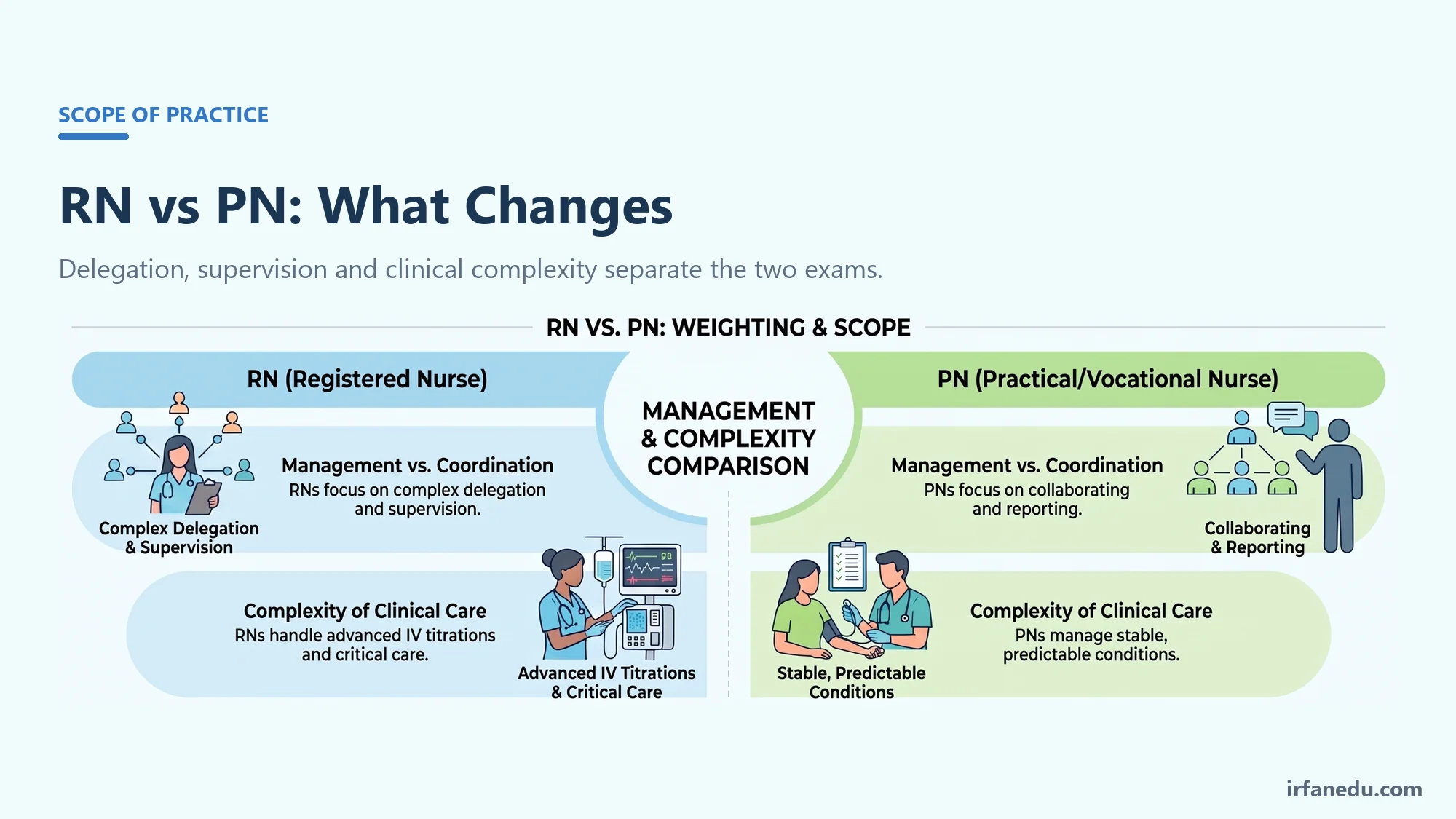
The charge nurse on the rehabilitation unit is making assignments for the day shift. Which assignment would be most appropriate for the licensed practical nurse (LPN)?
Show answer and rationale
Correct answer: C. Have the LPN call the HCP to obtain an order for a diet change.
The LPN’s scope of practice allows the LPN to take telephone orders.
The charge nurse received laboratory data on the following clients. Which client warrants immediate intervention by the charge nurse?
Show answer and rationale
Correct answer: A. The client on antibiotic therapy who has a serum potassium level of 3.3 mEq/L.
Antibiotic therapy can result in a superinfection that destroys the normal bacterial flora of the intestines and produces diarrhea. Diarrhea, in turn, causes an increased excretion of potassium, resulting in hypokalemia. This K+ level is below normal, and the charge nurse should notify the healthcare provider.
The client tells the primary nurse, "I just finished completing my living will and I need you to witness my signature." Which action should the nurse implement?
Show answer and rationale
Correct answer: B. Explain that the nurse cannot witness this document.
This is the correct action to take; the nurse is an employee of the hospital directly involved in providing care and cannot witness documents for clients.
The nurse is preparing to ambulate the client with full-thickness burns on the lower extremities down the hall. Which priority intervention should the nurse implement?
Show answer and rationale
Correct answer: C. Put a gait belt around the client’s waist.
The nurse’s priority is to ensure the safety of the client, and placing a safety gait belt around the client’s waist before ambulating the client helps to ensure safety. The gait belt provides a handle to hold onto the client securely during ambulation.
The client in the rehabilitation unit tells the nurse, "I will not go to physical therapy again because it hurts so much when I do the exercises." Which statement supports the nurse’s role as a client advocate?
Show answer and rationale
Correct answer: A. "Let me check and see if you can receive pain medication before therapy."
Finding ways for the client to perform the exercises by the physical therapist is supporting the medical regimen. This action supports client advocacy. PTs cannot prescribe.
The rehabilitation nurse enters the client’s room and the client is talking on the phone. The client asks the nurse to talk to his wife because she has some questions. Which action should the nurse take?
Show answer and rationale
Correct answer: B. Honor the client’s request and answer any questions the wife has on the phone.
The nurse can talk to anyone the client requests. This is not a violation of HIPAA as long as the client gives permission for the nurse to share information.
Which action by the primary nurse requires immediate intervention by the charge nurse?
Show answer and rationale
Correct answer: B. The nurse leaves the computer screen open at the nurse’s station.
This is a violation of HIPAA. The client’s right to confidentiality is being compromised because anyone could read the client’s record on the computer. The charge nurse should intervene.
The nurse is triaging phone calls in a dermatological clinic. Which client warrants the nurse making an appointment immediately?
Show answer and rationale
Correct answer: A. The client reports redness and itching on the hands.
Allergic contact dermatitis occurs when skin comes in contact with an allergen the client is sensitive or allergic to. Symptoms include redness, swelling, blistering, itching, and weeping. This client has an acute dermatological condition and should be seen immediately.
The client has an area on the skin the dermatologist thinks may be basal cell carcinoma. Which intervention will the nurse implement to confirm the diagnosis?
Show answer and rationale
Correct answer: D. Prepare the client for a biopsy of the abnormal skin growth.
The only way to tell for sure if a skin growth is cancerous is to biopsy it.
The nurse is assisting the client to use a cane when ambulating. Rank in order of performance the interventions the nurse would take.
Show answer and rationale
Correct answer: A. Apply a gait’s belt around the client’s waist.
The gait belt is applied to ensure safety of the patient and the person assisting the client to ambulate.
Which priority intervention should the nurse implement to help prevent pressure ulcers in the client who is on strict bed rest?
Show answer and rationale
Correct answer: D. Turn the client every 2 hours or more often.
The priority intervention to prevent skin impairment is frequent position changes along with skin care and nutritional support.
Which intervention should the nurse implement first for the client with a fractured femur who is suspected of having a fat embolism?
Show answer and rationale
Correct answer: B. Administer oxygen via nasal cannula.
Oxygen must be administered to treat hypoxia, which occurs after a fat embolism; therefore, this is the nurse’s first intervention.
The client with an electrical burn is brought to the emergency department (ED). The entrance wound is on the right hand and the exit wound is on the left foot. Which intervention should the nurse implement first?
Show answer and rationale
Correct answer: D. Place the client on cardiac telemetry.
The electrical current in the body bounces off bone and goes through muscle. The heart is a muscle; therefore, the priority intervention is for the nurse to apply cardiac monitors to assess for lethal dysrythmias that may occur.
The nurse is using an electric patient "Hoyer" lift to transfer the client from the bed to a stretcher. Which priority intervention should the nurse implement?
Show answer and rationale
Correct answer: A. Ensure the client is correctly placed in the lift prior to moving.
This is priority because the safety of the client must be ensured. If the client is not placed correctly in the lift sleeve, the client could fall. Electric lifts are powered either through a standard electrical outlet or by a rechargeable battery. The lifting is completely controlled through a hand control, eliminating any physical exertion by the caregiver.
The nurse is assessing the functional ability of a client using the Katz Index of Activities of Daily Living (ADLs). Which assessment grade would require the nurse to delegate feeding, bathing, and toileting to the unlicensed assistive personnel (UAP)?
Show answer and rationale
Correct answer: B. Katz Index of ADLs grade G.
Grade G indicates the client is dependent in all six functions including bathing, feeding, toileting, continence, dressing, and transferring. This client would require the nurse to delegate activities of daily living to the UAP.
The client has cellulitis on the right lower leg. Which intervention should the nurse implement?
Show answer and rationale
Correct answer: B. Apply warm moist heat to the affected area.
Moist heat, immobilization, elevation, and systemic antibiotics are the treatments for cellulitis, which is an inflammation of subcutaneous tissue.
The unlicensed assistive personnel (UAP) is transferring the client from the bed to the chair. Which interventions should the nurse ensure the UAP implements during this procedure? Rank in order of priority.
Show answer and rationale
Correct answer: C. Lock the wheelchair brakes and secure the chair position.
The brakes should be locked so the chair will not move during the transfer.
The charge nurse on the rehabilitation unit is assigning/delegating tasks to the unlicensed assistive personnel (UAP) and licensed practical nurse (LPN). Which task is most appropriate for the nurse to delegate/assign?
Show answer and rationale
Correct answer: C. Tell the UAP to elevate client’s residual limb above the heart.
The residual limb of an AKA should be elevated after 48 hours to help prevent contractures. Since the client is in the rehabilitation unit, it is past 48 hours.
The client is admitted to the emergency department (ED) with a third-degree burn over the front of both legs. Which priority intervention should the nurse implement?
Show answer and rationale
Correct answer: A. Insert two large-bore intravenous access routes.
The priority intervention in the first 24 hours for the client with a third degree burn is maintaining intravascular volume so the client will not die from hypovolemic shock.
The nurse is discussing alternative medication (CAM) with a client on the rehabilitation unit. Which therapies should the nurse discuss with the client? Select all that apply.
Show answer and rationale
Correct answer: B. Acupuncture.
Acupuncture is traditional Chinese medicine, which involves the use of sharp, thin needles that are inserted in the body at very specific points and is believed to adjust and alter the body’s energy flow into healthier patterns.
The nurse tells the client, "I am going to refer you to the vocational counselor." The client asks the nurse, "Why are you making this referral?" Which statement is the nurse’s best response?
Show answer and rationale
Correct answer: D. "The counselor will assist you with job placement, training, or further education."
This is the reason for referring a client to a vocational counselor.
The nurse is assessing the client’s daily schedule and habits. Which question is most appropriate for the nurse to ask the client?
Show answer and rationale
Correct answer: C. "What time do you prefer bathing and do you take a tub bath or a shower?"
Assessment of daily schedules and habits includes questions concerning hygiene practices, eating, elimination, sexual activity, sleep, work, exercise, and recreational activities.
The home health (HH) nurse has arranged for a home health aide (HHA) to assist a 79-year-old client diagnosed with Alzheimer’s disease. Which interventions should the nurse delegate to the HHA? Select all that apply.
Show answer and rationale
Correct answer: B. Weigh the client once a week and document the weight on the patient record.
The HHA is capable of weighing a client and documenting the finding.
The nurse is at the local mall and a young woman starts having shortness of breath, has hives on her face and arms, and is complaining of itching. Which intervention should the nurse implement first?
Show answer and rationale
Correct answer: B. Ask the woman if she has an EpiPen.
The nurse should determine if the woman has medication available that will save her life. If she doesn’t, the nurse will have to wait for the ambulance.
The home health (HH) nurse is planning to make rounds for the day. List the order the clients should be seen by priority.
Show answer and rationale
Correct answer: C. The 67-year-old client diagnosed with emphysema who called to report that the sputum is a rusty color this morning.
This patient has a change in normal sputum production. Frequently, patients diagnosed with obstructive pulmonary diseases are placed on steroid therapy. Steroid therapy can mask an infection. The only symptom of an infection may be a change in the color of the sputum.
The male client is admitted to the burn unit after a boiling pot of hot water accidentally spilled on his lower legs. The assessment reveals blistered, mottled red skin, and both feet are edematous. Which depth of burn should Mr. George document?
Show answer and rationale
Correct answer: D. Deep partial thickness.
Deep partial-thickness burns are scalds and flash burns that injure the epidermis, upper dermis, and portions of the deeper dermis. This causes pain, blistered and mottled red skin, and edema.
Mr. Rob is caring for a client who experienced a full-thickness burn to 65% of the body 12 hours ago. After establishing a patent airway, which nursing intervention is priority for the client?
Show answer and rationale
Correct answer: C. Replace the client’s fluids and electrolytes.
After airway, the most urgent need is preventing irreversible shock by replacing fluids and electrolytes.
Ms. Glada is developing a nursing care plan for a client who experienced a full-thickness burn and deep partial-thickness burns over half the body 4 days ago. Which client problem should Ms. Glada make priority?
Show answer and rationale
Correct answer: C. Pain.
Pain is the client’s priority problem. The client has a full-thickness burn, which has no pain but the deep partial-thickness burns are very painful.
Which nursing interventions should be included for the client who has full-thickness and deep partial-thickness burns to 50% of the body? Select all that apply.
Show answer and rationale
Correct answer: B. Screen visitors for infections.
The client is at risk for infection and visitors with infections should not be allowed to visit the client.
Administer prophylactic antibiotics as prescribed. 5. Which nursing task should Ms. Kathy, the RN, delegate to a UAP for the client with full-thickness burns over the right leg?
Show answer and rationale
Correct answer: D. Instruct the UAP to take the client’s pulse oximeter reading.
The UAP can put the pulse oximeter on the client’s finger and record the number. Ms. Kathy must evaluate the reading to determine if it is within normal limits.
Mr. Rob is caring for a client with deep partial-thickness and full-thickness burns to the chest area. Which of the following assessment data warrant notifying the healthcare provider?
Show answer and rationale
Correct answer: D. The client’s pulse oximeter reading is 90%.
A pulse oximeter reading greater than 93% is WNL. Therefore, a 90% reading indicates the client is in respiratory distress and requires Mr. Rob to notify the healthcare provider.
Ms. Glada is teaching a group of community members about fire safety. A participant asks, "What should I do if I get hot grease burns on my hand?" Which statement is Ms. Glada’s best response?
Show answer and rationale
Correct answer: C. "Place the hand under cool tap water."
Cool water gives immediate and striking relief from pain and limits local tissue edema and damage.
Ms. Glada is teaching a group of new UAPs about burn care. Which information regarding skin care should Ms. Glada emphasize?
Show answer and rationale
Correct answer: A. Tell the UAPs to turn the client from side to side at least every 2 hours.
Clients should be turned at least every 1 to 2 hours to prevent pressure areas on the skin. Prevention of pressure areas is priority to a client with a burn.
Which action by the UAP warrants intervention by Ms. Glada?
Show answer and rationale
Correct answer: B. The UAP decreases the IV rate of the client whose total parenteral nutrition is almost empty.
The UAP cannot touch TPN; it is administered via a subclavian line and should be considered a medication. The nurse cannot delegate assessment, teaching, evaluation, medications, or an unstable client.
Ms. Glada is caring for clients on the burn unit. After the shift report which client should Ms. Glada assess first?
Show answer and rationale
Correct answer: B. The client with full-thickness burns on the chest who is having difficulty breathing.
When determining which client to see first, Ms. Glada should use Maslow’s Hierarchy of Needs and assess the client with airway problems first.
The client diagnosed with breast cancer who is positive for the BRCA gene is requesting advice from the nurse about treatment options. Which statement is the nurse’s best response?
Show answer and rationale
Correct answer: B. "What treatment options has your healthcare provider (HCP) discussed with you?"
The nurse must assess what information the client actually needs. To do this, the nurse must know what treatment options have been suggested to the client. Assessment is the first step in the nursing process.
The staff nurse answers the telephone on a medical unit and the caller tells the nurse that he has planted a bomb in the facility. Which actions should the nurse implement? Select all that apply.
Show answer and rationale
Correct answer: D. Do not touch any suspicious object.
The nurse should begin a systematic search of the unit after activating the bomb scare emergency plan, and if any suspicious objects are found the nurse should not touch them, and should notify the bomb squad.
The new graduate working on a medical unit night shift is concerned that the charge nurse is drinking alcohol on duty. On more than one occasion, the new graduate has smelled alcohol when the charge nurse returns from a break. Which action should the new graduate nurse implement first?
Show answer and rationale
Correct answer: C. Talk with the night supervisor about the concerns.
The night supervisor or the unit manager has the authority to require the charge nurse to submit to drug screening. In this case, the supervisor on duty should handle the situation.
The nurse is completing a head-to-toe assessment on a client diagnosed with breast cancer and notes a systolic murmur that the nurse was not informed of during report. Which action should the nurse implement first?
Show answer and rationale
Correct answer: C. Check the chart to determine whether this is the first time a murmur has been identified.
Although the client was not admitted for a cardiac problem, she may have had a murmur for a while, and the previous nurse did not pick it up or did not mention it in the report because it was a long-standing physiological finding in this client. The nurse should research the chart for a current history and physical to determine whether the HCP is aware of the condition.
The client diagnosed with lung cancer has a hemoglobin and hematocrit (H&H) of 13.4 mg/dL and 40.1, a WBC count of 7800, and a neutrophil count of 62%. Which action should the nurse implement?
Show answer and rationale
Correct answer: A. Continue to monitor the client.
This client’s lab work is within normal limits. The nurse should continue to monitor the client.
The charge nurse observes two unlicensed assistive personnel (UAPs) arguing in the hallway. Which action should the nurse implement first in this situation?
Show answer and rationale
Correct answer: A. Instruct the UAPs to stop arguing in the hallway.
The first action is to stop the argument from occurring in a public place. The charge nurse should not discuss the UAPs’ behavior in public.
The graduate nurse is working with an unlicensed assistive personnel (UAP) who has been an employee of the hospital for 12 years. However, tasks delegated to the UAP by the graduate nurse are frequently not completed. Which action should the graduate nurse take first?
Show answer and rationale
Correct answer: C. Address the UAP to discuss why the tasks are not being done as requested.
The graduate nurse must discuss the insubordination directly with the UAP first. The nurse must give objective data as to when and where the UAP did not follow through with the completion of assigned tasks.
The client is diagnosed with laryngeal cancer and is scheduled for a laryngectomy next week. Which intervention would be priority for the clinic nurse?
Show answer and rationale
Correct answer: C. Refer the client to a speech therapist.
The client will not be able to speak after the removal of the larynx; therefore, referral to a speech therapist who will be able to discuss an alternate means of communication is priority.
The charge nurse is making assignments for the surgical unit. Which client should be assigned to the new graduate nurse?
Show answer and rationale
Correct answer: A. The 42-year-old client who has just returned to the unit after a breast biopsy.
Of the four clients, the one who is most stable is the client who has just undergone a breast biopsy; therefore, this client would be the most appropriate to assign to a new graduate nurse.
Which task is most appropriate for the surgical nurse to assign to the licensed practical nurse (LPN)?
Show answer and rationale
Correct answer: B. Tell the LPN to administer the aminoglycoside antibiotic to the client.
The LPN can administer intravenous antibiotic medication according to the LPN scope of practice.
The primary nurse informs the shift manager that one of the unlicensed assistive personnel (UAPs) is falsifying vital signs. Which action should the shift manager implement first?
Show answer and rationale
Correct answer: C. Take the assigned client’s vital signs and compare them with the UAP’s results.
The shift manager should have objective data about the allegation of falsifying vital signs prior to confronting the UAP; therefore, the shift manager should take the client’s vital signs and compare them with the UAP’s results before taking any other action.
The client tells the nurse, "I am not sure my surgeon is telling me the truth about my prognosis." The nurse knows the client has terminal cancer but the healthcare provider is not telling the client per the family’s request. Which statement is the nurse’s best response?
Show answer and rationale
Correct answer: A. "I think you should talk to your surgeon about your concerns."
Since the nurse knows the client is terminal, it would be best for the nurse to encourage the client to talk to the surgeon. The client needs the truth and the surgeon is the person who should tell it to the client.
The nurse hung the wrong intravenous antibiotic for the postoperative client. Which intervention should the nurse implement first?
Show answer and rationale
Correct answer: C. Assess the client for any adverse reactions.
The nurse should first assess the client prior to taking any other action to determine if the client is experiencing any untoward reaction.
The 24-year-old male client diagnosed with testicular cancer is scheduled for a unilateral orchiectomy. Which priority intervention should the clinic nurse implement?
Show answer and rationale
Correct answer: C. Discuss the importance of sperm banking.
Sperm banking will allow the client’s sperm to be kept until the time the client wants to conceive a child. This is priority because it must be done between the clinic visit and admission to the hospital for the procedure. The unilateral orchiectomy will not result in sterility, but the subsequent treatments may cause sterility.
The female client in the preoperative holding area tells the nurse that she had a reaction to a latex diaphragm. Which intervention should the nurse perform first?
Show answer and rationale
Correct answer: A. Notify the operating room personnel.
Because the client is in the preoperative holding area, the immediate safety need for the client is to inform the operating room personnel so that no latex gloves or equipment will come into contact with the client. Person-to-person communication for a safety issue ensures that the information is not overlooked.
The nurse, a licensed practical nurse (LPN), and the unlicensed assistive personnel (UAP) are caring for clients in a critical care unit. Which task would be most appropriate for the nurse to assign/delegate?
Show answer and rationale
Correct answer: A. Tell the UAP to obtain urine output for the 12-hour shift.
The UAP can add up the urine output for the 12-hour shift; however, the nurse is responsible for evaluating whether the urine output is what is expected for the client.
Which task should the critical care nurse delegate to the unlicensed assistive personnel (UAP)?
Show answer and rationale
Correct answer: B. Take the client’s sterile urine specimen to the laboratory.
The UAP can take specimens to the laboratory; it is not medications and not vital to the client.
The critical care charge nurse is making client assignments. Which client should the charge nurse assign to the nurse who is pregnant?
Show answer and rationale
Correct answer: A. The client who is HIV positive and admitted for chest pain R/O myocardial infarction.
The pregnant nurse can be assigned to a client who is HIV positive. The nurse must adhere to Standard Precautions.
The intensive care nurse is caring for a client and notes blood oozing out from under the Tegaderm dressing over the peripheral intravenous site, bleeding gums, and blood in the indwelling urinary catheter bag. Which intervention should the nurse implement first?
Show answer and rationale
Correct answer: C. Notify the client’s healthcare provider.
The client is exhibiting signs of DIC, which requires intravenous therapy. This is a life-threatening complication that requires immediate medical intervention, so the nurse must notify the HCP first.
A client diagnosed with AIDS dementia is angry and yells at everyone entering the room. None of the critical care staff want to be assigned to this client. Which intervention would be most appropriate for the nurse manager to use in resolving this situation?
Show answer and rationale
Correct answer: D. Discuss some possible options with the nursing staff.
This would be the most appropriate intervention because it allows the staff to have input into resolving the problem. When staff have input into resolving the situation, then there is ownership of the problem.
Which situation would prompt the healthcare team to utilize the client’s advance directive when needing to make decisions for the client?
Show answer and rationale
Correct answer: D. The client with a head injury who is exhibiting decerebrate posturing.
The client must have lost decision-making capacity because of a condition that is not reversible, or must be in a condition that is specified under state law, such as a terminal, persistent vegetative state, irreversible coma, or as specified in the advance directive. A client who is exhibiting decerebrate posturing is unconscious and unable to make decisions.
Which staff nurse should the charge nurse in the intensive care unit (ICU) send to the medical unit?
Show answer and rationale
Correct answer: B. The nurse who has worked in the unit for 18 months.
This nurse should be sent to the medical unit because, with 18 months’ experience, the nurse is familiar with the hospital routine and would be helpful to the medical unit but is not the most experienced ICU nurse on duty.
The confused client in the critical care unit is attempting to pull out the IV line and the indwelling urinary catheter. Which action should the nurse implement first?
Show answer and rationale
Correct answer: B. Request the UAP to stay with the client.
The nurse should first ensure the client’s safety by having someone stay at the bedside with the client, and then call the HCP, and finally apply mitt restraints.
The nurse notes the unlicensed assistive personnel (UAP) tied a sheet around the client in the chair so the client will not fall out. Which action should the nurse implement first?
Show answer and rationale
Correct answer: C. Remove the sheet from the client immediately.
The nurse must remove the sheet since it is a restraint. There must be an HCP’s order prior to restraining a client.
The charge nurse in the long-term care center is making assignments for licensed practical nurses (LPNs) and unlicensed assistive personnel (UAPs) on the day shift. Which task is most appropriate to assign to the LPN?
Show answer and rationale
Correct answer: B. Tell the LPN to administer the tube feeding to the client.
The LPN should administer a tube feeding, not the UAP.
The nurse is caring for clients on a skilled nursing unit. Which task should not be delegated to the unlicensed nursing personnel (UAP)?
Show answer and rationale
Correct answer: B. Request the UAP to prepare the client for a wound debridement at the bedside.
The client will need to be pre-medicated for a wound debridement; therefore, this task cannot be delegated to the UAP.
The older adult client receiving chemotherapy complains that food just does not taste like it used to. Which intervention should the medical unit nurse implement first?
Show answer and rationale
Correct answer: C. Check the client’s current weight with the client’s usual weight.
Checking the client’s weight change over a period of time is the first step in assessing the client’s nutritional status and the impact of the taste changes on the client.
The nurse is assigned to a quality improvement committee to decide on a quality improvement project for the unit. Which issue should the nurse discuss at the committee meetings?
Show answer and rationale
Correct answer: A. Systems that make it difficult for the nurses to do their job.
A quality improvement project looks at the way tasks are performed and attempts to see whether the system can be improved. A medication delivery system in which it takes a long time for the nurse to receive a STAT or "now" medication is an example of a system that needs improvement and should be addressed by a quality improvement committee.
The female nurse is discussing an upcoming surgical procedure with a 76-year-old male client diagnosed with cancer. Which action is an example of the ethical principle of fidelity?
Show answer and rationale
Correct answer: B. The nurse refuses to disclose the client’s personal information to the CNO.
This is an example of fidelity. Fidelity is the duty to be faithful to commitments and involves keeping information confidential and maintaining privacy and trust.
Which client laboratory data should the nurse report to the HCP immediately?
Show answer and rationale
Correct answer: A. The urinalysis report showing many bacteria in a client receiving chemotherapy.
The urinalysis report showing many bacteria is indicative of an infection. Clients receiving chemotherapy are at high risk of developing an infection. The nurse should notify the HCP immediately.
The charge nurse in a long-term care facility is reviewing the male resident’s laboratory data and notes the following: H&H, 13/39; WBC count, 5.25 (103); and platelets, 39 (103). Which instructions should the nurse give to the unlicensed assistive personnel (UAP) caring for the client?
Show answer and rationale
Correct answer: D. Do not shave the resident with a safety razor.
The resident’s platelet count is very low and could cause the resident to bleed. The nurse should initiate bleeding precautions that include not using sharp blades to shave the resident and using soft-bristle toothbrushes.
The clinic RN manager is discussing osteoporosis with the clinic staff. Which activity is an example of a secondary nursing intervention when discussing osteoporosis?
Show answer and rationale
Correct answer: D. Obtain a bone density evaluation test on a female client older than 50.
A secondary nursing intervention includes screening for early detection. The bone density evaluation will determine the density of the bone and is diagnostic for osteoporosis.
A client had an allergic reaction to penicillin, an antibiotic, and was admitted to the hospital 2 weeks ago. The client is being seen at the clinic for a follow-up visit. Which priority intervention should the nurse implement?
Show answer and rationale
Correct answer: B. Recommend the client wear a medical alert bracelet.
This is the nurse’s priority intervention because any emergency personnel who may come into contact with the client should be aware of the client’s allergy. A penicillin allergy can kill the client.
Which action would be most appropriate for the clinic nurse who suspects another staff nurse of stealing narcotics from the clinic?
Show answer and rationale
Correct answer: A. Notify the director of nurses immediately.
The clinic nurse should report the suspicions so that appropriate actions can be taken, such as a urine drug screen for the nurse, watching the nurse for the behavior, and possibly notifying the police department.
The clinic nurse administered 200,000 units of intramuscular penicillin to a client. Which priority intervention should the nurse implement?
Show answer and rationale
Correct answer: A. Inform the client to stay in the waiting room for 30 minutes.
The client is at risk for having an allergic reaction to the penicillin, which is a lifethreatening complication. Therefore, the client must stay in the waiting room for at least 30 minutes so the nurse can determine whether an allergic reaction is occurring.
The female home health (HH) aide calls the office and reports pain after feeling a pulling sensation in her back when she was transferring the client from the bed to the wheelchair. Which priority action should the HH nurse tell the HH aide?
Show answer and rationale
Correct answer: A. Recommend that she apply an ice pack to the back.
The HH aide is in pain, and applying ice to the back will help decrease pain and inflammation. The HH nurse should be concerned about a co-worker’s pain. Remember: Ice for acute pain and heat for chronic pain.
The female client with osteoarthritis is 6 weeks postoperative for open reduction and internal fixation of the right hip. The home health (HH) aide tells the HH nurse the client will not get in the shower in the morning because she "hurts all over." Which action would be most appropriate by the HH nurse?
Show answer and rationale
Correct answer: A. Explain to the HH aide that the client should get up and take a warm shower.
Movement and warm or hot water will help decrease the pain; the worst thing the client can do is not to move. The HH aide should encourage the client to get up and take a warm shower or bath.
The home health (HH) nurse is discussing the care of a client with an HH aide. Which task can the HH nurse delegate to the HH aide?
Show answer and rationale
Correct answer: A. Instruct the HH aide to assist the client with a shower.
The HH aide’s responsibility is to care for the client’s personal needs, which include assisting with a.m. care.
The home health (HH) care agency director is teaching a class to the HH aides concerning safety in HH nursing. Which statement by the HH aide indicates the director needs to re-teach safety information?
Show answer and rationale
Correct answer: D. "It is all right if I don’t wear gloves when touching bodily fluids."
Standard precautions apply in the home as in the hospital. If the HH aide has the potential to touch the client’s bodily fluids, then the aide should wear gloves and wash his or her hands. The statement indicates the HH aide needs re-teaching.
The home healthcare (HH) agency director is making assignments. Which client should be assigned to the most experienced HH nurse?
Show answer and rationale
Correct answer: A. The client who has multiple Stage 3 and 4 pressure ulcers on the sacral area.
The client with pressure ulcers requires meticulous nursing care and a nurse who has experience with wounds. The most experienced nurse should be assigned this client.
The home health (HH) nurse is visiting a female client diagnosed with colon cancer who has had a sigmoid colostomy. The client is crying and tells the nurse that she was told the cancer has spread and she will die very soon. Which intervention should the nurse implement?
Show answer and rationale
Correct answer: A. Discuss the possibility of being placed on hospice services.
Hospice is a service for clients who have less than 6 months to live. If the client has been told she will die "very soon," then this is probably less than 6 months. If the client does not die within the 6 months, she will not automatically be discharged from hospice. Each client is assessed individually for the need to remain in hospice care. If the client does not want any heroic measures and wants to die at home, then hospice will provide these services. This intervention would be appropriate for the HH nurse.
The client tells the home health (HH) nurse, "My oncologist told me they can’t do anything else for my cancer. I do not want my children to know, but I had to tell someone. You won’t tell them, will you?" Which statement is the nurse’s best response?
Show answer and rationale
Correct answer: A. "I will not say anything to your children, but I will contact the HH doctor."
The nurse not telling the children respects the client’s wishes and confidentiality but the healthcare providers should be told of new client circumstances, as the information applies to the client’s care.
The home health (HH) hospice nurse is making rounds. Which client should the nurse assess first?
Show answer and rationale
Correct answer: C. The client with end-stage heart failure who has increasing difficulty breathing.
This client may need oxygen or an intervention to keep the client comfortable. This client should be seen first.
A client diagnosed with cancer and receiving chemotherapy is brought to the emergency department (ED) after vomiting bright red blood. Which intervention should the nurse implement first?
Show answer and rationale
Correct answer: C. Start an IV of normal saline with an 18-gauge intravenous catheter.
The client is at risk for shock. The nurse should take steps to prevent vascular collapse. Starting the IV is the priority.
The nurse is called to the room of a male client diagnosed with lung cancer by the client’s wife because the client is not breathing. The client has discussed having a DNR order written but has not made a decision. Which interventions should the nurse implement first?
Show answer and rationale
Correct answer: A. Assess the client’s breathing and call a code from the room.
These are the first steps of a code.
The female client who is dying asks to see her son, but the son refuses to come to the hospital. Which action should the nurse implement first?
Show answer and rationale
Correct answer: A. Check with the family to see whether they can discuss the issue with the son.
Other family members are more likely to understand the family dynamics and would be the best ones to intervene in the situation.
The nurse is caring for clients on an oncology unit. Which client should the nurse assess first?
Show answer and rationale
Correct answer: D. The client who has undergone four rounds of chemotherapy and is nauseated.
This client is complaining of nausea, which is an uncomfortable experience. The nurse should attempt to intervene and treat the nausea. This client should be seen first.
The nurse caring for clients on an oncology unit is administering medications. Which medication should the nurse administer first?
Show answer and rationale
Correct answer: C. The antinausea medication to the male client who thinks he may get sick.
Anticipatory nausea is a very real problem for clients diagnosed with cancer and undergoing treatment. If this problem is not rectified quickly and progresses to vomiting, the client may not get relief. This medication should be administered first.
What to do with your score
Score the set, then spend longer on the review than you did on the questions. For every item you missed, decide which of three things went wrong: you did not know the fact, you misread what the item was asking, or you knew the fact and still chose second-best. Those need three different fixes — content review, slower reading, and priority-framework practice — and lumping them together is why question banks stop working for people.
Read the rationale on the items you got right as well. Arriving at the correct option for the wrong reason is common, and it does not survive a harder version of the same question.
More NCLEX practice and review
Everything on this site tagged NCLEX lives in the NCLEX category.
Sources