
NCLEX Management of Care
On this page
Where this fits in the test plan
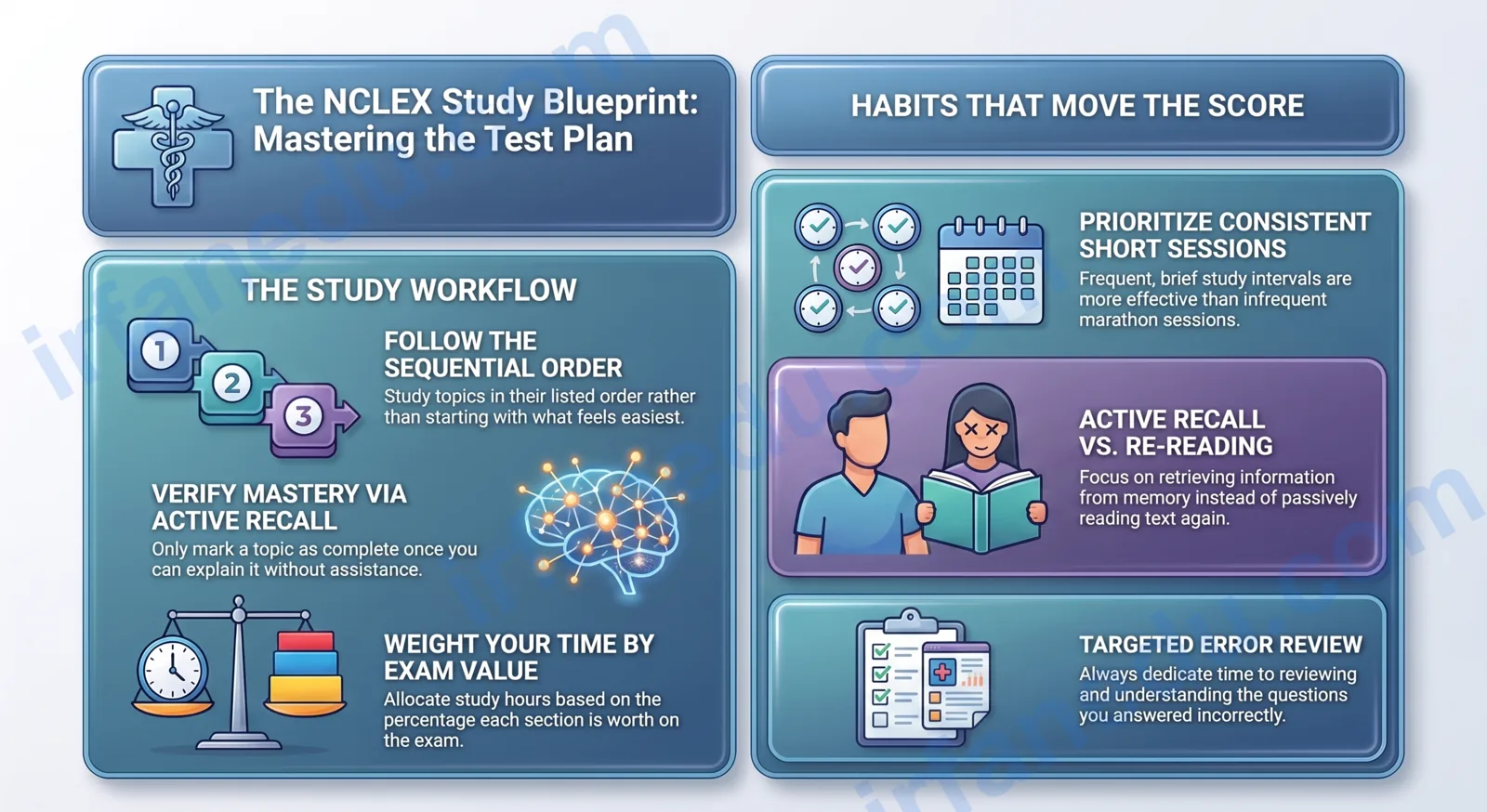
Management of Care is about 20% of the items you will see. That percentage is worth taking literally when you plan revision time: a category at 20% deserves roughly 20% of your question practice, not equal time with everything else.
| Topic | Focus | Study time |
|---|---|---|
| Delegation and Supervision high yield | Who can do what, and what stays with you | 14 min |
| Prioritisation of Care high yield | Deciding who and what comes first | 16 min |
| Legal and Ethical Practice | Confidentiality, reporting, and professional boundaries | 13 min |
| Advocacy and Informed Consent | Whose signature, whose explanation | 11 min |
| Case Management and Continuity | Referrals, handoff, and discharge planning | 11 min |
| Quality Improvement and Performance | Reporting, near misses, and systems thinking | 9 min |
Delegation and Supervision
Who can do what, and what stays with you
Delegation questions are the single most common Management of Care item type. They rarely test whether you know a task; they test whether you know who is legally and safely allowed to perform it. The registered nurse always retains accountability for the outcome, even when the task itself is handed off.
Subtopics: Scope of practice · Five rights of delegation · Assignment vs delegation · Supervising unlicensed personnel
The five rights of delegation
Right task, right circumstance, right person, right direction and communication, right supervision and evaluation. If any one of these fails, the delegation is unsafe regardless of how routine the task is.
Assignment is not delegation
Assignment moves work that already sits inside someone’s scope of practice. Delegation transfers a task that belongs to the nurse to someone whose scope does not normally include it. Only the second requires the five rights analysis.
Stability is the deciding variable
The same task can be delegated for one client and not another. Vital signs on a stable post-operative client can go to assistive personnel; vital signs on a client receiving a first dose of IV antibiotics cannot.
Accountability never transfers
The nurse who delegates remains responsible for supervising the task and evaluating the outcome. ‘The aide did it’ is never a defence.
High-yield points
- Never delegate assessment, evaluation, teaching, care planning, or anything requiring nursing judgement.
- Assistive personnel: bathing, feeding a client with no swallowing risk, positioning, ambulating, routine vital signs, intake and output, specimen collection.
- Licensed practical or vocational nurse: stable clients with predictable outcomes, routine medications within scope, dressing changes, tracheostomy care, reinforcing teaching the RN has already given.
- Registered nurse only: initial assessment, unstable clients, blood product administration, IV push in most facilities, care plan development, discharge teaching.
- A client who is newly admitted, newly post-operative, or newly unstable is always an RN client.
- If an option has assistive personnel performing an assessment or teaching, it is wrong.
- When the answer choices list clients, assign the most stable and predictable client to the least qualified staff member.
Prioritisation of Care
Deciding who and what comes first
Prioritisation items give you several clients or several tasks and ask which comes first. The trick is to apply the frameworks in a fixed order rather than reasoning from scratch each time: airway, breathing and circulation first; then Maslow; then acute over chronic and unexpected over expected; then the nursing process.
Subtopics: ABC framework · Maslow hierarchy · Acute vs chronic · Nursing process order · Time management
ABC, then Maslow
Airway beats breathing beats circulation. When all options are physiological, drop to Maslow: physiological need, then safety, then belonging, esteem and self-actualisation.
Unexpected beats expected
A finding consistent with the client’s diagnosis can usually wait. A finding that does not fit the picture is the one to investigate. New confusion in a previously alert client outranks chronic pain in a client with arthritis.
Actual beats potential
A problem that is already happening outranks a risk. Active bleeding outranks a risk for bleeding.
Assessment before intervention
Unless the client is in immediate danger, gather data before acting. The exceptions are obstructed airway, cardiac arrest and uncontrolled haemorrhage.
High-yield points
- Ask yourself: which client could deteriorate in the next few minutes if I do nothing?
- A silent chest in an asthmatic is more dangerous than loud wheezing.
- Sudden onset of anything – pain, dyspnoea, confusion, numbness – moves that client to the front.
- Post-operative clients with a change in level of consciousness, oxygen saturation or bleeding come first.
- A client with an abnormal value that is expected for their condition can generally wait behind a client whose values are trending the wrong way.
- When the stem asks what to do first and one option is ‘assess’, check whether the client is in immediate danger before choosing it.
- Time management: do the assessments that drive the rest of the shift first, then medications, then documentation.
Legal and Ethical Practice
Confidentiality, reporting, and professional boundaries
Legal items reward the answer that protects the client and follows the chain of accountability. Ethical items reward the answer that respects autonomy without abandoning safety. The nurse never withholds information the client is entitled to, and never shares information the client has not authorised.
Subtopics: Confidentiality · Mandatory reporting · Incident reports · Malpractice elements · Ethical principles
Confidentiality has narrow exceptions
Information is shared only with those directly involved in the client’s care, or where the law requires reporting: communicable disease, suspected abuse or neglect, gunshot and stab wounds, and a credible threat to an identified person.
The four elements of malpractice
Duty, breach of duty, causation and damages. All four must be present. A breach that causes no harm is not malpractice, though it may still be a disciplinary matter.
Incident reports are internal
An incident report documents facts for quality improvement. It is never referenced in the client record, and the record itself contains only the objective clinical facts and the client’s response.
Ethical principles
Autonomy is the client’s right to choose. Beneficence is doing good, non-maleficence is avoiding harm, justice is fair distribution, veracity is truthfulness and fidelity is keeping commitments.
High-yield points
- A competent adult may refuse any treatment, including one that will save their life.
- Do not chart ‘incident report completed’ in the client record.
- Never look up the record of a client you are not caring for, including your own family.
- Suspected child, older adult or vulnerable adult abuse is reported on suspicion, not on proof.
- The nurse who witnesses a colleague diverting medication reports it through the chain of command immediately.
- Assault is the threat, battery is the unconsented touch. Restraining a competent refusing adult is battery.
- Advance directives and durable power of attorney for health care take effect only when the client can no longer decide.
Advocacy and Informed Consent
Whose signature, whose explanation
The recurring exam point is that the person performing the procedure obtains the consent. The nurse witnesses the signature, confirms the client understands, and stops the process if they do not.
Subtopics: Elements of informed consent · Nurse role in consent · Minors and emancipation · Client advocacy
Three elements of valid consent
The client must be given adequate information, must be competent to decide, and must consent voluntarily without coercion. Missing any one invalidates the consent.
The nurse witnesses, the provider explains
If the client cannot describe the procedure, its risks or its alternatives, the nurse stops and contacts the provider rather than explaining it themselves.
Advocacy means amplifying the client
Advocating is not deciding for the client. It is making sure their stated wishes reach the team and are acted on.
Consent for minors
A parent or guardian consents for a minor, with exceptions for emancipated minors and, in many jurisdictions, for care relating to pregnancy, sexually transmitted infection and substance use.
High-yield points
- If the client says ‘I am not really sure what they are doing’, the correct action is to notify the provider, not to explain.
- A pre-medicated client cannot give consent. Obtain it before sedation.
- In a life-threatening emergency where the client cannot consent and no surrogate is available, implied consent applies.
- A client may withdraw consent at any time, including after signing and after arriving in the procedure room.
- An interpreter must be a trained medical interpreter, not a family member, for consent.
- The nurse’s signature attests to the identity of the signer and the voluntariness of the signature.
Case Management and Continuity
Referrals, handoff, and discharge planning
Continuity items test whether you know which discipline solves which problem and whether discharge planning began early enough. Discharge planning starts at admission, not on the day of discharge.
Subtopics: Discharge planning · Referral · Handoff communication · Interdisciplinary team
Match the problem to the discipline
Financial and community resources go to the social worker. Swallowing and communication go to speech therapy. Mobility and transfers go to physical therapy. Activities of daily living and adaptive equipment go to occupational therapy. Nutrition goes to the dietitian.
Structured handoff
A situation, background, assessment and recommendation format keeps handoff complete. Handoff happens face to face where possible and allows questions.
Discharge readiness
The client must be able to describe their medications, warning signs to report, follow-up plans and any new self-care skill. Teach-back is the check.
High-yield points
- Discharge planning begins on the day of admission.
- A client living alone who cannot climb stairs needs a home safety and physical therapy referral before discharge, not after.
- New oxygen at home requires teaching about no smoking, no open flame and how to order refills.
- If the client cannot afford the prescription, the referral is to social work or case management.
- During handoff, report what changed on your shift and what needs watching, not the entire history.
Quality Improvement and Performance
Reporting, near misses, and systems thinking
Quality items reward the systems answer over the blame answer. The nurse reports the event, participates in the analysis, and looks for the process failure rather than the individual failure.
Subtopics: Sentinel events · Root cause analysis · Near miss reporting · Chain of command
Sentinel event
An unexpected occurrence involving death or serious physical or psychological injury, or the risk of one. It triggers a root cause analysis.
Near miss still gets reported
An error caught before it reached the client is exactly the event that reveals a fixable system flaw.
Chain of command
When a concern is not resolved, escalate: charge nurse, then nurse manager, then supervisor, then the provider’s supervising physician. Do not skip steps unless the client is in immediate danger.
High-yield points
- Report a near miss even when no harm occurred.
- When a provider’s order seems unsafe, clarify with the provider first; escalate only if the concern stands.
- Never carry out an order you believe is unsafe simply because it was written.
- Root cause analysis asks why the system allowed the error, not who made it.
More NCLEX practice and review
Everything on this site tagged NCLEX lives in the NCLEX category.