How Dubai’s Water Battery Works: The Physics of Pumped-Storage Hydroelectric Power
Discover how gravity, potential energy, fluid mechanics, turbines and electrical generators help Dubai store renewable energy using water.
Project figures are based on DEWA’s published specifications and may be updated by the authority.
1. Introduction: Can Water Work Like a Battery?
Electricity from solar panels is not always available when demand is highest. Solar power production decreases after sunset, while electricity consumption can remain high. One solution is to store energy when it is available and release it when required.
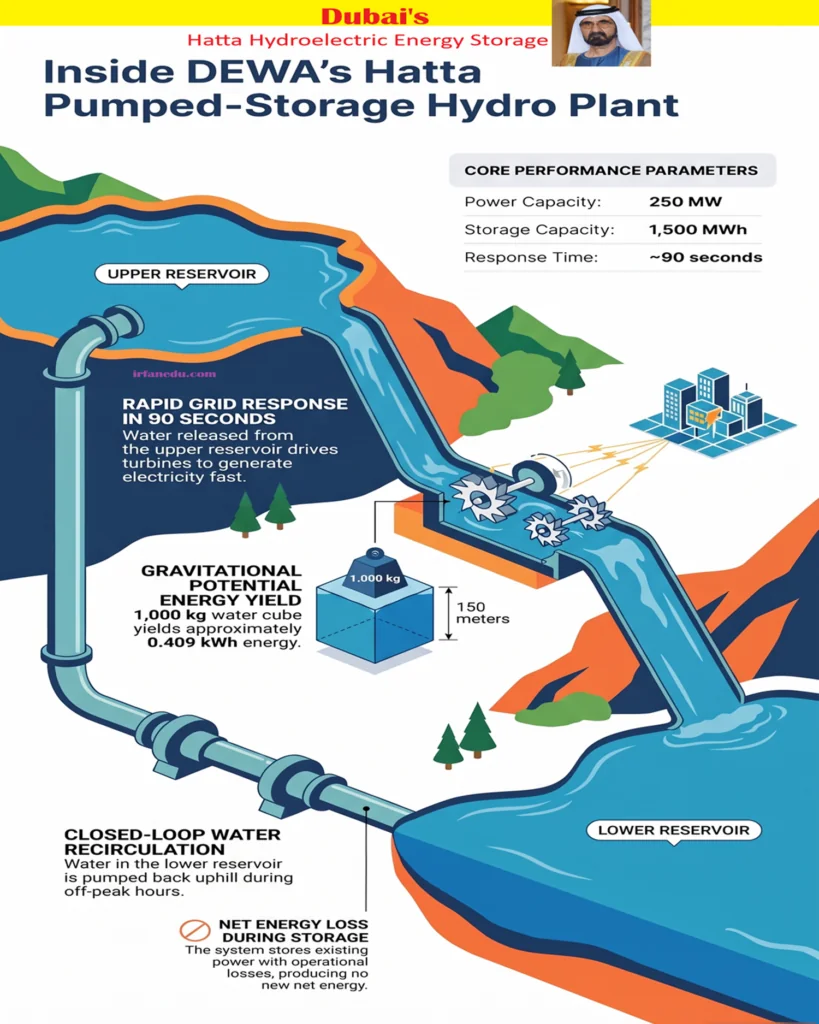
Dubai’s pumped-storage hydroelectric power plant in Hatta uses two reservoirs at different elevations to achieve this. Developed by the Dubai Electricity and Water Authority (DEWA), the project is designed for a power output of 250 megawatts (MW), an energy storage capacity of 1,500 megawatt-hours (MWh), and a round-trip efficiency of 78.9%.
This technology is often called a water battery. Unlike a conventional chemical battery, it stores energy primarily as gravitational potential energy rather than through electrochemical reactions.
Official reference: DEWA — Hatta Hydroelectric Power Plant.
2. What Is Pumped-Storage Hydroelectric Power?
Pumped-storage hydroelectricity is a large-scale energy storage technology. It uses two reservoirs located at different heights, a pumping and turbine system, and an electrical generator.
The upper reservoir stores water at a higher gravitational potential energy. When electricity is needed, water flows down towards the lower reservoir, passes through a turbine, and drives a generator.
When surplus electricity is available, the system pumps water back to the upper reservoir, storing energy for later use.
- Upper reservoir: Stores water at a higher elevation.
- Lower reservoir: Receives water during generation and supplies water during pumping.
- Water tunnel or penstock: Carries water between the reservoirs and the powerhouse.
- Turbine: Converts hydraulic energy into rotational mechanical energy.
- Generator: Converts mechanical energy into electrical energy.
- Motor-pump system: Uses electricity to return water to the upper reservoir.
3. How Does Dubai’s Hatta Water Battery Work?
Step 1: Energy Storage Mode
When electricity is available in excess, power from the grid, including solar-generated electricity, can operate the pumping system. Water is pumped from the lower reservoir to the upper reservoir.
As the water moves uphill, electrical energy is converted into gravitational potential energy. This energy remains stored while the water stays at the higher elevation.
Step 2: Energy Generation Mode
When electricity demand increases, water from the upper reservoir is released through an underground water passage. The flowing water drives a turbine connected to an electrical generator.
The generator supplies electricity to the grid. DEWA specifies that the Hatta plant is designed to respond to electricity demand within approximately 90 seconds.
Step 3: Repeating the Cycle
After generation, the water reaches the lower reservoir. It can be pumped uphill again when suitable electricity is available. This cycle allows the same water to be used repeatedly, subject to water losses and operational requirements.
Read the DEWA project update, February 2025.
4. Physics Concept 1: Gravitational Potential Energy
The most important Physics principle behind pumped-storage hydropower is gravitational potential energy.
For water at a height h above a reference level, the gravitational potential energy is approximately:
Where:
- E: Gravitational potential energy, in joules (J).
- m: Mass of water, in kilograms (kg).
- g: Acceleration due to gravity, approximately 9.81 m/s².
- h: Vertical height difference, in metres (m).
The greater the mass of water and the height difference between reservoirs, the greater the potential energy that can be stored.
Worked Example
Suppose 1,000 kg of water is raised through a vertical height of 150 m. Its ideal gravitational potential energy is:
Therefore, E ≈ 1.472 MJ. Since 1 kWh = 3.6 MJ:
This is the ideal stored energy before accounting for losses. The 150 m height is an illustrative calculation, not a claim that every portion of stored water has exactly this height difference.
5. Physics Concept 2: Pressure and Fluid Mechanics
Water pressure increases with depth. For a stationary liquid, the gauge pressure at depth h is given by:
Here, ρ is the density of water, approximately 1,000 kg/m³, and h is the vertical water head.
For an ideal water head of 150 m:
This corresponds to approximately 1.47 MPa of gauge pressure. Actual pressure in a hydropower system depends on the effective water head, flow conditions, tunnel geometry, friction losses and the location being considered.
As water flows through the tunnel, its hydraulic energy is transferred to the turbine. Engineers design the water passages to manage pressure, flow rate, friction and transient effects safely.
6. Physics Concept 3: Conservation of Energy
The water battery illustrates the law of conservation of energy: energy is transferred from one form to another rather than created or destroyed.
- Charging: Electrical energy drives the pump.
- Storage: Pumping raises the water and increases its gravitational potential energy.
- Discharging: Descending water transfers hydraulic energy to the turbine.
- Conversion: The turbine rotates the generator, producing electrical energy.
Real systems experience losses caused by friction, turbulence, pump inefficiency, turbine inefficiency and electrical resistance. Consequently, the electricity recovered is less than the electricity originally used for pumping.
7. Physics Concept 4: Turbines and Electrical Generators
A turbine converts the energy of moving or pressurised water into rotational mechanical energy. The turbine shaft drives a generator.
Electrical generation is explained by Faraday’s law of electromagnetic induction. When the magnetic flux linked with a conducting coil changes, an electromotive force is induced.
In a typical generator, the relative motion of magnetic fields and coils produces electrical output. The generator then delivers electricity through appropriate electrical equipment to the grid.
During pumping, a motor drives the pump. Depending on the system design, reversible pump-turbine machinery and motor-generator equipment may support both operating modes.
8. Power vs Energy: Understanding 250 MW and 1,500 MWh
Power and energy are related but different quantities.
- Power (MW): The rate at which energy is transferred or electricity is generated.
- Energy (MWh): The amount of energy stored or delivered over time.
DEWA’s published design figures for Hatta are 250 MW of power and 1,500 MWh of storage capacity.
A simple calculation gives:
This is an idealised calculation using the stated storage capacity and full rated output. Actual operating duration depends on usable stored energy, operating limits and system conditions.
9. What Does 78.9% Round-Trip Efficiency Mean?
Round-trip efficiency measures how much electrical energy can be recovered after storing energy and then discharging the system.
If a system has a round-trip efficiency of 78.9%, then for every 100 kWh of electricity used for pumping, approximately 78.9 kWh can be recovered under the relevant efficiency conditions.
The difference of 21.1 kWh represents energy not recovered as electrical output. It should not be interpreted as a fixed loss in every operating cycle because actual performance varies with operating conditions.
This efficiency is important when comparing pumped-storage hydroelectricity with other energy storage technologies.
10. Why Is Pumped-Storage Hydropower Useful for Solar Energy?
Solar power production depends on sunlight, whereas electricity demand changes throughout the day. Pumped-storage systems can help bridge this timing gap.
- Surplus solar electricity can be used to pump water uphill.
- Stored energy can be released after sunset or during periods of high demand.
- Rapid response can help balance variations in electricity supply and demand.
- Long-duration storage can complement solar and wind power in an electricity system.
The system does not generate solar electricity itself. It shifts some electricity from one time to another and returns less energy than it consumes during charging.
11. Advantages and Limitations
Advantages
- Large-scale storage of electrical energy.
- Rapid response to changing electricity demand.
- Long service life when properly maintained.
- Support for integrating variable renewable energy sources.
- Repeated operation using stored water.
Limitations
- High initial construction costs.
- Requires suitable topography and reservoirs.
- Energy is lost during the storage and recovery cycle.
- Environmental impacts, land use and water management require assessment.
- Construction and operation depend on geology, engineering design and local conditions.
12. Quick Revision: Key Physics Formulas
- Gravitational potential energy: E = mgh
- Hydrostatic gauge pressure: P = ρgh
- Ideal hydraulic power: P = ρgQH
- Electrical energy: E = Pt
- Round-trip efficiency: η = (Energy recovered / Energy input) × 100%
In the hydraulic power equation, Q is the volume flow rate in m³/s and H is the effective hydraulic head in metres. The ideal equation excludes losses; actual electrical output is lower and depends on the combined efficiency of the system.
13. Frequently Asked Questions
Is Dubai’s Hatta plant a real water battery?
Yes, as an energy-storage analogy. It stores energy by pumping water to a higher elevation and recovers part of that energy through hydroelectric generation.
Does a water battery produce more energy than it consumes?
No. It returns less electricity than it consumes during charging because of energy losses.
What is the role of gravity in pumped-storage hydropower?
Gravity drives water from the upper reservoir toward the lower reservoir, allowing stored gravitational potential energy to be converted into hydraulic and mechanical energy.
How much power is the Hatta plant designed to generate?
DEWA specifies a power generation capacity of 250 MW and an energy storage capacity of 1,500 MWh.
What Physics topics can students learn from this project?
Students can study gravitational potential energy, fluid pressure, hydraulic power, conservation of energy, mechanical systems, electromagnetic induction and energy efficiency.
Conclusion
Dubai’s Hatta pumped-storage hydroelectric power plant demonstrates how fundamental Physics principles can solve a modern energy challenge. By raising water, storing gravitational potential energy and later driving turbines and generators, the system helps shift electricity to the times when it is needed.
For Engineering Physics students, this project provides a practical example of mechanics, fluid dynamics, energy conversion and electromagnetic induction working together in one large-scale engineering system.