
Subtraction Word Problems: The Step-by-Step Guide That Actually Works
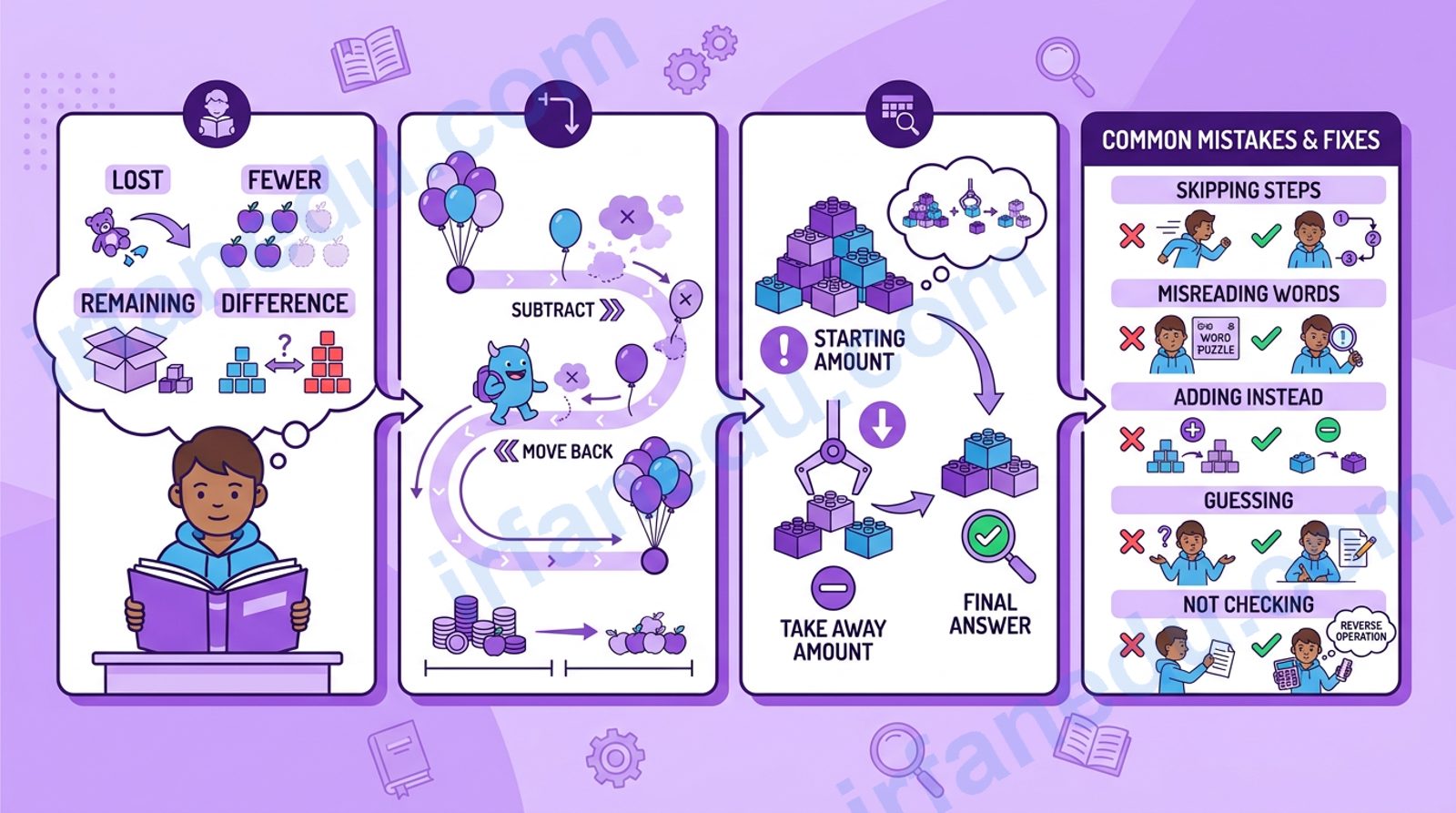
If I could teach you one thing about math word problems, it would be this: the numbers are never the hard part. The hard part is reading the question carefully enough to know which numbers to use and what to do with them. I have watched hundreds of students freeze on subtraction word problems not because they forgot how to subtract, but because they never identified what the problem was actually asking.
A subtraction word problem is a math story that describes a real-world situation where you need to find a difference, a remaining amount, or how much less one quantity is than another. Solving it takes four clear steps: identify the unknown, spot the signal words, write the equation, and verify with addition.
In this guide, I walk you through every part of that process — from the simplest one-step problems to tricky multi-step ones. You will find worked examples, a visual number-line diagram, a common-mistakes breakdown, a quiz, and practice problems with hidden answers. By the end, subtraction word problems will feel routine.
- 🎯 Understand what subtraction word problems are and why they trip students up
- 🔑 Learn the signal words that tell you to subtract
- 📐 Apply a reliable 4-step solving method
- ⚠️ Avoid the five most common errors
- ✅ Practice with real problems and check your work
A subtraction word problem asks you to find a difference, a remaining amount, or how much less one value is than another. Solve it in four steps: (1) read the problem and name the unknown, (2) highlight signal words like left, fewer, or difference, (3) write the equation with the larger value first, and (4) check by adding your answer back to the number you subtracted.
⚡ In Short
- 📖 Subtraction word problems describe real situations needing a difference or remainder.
- 🔑 Signal words (left, fewer, difference, remaining) confirm you need to subtract.
- 📐 The 4-step method works for every problem: read, identify, write, check.
- ⚠️ The #1 mistake is subtracting in the wrong order — always put the larger value first.
- 🔢 Multi-step problems need each operation identified separately before solving.
- ✅ Always verify: add your answer to the subtracted number to get the starting value.
What Is a Subtraction Word Problem?
A subtraction word problem is a written scenario that requires you to subtract one quantity from another to find an answer. Unlike a bare equation like 15 − 8 = ?, a word problem wraps the numbers inside a story. Your job is to decode the story and extract the math.
Three situations almost always call for subtraction:
- Finding what remains: You start with a quantity, some is removed, and you need to know what is left.
- Finding the difference: Two quantities are compared, and you need to know how much larger or smaller one is than the other.
- Finding a missing part: You know the total and one part, and you need the other part.
Recognising which of these three situations you are in is the fastest way to set up the right equation. I tell students to ask one question before touching the numbers: “What is the story taking away, comparing, or leaving out?” That single question cuts through most of the confusion.
Signal Words That Mean Subtract
Signal words are the vocabulary clues embedded in a problem that tell you which operation to use. For subtraction, these are the most reliable ones:
| Signal Word / Phrase | What It Means | Example in a Problem |
|---|---|---|
| Left / Remaining | Something was removed; find what stays | “How many apples are left?” |
| Fewer / Less than | Comparing — one amount is smaller | “She has 5 fewer stickers than Tom.” |
| Difference | The gap between two values | “What is the difference in scores?” |
| Decreased by / Reduced by | A value goes down by a set amount | “The price was reduced by $4.” |
| Spent / Used / Lost / Gave away | A quantity leaves a total | “He spent $12 of his savings.” |
| How many more | Comparison — find the gap | “How many more points did she score?” |
| Change (in money context) | Amount returned after a purchase | “What change did he receive?” |
Signal words are helpful guides, not absolute rules. The phrase “how many more” almost always means subtract — but in a multi-step problem, you might add first and then subtract. Always read the full problem before deciding on your operation.
The 4-Step Method for Solving Any Subtraction Word Problem
Every subtraction word problem, from the simplest to the most complex, responds to the same four-step process. This method works because it forces you to think before you calculate.
-
Read and Identify the Unknown
Read the problem twice. On the second read, ask: what is the question asking me to find? Write it as a label (e.g., “unknown = apples left”). This prevents the most common error — solving for the wrong thing. -
Highlight Signal Words
Circle or underline every subtraction signal word. These confirm your operation and often reveal which number is the starting value (minuend) and which is being removed (subtrahend). -
Write the Equation
Set up: starting value − amount removed = unknown. Label each number. If you are comparing two values, put the larger one first. Never subtract blindly — know what each number represents. -
Solve and Check
Calculate the answer. Then verify using the inverse operation: answer + subtracted number = starting value. If that equation holds, your answer is correct. Also ask: does this answer make sense in the real-world context of the story?
Worked Examples: From Simple to Complex
Let me walk through three examples at increasing difficulty levels. Each one uses the 4-step method so you can see exactly how it applies.
Example 1 — Basic (Grade 2–3)
Maya had 24 crayons. She gave 9 to her friend. How many crayons does Maya have left?
Step 1 — Unknown: crayons Maya has left.
Step 2 — Signal word: “left” → subtract.
Step 3 — Equation: 24 − 9 = ?
Step 4 — Solve: 24 − 9 = 15. Check: 15 + 9 = 24 ✓
Answer: Maya has 15 crayons left.
Example 2 — Intermediate (Grade 3–4)
The school library had 312 books. Students borrowed 87 books on Monday. How many books remained on the shelf?
Step 1 — Unknown: books remaining on the shelf.
Step 2 — Signal word: “remained” → subtract.
Step 3 — Equation: 312 − 87 = ?
Step 4 — Solve:
  312
−  87
------
  225
Check: 225 + 87 = 312 ✓
Answer: 225 books remained on the shelf.
Example 3 — Comparison Problem (Grade 4–5)
In a science fair, Priya scored 148 points and James scored 119 points. How many more points did Priya score than James?
Step 1 — Unknown: the difference in their scores.
Step 2 — Signal phrase: “how many more” → subtract.
Step 3 — Equation: 148 − 119 = ?
Step 4 — Solve: 148 − 119 = 29. Check: 29 + 119 = 148 ✓
Answer: Priya scored 29 more points than James.
Notice that in Example 3, nothing was “taken away” — the problem is purely a comparison. Many students miss this and try to add instead. The phrase “how many more” is the key signal.
📐 Explore the Complete Geometry Formula Sheet
Visual Number-Line Solution
A number line makes subtraction concrete. Here is how Example 1 (24 − 9 = 15) looks on a number line, using jumps of 1 and then a larger jump to show the process:
 0    5    10   15   20   24
 |----|----|----|----|----|-
                  ←←←←←←←←←
                  Jump back 9
                  Land on 15

 Start: 24
 Jump back 9 steps
 Land: 15  ← Answer
[IMAGE: A colorful number line from 0 to 30 with an arrow jumping back 9 spaces from 24 to 15, labeled “24 − 9 = 15” | ALT: number line subtraction visual showing 24 minus 9 equals 15 for students]
For comparison problems, the number line shows the gap between two points rather than a jump backward. This visual distinction helps students understand that “how many more” is still a subtraction operation.
Common Mistakes in Subtraction Word Problems (and How to Fix Them)
After years of reviewing student work, I have seen the same five errors appear again and again. Knowing them in advance is the fastest way to avoid them.
| Mistake | What It Looks Like | The Fix |
|---|---|---|
| Subtracting in the wrong order | Writing 9 − 24 instead of 24 − 9 | Always put the starting (larger) value first |
| Solving for the wrong unknown | Finding what was removed instead of what remains | Label the unknown before writing any equation |
| Ignoring signal words | Adding when the problem says “fewer” | Circle signal words before doing any math |
| Skipping the check step | Accepting an answer that doesn’t add back correctly | Always verify: answer + subtracted = starting value |
| Misreading “how many more” as addition | Adding both values instead of finding the gap | Recognise “how many more/fewer” as a comparison → subtract |
Before writing any equation, write one sentence: “I need to find ___.” This single habit eliminates the two most common errors — wrong order and wrong unknown — because it forces you to think about the answer before the arithmetic.
Multi-Step Subtraction Word Problems
A multi-step subtraction word problem requires two or more operations to reach the final answer. These problems are harder not because the arithmetic is harder, but because students try to solve them in one move instead of breaking them into parts.
Example: Multi-Step Problem (Grade 5–6)
A school store had 500 pencils. On Tuesday, students bought 134 pencils. On Wednesday, the store received a new delivery of 75 pencils. On Thursday, 98 more pencils were sold. How many pencils does the store have now?
Step 1 — Identify each operation:
- Tuesday: 500 − 134 = 366 pencils
- Wednesday: 366 + 75 = 441 pencils (delivery = addition)
- Thursday: 441 − 98 = 343 pencils
Answer: The store has 343 pencils.
The key insight here: not every step in a multi-step problem is subtraction. The delivery on Wednesday is an addition. Students who read too fast miss this and subtract everything, getting the wrong answer. Read each sentence as its own mini-problem and decide the operation for each one separately.
Multi-step problems often appear alongside other math skills. If your student is working on geometry alongside arithmetic, the Distance & Midpoint Formulas guide shows how subtraction connects directly to coordinate geometry — a natural next step.
Here is something most guides never tell you: the hardest subtraction word problems are not hard because of the subtraction — they are hard because of the sentence structure. Specifically, problems that use passive voice or reverse the natural order of events (“James has 15 fewer cards than Sarah, who has 43”) force students to mentally re-order the information before they can write the equation. The fix is to rewrite the sentence in active, forward order before setting up the equation: “Sarah has 43. James has 15 fewer. So James has 43 − 15 = 28.” Teaching students to rewrite, not just read, the problem is the single highest-leverage skill I have found in 15 years of teaching math.
🧠 Quick Quiz: Test Your Understanding
Can You Spot the Right Approach?
Q1. “Lena had 56 stickers. She gave 18 to her sister. How many does she have left?” — Which equation is correct?
Q2. “Tom scored 94 points. Anna scored 67 points. How many more points did Tom score?” — What type of subtraction problem is this?
Q3. A bag had 200 marbles. 45 were red, and the rest were blue. How many were blue? — Which equation solves this?
✏️ Practice Problems (Reveal-on-Click)
Try each problem on your own first, then click to reveal the full worked solution.
Problem 1 (Grade 2): A baker made 48 muffins. By noon, 29 were sold. How many muffins are left?
Step 2: Signal word: “left” → subtract.
Step 3: 48 − 29 = ?
Step 4: 48 − 29 = 19. Check: 19 + 29 = 48 ✓
Answer: 19 muffins are left.
Problem 2 (Grade 3): A train has 215 seats. 178 passengers are seated. How many seats are empty?
Step 2: Signal: “how many seats are empty” → missing part → subtract.
Step 3: 215 − 178 = ?
Step 4: 215 − 178 = 37. Check: 37 + 178 = 215 ✓
Answer: 37 seats are empty.
Problem 3 (Grade 4): Mia has $8.50. She buys a book for $3.75. How much money does she have left?
Step 2: Signal: “left” → subtract.
Step 3: $8.50 − $3.75 = ?
Step 4: $8.50 − $3.75 = $4.75. Check: $4.75 + $3.75 = $8.50 ✓
Answer: Mia has $4.75 left.
Problem 4 (Grade 5, Multi-Step): A tank holds 1,000 litres. On Day 1, 325 litres were used. On Day 2, 150 litres were added and then 200 litres were used. How much water remains?
After Day 1: 1,000 − 325 = 675 litres.
After Day 2 delivery: 675 + 150 = 825 litres.
After Day 2 use: 825 − 200 = 625 litres.
Check: 625 + 200 = 825; 825 − 150 = 675; 675 + 325 = 1,000 ✓
Answer: 625 litres remain.
📐 Practice More Math: Parallel & Perpendicular Lines Guide
❓ Frequently Asked Questions
What are the key words that signal subtraction in a word problem?
How do you check your answer in a subtraction word problem?
What is a multi-step subtraction word problem?
Why do students struggle with subtraction word problems?
📚 Related Articles
📎 Sources & References
- Khan Academy — Subtraction Word Problems (Grade 3) — a widely-used free resource for subtraction practice problems and worked examples.
- Wikipedia — Subtraction — foundational definition and mathematical properties of subtraction.
- NCTM (National Council of Teachers of Mathematics) — nctm.org — the primary professional body setting standards for mathematics education.
✍ Editorial note: This article was written and fact-checked by Dr. Irfan Mansuri. All examples are original. No statistics or studies were fabricated. Last reviewed August 2026.