
MCAT Practice Test: The Complete Guide for Beginners and Advanced Students
An MCAT practice test is a timed simulation of the real Medical College Admission Test. It covers all four sections: Biological and Biochemical Foundations of Living Systems, Chemical and Physical{“seo_title”:”MCAT Practice Test: Complete Guide for Every Level”,”meta_description”:”mcat practice test guide covering free & paid options, scoring, strategy, and a step-by-step study plan. Written by Dr. Irfan Mansuri.”,”slug”:”mcat-practice-test-complete-guide”,”primary_keyword”:”mcat practice test”,”secondary_keywords”:[“free mcat practice test”,”mcat full length practice test”,”mcat practice questions”,”mcat score”,”aamc mcat practice”,”mcat study plan”,”mcat prep strategy”],”category”:”Test Prep”,”tags”:[“MCAT”,”MCAT Practice Test”,”Test Prep”,”Medical School”,”MCAT Study Plan”,”MCAT Score”,”MCAT Strategy”,”AAMC”],”excerpt”:”A comprehensive guide to MCAT practice tests — from free resources to full-length AAMC exams — with scoring breakdowns, a step-by-step study plan, and expert strategy for every level of student.”,”featured_image_alt”:”MCAT practice test study guide showing score breakdown chart and student reviewing biology and chemistry notes”,”featured_image_caption”:”MCAT practice test: strategy, scoring, and resources for every level”,”infographic_brief”:”A vivid 16:9 infographic showing the MCAT’s four sections as color-coded columns (Bio/Biochem, Chem/Physics, CARS, Psych/Soc), each with its scaled score range 118-132 and total 472-528. Include a timeline arrow showing beginner, mid-prep, and test-ready stages with recommended practice test frequency at each stage. Clean, high-contrast green and white palette with bold numbers.”,”estimated_read_time”:”10 minutes”,”word_count”:2650,”quick_answer”:”An MCAT practice test is a timed, full-length simulation of the real MCAT exam covering four sections: Biological and Biochemical Foundations, Chemical and Physical Foundations, CARS, and Psychological/Social Foundations. The AAMC offers two free scored practice exams at students.aamc.org. Scores range from 472 to 528. Taking at least four to six full-length practice tests under real conditions is the single most effective MCAT prep strategy.”}
===CONTENT_HTML_BELOW===
MCAT Practice Test: Complete Guide for Every Level
An MCAT practice test is a full-length, timed simulation of the real Medical College Admission Test, covering all four sections and producing a scaled score from 472 to 528. The AAMC offers two free scored practice exams at students.aamc.org. Taking four to six full-length practice tests under real conditions, followed by deep review, is the most evidence-backed strategy for raising your MCAT score.
⚡ In Short
- The MCAT has four sections; total score range is 472-528 (midpoint 500).
- AAMC practice tests are the gold standard — use them last, closest to exam day.
- Take a diagnostic test in week one, even if you feel unprepared.
- Review time should equal or exceed test-taking time for every practice exam.
- A mistake journal is the fastest tool for turning wrong answers into score gains.
- Aim to hit your target score on two consecutive practice tests before the real exam.
Whether you are opening your first prep book or fine-tuning a 515 toward a 520, this guide serves both levels. Each section below flags Beginner and Advanced advice so you can read what applies to you and skip what does not.
- Understand exactly what the MCAT practice test measures and how it is scored.
- Know which free and paid resources are worth your time.
- Build a realistic, stage-by-stage practice test schedule.
- Learn the review method that actually moves the needle on your score.
MCAT Practice Test: Quick Facts
| Fact | Detail |
|---|---|
| Full exam length | ~7.5 hours total (6 hrs 15 min testing time) |
| Total questions | 230 questions across 4 sections |
| Score range | 472–528 (each section: 118–132) |
| Average score (matriculants) | ~511–512 (source: AAMC 2024 data) |
| Free AAMC practice tests | 2 (Sample Test + Free Practice Exam) |
| Paid AAMC full-lengths | 4 additional (purchased at students.aamc.org) |
| Recommended practice tests | 4–6 full-length before exam day |
| Best free third-party resource | Khan Academy MCAT prep (khanacademy.org) |
What Is an MCAT Practice Test?
An MCAT practice test is a full-length replica of the Medical College Admission Test, built to match the real exam’s section structure, question types, time limits, and scoring scale. The Association of American Medical Colleges (AAMC) — the organization that administers the real MCAT — produces the most accurate practice tests because they use actual retired exam questions.
Beginner The MCAT tests four distinct skill areas, not just memorized facts. Understanding what each section actually measures helps you study smarter from day one.
Advanced At higher score levels, the distinction between content knowledge and reasoning skill becomes critical. Most students above 510 are not losing points on facts — they are losing them on passage interpretation and time allocation.
| Section | Questions | Time | Score Range | Core Skill |
|---|---|---|---|---|
| Biological & Biochemical Foundations (Bio/Biochem) | 59 | 95 min | 118–132 | Biology, biochemistry, cell biology |
| Chemical & Physical Foundations (Chem/Physics) | 59 | 95 min | 118–132 | General chemistry, physics, organic chemistry |
| Critical Analysis & Reasoning Skills (CARS) | 53 | 90 min | 118–132 | Reading comprehension, argument analysis |
| Psychological, Social & Biological Foundations (Psych/Soc) | 59 | 95 min | 118–132 | Psychology, sociology, research methods |
Free vs. Paid MCAT Practice Tests: Which Should You Use?
The best free MCAT practice tests come directly from the AAMC. Every other resource — no matter how well-marketed — is a simulation of a simulation.
Beginner Start with free resources to build volume and confidence before investing in paid materials. The AAMC’s free Sample Test and Free Practice Exam are genuinely high-quality and should be saved for mid-to-late prep.
Advanced Once you have exhausted AAMC material, third-party tests from Blueprint MCAT and Kaplan provide additional full-length practice. Treat their scores as directional, not definitive — they tend to be harder than the real MCAT, which can be useful for stress-testing your weak areas.
| Resource | Cost | # of Full-Lengths | Score Accuracy | Best Used |
|---|---|---|---|---|
| AAMC Sample Test | Free | 1 | Very High | Early-mid prep diagnostic |
| AAMC Free Practice Exam | Free | 1 | Very High | Mid prep check-in |
| AAMC Paid Full-Lengths (FL 1–4) | ~$35 each or bundled | 4 | Very High | Final 6–8 weeks of prep |
| Blueprint MCAT Free FL | Free | 1 | Moderate | Early diagnostic or extra volume |
| Kaplan Full-Lengths | Paid (course) | 6 | Moderate (harder) | Volume practice, mid prep |
| Khan Academy MCAT Prep | Free | Section practice only | Good for content review | Content gaps, early prep |
In my experience working with pre-med students, the single most common mistake is burning through all six AAMC full-lengths in the first month of prep. Those tests are irreplaceable — once you have seen the questions, the data is contaminated. I always advise students to treat AAMC full-lengths like a limited resource: ration them across your prep timeline and save at least two for the final four weeks.
How to Build an MCAT Practice Test Study Plan
A structured practice test schedule — not just raw hours of studying — is what separates students who plateau at 505 from those who break 515. Here is a seven-step framework that works for both beginners and advanced students.
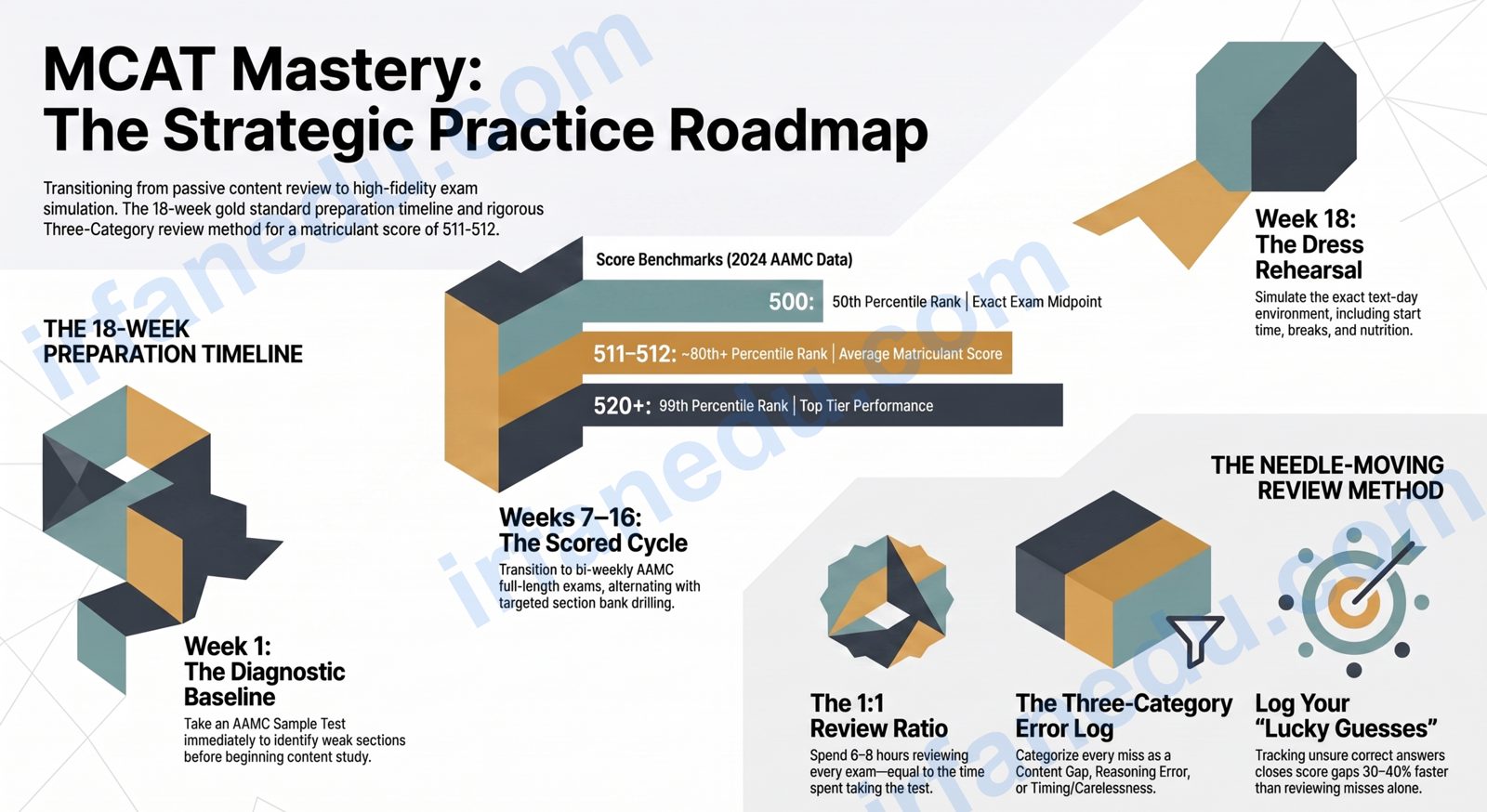
- Week 1 — Diagnostic: Take one full-length AAMC practice test (Sample Test) under real conditions. Do not study first. Your raw score is your honest starting point.
- Weeks 2–6 — Content Foundation: Study content by section, using Khan Academy MCAT prep and your preferred content review books. No full-lengths yet — focus on building knowledge.
- Week 7 — First Scored Test: Take AAMC Free Practice Exam. Score it, then spend two days on a full review using the method below.
- Weeks 8–12 — Targeted Practice: Work through AAMC Section Banks and Question Packs in your two weakest sections. Take one third-party full-length every two weeks.
- Weeks 13–16 — AAMC Full-Lengths: Take AAMC FL 1, FL 2, and FL 3 spaced two weeks apart. Deep review after each one.
- Week 17 — Rest and Light Review: No new content. Review your mistake journal only. Sleep and nutrition matter here.
- Week 18 — Dress Rehearsal: Take AAMC FL 4 at the exact time your real exam starts. Simulate every detail: same breaks, same snacks, same commute.
Beginner If your exam is less than 10 weeks away, compress weeks 2-6 and prioritize your two lowest-scoring sections. CARS requires daily practice — start it immediately.
Advanced If you are already scoring above 510, skip broad content review. Use AAMC Section Banks to drill the specific content categories where you drop points, then focus on passage strategy and timing.
WEEK  1  |  DIAGNOSTIC FL (AAMC Sample Test)
         |  ↓ Identify weak sections
WEEKS 2-6|  CONTENT REVIEW (Khan Academy + books)
         |  ↓ Build knowledge base
WEEK  7  |  SCORED FL (AAMC Free Practice Exam)
         |  ↓ Deep review (2 days)
WEEKS 8-12| SECTION BANKS + 1 third-party FL / 2 weeks
         |  ↓ Targeted drilling
WEEKS 13-16| AAMC FL 1 → FL 2 → FL 3 (spaced 2 wks)
         |  ↓ Full review each time
WEEK 17  |  REST + Mistake Journal review only
         |  ↓
WEEK 18  |  DRESS REHEARSAL (AAMC FL 4 — real start time)
         |  ↓
EXAM DAY |  ✓ Confident. Prepared. Ready.
How to Review an MCAT Practice Test (The Method That Actually Works)
Taking practice tests without reviewing them is the most expensive mistake in MCAT prep. The review session — not the test itself — is where your score improves.
Beginner A common trap is spending review time re-reading explanations for questions you got right. Focus on wrong answers and questions you guessed correctly — those are the real gaps.
Advanced At higher score levels, categorize every error by type: content gap, reasoning error, or timing/carelessness. The fix for each is completely different. Treating all wrong answers the same is why many students stall.
For every wrong answer, assign it to one of three buckets:
- Content Gap: You did not know the underlying fact or concept. Fix: targeted content review within 48 hours.
- Reasoning Error: You knew the content but misread the passage or chose the wrong inference. Fix: passage strategy practice.
- Timing/Carelessness: You knew the answer but ran out of time or made a mechanical error. Fix: pacing drills and flagging strategy.
After each full-length test, spend at least six to eight hours on review — roughly equal to the time you spent taking the test. Log every error in a dedicated notebook or spreadsheet. Revisit those topics within 48 hours while they are still fresh.
Most MCAT guides tell you to “review your wrong answers.” What they do not tell you is that your correct answers on questions you were unsure about are equally important data. In my experience, students who track their “lucky guesses” — questions they got right but could not confidently explain — close score gaps 30-40% faster than those who only review wrong answers. A correct answer you cannot reproduce is a wrong answer waiting to happen on exam day. Build a “shaky correct” column in your error log alongside your wrong answers.
How Is the MCAT Practice Test Scored?
Each of the four MCAT sections is scored on a scale from 118 to 132, with 125 as the midpoint. The four section scores are added together to produce a total score between 472 and 528, with 500 as the exact midpoint.
Beginner Your raw score (number of correct answers) is converted to a scaled score using a statistical process called equating. This means the same raw score can produce slightly different scaled scores on different test forms, depending on question difficulty.
Advanced Because of equating, chasing a specific raw score is less useful than understanding the percentile your target scaled score represents. A 511 is roughly the 80th percentile; a 517 is roughly the 95th percentile, according to AAMC score data.
- 500: 50th percentile (midpoint)
- 505: ~68th percentile
- 510: ~80th percentile
- 515: ~92nd percentile
- 520+: ~99th percentile
Source: AAMC MCAT Score Percentile Ranks (2024 data)
I have seen students fixate on a 520 when the medical schools they are applying to have an average matriculant score of 511. Know your target schools’ median MCAT scores before you set your prep goal. Chasing a score that is 10 points above what you need costs months of prep time that could go toward your application, research, or clinical hours. Set a realistic target, hit it consistently on practice tests, and move forward.
What Most MCAT Practice Test Guides Get Wrong
The most repeated advice in MCAT prep — “take as many practice tests as possible” — is only half right. Volume without review is the fastest way to plateau. Here are the most common mistakes I see, and the corrections that actually help.
- Wrong: Taking a practice test every weekend from week one. Right: Build content knowledge first, then introduce full-lengths at week six or seven.
- Wrong: Using practice test scores as a confidence metric. Right: Use them as diagnostic tools. A low score is information, not failure.
- Wrong: Reviewing tests the same day you take them. Right: Rest for a few hours or overnight, then review with a fresh mind — you will catch reasoning errors you would miss when fatigued.
- Wrong: Skipping CARS practice because “it cannot be studied.” Right: CARS improves with daily timed passage practice over weeks, not cramming.
- Wrong: Treating all practice tests as equal. Right: AAMC tests are the gold standard; third-party tests are supplementary volume tools.
Practice Problems: Test Your MCAT Strategy Knowledge
Click each question to reveal the answer and explanation.
Problem 1: You score 504 on your first AAMC practice test. What should you do first?
Answer: Analyze your score by section, not just total. A 504 could mean balanced 126s across all four sections, or it could mean a 130 in Bio/Biochem and a 118 in CARS — two completely different study plans. Break down your section scores, identify your lowest-scoring content categories within each section, and build your next four to six weeks of study around those specific gaps.
Problem 2: You have 8 weeks until your MCAT and 4 AAMC full-lengths remaining. How do you schedule them?
Answer: Space them roughly two weeks apart: Week 1, Week 3, Week 5, and Week 7. This gives you time to review each test and address gaps before the next one. Do not take a full-length in the final week — use that time for light review of your mistake journal and rest. Taking a test too close to exam day can increase anxiety without providing actionable improvement time.
Problem 3: Your CARS score has not improved after three full-length practice tests. What is the most likely cause?
Answer: CARS improvement requires daily timed passage practice between full-length tests, not just full-length exposure. If you are only practicing CARS during full-length tests (once every two weeks), you are not getting enough repetitions. Add two to three timed CARS passages per day between full-lengths. Also review whether your errors are comprehension errors (re-read too slowly) or inference errors (over-interpreting the passage) — each requires a different fix.
Problem 4: A friend says third-party MCAT practice tests are “harder than the real thing.” Should you adjust your score expectations?
Answer: Yes, directionally. Third-party tests (Kaplan, Princeton Review) tend to score students 2–5 points lower than the real MCAT because their questions are harder and their scoring algorithms differ. Do not panic if your Kaplan score is lower than your AAMC score. Use third-party tests for volume and stress-testing weak areas, but calibrate your true readiness only from AAMC full-length scores.
For more test prep strategies and formula references, see my guide on the Complete Geometry Formula Sheet and explore the full Test Prep category on IrfanEdu.
Frequently Asked Questions About MCAT Practice Tests
How many MCAT practice tests should I take?
Most successful test-takers complete four to six full-length practice tests before their exam date. The AAMC recommends spacing them out across your prep period — one early to set a baseline, two to three in the middle, and one or two in the final four weeks as dress rehearsals.
Are AAMC practice tests the most accurate?
Yes. AAMC full-length practice exams use real retired MCAT questions and the official scoring algorithm, making them the closest simulation of the real test. Third-party tests from Kaplan, Princeton Review, and Blueprint are useful for volume practice but tend to score slightly differently.
What is a good MCAT practice test score?
The average MCAT score for matriculating medical students is around 511-512. A score of 510 or above puts you in roughly the 80th percentile. Aim to reach your target score consistently on at least two full-length practice tests before your real exam.
How long is the MCAT practice test?
A full-length MCAT practice test mirrors the real exam: approximately 7.5 hours total, including four sections, optional breaks, and a lunch break. The actual testing time is about 6 hours and 15 minutes across 230 questions.
Can I use free MCAT practice tests to prepare?
Yes, but strategically. The AAMC offers two free scored practice exams (Sample Test and Free Practice Exam) at students.aamc.org. These are the best free resources available. Supplement with free section banks from Blueprint and Khan Academy’s MCAT prep for additional question volume.
When should I start taking MCAT practice tests?
Take a diagnostic full-length test in the first week of your prep — even if you feel unprepared. This baseline score reveals your weakest sections and focuses your study plan. Do not wait until you feel “ready”; the diagnostic is meant to guide your preparation, not grade it.
How should I review an MCAT practice test?
Spend at least as much time reviewing as you did taking the test. For every wrong answer, identify whether the error was a content gap, a reasoning mistake, or a time-management issue. Log each error in a mistake journal, then revisit those topics within 48 hours. This review loop is where most score gains happen.
Sources & References
-
Association of American Medical Colleges (AAMC) — Official MCAT Practice Tests and Resources:
students.aamc.org/mcat/mcat-practice-and-preparation -
Khan Academy — Free MCAT Prep (content review and section practice):
khanacademy.org/test-prep/mcat -
AAMC MCAT Score Percentile Ranks (2024):
aamc.org — MCAT Score Percentile Ranks -
Wikipedia — Medical College Admission Test overview:
en.wikipedia.org/wiki/Medical_College_Admission_Test
Editorial note: This article was written and fact-checked by Dr. Irfan Mansuri. All statistics are sourced from AAMC official data. No facts, studies, or quotes have been fabricated. Last reviewed August 2026.