
ServSafe Manager Practice Test: Stop Studying the Wrong Way
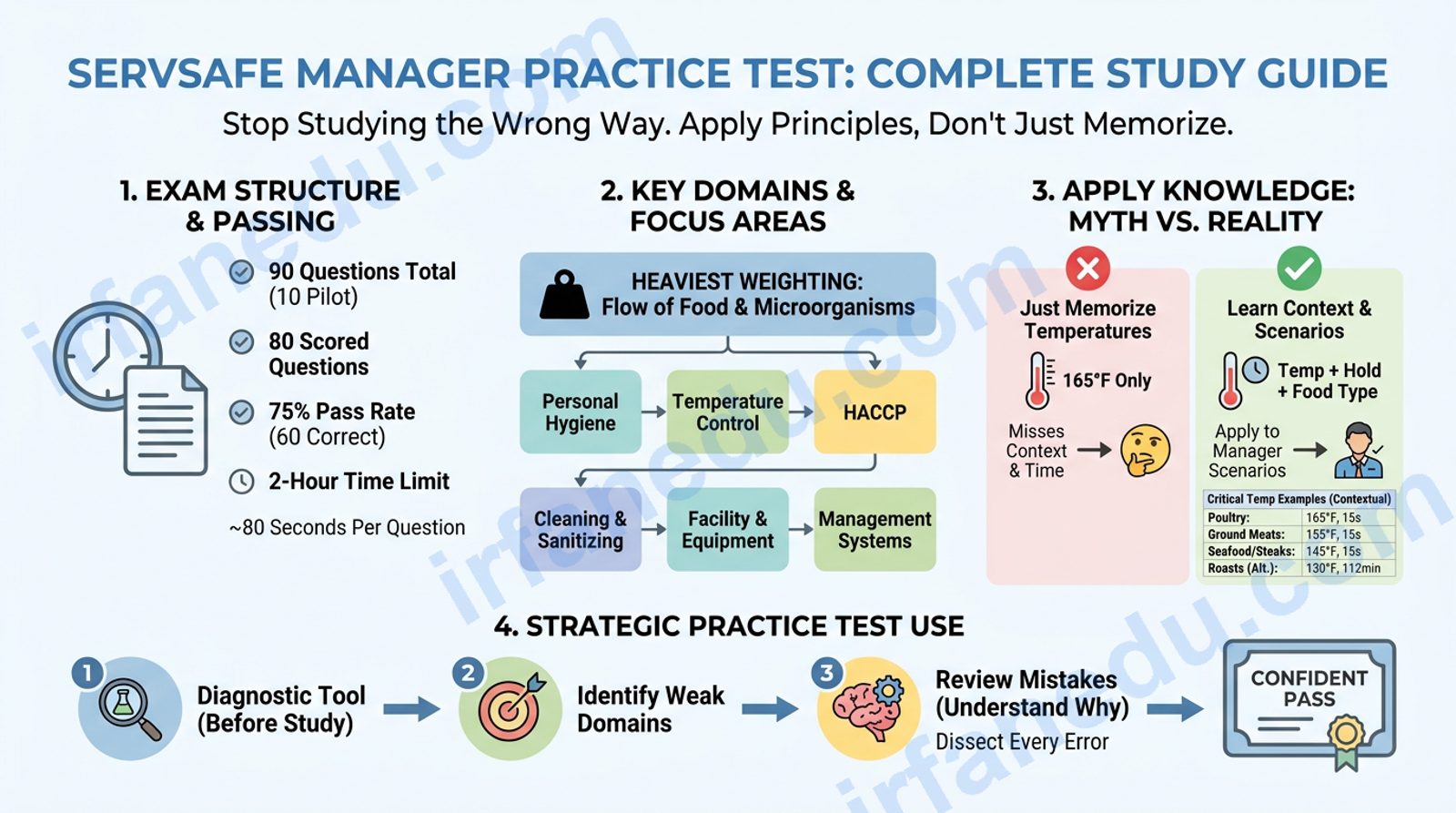
You’ve probably been told that the ServSafe Manager exam is just a matter of memorizing food temperatures and a few definitions. That’s wrong — and it’s the reason so many candidates fail on their first attempt. The exam is designed to test how you apply food safety principles as a manager, not whether you can recite them.
In this guide I break down exactly what the real exam looks like, which myths are costing candidates points, and how to use a ServSafe manager practice test the right way so you walk in confident.
⚡ In Short
- 90 questions total; only 80 are scored — 10 are invisible pilot questions.
- Passing score is 75% of the 80 scored questions (60 correct answers).
- Time limit is 2 hours; that’s roughly 80 seconds per question.
- Seven domains tested; Flow of Food and Foodborne Microorganisms are the heaviest.
- Scenario-based application questions are harder than pure recall questions.
- One full-length timed practice test beats five hours of passive re-reading.
Myth 1: “You Just Need to Memorize Temperatures”
Temperature knowledge is necessary but not sufficient. The exam presents manager-level scenarios where you must decide what action to take, not just name a number.
For example, a question might describe a cook who checks a chicken breast and reads 158°F (70°C). Is that safe? The correct answer depends on whether the temperature was held for the required dwell time — a detail pure memorization misses. The ServSafe standard for poultry is 165°F (74°C) for 15 seconds, or an equivalent time-temperature combination. Knowing only “165°F” without understanding the time component will lead you to wrong answers on scenario questions.
Critical Temperature Reference
| Food Type | Minimum Internal Temp | Hold Time |
|---|---|---|
| Poultry (whole & ground) | 165°F / 74°C | 15 seconds |
| Ground beef / pork / seafood | 155°F / 68°C | 15 seconds |
| Whole-muscle beef (steaks) | 145°F / 63°C | 15 seconds |
| Pork chops / roasts | 145°F / 63°C | 15 seconds |
| Fish & shellfish | 145°F / 63°C | 15 seconds |
| Eggs (immediate service) | 145°F / 63°C | 15 seconds |
| Eggs (hot-hold for service) | 155°F / 68°C | 15 seconds |
| Roasts (alternative method) | 130°F / 54°C | 112 minutes |
Myth 2: “The Practice Test Is Just a Warm-Up”
Most candidates treat practice tests as a confidence check after studying. In my experience teaching certification prep, that’s backwards. A practice test taken before you study is one of the most powerful diagnostic tools available — it shows you exactly which domains you’re weak in so you can allocate study time efficiently.
I’ve coached hundreds of food service professionals through certification exams. The single biggest predictor of first-attempt success is not how many hours someone studied — it’s whether they reviewed their wrong answers with a focus on why they were wrong, not just what the right answer was. A candidate who scores 55% on a practice test, then spends two hours dissecting every mistake, will almost always outscore someone who scored 70% and just moved on.
What the Real ServSafe Manager Exam Looks Like
The ServSafe Manager certification exam is developed and administered by the National Restaurant Association Educational Foundation (NRAEF). Here is the exact format as of the current 7th-edition curriculum.
| Feature | Detail |
|---|---|
| Total questions | 90 multiple-choice |
| Scored questions | 80 (10 are unscored pilot questions) |
| Passing score | 75% of scored questions = 60 correct |
| Time limit | 2 hours (120 minutes) |
| Delivery | Paper-based (instructor-led) or online proctored |
| Languages available | English, Spanish, Chinese, Korean, French Canadian, Japanese |
| Certification validity | 5 years from passing date |
| Retake policy | Must wait 24 hours; retake fee applies |
The 7 exam domains and their approximate question weights are:
- Providing Safe Food — ~15% (foodborne illness, contamination, high-risk populations)
- Forms of Contamination — ~12% (biological, chemical, physical, allergens)
- The Safe Food Handler — ~9% (personal hygiene, handwashing, illness policies)
- The Flow of Food — ~26% (purchasing, receiving, storage, prep, cooking, holding, cooling, reheating)
- Food Safety Management Systems — ~12% (HACCP, Active Managerial Control, regulatory requirements)
- Safe Facilities and Pest Management — ~13% (equipment, design, pest control)
- Cleaning and Sanitizing — ~13% (methods, chemicals, schedules)
The Flow of Food domain alone covers 26% of the exam. If you’re short on study time, that domain gives you the highest return per hour.
Wrong vs. Right: Common Study Mistakes
The table below captures the most frequent mistakes I see candidates make, and what to do instead. These are not obvious — most study guides don’t address them.
| What Most Candidates Do (Wrong) | What Actually Works (Right) |
|---|---|
| Re-read the textbook chapter by chapter | Use active recall: close the book and write down everything you remember about a domain, then check |
| Memorize temperature numbers in isolation | Learn each temperature with its food type, hold time, and the manager decision it triggers |
| Skip questions about facilities and pest control (“I’ll never need this”) | Study all 7 domains — facilities/pest and cleaning/sanitizing together are ~26% of the exam |
| Take practice tests and only note the score | Review every wrong answer; identify the domain; track which domains have the most errors |
| Study the night before for 4+ hours | Spread study over 5-7 days; sleep the night before — memory consolidation requires sleep |
| Assume “manager” questions are the same as food handler questions | Manager questions ask what you would do or implement — they test decision-making, not just knowledge |
How to Pass the ServSafe Manager Exam: Step-by-Step
This is the preparation sequence I recommend based on what consistently produces first-attempt passes.
- Take a diagnostic practice test first. Before opening the textbook, sit a full 90-question practice test under timed conditions. Score it and map your errors to the 7 domains.
- Study weak domains first, heaviest domains second. Fix your biggest gaps, then invest extra time in The Flow of Food (26% weight) and Providing Safe Food (15%).
- Build a temperature decision tree. Create a one-page reference that links each food type to its minimum internal temp, hold time, and the cooling/reheating rules that apply to it.
- Practice scenario questions daily. Use the official ServSafe practice exam or a reputable third-party question bank. Aim for 20-30 scenario questions per study session.
- Review wrong answers with the “why” method. For each wrong answer, write one sentence explaining the correct food safety principle. This forces conceptual understanding.
- Simulate exam conditions 48 hours before. Take a full 90-question timed test two days before your exam — not the night before. Use the results to do a final review of weak spots.
Most study guides tell you the ServSafe exam tests “food safety knowledge.” That framing is misleading. The exam is built around the concept of Active Managerial Control (AMC) — the idea that a certified manager proactively identifies and eliminates food safety risks rather than reacting to them. Almost every scenario question is really asking: “As a manager applying AMC, what is the correct intervention here?” Candidates who understand AMC as a lens score significantly higher on scenario questions than those who approach the exam as a pure knowledge test. You won’t find this framing in most free study guides.
What Is HACCP and Why Does It Appear on Every Practice Test?
HACCP stands for Hazard Analysis and Critical Control Points. It is a systematic, science-based approach to identifying food safety hazards and controlling them at specific points in the food production process.
The ServSafe Manager exam tests HACCP because it is the foundation of the Food Safety Management Systems domain (Domain 5). A manager who understands HACCP can prevent foodborne illness outbreaks rather than just respond to them.
The 7 HACCP Principles
- Conduct a hazard analysis
- Identify Critical Control Points (CCPs)
- Establish critical limits for each CCP
- Establish monitoring procedures
- Establish corrective actions
- Establish verification procedures
- Establish record-keeping and documentation
On the exam, HACCP questions often describe a food production scenario and ask you to identify the CCP or the correct corrective action. The answer almost always involves the point in the process where a hazard can be eliminated or reduced to a safe level — that is the definition of a CCP.
HACCP FLOW: From Receiving to Service
======================================

  [RECEIVE]  -->  [STORE]  -->  [PREP]  -->  [COOK]  -->  [HOLD]  -->  [SERVE]
      |                             |             |            |
   CCP #1                        CCP #2        CCP #3       CCP #4
  (Inspect                    (Prevent        (Reach       (Maintain
  temps &                   cross-contam)    min internal  safe holding
  condition)                               temperature)   temperature)

Critical Limit Examples:
  CCP #1  -->  Reject if delivery temp > 41°F (5°C) for cold TCS food
  CCP #3  -->  Poultry must reach 165°F (74°C) for 15 sec
  CCP #4  -->  Hot food held at >= 135°F (57°C); cold at <= 41°F (5°C)
Myth 3: "Online Practice Tests Are All the Same Quality"
They are not. Many free practice tests circulating online contain outdated questions based on the 6th-edition ServSafe curriculum, which used different temperature thresholds and cooling time windows. The 7th edition (current) changed several critical limits.
The most reliable practice material comes directly from the National Restaurant Association's official ServSafe website. Third-party question banks from established test-prep publishers are generally accurate, but always cross-reference answers against the 7th-edition textbook before accepting them as correct.
In my experience, the best free resource for ServSafe practice questions is the official ServSafe website's sample exam. It's limited in length, but every question is guaranteed to reflect the current curriculum. I recommend using it as a final calibration tool — not as your primary study resource — because you need volume and variety in your practice questions to build real exam readiness.
Test Yourself: ServSafe Manager Mini Quiz
Answer each question, then select an option to see instant feedback.
ServSafe Manager Practice Quiz
Q1. A food manager notices that a shipment of raw chicken arrived at 48°F (9°C). What is the correct action?
Q2. Which of the following is a Critical Control Point (CCP) in a HACCP plan for a burger operation?
Q3. Cooked rice must be cooled from 135°F (57°C) to 41°F (5°C) within how many hours total?
Frequently Asked Questions
How many questions are on the ServSafe Manager exam?
What is the passing score for the ServSafe Manager exam?
How long is the ServSafe Manager exam?
What topics does the ServSafe Manager practice test cover?
About the Author
Sources & References
- National Restaurant Association Educational Foundation. ServSafe Manager, 7th Edition. Official curriculum and exam blueprint. servsafe.com/servsafe-manager
- U.S. Food & Drug Administration. Food Code 2022 — the regulatory basis for ServSafe temperature standards. fda.gov/food/fda-food-code
- U.S. Centers for Disease Control and Prevention. Foodborne Illness Surveillance — background on foodborne pathogens covered in Domain 1. cdc.gov/foodsafety
Editorial note: This article was written and fact-checked by Dr. Irfan Mansuri. All temperature standards and exam format details are cross-referenced against the ServSafe Manager 7th Edition textbook and the FDA Food Code 2022. No statistics or quotes were fabricated.