
AP Chemistry Notes: The Complete Study Guide That Actually Helps You Score a 4 or 5
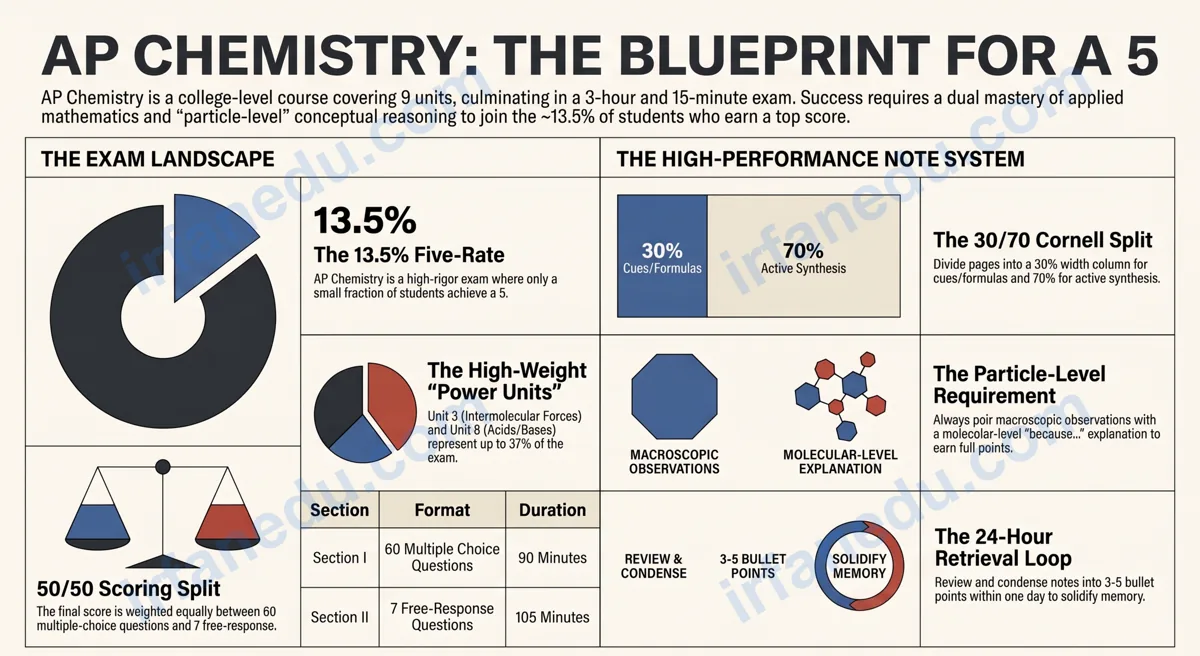
AP Chemistry notes are structured, unit-by-unit summaries of the College Board AP Chemistry curriculum, covering atomic structure, bonding, kinetics, thermodynamics, equilibrium, acids and bases, and electrochemistry. Effective notes combine precise definitions, worked numerical examples, and formula references to build both conceptual understanding and calculation fluency — the two skills the AP exam tests simultaneously.
- Understand all 9 AP Chemistry units and their exam weights
- Learn a proven note-taking system that builds real understanding
- Get worked examples for the most-tested calculation types
- Identify the three most common mistakes that cost students points
- Walk away with a formula reference and a study schedule you can use tonight
TL;DR – Quick Summary
- AP Chemistry has 9 units; Units 4, 5, 7, and 8 carry the most exam weight.
- The exam is 3 hours 15 minutes: 60 MCQ + 7 free-response questions.
- You get a formula/constants sheet — knowing when to use each formula matters more than memorizing them.
- The Cornell two-column method works best for AP Chem notes.
- Review notes within 24 hours; attempt past free-response questions by unit.
- The 5-rate is ~12-15% — a structured note system is the single biggest differentiator.
| Feature | Detail |
|---|---|
| Exam Name | AP Chemistry (College Board) |
| Number of Units | 9 |
| Exam Duration | 3 hours 15 minutes |
| MCQ Section | 60 questions (90 min) — 50% of score |
| Free Response | 7 questions (105 min) — 50% of score |
| Formula Sheet | Provided on exam day |
| Passing Score | 3 (most colleges credit 4 or 5) |
| 5-Rate (2024) | ~13.5% |
| Recommended Prerequisite | Honors/Pre-AP Chemistry or equivalent |
What Is AP Chemistry?
AP Chemistry is a college-level introductory chemistry course and exam administered by College Board. It covers the equivalent of a first-year university general chemistry sequence, spanning atomic theory, chemical bonding, thermodynamics, kinetics, equilibrium, and electrochemistry across 9 structured units.
AP Chemistry sits at the intersection of conceptual science and applied mathematics. Unlike a standard high school chemistry course, it requires students to explain phenomena at the particle level, not just perform calculations. That distinction shapes how your notes should be structured.
The course is designed around three big ideas from College Board’s curriculum framework: the structure of matter, the properties of matter, and the changes matter undergoes. Every unit connects back to at least one of these ideas — which means your notes should too.
Why Your Notes Determine Your AP Chemistry Score
Strong AP Chemistry notes do more than record what a teacher said — they build a mental model you can apply to problems you have never seen before. The AP exam deliberately uses novel scenarios to test whether you understand why chemistry works, not just what the formulas say.
In my experience teaching AP Chemistry students, the ones who struggle on free-response questions almost always have the same problem: their notes are a transcript of the lesson, not a synthesis of it. They can recite Le Chatelier’s Principle but cannot explain what happens to equilibrium when you add a catalyst and simultaneously increase pressure. Notes that force you to connect ideas — not just list them — are the ones that build that skill.
I have reviewed hundreds of student note sets over 15 years. The single biggest predictor of a high AP Chemistry score is not how many pages of notes a student has — it is whether each page contains at least one worked example the student wrote themselves. Passive copying does not build the problem-solving instinct the exam demands. Active note-taking does.
How to Take AP Chemistry Notes That Actually Work
The most effective AP Chemistry note system combines the Cornell method with a running formula reference. Here is the exact process I recommend to every student I work with.
- Divide your page into two columns before class. Left column (30% width): key terms, formulas, and questions. Right column (70% width): explanations, examples, and connections.
- Write a one-sentence definition for every new concept — in your own words, not the textbook’s. If you cannot paraphrase it, you do not understand it yet.
- Solve at least one numerical example per concept and annotate every step. Write why you did each step, not just what you did.
- Add a “particle-level explanation” line for every macroscopic observation. AP free-response questions almost always ask you to explain observations at the molecular or atomic level.
- Keep a running formula reference page at the back of each unit. Include the formula, the variables defined, and one example of when to use it.
- Review and condense within 24 hours. Reduce each page to 3-5 bullet points in the left column. This forces retrieval practice, which research consistently shows is the most effective study technique.
Unit-by-Unit AP Chemistry Notes (All 9 Units)
Below are concise, exam-focused summaries for each of the 9 AP Chemistry units. Each summary highlights the core concept, the most-tested calculation or reasoning type, and one thing most students miss.
Unit 1: Atomic Structure and Properties (7-9% of exam)
Covers electron configuration, periodic trends, photoelectron spectroscopy (PES), and the mole concept. The most-tested skill is reading a PES spectrum and connecting peak position and relative area to electron subshells.
The areas (2:2:1) give electron counts per subshell. Reading right to left (lowest to highest energy): 2 electrons at 2.5 (2p), 2 electrons at 18.7 (2s), 1 electron at 870 (1s) — but wait, that totals 5 electrons. Adjust: the outermost peak at 2.5 has area 1, middle has 2, innermost has 2 — giving 1+2+2 = 5 electrons. That is Boron (B).
Unit 2: Molecular and Ionic Compound Structure and Properties (7-9%)
Covers Lewis structures, VSEPR theory, formal charge, resonance, and ionic vs. covalent bonding. The key skill is drawing Lewis structures with correct formal charges and predicting molecular geometry.
Most-missed point: formal charge is not the same as oxidation state. Formal charge assumes equal sharing of bonding electrons; oxidation state assumes the more electronegative atom takes both.
Unit 3: Intermolecular Forces and Properties (18-22%)
This is the highest-weight unit. It covers London dispersion forces, dipole-dipole, hydrogen bonding, and their effects on physical properties (boiling point, viscosity, vapor pressure). It also covers solutions, colligative properties, and chromatography.
Unit 4: Chemical Reactions (7-9%)
Covers reaction types (synthesis, decomposition, combustion, acid-base, oxidation-reduction), net ionic equations, and stoichiometry. The AP exam expects you to predict products and write balanced net ionic equations from scratch.
Unit 5: Kinetics (7-9%)
Covers rate laws, the rate constant k, reaction mechanisms, and the Arrhenius equation. The most-tested calculation is determining the rate law from experimental data (method of initial rates).
Experiment 1: [A]=0.10 M, [B]=0.10 M, rate = 2.0 × 10⁻³ M/s
Experiment 2: [A]=0.20 M, [B]=0.10 M, rate = 4.0 × 10⁻³ M/s
Experiment 3: [A]=0.10 M, [B]=0.20 M, rate = 2.0 × 10⁻³ M/s
Doubling [A] doubles the rate → first order in A. Doubling [B] has no effect → zero order in B.
Rate = k[A]¹[B]⁰ = k[A]
k = rate/[A] = 2.0 × 10⁻³ / 0.10 = 0.020 s⁻¹
Unit 6: Thermodynamics (7-9%)
Covers enthalpy (ΔH), entropy (ΔS), Gibbs free energy (ΔG), Hess’s Law, calorimetry, and bond enthalpies. The Gibbs equation (ΔG = ΔH − TΔS) is the most-tested formula in this unit.
Unit 7: Equilibrium (7-9%)
Covers the equilibrium constant (Kc, Kp), ICE tables, Le Chatelier’s Principle, and solubility product (Ksp). ICE tables are the single most-tested calculation type across the entire AP Chemistry exam.
Visual: ICE Table Structure
Reaction:    A(g)  +  B(g)  ⇌  2C(g)

            [A]       [B]      [C]
Initial:    0.50      0.30     0.00   (mol/L)
Change:     -x        -x       +2x
Equilib:  (0.50-x)  (0.30-x)  (2x)

Kc = [C]² / ([A][B]) = (2x)² / ((0.50-x)(0.30-x))

Solve for x, then substitute back to find equilibrium concentrations.
Unit 8: Acids and Bases (11-15%)
Covers Brønsted-Lowry theory, Ka and Kb, pH calculations, buffers, and titrations. This is the second-heaviest unit. The Henderson-Hasselbalch equation and titration curve interpretation appear on nearly every exam.
Unit 9: Electrochemistry and Electrolysis (7-9%)
Covers galvanic cells, standard reduction potentials, the Nernst equation, and electrolysis calculations. Students often confuse galvanic (spontaneous, ΔG < 0) and electrolytic (non-spontaneous, requires external voltage) cells — a distinction the exam tests directly.
Key AP Chemistry Formulas You Must Know How to Use
College Board provides a formula and constants sheet on exam day, so the goal is not memorization — it is fluency. You need to recognize which formula applies to a given scenario within seconds.
| Formula | Unit | When to Use It |
|---|---|---|
| PV = nRT | Unit 3 | Any gas-phase problem with pressure, volume, moles, or temperature |
| Rate = k[A]ᵐ[B]ⁿ | Unit 5 | Determining or applying the rate law from experimental data |
| ln[A]t = -kt + ln[A]₀ | Unit 5 | First-order integrated rate law; half-life problems |
| ΔG = ΔH − TΔS | Unit 6 | Predicting spontaneity; finding temperature where ΔG = 0 |
| ΔG° = −nFE°cell | Unit 9 | Connecting cell potential to Gibbs free energy |
| Kw = Ka × Kb = 1.0 × 10⁻¹⁴ | Unit 8 | Finding Kb from Ka of conjugate acid (or vice versa) |
| pH = pKa + log([A⁻]/[HA]) | Unit 8 | Buffer pH calculations (Henderson-Hasselbalch) |
| E = E° − (RT/nF)ln Q | Unit 9 | Non-standard cell potential (Nernst equation) |
| Kp = Kc(RT)^Δn | Unit 7 | Converting between Kc and Kp for gas-phase equilibria |
What Most AP Chemistry Students Get Wrong
After reviewing student work for over a decade, I have identified three mistakes that appear on almost every low-scoring free-response answer. Fixing these alone can add 10-15 points to your score.
When the question says “explain in terms of intermolecular forces,” writing “the boiling point is higher because the substance is more polar” earns zero points. You must name the specific IMF (e.g., hydrogen bonding), describe what it does at the molecular level, and connect it to the observed property.
AP Chemistry free-response scoring guidelines explicitly penalize incorrect units and significant figures — but only once per problem. Students who rush lose these easy points repeatedly. Write units at every step and check sig figs before moving on.
Q (the reaction quotient) uses current concentrations; K uses equilibrium concentrations. If Q < K, the reaction proceeds forward. If Q > K, it proceeds in reverse. Students who mix these up get the direction of shift wrong — and lose points on Le Chatelier questions too.
The most underrated AP Chemistry study habit I have seen work consistently is reading College Board’s published scoring guidelines for past free-response questions — not just the questions themselves. The guidelines show you exactly what language earns points. After reading 10-15 of them, you start to internalize the vocabulary examiners expect. No textbook teaches this as efficiently.
Unique Insight: The Hidden Skill AP Chemistry Actually Tests
Most AP Chemistry guides focus on content — the units, the formulas, the reactions. But the skill that separates 4s and 5s from 2s and 3s is mechanistic reasoning at the particle level. The AP exam almost never asks you to simply calculate an answer. It asks you to calculate an answer and then explain why it makes sense using atomic or molecular theory.
In my experience, students who score 5s treat every calculation as a two-part answer: the number, and the particle-level justification. Students who score 2s treat every question as a calculation only. When you take notes, train yourself to always add a “because at the molecular level…” sentence after every worked example. That habit, built over months, is what the exam actually rewards — and it is almost never taught explicitly.
Quick AP Chemistry Knowledge Check
Test Your AP Chemistry Knowledge
1. A reaction has ΔH = +50 kJ/mol and ΔS = +200 J/(mol·K). At what temperature does the reaction become spontaneous?
Show Answer
B. Above 250 K. ΔG = ΔH − TΔS. For spontaneity, ΔG < 0. Set ΔG = 0: T = ΔH/ΔS = 50,000 J / 200 J/K = 250 K. Above 250 K, the TΔS term dominates and ΔG becomes negative (spontaneous).
2. In a galvanic cell, oxidation occurs at the:
Show Answer
B. Anode. In any electrochemical cell, oxidation always occurs at the anode and reduction at the cathode. Mnemonic: AN OX, RED CAT (ANode = OXidation, REDuction = CAThode).
3. Which intermolecular force is responsible for water’s unusually high boiling point relative to its molar mass?
Show Answer
C. Hydrogen bonding. Water (H₂O) forms hydrogen bonds because oxygen is highly electronegative and has lone pairs. Each water molecule can form up to 4 hydrogen bonds. This network of strong IMFs requires significantly more energy to break, raising the boiling point well above what molar mass alone would predict.
Practice Problems (Reveal-on-Click)
Problem 1: ICE Table — Find Equilibrium Concentrations
Problem: For the reaction N₂(g) + 3H₂(g) ⇌ 2NH₃(g), Kc = 0.500 at a certain temperature. If [N₂]₀ = 1.00 M and [H₂]₀ = 1.50 M with no NH₃ initially, find the equilibrium concentration of NH₃.
Solution:
Set up the ICE table: N₂ changes by −x, H₂ by −3x, NH₃ by +2x.
Kc = [NH₃]² / ([N₂][H₂]³) = (2x)² / ((1.00−x)(1.50−3x)³) = 0.500
This requires a numerical approach (or the small-x approximation if Kc is small). For a full numerical solution, x ≈ 0.166 M, giving [NH₃] ≈ 0.332 M.
AP Tip: Always check your answer by substituting back into the Kc expression. If it does not equal Kc, recheck your algebra.
Problem 2: Buffer pH Using Henderson-Hasselbalch
Problem: A buffer contains 0.200 mol of acetic acid (CH₃COOH) and 0.150 mol of sodium acetate (CH₃COONa) in 1.00 L of solution. Ka of acetic acid = 1.8 × 10⁻⁵. Calculate the pH.
Solution:
pH = pKa + log([A⁻]/[HA])
pKa = −log(1.8 × 10⁻⁵) = 4.74
[A⁻]/[HA] = 0.150/0.200 = 0.750
pH = 4.74 + log(0.750) = 4.74 + (−0.125) = 4.62
AP Tip: The ratio [A⁻]/[HA] uses moles directly when both are in the same volume — the volume cancels.
Problem 3: Arrhenius Equation — Effect of Temperature on Rate
Problem: A reaction has an activation energy Ea = 75.0 kJ/mol. The rate constant at 300 K is 1.20 × 10⁻³ s⁻¹. What is the rate constant at 350 K? (R = 8.314 J/mol·K)
Solution:
Use the two-temperature Arrhenius form: ln(k₂/k₁) = (Ea/R)(1/T₁ − 1/T₂)
ln(k₂/k₁) = (75,000/8.314)(1/300 − 1/350) = 9020 × (0.003333 − 0.002857) = 9020 × 4.76 × 10⁻⁴ = 4.29
k₂/k₁ = e^4.29 = 73.1
k₂ = 73.1 × 1.20 × 10⁻³ = 8.77 × 10⁻² s⁻¹
A 50 K increase multiplied the rate constant by ~73 — this illustrates why temperature control is critical in industrial chemistry.
Frequently Asked Questions About AP Chemistry Notes
How many units are in AP Chemistry?
What is the best way to take AP Chemistry notes?
What score do you need to pass AP Chemistry?
What topics are on the AP Chemistry exam?
Is AP Chemistry hard?
What formulas do I need to memorize for AP Chemistry?
How long should I study for AP Chemistry?
Key Takeaways
- AP Chemistry has 9 units; prioritize Units 3, 7, and 8 — they carry the most exam weight.
- Use the Cornell two-column method with a running formula reference page per unit.
- Always add a particle-level explanation after every macroscopic observation in your notes.
- The exam provides a formula sheet — fluency in when to use each formula is the real skill.
- ICE tables, Henderson-Hasselbalch, and the Gibbs equation appear on nearly every exam.
- Read College Board’s published scoring guidelines for past free-response questions — this is the fastest way to learn what language earns points.
- Review notes within 24 hours and attempt unit-specific free-response questions as you finish each unit.
Related Articles
Dr. Irfan Mansuri
Sources & References
Written and fact-checked by Dr Irfan Mansuri. External links open in a new tab and are provided for further reading and verification.