
TELPAS Practice Test: The Complete 2026 Prep Guide 🎯
🤔 Quick Self-Test: Before You Read…
A student’s TELPAS writing score is based on a single timed essay written on test day. True or False?
👉 Reveal the answer
False! TELPAS writing is scored from a collection of writing samples gathered throughout the school year — not a single timed essay. This surprises many students and teachers. Keep reading to find out exactly how it works and how to prepare.
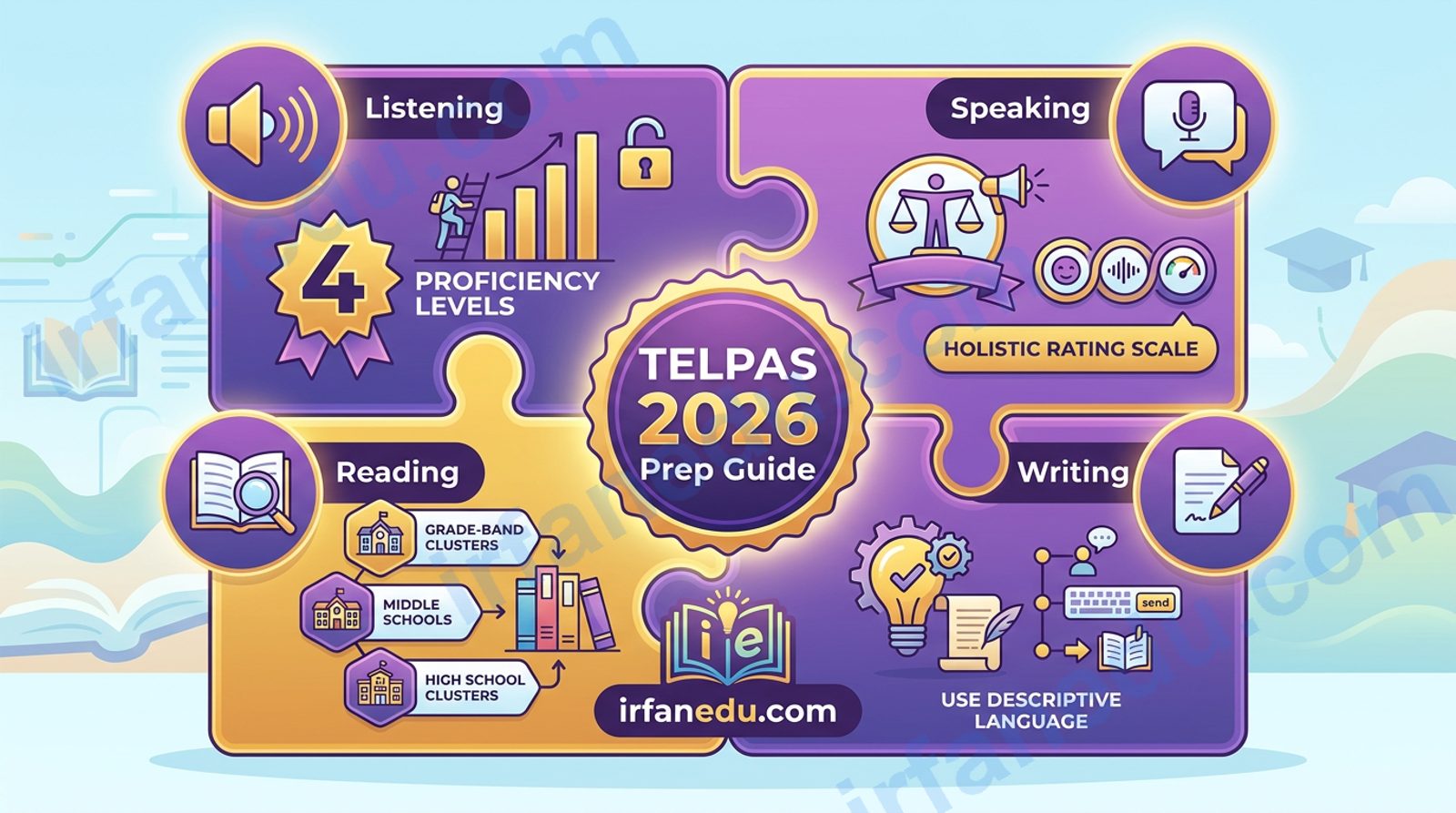
The TELPAS practice test is a preparation tool for the Texas English Language Proficiency Assessment System — the annual state test that measures how well English Language Learners (ELLs) in Texas develop English skills across four domains: Listening, Speaking, Reading, and Writing. Students are rated on four levels from Beginning to Advanced High. Practicing with official sample materials helps students understand the format, reduce anxiety, and identify exactly which skills need more work before test day.
🎯 The Short Version
- 📋 TELPAS tests four domains: Listening, Speaking, Reading, and Writing.
- 🏆 Four proficiency levels: Beginning, Intermediate, Advanced, Advanced High.
- 📝 Writing is scored from a year-long collection — not a single test-day essay.
- 🌐 Official TEA sample items are the gold-standard practice resource.
- 🎓 Advanced High in all four domains is required for reclassification as fluent.
- ⏱ The reading test is untimed; most students finish in 1–3 hours.
📑 Table of Contents
- What Is TELPAS and Why Does It Matter?
- Quick Facts: TELPAS at a Glance
- The Four TELPAS Language Domains Explained
- What the Four Proficiency Levels Actually Mean
- How to Prepare for the TELPAS: Step-by-Step
- Domain-by-Domain: What Raters Look For
- Common Mistakes Students Make (and How to Avoid Them)
- 🧠 Worth Knowing: The Insight Most Guides Miss
- Reveal-on-Click Practice Problems
- Frequently Asked Questions
- About the Author
- Sources & References
💡 What you will gain from this guide: a clear picture of every TELPAS domain, a step-by-step prep plan, domain-specific strategies, worked examples, and the one insight about writing scores that most prep guides completely miss.
1. What Is TELPAS and Why Does It Matter? 📌
TELPAS — the Texas English Language Proficiency Assessment System — is the annual English proficiency test required for all identified English Language Learners in Texas public schools, from Kindergarten through Grade 12. It is not an academic achievement test. It measures one thing: how well a student is developing English language skills.
The results carry real consequences. Schools use TELPAS scores to determine whether a student still needs bilingual or ESL program support. Federal law (Title III of the Every Student Succeeds Act) requires states to track ELL progress annually, and TELPAS is Texas’s tool for that reporting. A student who reaches Advanced High in all four domains — and meets other criteria — can be reclassified as Fluent English Proficient (FEP) and exited from language support programs.
In my experience working with ELL students and teachers, the biggest source of test anxiety is simply not knowing what the test looks like. Once students understand the format and the proficiency-level descriptors, their confidence improves immediately — even before they do a single practice question.
I have seen students who are genuinely Advanced High in speaking and listening score only Intermediate in reading — not because their English is weak, but because they have never practiced reading academic passages under test conditions. TELPAS preparation is not about cramming vocabulary lists. It is about building familiarity with the type of English the test uses. That distinction changes how you prepare.
2. Quick Facts: TELPAS at a Glance 📊
| Feature | Detail |
|---|---|
| Full Name | Texas English Language Proficiency Assessment System |
| Administered By | Texas Education Agency (TEA) |
| Who Takes It | All identified ELL students, Grades K–12 |
| Domains Tested | Listening, Speaking, Reading, Writing |
| Proficiency Levels | Beginning, Intermediate, Advanced, Advanced High |
| Reading Format | Computer-based (Grades 2–12); observation-based (K–1) |
| Writing Assessment | Holistic rating of a year-long writing collection |
| Timing | Untimed (reading typically 1–3 hours) |
| Grade Bands | K–1, 2–3, 4–5, 6–7, 8, 9–10, 11–12 |
| Official Practice Source | tea.texas.gov (released test forms) |
3. The Four TELPAS Language Domains Explained 🗣️📖✍️👂
TELPAS assesses English proficiency across four distinct language domains. Each domain is scored separately, and a student receives four individual proficiency ratings — one per domain.
Listening 👂
Students listen to audio passages and answer comprehension questions. Items test understanding of main ideas, details, vocabulary in context, and the speaker’s purpose. In my experience, students who watch academic English content regularly — such as educational videos or news segments — perform noticeably better on this domain.
Speaking 🗣️
Teachers rate students’ spoken English using the TELPAS holistic rating rubric throughout the year. They observe how students communicate in classroom discussions, presentations, and informal interactions. This is not a single recorded test — it is an ongoing observation-based assessment.
Reading 📖
This is the only domain with a formal computer-based test for grades 2–12. Students read grade-appropriate passages — including literary and informational texts — and answer multiple-choice questions. The passages increase in complexity as the proficiency level rises.
Writing ✍️
Writing is assessed through a collection of student writing samples gathered across the school year. A trained holistic rater reviews the collection and assigns one of the four proficiency ratings. This is the domain that surprises most students and families — there is no single test-day writing prompt.
4. What the Four Proficiency Levels Actually Mean 🏆
Each TELPAS domain is scored on a four-point scale. Understanding what each level looks like in practice helps students and teachers set realistic preparation goals.
| Level | What It Looks Like in Practice | Typical Characteristics |
|---|---|---|
| Beginning | Very limited English; relies heavily on visual cues and native language | Single words, memorised phrases, minimal comprehension of academic English |
| Intermediate | Basic communication; understands simple sentences in familiar contexts | Simple sentences, common vocabulary, errors that sometimes interfere with meaning |
| Advanced | Communicates effectively in most academic and social situations | Varied sentence structures, grade-appropriate vocabulary, occasional errors that rarely interfere |
| Advanced High | Near-native proficiency in academic English across all four domains | Complex sentences, wide vocabulary range, minimal errors, comparable to native-English peers |
A student must reach Advanced High in all four domains — combined with other criteria such as academic performance — to be recommended for reclassification as Fluent English Proficient.
5. How to Prepare for the TELPAS: Step-by-Step 🪜
Effective TELPAS preparation follows a clear sequence. Here is the process I recommend based on working with ELL students across multiple grade levels.
- Step 1 — Know your current level. Ask your ESL or bilingual teacher for your most recent TELPAS scores. Identify which domain is your lowest and start there.
- Step 2 — Download official TEA sample items. Go to tea.texas.gov and find released TELPAS test forms for your grade band. These are the most accurate practice materials available — they use the real item types and difficulty levels.
- Step 3 — Practice reading under test conditions. Read each passage without a dictionary. Answer all questions before checking answers. Time yourself to build stamina, even though the real test is untimed.
- Step 4 — Build your writing collection intentionally. Write on academic topics every week. Use the holistic rating rubric (available on TEA’s website) to self-evaluate. Aim to use varied sentence structures and content-area vocabulary in every piece.
- Step 5 — Strengthen listening and speaking daily. Listen to academic English for at least 20 minutes each day — podcasts, educational videos, or classroom discussions. Practice summarising what you heard in two or three sentences.
- Step 6 — Review and adjust weekly. After each practice session, identify which proficiency-level descriptors you are not yet meeting. Target those specific gaps rather than reviewing everything equally.
  ┌─────────────────────────────────────────────────────────┐
  │           TELPAS PREPARATION CYCLE (Grades 2–12)        │
  ├──────────────┬──────────────┬──────────────┬────────────┤
  │  LISTENING   │   SPEAKING   │   READING    │  WRITING   │
  │  (Computer)  │  (Teacher    │  (Computer   │ (Year-long │
  │              │  Observation)│  Based Test) │ Collection)│
  ├──────────────┼──────────────┼──────────────┼────────────┤
  │ ▸ Academic   │ ▸ Classroom  │ ▸ Official   │ ▸ Weekly   │
  │   audio      │   discussion │   TEA sample │   writing  │
  │ ▸ Summarise  │ ▸ Oral       │   passages   │   on acad. │
  │   what you   │   reports    │ ▸ Vocab in   │   topics   │
  │   heard      │ ▸ Q&A in     │   context    │ ▸ Use TEA  │
  │ ▸ TEA sample │   English    │ ▸ Main idea  │   rubric   │
  │   items      │              │   questions  │   to self- │
  │              │              │              │   rate     │
  ├──────────────┴──────────────┴──────────────┴────────────┤
  │  ALL YEAR ──────────────────────────────► TEST WINDOW   │
  └─────────────────────────────────────────────────────────┘
6. Domain-by-Domain: What Raters Look For 🔍
Knowing the scoring criteria for each domain lets you practice with purpose. The table below summarises what moves a student from one level to the next in each domain.
| Domain | Key Scoring Criteria | Most Effective Practice Activity |
|---|---|---|
| Listening | Comprehension of main idea, details, vocabulary in context, speaker’s purpose | Listen to grade-level academic audio; answer TEA sample listening items |
| Speaking | Vocabulary range, sentence complexity, pronunciation clarity, communication effectiveness | Participate actively in class; record yourself explaining a topic and review |
| Reading | Passage comprehension, vocabulary in context, inference, author’s purpose | Read one grade-level informational text per day; practice TEA released items |
| Writing | Vocabulary range, sentence variety, grammar control, overall communication | Write weekly on academic topics; self-rate using the TEA holistic rubric |
7. Common Mistakes Students Make (and How to Avoid Them) ⚠️
In my experience, the same preparation errors come up again and again. Avoiding them saves weeks of wasted effort.
The most underused resource in TELPAS preparation is the TEA’s own proficiency-level descriptor documents. These are free, detailed, and tell you exactly what a student at each level can and cannot do in each domain. I have seen teachers transform their instruction — and students transform their scores — simply by reading those descriptors carefully and targeting the gap between where a student is and where they need to be. If you have not read them, do that before anything else.
The holistic writing rating is a composite judgment — not a checklist. Most guides tell students to “use complex sentences and varied vocabulary.” That advice is correct but incomplete. What most guides miss is this: TELPAS holistic raters are specifically trained to look at the overall pattern of a writing collection, not individual pieces in isolation. A student who writes one excellent essay and several weak ones will likely score lower than a student who writes consistently at a solid Intermediate-to-Advanced level across all pieces.
This means the single most effective writing strategy is consistency over brilliance. Write at your best level every time, on every assignment — not just when you know a piece will go into the collection. Raters see the full picture, and inconsistency signals that the higher-level writing is not yet a reliable skill.
8. Reveal-on-Click Practice Problems 🧩
These sample items mirror the type of thinking TELPAS reading questions require. Try each one before revealing the answer.
📖 Practice Problem 1 — Vocabulary in Context (Grade 4–5 Level)
Passage excerpt: “The river had been rising for three days. By Tuesday morning, it had inundated the lower fields, covering the crops completely.”
Question: What does the word inundated most likely mean in this passage?
A) dried out B) flooded C) fertilised D) divided
✅ Answer: B — flooded. The context clues “river had been rising” and “covering the crops completely” tell you the word means the fields were covered with water. This is exactly the type of vocabulary-in-context item TELPAS uses — the definition is never given directly; you must infer it from the surrounding text.
📖 Practice Problem 2 — Main Idea (Grade 6–7 Level)
Passage excerpt: “Coral reefs cover less than 1% of the ocean floor, yet they support about 25% of all marine species. Scientists call them the ‘rainforests of the sea’ because of their extraordinary biodiversity. Unfortunately, rising ocean temperatures are causing widespread coral bleaching, threatening these ecosystems.”
Question: What is the main idea of this passage?
A) Coral reefs are very colourful. B) Coral reefs are important but threatened ecosystems. C) Scientists study the ocean floor. D) Marine species live in many places.
✅ Answer: B. The passage establishes the importance of coral reefs (biodiversity, “rainforests of the sea”) and then introduces the threat (bleaching). A strong main-idea answer captures both elements. Options A, C, and D each capture only one detail from the passage, not the central point.
📖 Practice Problem 3 — Inference (Grade 8–9 Level)
Passage excerpt: “Maria checked her watch for the third time in ten minutes. The presentation was in two hours, and her notes were still spread across the kitchen table. She closed her laptop, took a slow breath, and began to organise the pages one by one.”
Question: What can the reader infer about Maria?
A) She has already finished preparing. B) She is nervous but taking action to calm herself. C) She does not care about the presentation. D) She is waiting for someone to help her.
✅ Answer: B. Checking her watch repeatedly signals anxiety. Closing the laptop and organising her notes one by one signals a deliberate, calming action. Inference questions require you to combine two or more clues from the text — this is a skill that improves dramatically with regular reading practice.
9. Frequently Asked Questions ❓
What is the TELPAS test?
TELPAS stands for Texas English Language Proficiency Assessment System. It is a state-mandated annual assessment that measures how well English Language Learners (ELLs) in Texas read, write, listen, and speak in English. Results are used for program placement, reclassification, and federal reporting under Title III of the Every Student Succeeds Act.
What are the four TELPAS proficiency levels?
The four TELPAS proficiency levels are: Beginning, Intermediate, Advanced, and Advanced High. A student must reach Advanced High in all four language domains — along with meeting other academic criteria — to be considered for reclassification as a Fluent English Proficient (FEP) student.
Where can I find official TELPAS practice tests?
The Texas Education Agency (TEA) publishes released TELPAS test forms and sample items on its official website at tea.texas.gov. These are the most accurate practice materials available because they reflect the real test format, item types, and proficiency-level expectations. Always start with official materials before using third-party resources.
How is the TELPAS writing domain scored?
The TELPAS writing domain uses a holistic rating system. Trained raters evaluate a student’s writing collection — gathered throughout the school year — on a 1–4 scale corresponding to Beginning through Advanced High. Raters look at vocabulary range, sentence complexity, grammar control, and overall communication effectiveness across the entire collection, not just individual pieces.
What grades take the TELPAS?
TELPAS is administered to ELL students in Kindergarten through Grade 12 in Texas public schools. Students are grouped into grade-band clusters: K–1, 2–3, 4–5, 6–7, 8, 9–10, and 11–12. The reading assessment is computer-based for grades 2–12. Kindergarten and Grade 1 students are assessed through teacher observation rather than a computer-based test.
How long does the TELPAS take to complete?
The TELPAS reading test is untimed, but most students in grades 2–12 complete it in 1–3 hours depending on grade band. The listening assessment is also computer-based and untimed. Speaking and writing are not administered on a single test day — they are rated through ongoing teacher observation and a year-long writing collection respectively.
📚 Sources & References
- Texas Education Agency — TELPAS Official Assessment Page (tea.texas.gov)
- Khan Academy — English Language Arts Resources (supplementary grammar and reading practice)
✍ Editorial note: This article was written and fact-checked by Dr. Irfan Mansuri. All claims about TELPAS structure, scoring, and proficiency levels are based on official TEA documentation. No statistics or quotes have been fabricated. Last reviewed August 2026.