
Back to School Night: The Complete Guide for Teachers, Parents and Students
Before You Read This Guide
- Know your role: this guide covers all three perspectives — teacher, parent, and student.
- Back to school night is a group event, not a one-on-one conference. Individual child concerns belong in a separate meeting.
- Timing varies by school: most events run 60 to 90 minutes in the first two to four weeks of term.
- If your school calls it “curriculum night,” “open house,” or “meet the teacher night,” the same principles apply.
Back to school night is a school-organized event held at the start of the academic year where parents visit classrooms, meet teachers, and learn about the curriculum, grading policies, and classroom expectations. It is a group presentation for all families, not a time for individual student discussions.
Every September (or whenever your school year begins), teachers spend days preparing for an event that lasts barely 90 minutes. Parents rush from work, unsure what to ask. Students wonder whether they should even show up. I have been on both sides of the classroom door, and I can tell you the difference between a back to school night that builds real trust and one that wastes everyone’s time comes down to preparation and clear expectations.
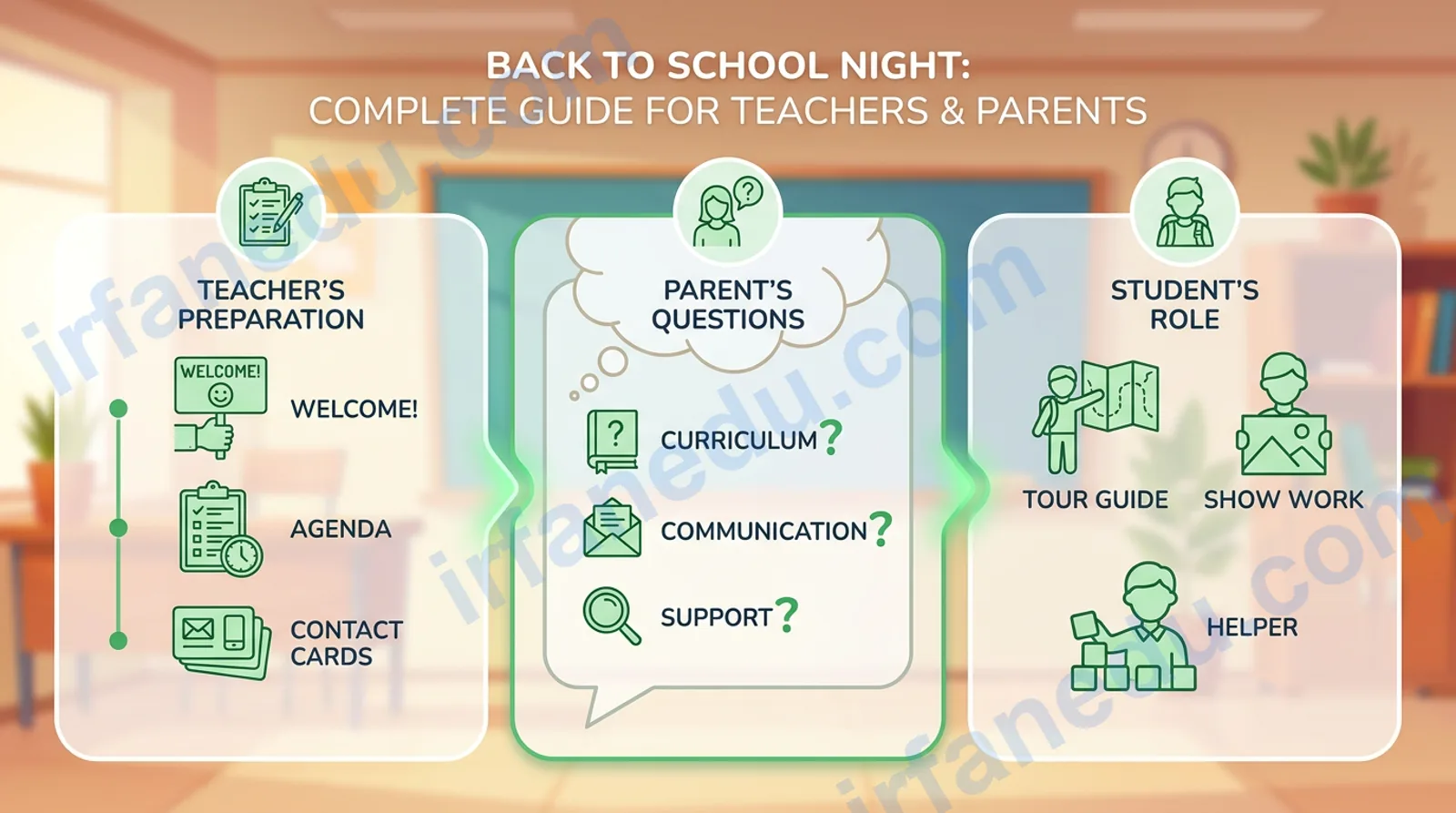
This guide gives you a concrete, actionable plan whether you are the teacher running the room, the parent sitting in a tiny chair, or the student whose work is on display.
After reading this, you will be able to:
- Understand exactly what back to school night is and what it is not.
- Prepare a step-by-step plan as a teacher, parent, or student.
- Ask the right questions and avoid the most common mistakes.
- Use a ready-made checklist on the night itself.
⚡ In Short
- Back to school night = group parent presentation, not a personal conference.
- Teachers: prepare a one-page handout, a clear agenda, and a 60-second personal intro.
- Parents: write questions in advance; save child-specific concerns for a follow-up meeting.
- Students: prepare a welcome note or display; confirm whether attendance is expected.
- The event builds the teacher-family relationship that supports a child all year long.
- Common mistake: teachers over-explain the syllabus instead of building rapport first.
| Fact | Detail |
|---|---|
| Also called | Curriculum night, open house, meet the teacher night |
| Typical timing | First 2 to 4 weeks of the academic year |
| Duration | 60 to 90 minutes total; 10 to 15 min per classroom on rotating schedules |
| Audience | Parents and guardians (students sometimes invited) |
| Purpose | Curriculum overview, grading policy, communication channels, classroom expectations |
| NOT for | Individual child progress, grades, or behavioral concerns |
| Key output | Parents leave knowing how to support their child and how to reach the teacher |
What Is Back to School Night?
Back to school night is a structured school event where teachers present their classroom program to parents as a group. The teacher explains what students will learn, how they will be graded, what the homework policy is, and how families can best support learning at home.
The key word is “group.” Every parent in the room hears the same information at the same time. This is intentional: it creates a shared baseline so that all families start the year with equal knowledge. It is not a parent-teacher conference, and it is not the right moment to ask “How is my child doing?” — that question belongs in a separate, scheduled meeting.
Schools use different names for this event. “Curriculum night” emphasizes the academic content focus. “Open house” often implies a more informal drop-in format. “Meet the teacher night” is common in primary schools where one teacher covers most subjects. The underlying structure is the same regardless of the label.
When parents understand that back to school night is a group presentation, they stop expecting individual feedback and start listening for the information that benefits every child in the class. Teachers who set this expectation at the door run smoother, more productive evenings.
How Should a Teacher Prepare for Back to School Night?
Teacher preparation is the single biggest factor in whether back to school night feels valuable or like a wasted evening. The goal is not to impress parents with a polished performance; it is to give them the specific information they need to support their child at home.
Here is the step-by-step process I recommend, built from years of observing and running these events:
-
Set a focused agenda. Choose three to four key points only: curriculum overview, grading breakdown, homework policy, and your preferred communication method. Trying to cover everything guarantees you cover nothing well.
-
Prepare your classroom as a communication tool. Post the class schedule visibly. Display student work (even early, low-stakes pieces). Put a sign-in sheet and a printed contact card at every seat before parents arrive.
-
Write a one-page handout. Summarize your syllabus, grading weights, homework expectations, and contact information on a single sheet. Parents who cannot attend still get the information, and those who do attend have something to reference later.
-
Rehearse your 60-second personal introduction. Cover your background, your teaching philosophy in one sentence, and one thing you are genuinely excited to teach this year. Authenticity here builds more trust than any credential.
-
Plan for questions. Reserve the final three to five minutes. Keep a notecard to collect questions you cannot answer on the spot, and follow up by email within 48 hours.
One thing most guides miss: the physical setup of your room sends a message before you say a word. A classroom with student names on desks, work on the walls, and clear visual organization tells parents “this teacher is prepared and my child belongs here.” A bare room with nothing on the walls does the opposite.
[IMAGE: Teacher’s classroom prepared for back to school night with student work displayed and welcome sign | ALT: classroom prepared for back to school night with student work on walls and welcome sign on whiteboard]
The Teacher’s Back to School Night Checklist
Use this checklist in the days before the event and again on the night itself. Every item has a direct payoff for parents or for your own confidence.
One Week Before
- Draft your agenda (3 to 4 items, timed)
- Write and print your one-page parent handout
- Prepare a brief slide deck or visual aid (optional but helpful)
- Confirm the schedule format with administration (rotating or single-room)
- Notify parents of the date, time, and location via your usual channel
The Day Before
- Display student work or a welcome message from students
- Post the class schedule and key classroom rules visibly
- Prepare a sign-in sheet with space for name, email, and phone
- Print contact cards (one per seat) with your email and response-time policy
- Rehearse your introduction and time your presentation
On the Night
- Stand at the door to greet parents as they arrive
- Start on time — parents on rotating schedules have hard deadlines
- Stick to your agenda; do not let one parent derail the group
- Redirect individual child questions: “That is a great question for a conference — let me give you my email”
- Collect the sign-in sheet and any written questions
- Send a follow-up email within 48 hours with your handout attached
What Should Parents Do at Back to School Night?
Parents who get the most out of back to school night arrive with a plan. The event is short — sometimes as little as 10 minutes per classroom on a rotating schedule — so every minute counts.
Before you go, write down two to three questions that apply to the whole class, not just your child. Good examples:
- How will homework be communicated each week?
- What is the grading breakdown between tests, projects, and participation?
- How early will you contact me if my child is struggling?
- What is the best way to reach you, and what is your typical response time?
Notice what is not on that list: “How is my child doing?” and “Why did my child get a B on the first quiz?” Those are conference questions. Asking them at back to school night puts the teacher in an awkward position and takes time from every other parent in the room.
Bring a small notebook. Write down the teacher’s name, email, preferred contact method, and any key dates mentioned. You will not remember them all when you get home, and this information shapes how you support your child for the rest of the year.
After the event, share what you learned with your child. Tell them what the teacher said about homework expectations or classroom rules. This simple conversation signals to your child that school matters at home too — and research on family engagement consistently links that signal to better academic outcomes.
  6:00 PM  |  Doors open — parents sign in, browse classroom
           |
  6:15 PM  |  Principal / admin welcome (all families, main hall)
           |
  6:30 PM  |  ROTATING SCHEDULE BEGINS
           |
           |  Period 1  (10 min)  Teacher intro + curriculum overview
           |  Period 2  (10 min)  Grading policy + homework expectations
           |  Period 3  (10 min)  Communication channels + Q&A
           |  Period 4  (10 min)  Elective / specialist teachers
           |  Period 5  (10 min)  Advisory / homeroom
           |
  7:20 PM  |  Informal time — parents visit specific teachers
           |
  7:30 PM  |  Event closes
What Role Do Students Play at Back to School Night?
Whether students attend back to school night depends entirely on the school’s policy, and it varies widely. Many schools run it as a parent-only event so teachers can speak candidly about class dynamics. Others invite students to act as classroom guides or to have their work on display.
If your school asks students to participate, here are the most effective contributions:
- Write a welcome letter to your parents describing what you are looking forward to this year. Leave it on your desk for them to find.
- Create a “getting to know me” display — a short poster or index card with your name, a goal for the year, and something you enjoy. It personalizes the classroom for your family.
- Act as a classroom guide if the teacher assigns this role. Know where supplies are kept, what the class schedule looks like, and two or three things the class has already done.
Even if students do not attend, they can help by tidying their desk space, organizing their folder, and letting parents know which teacher they are most excited about. That small act of ownership makes the evening feel relevant to the student, not just to the adults.
Back to School Night vs. Parent-Teacher Conference: What Is the Difference?
These two events are frequently confused, and the confusion leads to frustration on both sides. Here is a clear side-by-side comparison.
| Feature | Back to School Night | Parent-Teacher Conference |
|---|---|---|
| Timing | Start of year (first 2 to 4 weeks) | Mid-year or end of term |
| Format | Group presentation (all parents) | Individual meeting (one family) |
| Duration | 10 to 15 min per classroom | 15 to 30 min per family |
| Focus | Curriculum, policies, expectations | Specific child’s progress and needs |
| Student discussed? | No — no individual child data shared | Yes — grades, behavior, growth |
| Who attends | All parents simultaneously | One family at a time |
| Best question to ask | “How does homework work in this class?” | “What does my child need to improve?” |
Most teacher-preparation guides focus on what to say during back to school night. In my experience, the more important question is what parents feel in the first 90 seconds. When a teacher stands at the door, greets each parent by name (using the sign-in sheet from previous years or a class list), and says something specific — “I am really enjoying having your daughter in class; she asked a great question on day one” — the entire dynamic shifts. Parents who feel seen become allies, not auditors. This is the one move that costs nothing and pays dividends all year, yet almost no preparation guide mentions it. The presentation content matters far less than whether parents leave feeling that the teacher genuinely knows and cares about their child.
What Are the Most Common Back to School Night Mistakes?
After observing dozens of these events, the same errors appear repeatedly. Knowing them in advance lets you sidestep them entirely.
For Teachers
- Reading the syllabus aloud. Parents can read. Use the time to explain the reasoning behind your policies, not to recite them.
- Running over time. On rotating schedules, this causes a cascade of late arrivals in every subsequent classroom. Time your presentation and cut it if needed.
- Letting one parent dominate. Acknowledge the question, offer to follow up individually, and move on. “That is a great point — let me take your email and give you a fuller answer.”
- Forgetting to explain how to contact you. This is the single piece of information parents most want. Make it the last thing you say so it sticks.
For Parents
- Asking about your specific child. The teacher cannot and should not discuss individual students in a group setting. Save it for a conference.
- Arriving late and disrupting the presentation. If you know you will be late, sit near the door and slip in quietly.
- Not following up. If you had a question you did not get to ask, email the teacher within a week. The window of easy communication is widest right after back to school night.
Most back to school night advice tells teachers to “be organized” and tells parents to “be engaged.” That is generic and unhelpful. The real insight is this: the event’s purpose is relationship-building, not information transfer. The handout covers information. The 15 minutes in the room are for trust. Teachers who understand this shift their entire presentation — less time on policies, more time on personality, passion, and genuine warmth.
Quick Check: Back to School Night
1. Back to school night is primarily designed for:
2. How long does a typical back to school night last per classroom on a rotating schedule?
3. Which question is appropriate to ask a teacher at back to school night?
Frequently Asked Questions About Back to School Night
What is back to school night?
How long does back to school night last?
Should students attend back to school night?
What questions should parents ask at back to school night?
What is the difference between back to school night and parent-teacher conferences?
Related Articles
Educational Content Creator & Competitive Exam Specialist — Founder of IrfanEdu.com
Dr. Irfan Mansuri is an educator and SEO content expert with 15+ years of experience across high school, undergraduate, and postgraduate levels. I combine deep subject knowledge with proven teaching strategies to make complex ideas simple and actionable for students, parents, and educators worldwide.
Sources & References
-
Weiss, H. B., Kreider, H., Lopez, M. E., & Chatman, C. M. (2005). Preparing Educators to Involve Families. Harvard Family Research Project. Available via:
hfrp.org -
Edutopia. (2023). How to Make Back-to-School Night Meaningful.
edutopia.org -
National Education Association. Parent, Family, Community Involvement in Education.
nea.org - Wikipedia — Back to School
Editorial note: This article was written and fact-checked by Dr. Irfan Mansuri. All claims reflect established best practices in family-school engagement. No data or statistics have been fabricated. Last reviewed August 2026.