
Creatinine Clearance Calculator: CrCl the Right Way
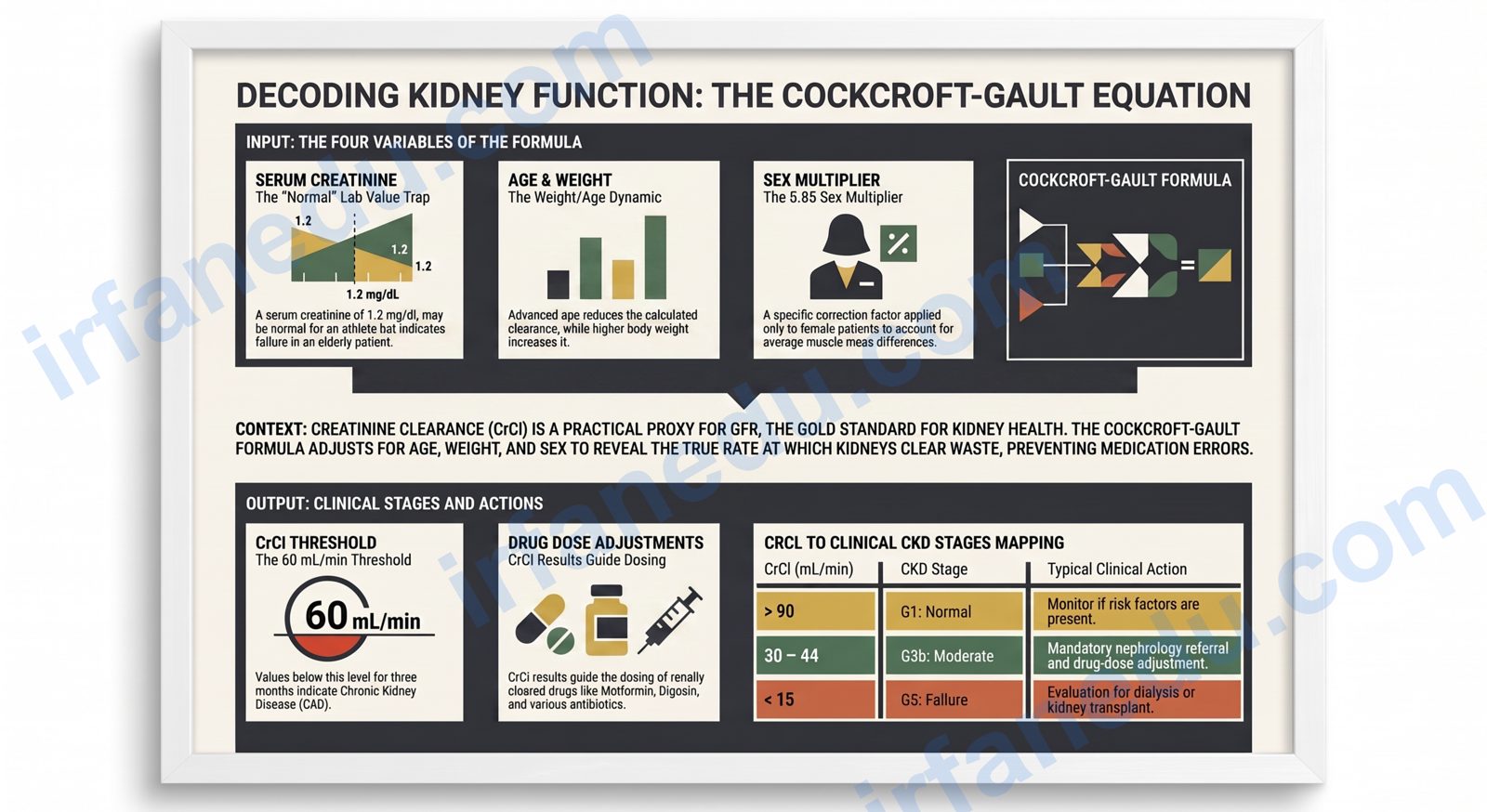
Here’s the part most people miss: the Cockcroft-Gault formula does not measure how much creatinine is in your blood — it estimates how fast your kidneys are clearing it. That distinction changes how you interpret every result. A serum creatinine of 1.2 mg/dL means very different things in a 25-year-old athlete and a 78-year-old with low muscle mass, yet both numbers look “normal” on a standard lab report.
Creatinine clearance (CrCl) is a calculated estimate of the glomerular filtration rate (GFR) — the volume of blood the kidneys filter per minute. The Cockcroft-Gault formula derives CrCl from four variables: age, body weight, serum creatinine, and biological sex. A result of 90 mL/min or above is considered normal for adults; values below 60 mL/min for more than three months indicate chronic kidney disease (CKD).
Use the calculator below to get an instant result with a full step-by-step breakdown. Then read on for the formula, worked examples, and the common mistakes that lead to wrong answers.
Creatinine Clearance Calculator
Cockcroft-Gault — result in mL/min
years
kg
mg/dL
mL/min
Step-by-Step Solution
How to Use This Calculator
- Select biological sex — male or female. This controls the 0.85 correction factor.
- Enter age in whole years.
- Enter body weight in kilograms. For obese patients, consider using adjusted body weight (see the common-mistakes section below).
- Enter serum creatinine (SCr) in mg/dL from a recent blood test.
- Click Calculate. The result card shows your CrCl in mL/min, a CKD-stage label, unit conversions, and a numbered solution matching the formula steps.
What Is Creatinine Clearance?
Creatinine clearance is the volume of blood plasma the kidneys clear of creatinine per unit of time, expressed in mL/min. It serves as a practical proxy for the glomerular filtration rate (GFR) — the gold-standard measure of kidney function.
Creatinine is a waste product of muscle metabolism. Healthy kidneys filter it out continuously. When kidney function declines, creatinine accumulates in the blood, raising the serum creatinine level. The Cockcroft-Gault formula turns that serum value into an estimated clearance rate by factoring in the patient’s age, weight, and sex — variables that determine how much creatinine a person’s muscles produce in the first place.
In clinical practice, CrCl is used to adjust doses of renally cleared drugs such as metformin, digoxin, aminoglycosides, and many antibiotics. According to the National Kidney Foundation, GFR (and by extension CrCl) is the best overall index of kidney function in health and disease.
The Cockcroft-Gault Formula Explained
Cockcroft-Gault Equation
where F = 0.85 for females, 1.0 for males
| Symbol | Meaning | Unit |
|---|---|---|
| CrCl | Creatinine clearance (estimated) | mL/min |
| Age | Patient age | years |
| Weight | Body weight (actual or adjusted) | kg |
| SCr | Serum creatinine concentration | mg/dL |
| F | Sex factor (0.85 female, 1.0 male) | dimensionless |
| 72 | Empirical constant (unit-balancing) | dimensionless |
The formula was published by Donald Cockcroft and Henry Gault in 1976 and validated against 24-hour urine creatinine collections. The constant 72 is not arbitrary — it was derived from the regression of measured clearances in the original study population and absorbs the unit conversions needed to output mL/min.
Worked Examples
Patient: Male, 62 years old, 80 kg, SCr = 1.3 mg/dL
- 140 − 62 = 78
- 78 × 80 = 6,240
- Male: no sex factor → numerator = 6,240
- 72 × 1.3 = 93.6
- 6,240 ÷ 93.6 = 66.7 mL/min (G2 — mildly reduced)
Patient: Female, 75 years old, 58 kg, SCr = 1.1 mg/dL
- 140 − 75 = 65
- 65 × 58 = 3,770
- Female multiplier: 3,770 × 0.85 = 3,204.5
- 72 × 1.1 = 79.2
- 3,204.5 ÷ 79.2 = 40.5 mL/min (G3b — moderately-severely reduced)
Note: a serum creatinine of 1.1 mg/dL looks borderline normal on a lab report, yet this 75-year-old woman has a CrCl that places her in CKD Stage 3b. This is exactly the “normal-looking but not normal” trap the formula exposes.
  COCKCROFT-GAULT — FORMULA ANATOMY

  Numerator:
  ┌─────────────────────────────────────────────┐
  │  (140 − Age)  ×  Weight (kg)  ×  F          │
  │       ↑               ↑          ↑           │
  │  Age effect    Muscle mass   Sex factor      │
  │  (older → ↓)  (heavier → ↑)  (F=0.85/1.0)  │
  └─────────────────────────────────────────────┘
           ÷
  Denominator:
  ┌─────────────────────────────────────────────┐
  │         72  ×  SCr (mg/dL)                  │
  │              ↑                               │
  │    Higher SCr → lower CrCl (worse kidneys)  │
  └─────────────────────────────────────────────┘
CrCl Ranges and CKD Stages
The table below maps CrCl values to CKD G-stages as defined by KDIGO 2022 guidelines. These stages guide clinical decisions from monitoring frequency to drug-dose adjustment.
| CrCl (mL/min) | CKD G-Stage | Description | Typical Action |
|---|---|---|---|
| ≥ 90 | G1 | Normal or high | Monitor if risk factors present |
| 60 – 89 | G2 | Mildly reduced | Monitor annually |
| 45 – 59 | G3a | Mildly-moderately reduced | Review medications; monitor every 6 months |
| 30 – 44 | G3b | Moderately-severely reduced | Nephrology referral; dose-adjust drugs |
| 15 – 29 | G4 | Severely reduced | Prepare for renal replacement therapy |
| < 15 | G5 | Kidney failure | Dialysis or transplant evaluation |
Common Mistakes When Calculating CrCl
Using actual body weight for an obese patient (e.g. 130 kg) inflates the numerator and produces an unrealistically high CrCl, leading to drug overdose.
Use
Sources & References
Written and fact-checked by Dr Irfan Mansuri. External links open in a new tab and are provided for further reading and verification.