
🧪 Lewis Dot Generator: Draw Electron Structures Instantly
Imagine you’re sitting in chemistry class, staring at the formula NH₃ on your test paper. You know you need to draw its Lewis dot structure — but you can’t remember whether nitrogen gets a lone pair or not. 😰 That moment of panic is exactly why I built this tool.
A Lewis dot structure shows every valence electron in a molecule as a dot or a bond line. Getting it right means knowing the total electron count, the octet rule, and where to place lone pairs — skills that show up on every chemistry exam from high school through university.
In this guide you’ll get a fully working Lewis dot generator, three detailed worked examples, a visual diagram, and a clear explanation of the rules — so you understand the why, not just the answer.
A Lewis dot generator draws electron dot structures by calculating total valence electrons for a molecule, placing the least electronegative atom at the center, forming single bonds, completing outer-atom octets, and distributing remaining electrons as lone pairs — then upgrading to double or triple bonds if needed. For H₂O: 8 total valence electrons, 2 O–H bonds, 2 lone pairs on oxygen.
- 🔵 Valence electrons = the key number; count them first for every atom.
- 🟠 The least electronegative atom (usually carbon) goes in the center.
- 🟢 Outer atoms get their octets filled before the central atom.
- 🔴 Hydrogen always stops at 2 electrons — never 8.
- ⭐ Use the generator below to check any common molecule instantly.
- 📐 Formal charge math tells you which structure is the best one.
🧮 Interactive Lewis dot generator
🚀 Quick-pick a molecule:
How to use this Lewis dot generator
- Click any preset molecule button (H₂O, CO₂, NH₃, etc.) for an instant result.
- Or type a formula in the text box (e.g.
CH4,SO2) and press Enter. - Click the orange Generate Structure button.
- Read the total valence electron count and bonding pairs in the result card.
- Study the ASCII Lewis dot diagram — dots are lone pairs, lines are bonds.
- Follow the numbered step-by-step solution to understand the construction logic.
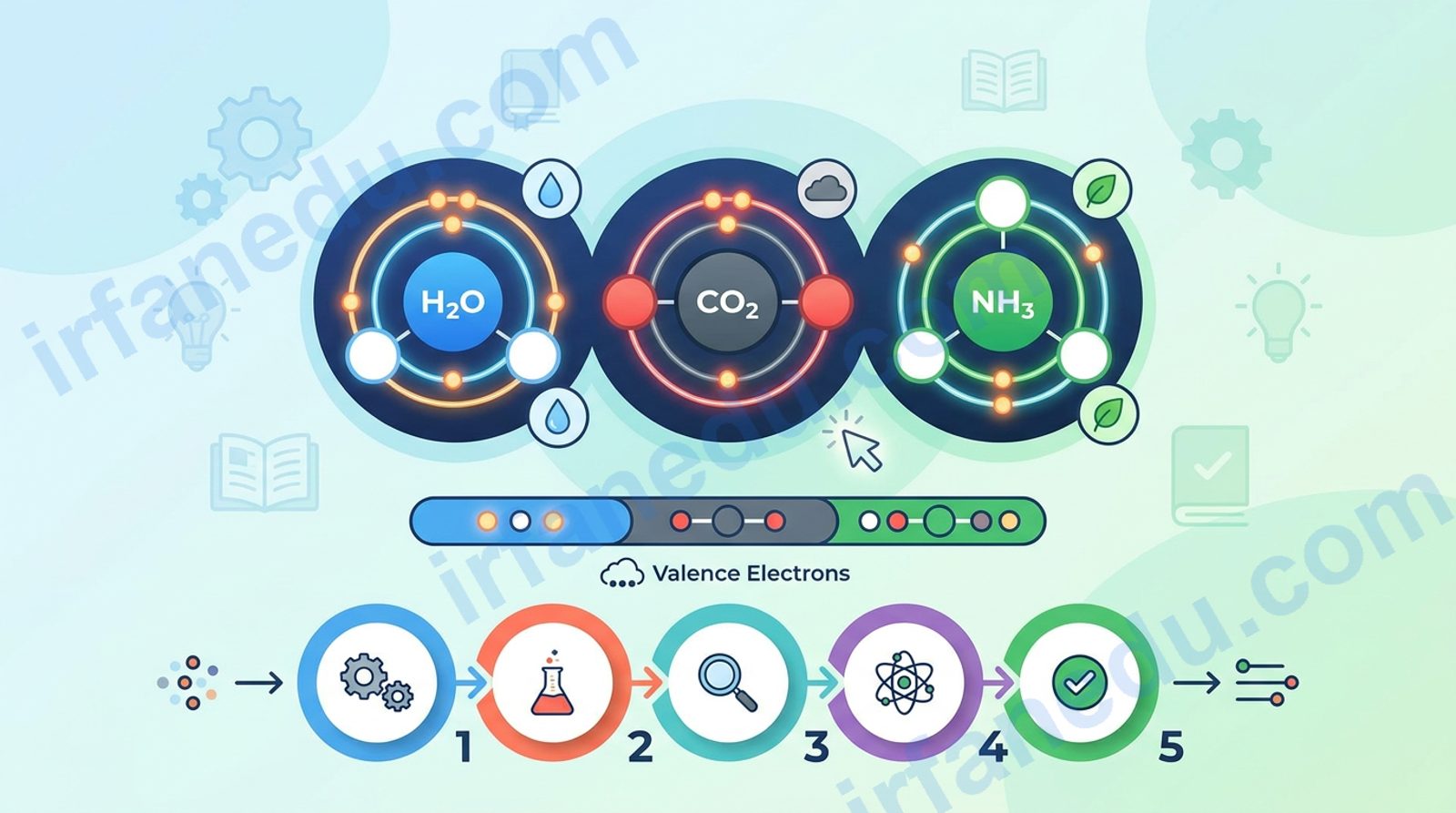
🎨 Visual solution: H₂O, CO₂, and NH₃ side by side
Seeing three structures together reveals the pattern: every molecule starts with the same counting process, but the number of lone pairs and bond types changes based on the total electron count.
🔬 Lewis Dot Diagrams — Three Core Molecules
  WATER (H₂O)          CARBON DIOXIDE (CO₂)      AMMONIA (NH₃)
  ─────────────        ──────────────────────     ─────────────
      ••                  ••  ••   ••  ••              ••
  H — O — H              O = C  = O                   N
      ••                  ••  ••   ••  ••             /|\
                                                     H H H

  Total VE: 8          Total VE: 16               Total VE: 8
  Bonds: 2 single      Bonds: 2 double            Bonds: 3 single
  Lone pairs on O: 2   Lone pairs on each O: 2    Lone pair on N: 1
  Shape: Bent          Shape: Linear              Shape: Trigonal pyramidal
Notice that CO₂ needs double bonds because single bonds leave carbon with only 4 electrons. That’s the octet rule forcing an upgrade — a pattern you’ll see repeatedly in chemistry.
Sources & References
Written and fact-checked by Dr Irfan Mansuri. External links open in a new tab and are provided for further reading and verification.