
Mulch Calculator: How Much Mulch Do You Need?
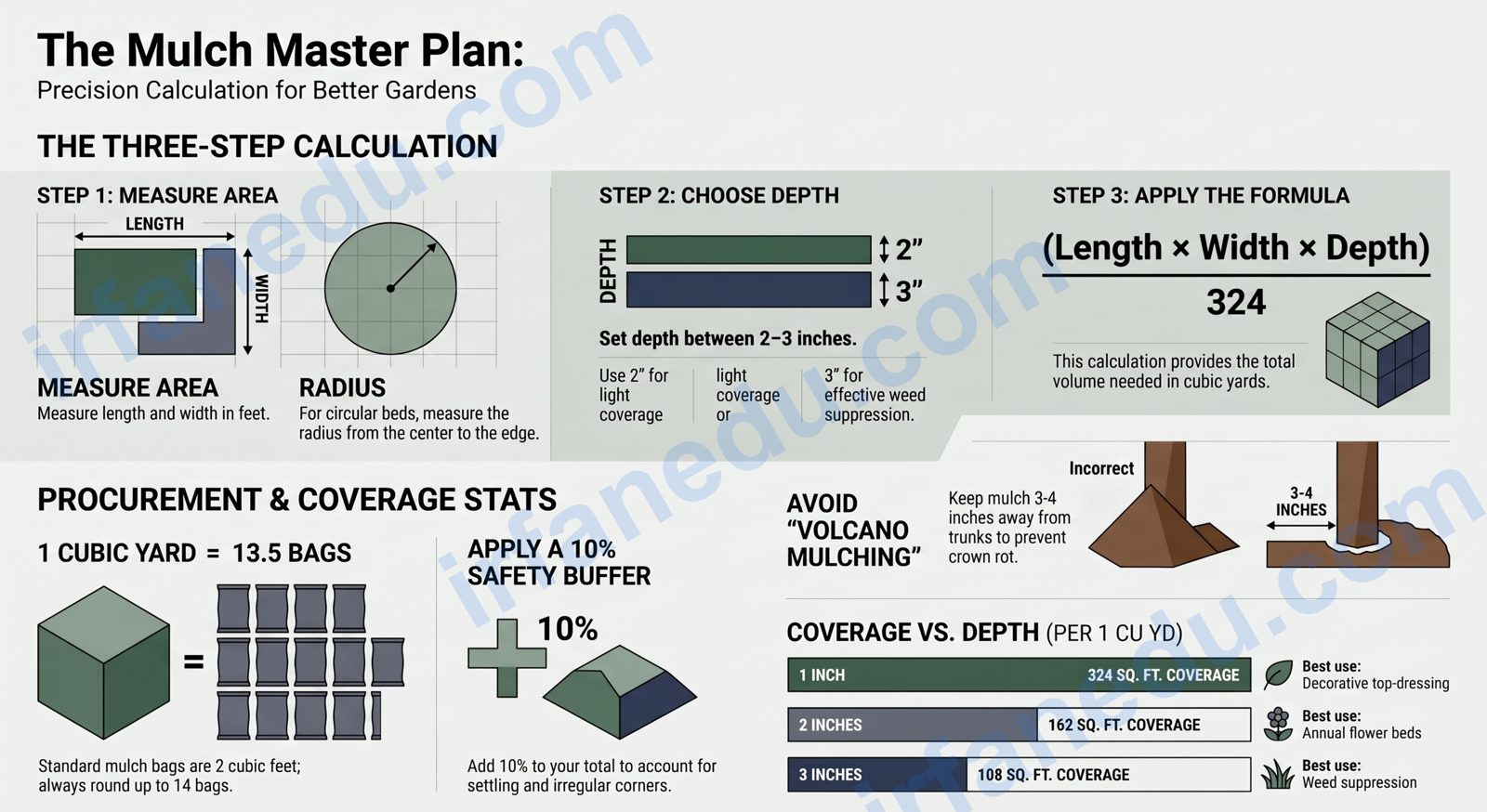
- A tape measure (or a rough step-count of your bed’s length and width in feet).
- Your desired mulch depth in inches (2 inches for light coverage, 3 inches for weed suppression).
- For circular beds: measure the radius (distance from center to edge) in feet.
- Know your purchase format: bulk delivery is sold in cubic yards; bagged mulch is typically 2 cubic feet per bag.
Buying too little mulch means a second trip to the garden center. Buying too much means wasted money and a pile rotting in the driveway. This mulch calculator gives you the exact cubic yards and bag count you need in seconds — just enter your bed dimensions and depth.
Quick Answer
To find how much mulch you need, multiply your bed’s length (ft) by its width (ft) by the desired depth (inches), then divide by 324. That gives cubic yards. One cubic yard covers 324 sq ft at 1 inch deep, 162 sq ft at 2 inches, or 108 sq ft at 3 inches. Divide cubic yards by 0.0741 to convert to standard 2-cu-ft bags.
- Formula: Cubic Yards = (Length x Width x Depth in inches) / 324.
- One cubic yard = 27 cubic feet = about 13.5 standard 2-cu-ft bags.
- Standard depth: 2-3 inches for most garden beds; never exceed 4 inches.
- Add a 10% buffer for irregular shapes and spillage at edges.
- Organic mulch compresses ~25% per year; plan for an annual top-up, not full replacement.
Interactive Mulch Calculator
Mulch Volume Calculator
ft
ft
inches
How to Use This Calculator
The calculator handles both rectangular and circular beds. Follow these five steps to get an accurate result.
- Choose your bed shape — click "Rectangular / Square Bed" or "Circular Bed."
- Enter dimensions — length and width in feet for rectangular beds, or radius in feet for circular beds. Measure to the nearest half-foot for best accuracy.
- Enter desired depth — type your target mulch depth in inches. Use 2 inches for light coverage, 3 inches for weed suppression.
- Click Calculate — the result card shows cubic yards, cubic feet, bag counts for both 2 cu ft and 3 cu ft bags, and a 10% buffer recommendation.
- Use the buffered number when ordering bulk delivery to account for settling, edge spillage, and irregular corners.
What Is Mulch and Why Does Volume Matter?
Mulch is any material — wood chips, bark, straw, gravel, or rubber — spread over soil to retain moisture, regulate temperature, and suppress weeds. Volume matters because mulch is sold by the cubic yard in bulk or by cubic feet in bags, and the coverage you get depends entirely on how thick you spread it.
A thin layer (under 1.5 inches) does almost nothing for weed suppression. Too thick a layer (over 4 inches) blocks oxygen from reaching roots and can cause crown rot in shrubs. Getting the volume right is not just about cost — it directly affects plant health.
In my experience helping students and homeowners understand garden math, the single most common error is confusing cubic feet with cubic yards. People see "1 cubic yard" on a delivery invoice and imagine a small box. In reality, one cubic yard is 27 cubic feet — roughly the volume of a standard washing machine times three. When you picture it that way, the formula stops feeling abstract and starts feeling practical.
The Mulch Formula Explained
The core formula converts a flat area and a depth into a three-dimensional volume, then converts that volume into the units suppliers use.
Cubic Yards = (Length ft × Width ft × Depth inches) ÷ 324
The divisor 324 comes from converting inches to feet (÷12) and cubic feet to cubic yards (÷27): 12 × 27 = 324.
| Symbol | Meaning | Unit |
|---|---|---|
| L | Bed length | feet (ft) |
| W | Bed width | feet (ft) |
| D | Desired mulch depth | inches (in) |
| r | Radius (circular beds) | feet (ft) |
| Vyd | Volume in cubic yards | yd³ |
| Vft | Volume in cubic feet | ft³ |
For circular beds, replace L × W with $$\pi r^2$$ (approximately 3.1416 × radius²), then divide by 324 the same way.
Coverage Reference: How Far Does One Cubic Yard Go?
| Depth | Coverage per 1 Cu Yd | Bags Needed per 1 Cu Yd | Best Use |
|---|---|---|---|
| 1 inch | 324 sq ft | 14 (2 cu ft bags) | Decorative top-dressing |
| 2 inches | 162 sq ft | 14 | Annual flower beds |
| 3 inches | 108 sq ft | 14 | Weed suppression, shrubs |
| 4 inches | 81 sq ft | 14 | Paths, heavy weed areas |
Note: bags per cubic yard is always ~13.5, rounded up to 14, regardless of depth — the depth only changes how far a given volume spreads.
Worked Examples
Given: Length = 15 ft, Width = 5 ft, Depth = 3 inches.
- Area = 15 × 5 = 75 sq ft
- Volume (cu ft) = 75 × 3 ÷ 12 = 18.75 cu ft
- Volume (cu yd) = 75 × 3 ÷ 324 = 0.69 cu yd
- Bags (2 cu ft) = 18.75 ÷ 2 = 9.4 → round up to 10 bags
- With 10% buffer: 0.69 × 1.10 = 0.76 cu yd recommended
Given: Radius = 4 ft, Depth = 2 inches.
- Area = 3.1416 × 4² = 3.1416 × 16 = 50.27 sq ft
- Volume (cu ft) = 50.27 × 2 ÷ 12 = 8.38 cu ft
- Volume (cu yd) = 50.27 × 2 ÷ 324 = 0.31 cu yd
- Bags (2 cu ft) = 8.38 ÷ 2 = 4.19 → round up to 5 bags
- With 10% buffer: 0.31 × 1.10 = 0.34 cu yd recommended
  SIDE VIEW — Garden Bed Cross-Section
  ┌─────────────────────────────────┐
  │  ░░░░░░░░░░░░░░░░░░░░░░░░░░░░  │  ← Mulch layer (3 in)
  │  ░░░░░░░░░░░░░░░░░░░░░░░░░░░░  │
  │  ░░░░░░░░░░░░░░░░░░░░░░░░░░░░  │
  ├─────────────────────────────────┤  ← Soil surface
  │                                 │
  │           Soil / Roots          │
  │                                 │
  └─────────────────────────────────┘
  ←──────────── Width (ft) ────────→
  Volume = Length × Width × (3÷12) ft³
         = Length × Width × 3 ÷ 324 yd³
Common Mistakes When Calculating Mulch
Wrong: Measuring depth in feet instead of inches.
Right: Always enter depth in inches. If you enter 0.25 ft instead of 3 inches, the formula gives you a result 12 times too small. The divisor 324 only works when depth is in inches.
Wrong: Treating cubic feet and cubic yards as the same unit.
Right: One cubic yard = 27 cubic feet. Ordering 3 cubic feet when you need 3 cubic yards means you receive 1/9th of the mulch you actually need.
Wrong: Calculating one large area when the bed has irregular cutouts (trees, paths, structures).
Right: Break the bed into rectangles and circles, calculate each separately, then add the volumes together. Subtract any areas occupied by large plants or hardscaping.
Wrong: Buying the exact calculated amount with no buffer.
Right: Add 10% to your total. Bags compress during transport, edges are rarely perfectly straight, and a small surplus is far cheaper than a second delivery fee.
Most mulch guides tell you how much to buy but never mention where the volume goes. In my experience, a significant portion of purchased mulch ends up piled against tree trunks in the classic "volcano" shape — a practice that is both harmful to trees and wasteful. A 3-inch deep, 12-inch-diameter volcano mound around a single tree consumes roughly 0.03 extra cubic yards of mulch that does zero horticultural good. Across a property with 10 trees, that is 0.3 cubic yards of wasted material — nearly half a bulk bag. Flat, even coverage at 2-3 inches, kept 3-4 inches away from the trunk, uses less mulch and keeps trees healthier. No other mulch calculator guide I have reviewed flags this as a volume-planning issue.
Frequently Asked Questions
How many cubic yards of mulch do I need for 500 square feet at 3 inches deep?
How many bags of mulch equal one cubic yard?
What is the best mulch depth for garden beds?
How do I calculate mulch for a circular bed?
Does mulch depth affect how much I need to buy each year?
- The mulch formula is: Cubic Yards = (Length × Width × Depth in inches) ÷ 324.
- One cubic yard covers 108 sq ft at 3 inches deep or 162 sq ft at 2 inches deep.
- One cubic yard equals approximately 13.5 standard 2-cu-ft bags; always round up to 14.
- Add a 10% buffer to your calculated volume before ordering.
- Never pile mulch against tree trunks — it wastes volume and harms the tree.
- Organic mulch compresses ~25% per year; plan for an annual top-up, not full replacement.