
New York DMV Permit Practice Test
What is in this test
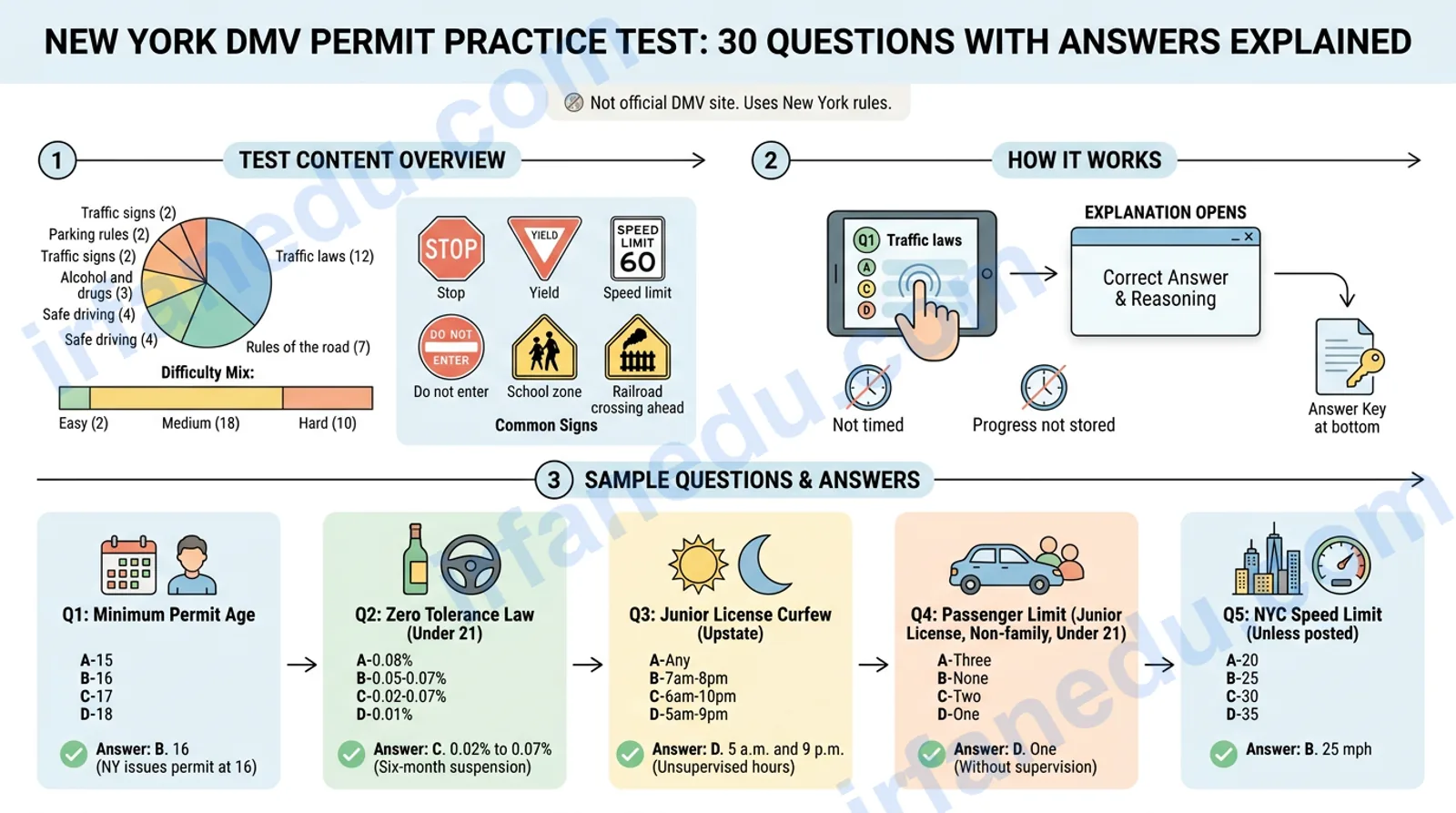
Tap an option and the page marks it and opens the explanation. Nothing is timed and nothing is stored, so you can work through it in one sitting or come back to it. If you would rather not tap through, every answer is also listed in the answer key at the bottom.
| Subject | Questions |
|---|---|
| Traffic laws | 12 |
| Rules of the road | 7 |
| Safe driving | 4 |
| Alcohol and drugs | 3 |
| Parking rules | 2 |
| Traffic signs | 2 |
Difficulty mix: 2 easy, 18 medium, 10 hard. The questions run easiest first.
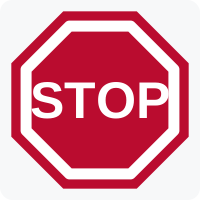
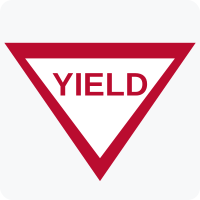
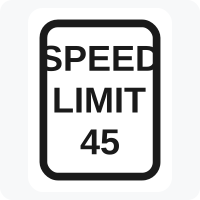
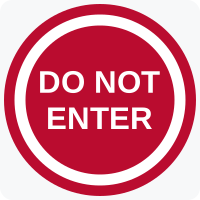
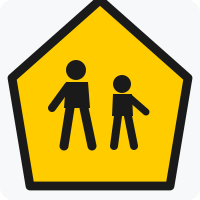
Signs come up on every state paper. These six account for more of them than any others:

The 30 questions
The minimum age to obtain a New York learner permit is:
Show the answer
Correct answer: B. 16
New York issues a learner permit at 16. Drivers aged 16 or 17 who pass the road test receive a junior license, which carries restrictions until they turn 18 or complete an approved driver education course.
Under New York’s Zero Tolerance Law, a driver under 21 commits an offense at a BAC of:
Show the answer
Correct answer: C. 0.02% to 0.07%
New York’s Zero Tolerance Law covers 0.02% through 0.07% for drivers under 21, bringing a six-month license suspension and a civil penalty. At 0.08% or above the driver faces the same DWI charge as an adult.
Outside New York City and Long Island, a junior license holder may generally drive unsupervised between:
Show the answer
Correct answer: D. 5 a.m. and 9 p.m.
The junior license curfew runs from 9 p.m. to 5 a.m. Outside those hours the driver may operate unsupervised upstate, subject to the passenger limit. Different and stricter rules apply in the New York City region.
A New York junior license holder may carry how many passengers under 21 who are not immediate family?
Show the answer
Correct answer: D. One
Only one passenger under 21 who is not an immediate family member is allowed, unless a parent, guardian, or driving instructor is supervising. Every passenger must wear a seat belt.
Unless otherwise posted, the speed limit in New York City is:
Show the answer
Correct answer: B. 25 mph
New York City’s default limit is 25 mph. Elsewhere in the state the default in a city or village is 30 mph, and 55 mph is the maximum on other roads unless a different limit is posted.
In New York, a BAC of 0.05% to 0.07% for a driver 21 or over can support a charge of:
Show the answer
Correct answer: A. Driving While Ability Impaired (DWAI)
New York uniquely charges DWAI between 0.05% and 0.07%. DWI applies at 0.08% or above, and Aggravated DWI at 0.18% or above, each carrying progressively heavier penalties.
New York’s seat belt law requires:
Show the answer
Correct answer: C. The driver and every passenger, front and rear, to wear a seat belt
New York requires all occupants of any age to be belted in every seating position. The driver is responsible for every passenger under 16, and unbelted rear passengers can injure those in front during a crash.
Handheld mobile phone use while driving in New York is:
Show the answer
Correct answer: D. Prohibited for all drivers, and any device use is prohibited for junior license and permit holders
New York bans handheld phone use and texting for every driver, and a violation adds five points to the record. Junior license and learner permit holders may not use a portable electronic device at all.
In New York, when a school bus stops with red lights flashing, you must stop:
Show the answer
Correct answer: A. Whether you are behind it or approaching from the opposite direction, including on divided highways
New York’s rule is stricter than most states: you must stop for a school bus with flashing red lights even on a divided highway or a multi-lane road. A first offense brings points, a fine, and possible jail.
New York’s Move Over law requires drivers to use due care and change lanes when passing:
Show the answer
Correct answer: C. Stopped emergency, hazard, and maintenance vehicles displaying flashing lights
The Ambrose-Searles Move Over Act covers police, fire, ambulance, tow trucks, and highway maintenance vehicles with flashing lights, on both shoulders. Slow down and move over a lane when it is safe.
In New York, you may not park within how many feet of a fire hydrant?
Show the answer
Correct answer: B. 15 feet
Fifteen feet is the New York clearance. Parking is also prohibited within an intersection, on a crosswalk or sidewalk, in front of a driveway, and on a bridge or in a tunnel.
You are approaching a New York intersection with a stop sign. You must stop:
Show the answer
Correct answer: D. At the stop line, or before the crosswalk, or before entering the intersection if there are no markings
Stop at the first of these you reach: the stop line, the crosswalk, or the point where you can see cross traffic. You may then edge forward to get a view before proceeding.
New York winters bring black ice. It is most likely to form:
Show the answer
Correct answer: B. On bridges, overpasses, and shaded areas, especially near freezing point
Bridges lose heat from above and below, so they freeze first. Black ice is nearly invisible because it is a thin clear film. If the road ahead looks unusually glossy, ease off well before you reach it.
A New York highway sign with white lettering on a green background provides:
Show the answer
Correct answer: A. Directions, distances, and route guidance
Green is the guide color nationwide. New York uses blue for motorist services, brown for parks and recreational sites, and orange for temporary work zone control.
When driving on a New York highway in heavy snow, you should:
Show the answer
Correct answer: B. Slow down, increase following distance to at least eight to ten seconds, and use low beams
Never crowd a plow: they throw snow and salt, and their blades extend beyond the vehicle. Cruise control is dangerous on snow because it can keep applying power when a wheel starts to slip.
New York child restraint law requires children to ride in a booster or child seat until they are:
Show the answer
Correct answer: C. At least 8, and rear-facing until at least 2
New York requires children under 2 to ride rear-facing and children under 8 to use an appropriate restraint system. Children under 4 must use a seat with a harness rather than a booster alone.
In New York, you must yield the right-of-way to a pedestrian:
Show the answer
Correct answer: A. In any marked or unmarked crosswalk
Pedestrians have the right-of-way in marked and unmarked crosswalks. Never pass a vehicle stopped at a crosswalk, because it is almost certainly yielding to a pedestrian you cannot yet see.
In New York, driving through a work zone where workers are present:
Show the answer
Correct answer: D. Carries doubled fines and, for repeat speeding offenses, license suspension
New York doubles work zone fines, and two speeding convictions in a work zone can suspend your license. Reduced limits apply until an END WORK ZONE sign, whether or not workers are visible.
New York’s minimum liability insurance must be in place:
Show the answer
Correct answer: A. Continuously for as long as the vehicle is registered, even while it is parked
New York requires continuous coverage while a vehicle is registered. A lapse of even a day triggers a civil penalty per day and can suspend both your registration and your driver license.
New York recommends a following distance in good conditions of at least:
Show the answer
Correct answer: B. Two seconds, and more in poor conditions or at higher speeds
Two seconds is the stated minimum in the New York manual for good conditions, and it should be increased substantially in rain, snow, fog, at night, or when following a large vehicle that blocks your view.
A New York junior license (Class DJ) is:
Show the answer
Correct answer: A. Not valid anywhere in New York City
A junior license or permit is not valid in any of the five boroughs of New York City at any time, for any purpose. Separate stricter rules also apply in Nassau, Suffolk, and Westchester counties.
In New York City, a right turn on a red light is:
Show the answer
Correct answer: D. Prohibited unless a sign specifically permits it
New York City reverses the usual rule: turning on red is banned unless a sign allows it. Elsewhere in the state right on red is permitted after a full stop unless a sign prohibits it.
In New York, a driver must report a crash to the DMV within 10 days when property damage exceeds:
Show the answer
Correct answer: B. $1,000
New York requires a written report on form MV-104 within ten days when damage to any one person’s property exceeds $1,000, and immediately when anyone is injured or killed. Failing to file can suspend your license.
New York’s point system requires a Driver Responsibility Assessment when a driver accumulates:
Show the answer
Correct answer: C. 6 or more points within 18 months
Six points within eighteen months triggers an annual Driver Responsibility Assessment for three years, separate from any fine. Eleven points within eighteen months can bring a license suspension.
In New York, when two vehicles arrive at a four-way stop at the same time:
Show the answer
Correct answer: A. The vehicle on the right goes first
The driver on the left yields to the driver on the right. A driver turning left must additionally yield to any vehicle coming straight through from the opposite direction.
A first DWI conviction in New York for a driver 21 or over brings a license revocation of at least:
Show the answer
Correct answer: C. 6 months
A first DWI brings a revocation of at least six months, a fine of $500 to $1,000, possible jail, and a mandatory ignition interlock. A revocation, unlike a suspension, requires you to reapply for the license.
New York requires headlights to be on:
Show the answer
Correct answer: B. From half an hour after sunset to half an hour before sunrise, in poor visibility, and whenever wipers are in use
New York’s wipers-on, lights-on rule applies to rain, sleet, and snow. Daytime running lights alone do not satisfy it, because they leave the tail lights unlit, which is when you are hardest to see in spray.
On a New York street with alternate side parking rules in effect, you must:
Show the answer
Correct answer: C. Move your vehicle during the posted hours so street cleaning can proceed
Alternate side parking clears one side of the street for cleaning during posted hours. Leaving a vehicle in place brings a ticket and, in some cases, towing. Check the sign for the specific days and times.
You are driving on a New York parkway and see a sign prohibiting commercial vehicles. This is because:
Show the answer
Correct answer: A. Many parkway bridges have low clearances that trucks and buses cannot pass under
New York’s parkways were built with stone-arch bridges of limited height. Truck strikes are a recurring problem, so commercial vehicles are barred and must use designated truck routes instead.
A New York sign showing a white rectangle with a red circle and slash over a truck symbol means:
Show the answer
Correct answer: D. Trucks are prohibited on that roadway
The red circle and slash is the universal prohibition symbol. On New York parkways this sign bars commercial vehicles because of the low bridge clearances along the route.
Answer key
Every answer in one place, in question order.
| No. | Ans | The correct option |
|---|---|---|
| 1 | B | 16 |
| 2 | C | 0.02% to 0.07% |
| 3 | D | 5 a.m. and 9 p.m. |
| 4 | D | One |
| 5 | B | 25 mph |
| 6 | A | Driving While Ability Impaired (DWAI) |
| 7 | C | The driver and every passenger, front and rear, to wear a seat belt |
| 8 | D | Prohibited for all drivers, and any device use is prohibited for junior license and permit holders |
| 9 | A | Whether you are behind it or approaching from the opposite direction, including on divided highways |
| 10 | C | Stopped emergency, hazard, and maintenance vehicles displaying flashing lights |
| 11 | B | 15 feet |
| 12 | D | At the stop line, or before the crosswalk, or before entering the intersection if there are no markings |
| 13 | B | On bridges, overpasses, and shaded areas, especially near freezing point |
| 14 | A | Directions, distances, and route guidance |
| 15 | B | Slow down, increase following distance to at least eight to ten seconds, and use low beams |
| 16 | C | At least 8, and rear-facing until at least 2 |
| 17 | A | In any marked or unmarked crosswalk |
| 18 | D | Carries doubled fines and, for repeat speeding offenses, license suspension |
| 19 | A | Continuously for as long as the vehicle is registered, even while it is parked |
| 20 | B | Two seconds, and more in poor conditions or at higher speeds |
| 21 | A | Not valid anywhere in New York City |
| 22 | D | Prohibited unless a sign specifically permits it |
| 23 | B | $1,000 |
| 24 | C | 6 or more points within 18 months |
| 25 | A | The vehicle on the right goes first |
| 26 | C | 6 months |
| 27 | B | From half an hour after sunset to half an hour before sunrise, in poor visibility, and whenever wipers are in use |
| 28 | C | Move your vehicle during the posted hours so street cleaning can proceed |
| 29 | A | Many parkway bridges have low clearances that trucks and buses cannot pass under |
| 30 | D | Trucks are prohibited on that roadway |
More permit test practice
Everything on this site tagged DMV lives in the DMV category.
Sources