
Florida DMV Permit Practice Test
What is in this test
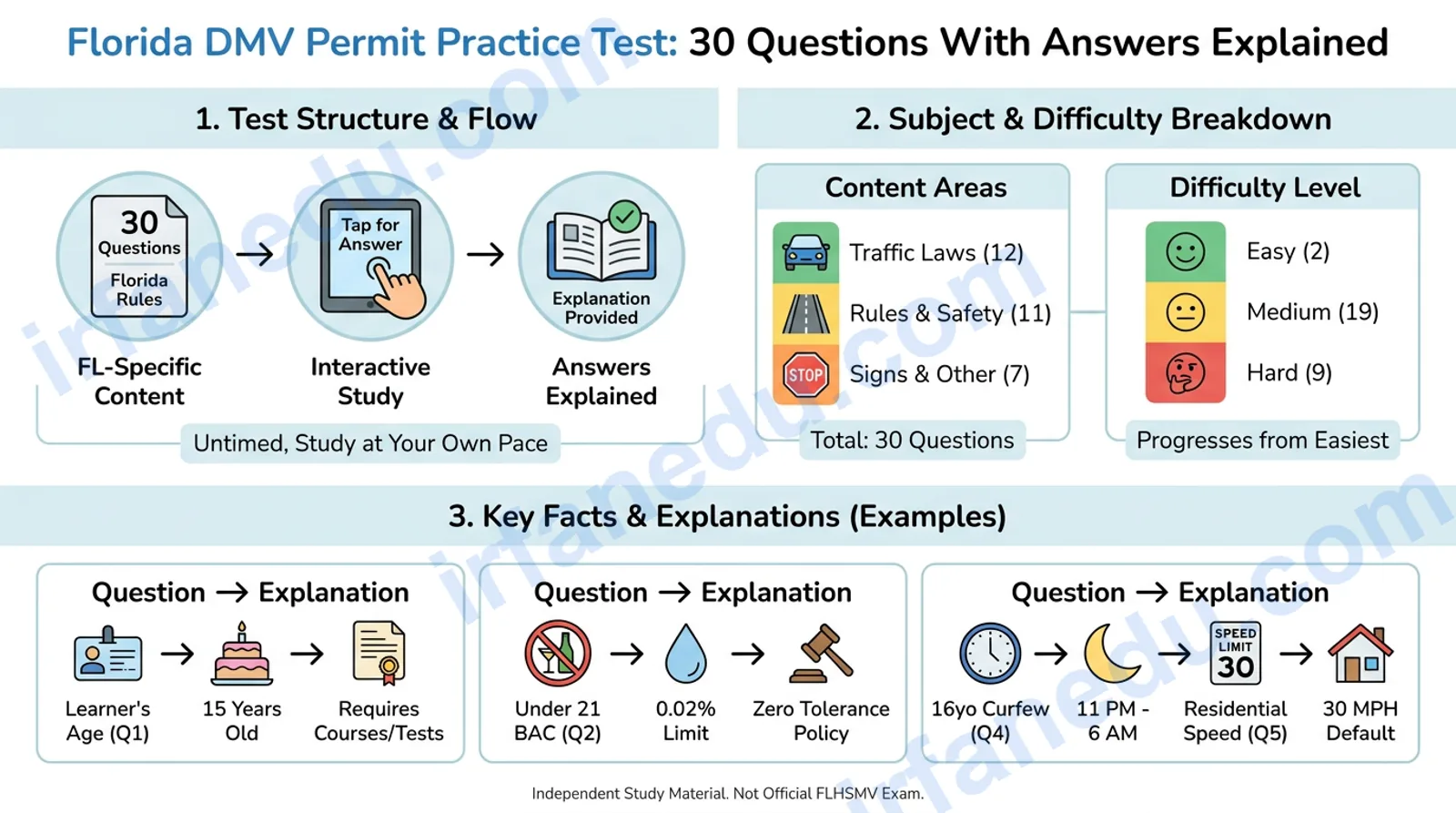
Tap an option and the page marks it and opens the explanation. Nothing is timed and nothing is stored, so you can work through it in one sitting or come back to it. If you would rather not tap through, every answer is also listed in the answer key at the bottom.
| Subject | Questions |
|---|---|
| Traffic laws | 12 |
| Rules of the road | 6 |
| Safe driving | 5 |
| Alcohol and drugs | 3 |
| Parking rules | 2 |
| Traffic signs | 2 |
Difficulty mix: 2 easy, 19 medium, 9 hard. The questions run easiest first.
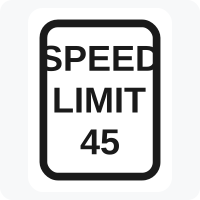
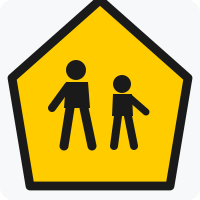
Signs come up on every state paper. These six account for more of them than any others:




The 30 questions
The minimum age to obtain a Florida learner’s license is:
Show the answer
Correct answer: B. 15
Florida issues a learner’s license at 15, after the applicant completes the Traffic Law and Substance Abuse Education course and passes the knowledge and vision tests.
In Florida, a driver under 21 is subject to a zero tolerance BAC limit of:
Show the answer
Correct answer: C. 0.02%
Florida sets 0.02% for drivers under 21. Reaching it brings an immediate six-month license suspension for a first offense, and a refusal to be tested brings a one-year suspension.
For the first three months after receiving a Florida learner’s license, you may drive only:
Show the answer
Correct answer: A. During daylight hours
Florida limits learner’s license holders to daylight driving for the first three months. After that they may drive until 10 p.m., always with a licensed driver 21 or older in the front passenger seat.
A 16-year-old with a Florida driver license may not drive between:
Show the answer
Correct answer: D. 11 p.m. and 6 a.m.
Sixteen-year-olds are restricted from driving between 11 p.m. and 6 a.m.; seventeen-year-olds between 1 a.m. and 5 a.m. Both may drive outside those hours for work or when accompanied by a licensed driver 21 or older.
Unless otherwise posted, the speed limit in a Florida residential area is:
Show the answer
Correct answer: B. 30 mph
Thirty miles per hour is the default in a business or residential district, 15 mph in an alley, 20 mph in a school zone, and 55 mph on rural roads unless posted differently.
A Florida driver under 21 who refuses a breath test faces a first-offense suspension of:
Show the answer
Correct answer: B. 1 year
Refusal by an under-21 driver brings a one-year administrative suspension, longer than the six months for testing at or above 0.02%. The suspension applies regardless of the criminal outcome.
Florida’s Move Over law requires you to, when approaching a stopped emergency or service vehicle with flashing lights on a multi-lane road:
Show the answer
Correct answer: A. Vacate the lane closest to the vehicle if you safely can, or slow to 20 mph below the posted limit
Florida requires the lane change where possible, and otherwise a reduction to 20 mph below the limit, or to 5 mph where the limit is 20 mph or less. The law covers law enforcement, EMS, tow trucks, utility, and sanitation vehicles.
In Florida, when a school bus stops with red lights flashing on a two-way street with no median, drivers:
Show the answer
Correct answer: A. In both directions must stop
On an undivided road, traffic in both directions must stop. On a divided highway with a raised barrier or median of at least five feet, oncoming traffic need not stop but should still slow and watch carefully.
Florida child restraint law requires a separate carrier or child seat for children aged:
Show the answer
Correct answer: A. 0 through 3 years
Children through age 3 must use a separate carrier or an integrated child seat. Children aged 4 and 5 may use a separate carrier, an integrated seat, or a booster. Every child under 13 is safest in the back seat.
In Florida, you may not park within how many feet of a fire hydrant?
Show the answer
Correct answer: B. 15 feet
Fifteen feet is the Florida clearance, along with 20 feet from a crosswalk at an intersection, 30 feet from a stop sign or signal, and 50 feet from a railroad crossing.
Florida roads see frequent afternoon thunderstorms. If you are caught in a heavy downpour, you should:
Show the answer
Correct answer: D. Slow down, turn on low-beam headlights, and increase following distance; pull well off the road if visibility fails
Florida law requires headlights whenever wipers are in continuous use, and hazard lights while moving are prohibited on most roads because they hide your turn signals. Cruise control is dangerous on wet surfaces.
In Florida, a flashing yellow arrow for a left turn means:
Show the answer
Correct answer: C. You may turn after yielding to oncoming traffic and pedestrians
A flashing yellow arrow is a permitted but unprotected turn: oncoming traffic still has green. A steady green arrow is the protected version where oncoming traffic is held at red.
Texting while driving in Florida is:
Show the answer
Correct answer: C. Prohibited for all drivers, and handheld use is banned entirely in school and work zones
Florida bans typing or reading messages while driving for everyone, and separately prohibits any handheld device use in an active school zone or work zone.
A Florida road marked with a solid yellow line on your side and a broken yellow line on the other means:
Show the answer
Correct answer: D. You may not pass, but oncoming traffic may
The line on your side of the center governs your permission. Solid on your side means passing is prohibited for you, usually because your sight distance ahead is inadequate.
Florida law requires you to yield to a pedestrian:
Show the answer
Correct answer: C. In marked and unmarked crosswalks, and to anyone who is blind and using a white cane or guide dog
Florida gives pedestrians the right-of-way at crosswalks whether painted or not. A pedestrian using a white cane or guide dog has absolute right-of-way, and failing to yield to them is a specific offense.
When approaching a Florida drawbridge with the gates coming down, you must:
Show the answer
Correct answer: C. Stop behind the gate and wait until it is fully raised and the signal clears
Driving around a lowered barrier is both extremely dangerous and a serious offense. Wait for the gate to rise fully and the warning signals to stop before proceeding.
At a Florida intersection with a steady red light, a right turn is:
Show the answer
Correct answer: D. Permitted after a complete stop and yielding, unless a sign prohibits it
Florida permits right on red after a full stop unless a NO TURN ON RED sign is posted. A left on red is permitted only from a one-way street onto another one-way street.
Florida requires headlights to be on:
Show the answer
Correct answer: C. From sunset to sunrise, and any time rain, smoke, or fog requires windshield wipers
The wiper rule matters most in Florida’s sudden downpours: if the wipers are running continuously, the headlights must be on so other drivers can see you through the spray.
In Florida, parking in a space reserved for people with disabilities without a valid permit:
Show the answer
Correct answer: B. Brings a substantial fine and possible towing
Florida imposes a fine of several hundred dollars, and blocking the striped access aisle beside the space is treated the same way, because it prevents a wheelchair or ramp from being deployed.
In Florida, a pentagon-shaped sign with a pointed top indicates:
Show the answer
Correct answer: D. A school zone or school crossing
The pentagon is reserved for school warnings nationwide. Florida hurricane evacuation routes use a distinct blue sign showing a circular storm symbol.
When sharing a Florida road with a bicycle, you must:
Show the answer
Correct answer: A. Allow at least three feet of clearance when passing
Florida requires a minimum of three feet when overtaking a bicycle. Cyclists have the same rights and duties as drivers, and may lawfully use a full lane where the lane is too narrow to share safely.
Unless posted otherwise, the Florida speed limit in a school zone is:
Show the answer
Correct answer: C. 20 mph
Twenty miles per hour is the standard Florida school zone limit during posted hours. Fines for speeding in a school zone are doubled and the zone applies whether or not children are visible at that moment.
Florida law requires drivers to carry which minimum insurance coverage?
Show the answer
Correct answer: A. Personal Injury Protection (PIP) and Property Damage Liability
Florida is a no-fault state, so every registered vehicle must carry Personal Injury Protection and Property Damage Liability. Letting the coverage lapse suspends your license and registration until it is reinstated.
In Florida you must report a crash to law enforcement when:
Show the answer
Correct answer: D. There is injury, death, apparent property damage of at least $500, or a hit and run
Florida sets a $500 apparent damage threshold, alongside any injury, death, DUI involvement, or hit and run. A written report is due within ten days when law enforcement did not investigate at the scene.
When driving in Florida and you see smoke across the highway from a brush fire, you should:
Show the answer
Correct answer: B. Slow down, turn on low-beam headlights, and be ready to stop, because visibility can drop to zero
Smoke mixed with fog produces sudden near-zero visibility and has caused multi-vehicle pileups on Florida highways. Low beams cut through better than high beams, which reflect off the particles.
In Florida, when may you drive in a lane marked with a solid white line separating it from the next lane?
Show the answer
Correct answer: D. Crossing is discouraged and, where the line is double or wide, prohibited
A single solid white line discourages lane changes at points where they are hazardous, such as approaching an intersection. A double solid white line prohibits crossing entirely.
Florida’s points system suspends a license when a driver accumulates:
Show the answer
Correct answer: A. 12 points within 12 months, with longer suspensions at higher totals
Twelve points within twelve months brings a 30-day suspension, eighteen points within eighteen months brings three months, and twenty-four points within thirty-six months brings a year. Points remain on the record for years.
A first DUI conviction in Florida for a driver 21 or over typically includes:
Show the answer
Correct answer: B. Fines, probation, community service, DUI school, license revocation, and possible jail
Florida attaches a substantial fine, up to six months in jail, at least 50 hours of community service, mandatory DUI school, vehicle impoundment, and a license revocation of at least 180 days to a first conviction.
You are driving in Florida and your vehicle begins to hydroplane. You should:
Show the answer
Correct answer: B. Ease off the accelerator, hold the wheel straight, and avoid braking until the tires regain grip
Hydroplaning removes steering and braking authority at once. Any input while the tires are riding on water will take effect abruptly when grip returns, so keep everything smooth and let speed bleed off.
On a Florida road with a two-way center turn lane, you may:
Show the answer
Correct answer: A. Use it only to prepare for a left turn or to complete a left turn onto the road
The center lane is shared by both directions, so traveling along it invites a head-on collision with a driver entering from the other way. Enter it only just before your turn.
Answer key
Every answer in one place, in question order.
| No. | Ans | The correct option |
|---|---|---|
| 1 | B | 15 |
| 2 | C | 0.02% |
| 3 | A | During daylight hours |
| 4 | D | 11 p.m. and 6 a.m. |
| 5 | B | 30 mph |
| 6 | B | 1 year |
| 7 | A | Vacate the lane closest to the vehicle if you safely can, or slow to 20 mph below the posted limit |
| 8 | A | In both directions must stop |
| 9 | A | 0 through 3 years |
| 10 | B | 15 feet |
| 11 | D | Slow down, turn on low-beam headlights, and increase following distance; pull well off the road if visibility fails |
| 12 | C | You may turn after yielding to oncoming traffic and pedestrians |
| 13 | C | Prohibited for all drivers, and handheld use is banned entirely in school and work zones |
| 14 | D | You may not pass, but oncoming traffic may |
| 15 | C | In marked and unmarked crosswalks, and to anyone who is blind and using a white cane or guide dog |
| 16 | C | Stop behind the gate and wait until it is fully raised and the signal clears |
| 17 | D | Permitted after a complete stop and yielding, unless a sign prohibits it |
| 18 | C | From sunset to sunrise, and any time rain, smoke, or fog requires windshield wipers |
| 19 | B | Brings a substantial fine and possible towing |
| 20 | D | A school zone or school crossing |
| 21 | A | Allow at least three feet of clearance when passing |
| 22 | C | 20 mph |
| 23 | A | Personal Injury Protection (PIP) and Property Damage Liability |
| 24 | D | There is injury, death, apparent property damage of at least $500, or a hit and run |
| 25 | B | Slow down, turn on low-beam headlights, and be ready to stop, because visibility can drop to zero |
| 26 | D | Crossing is discouraged and, where the line is double or wide, prohibited |
| 27 | A | 12 points within 12 months, with longer suspensions at higher totals |
| 28 | B | Fines, probation, community service, DUI school, license revocation, and possible jail |
| 29 | B | Ease off the accelerator, hold the wheel straight, and avoid braking until the tires regain grip |
| 30 | A | Use it only to prepare for a left turn or to complete a left turn onto the road |
More permit test practice
Everything on this site tagged DMV lives in the DMV category.
Sources