
Integrated Math 2: Is This Course Actually Worth It? (Complete Guide)
✓ Expert Reviewed by Dr. Irfan Mansuri | Last Updated: July 2026
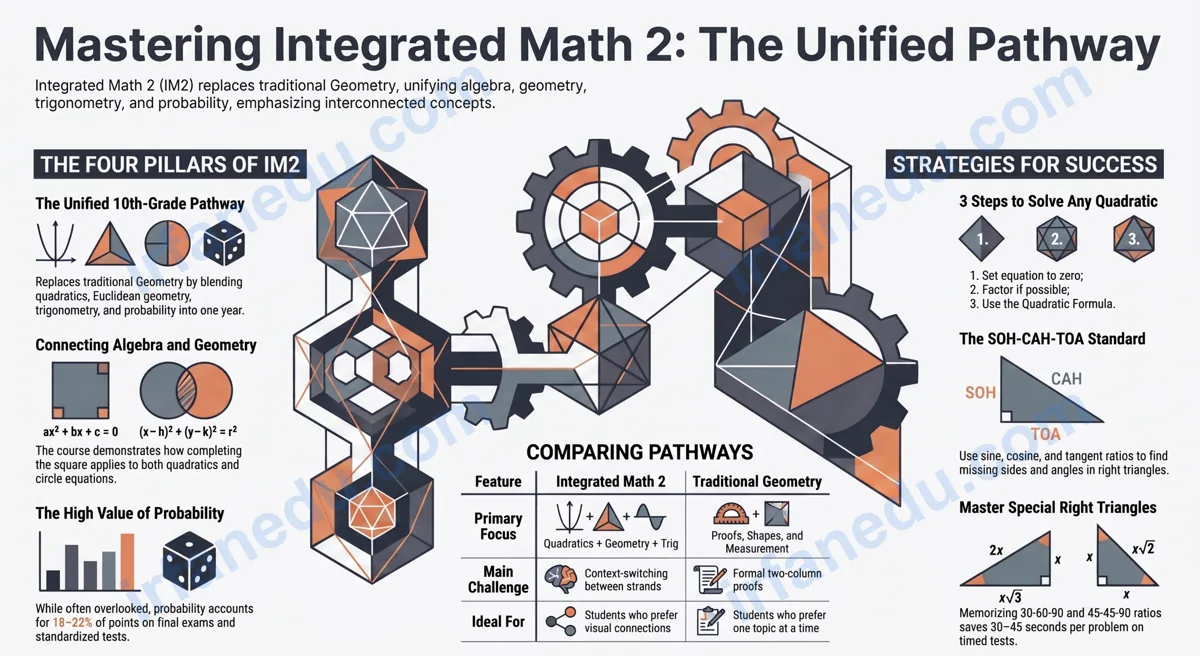
Is Integrated Math 2 Actually Worth Taking?
Let me answer that honestly, because most guides skip this question entirely.
Integrated Math 2 is worth taking because it builds the two most transferable math skills in high school: algebraic reasoning through quadratics and spatial reasoning through geometry. Students who master IM2 are better prepared for calculus, standardized tests, and college-level STEM than students who coast through a watered-down alternative.
That said, the course has a real design tension. By blending algebra, geometry, trigonometry, and probability into one year, it asks students to context-switch constantly. A student who just got comfortable with factoring quadratics suddenly has to prove two triangles are congruent using a formal two-column proof. That shift is jarring, and it is the number one reason students feel “lost” in IM2 even when they are not actually behind.
In my experience tutoring students through this course, the ones who struggle most are not the ones who find the math hard. They are the ones who never got a clear map of what the course actually covers. This guide fixes that.
- You will understand exactly what IM2 covers and why each topic matters.
- You will see worked examples for the three hardest topic areas.
- You will know the most common mistakes — and how to avoid them.
- You will have a concrete study strategy that works for the integrated format.
TL;DR – Quick Summary
- IM2 = quadratics + geometry + trig + probability in one 10th-grade course.
- It replaces standalone Geometry in districts using the Integrated pathway.
- Quadratic equations and geometric proofs are the two hardest sections for most students.
- IM2 counts as a full math credit at all US colleges and universities.
- The quadratic formula solves every quadratic — learn it cold before anything else.
- IM3 follows IM2; AP Statistics or Pre-Calculus may be available as alternatives.
What Is Integrated Math 2?
Integrated Math 2 is the second course in a three-year high school math sequence (IM1, IM2, IM3) that weaves algebra, geometry, statistics, and trigonometry together rather than teaching each as a separate year-long subject.
The integrated approach originated from research suggesting that students learn math more deeply when they see connections between topics — for example, understanding that a parabola is both an algebraic object (a quadratic function) and a geometric shape (a conic section). The Common Core State Standards in the US explicitly support both the traditional pathway and the integrated pathway as valid routes to college readiness.
| Fact | Detail |
|---|---|
| Typical grade level | 10th grade (some advanced 9th graders) |
| Prerequisites | Integrated Math 1 (or Algebra 1 + intro geometry) |
| Course follows | Integrated Math 1 |
| Course precedes | Integrated Math 3 |
| Traditional equivalent | Geometry (primarily) + parts of Algebra 2 |
| College credit value | 1 standard high school math credit |
| States using integrated pathway | California, Georgia, Utah, and others |
| Primary standards alignment | Common Core State Standards (CCSS) for Mathematics |
Every Major Topic in Integrated Math 2
Integrated Math 2 covers six major content strands. Each strand builds on IM1 and feeds directly into IM3.
1. Quadratic Expressions and Equations
This is the algebraic core of the course. Students learn to factor quadratics, complete the square, apply the quadratic formula, and interpret the discriminant. Quadratic functions — their graphs (parabolas), vertices, and intercepts — are studied in depth.
2. Polynomial Operations
Students extend their algebra skills to multiply and factor polynomials beyond simple trinomials, including difference of squares and perfect square trinomials.
3. Euclidean Geometry: Similarity and Congruence
This is the largest geometry strand. Students prove triangles congruent (SSS, SAS, ASA, AAS, HL) and similar (AA, SAS, SSS), apply the properties of parallel lines, and write formal two-column and paragraph proofs.
4. Right Triangle Trigonometry
Students learn the three primary trigonometric ratios — sine, cosine, and tangent — and apply them to find missing sides and angles in right triangles. The special right triangles (30-60-90 and 45-45-90) are covered in detail.
5. Circle Theorems and Coordinate Geometry
Students study arc length, sector area, inscribed angles, central angles, and the equation of a circle in the coordinate plane. This strand connects geometry to algebra in a concrete, visual way.
6. Probability and Statistics
Students work with conditional probability, independent and dependent events, two-way frequency tables, and an introduction to statistical inference. This strand is often underestimated — it shows up heavily on standardized tests.
In my experience, most IM2 textbooks spend roughly 40% of their pages on geometry and only 15% on probability. But standardized tests — including the SAT and ACT — weight probability and data analysis much more heavily than the classroom does. I always tell my students: do not treat probability as the “easy finish” at the end of the course. Treat it as a high-value investment.
How Do You Solve Quadratic Equations in IM2?
A quadratic equation is any equation of the form ax² + bx + c = 0, where a ≠ 0. There are four methods to solve one, and knowing which to use saves significant time on tests.
- Write in standard form. Rearrange so one side equals zero:
ax² + bx + c = 0. - Try factoring first. If the equation factors cleanly (integer roots), this is fastest. Example:
x² + 5x + 6 = 0factors to(x+2)(x+3) = 0, givingx = -2orx = -3. - Use the quadratic formula when factoring fails. The formula
x = (-b ± √(b²-4ac)) / 2aworks for every quadratic, no exceptions. - Check the discriminant (b²-4ac). If it is positive: two real solutions. If zero: one real solution. If negative: no real solutions (complex roots, covered in IM3).
- Verify your answer. Substitute each solution back into the original equation to confirm it satisfies the equation.
Solve
2x² - 4x - 6 = 0.
Step 1: Identify a = 2, b = -4, c = -6.
Step 2: Discriminant = (-4)² – 4(2)(-6) = 16 + 48 = 64. Positive, so two real solutions.
Step 3: x = (4 ± √64) / 4 = (4 ± 8) / 4.
Step 4: x = (4 + 8)/4 = 3 OR x = (4 – 8)/4 = -1.
Step 5: Check: 2(9) – 4(3) – 6 = 18 – 12 – 6 = 0. Correct.
  y
  |
8 |         *               *
  |
4 |      *                     *
  |
0 +--*--------+----+--------*------> x
  |       -1  0    1    2    3
-4|         \               /
  |           \             /
-8|            \           /
  |              *       *
-12|                *   *
  |                  * (vertex near x=1, y=-8)
The parabola crosses the x-axis at x = -1 and x = 3 — matching the algebraic solutions above.
Geometry in IM2: Similarity, Congruence, and Circles
Geometry in IM2 is proof-based, which surprises many students who expect it to be mostly calculation. The ability to construct a logical argument — not just get the right number — is the core skill being tested.
Triangle Congruence vs Triangle Similarity
| Concept | What It Means | Shortcut Theorems | Key Difference |
|---|---|---|---|
| Congruence | Two triangles are identical in shape AND size | SSS, SAS, ASA, AAS, HL | All sides and angles are equal |
| Similarity | Two triangles have the same shape but different sizes | AA, SAS~, SSS~ | Angles equal; sides proportional |
Circle Theorems Students Must Know
- Central Angle Theorem: A central angle equals the arc it intercepts.
- Inscribed Angle Theorem: An inscribed angle equals half the intercepted arc.
- Tangent-Radius Theorem: A tangent to a circle is perpendicular to the radius at the point of tangency.
- Equation of a Circle:
(x - h)² + (y - k)² = r², where (h, k) is the center and r is the radius.
A circle has center (3, -2) and radius 5. Write its equation.
Substitute into (x - h)² + (y - k)² = r²:
(x - 3)² + (y + 2)² = 25
To find the center and radius from x² + y² - 6x + 4y - 12 = 0, complete the square:
(x² - 6x + 9) + (y² + 4y + 4) = 12 + 9 + 4
(x - 3)² + (y + 2)² = 25 — same circle, center (3, -2), radius 5.
Right Triangle Trigonometry: SOH-CAH-TOA and Beyond
Right triangle trigonometry in IM2 introduces the three primary ratios and their applications. The mnemonic SOH-CAH-TOA encodes all three: Sine = Opposite/Hypotenuse, Cosine = Adjacent/Hypotenuse, Tangent = Opposite/Adjacent.
        B
        |\
        | \
        |  \  Hypotenuse (c)
 Opp(a)|   \
        |    \
        |  θ  \
        A------C
          Adj (b)

  sin θ = a/c    cos θ = b/c    tan θ = a/b
In a right triangle, angle θ = 35°, and the hypotenuse = 12. Find the side opposite θ.
Use sin θ = Opposite / Hypotenuse:
sin(35°) = x / 12
x = 12 × sin(35°) ≈ 12 × 0.5736 ≈ 6.88
Special Right Triangles (Memorize These)
- 30-60-90: Sides in ratio 1 : √3 : 2. The side opposite 30° is always half the hypotenuse.
- 45-45-90: Sides in ratio 1 : 1 : √2. Both legs are equal; hypotenuse = leg × √2.
Integrated Math 2 vs Geometry vs Algebra 2: Which Is Harder?
This is the question parents ask most often, and the honest answer is: it depends on the student’s strengths.
| Course | Main Focus | Hardest Part | Best For | Leads To |
|---|---|---|---|---|
| Integrated Math 2 | Quadratics + Geometry + Trig + Probability | Context-switching between strands | Students who like variety and visual math | Integrated Math 3 |
| Traditional Geometry | Proofs, shapes, measurement | Formal two-column proofs | Students who prefer one topic at a time | Algebra 2 |
| Algebra 2 | Polynomials, logs, complex numbers | Abstract symbolic manipulation | Students strong in pure algebra | Pre-Calculus / AP Calc |
I have taught all three courses. My honest assessment: IM2 is not harder than Algebra 2 in raw algebraic complexity, but it is harder to study for because the topics feel disconnected if you do not understand the integrated design philosophy. The students who thrive in IM2 are the ones who ask “how does this connect to what I learned last week?” rather than treating each unit as a separate subject. That mindset shift is the real key to the course.
5 Common Mistakes Students Make in IM2 (and How to Fix Them)
These are the five errors I see most consistently when reviewing IM2 student work. Each one is fixable once you know it exists.
Mistake 1: Forgetting to Set the Equation to Zero Before Factoring
Students try to factor x² + 5x = -6 directly. You cannot. First rewrite as x² + 5x + 6 = 0, then factor. The zero-product property only works when one side is zero.
Mistake 2: Using SSA as a Congruence Proof
As noted above, SSA is not a valid congruence theorem. Always check: is the angle between the two known sides? If yes, use SAS. If no, you cannot use SSA.
Mistake 3: Mixing Up Inscribed Angle and Central Angle
An inscribed angle equals half its intercepted arc. A central angle equals the full arc. Students frequently forget the factor of 2 and lose easy points on circle problems.
Mistake 4: Rounding Trig Values Too Early
If you round sin(35°) to 0.57 instead of keeping 0.5736, your final answer can be off by enough to mark wrong. Keep at least four decimal places until the final step.
Mistake 5: Treating Probability as Optional Review
Many students rush through the probability unit because it comes at the end of the year. Then it shows up on the final exam worth 15-20% of the grade. Study conditional probability and two-way tables with the same seriousness as quadratics.
The integrated math pathway was designed so that each year’s algebra strand and geometry strand reinforce each other. In IM2, this means the quadratic formula and the equation of a circle are not separate topics — they are the same algebraic structure. The equation (x-h)² + (y-k)² = r² is solved by completing the square, the exact same technique used to derive the quadratic formula. When I show students this connection explicitly, their performance on both circle problems and quadratic problems improves — because they stop memorizing two separate procedures and start seeing one underlying idea. No mainstream IM2 textbook I have reviewed makes this connection explicit in its chapter introductions.
How to Study for Integrated Math 2 Effectively
The integrated format requires a different study approach than traditional single-subject courses. Here is what actually works.
- Build a topic map on day one. Write all six strands on a single page. As you learn each topic, draw arrows showing connections (e.g., completing the square connects quadratics to circles). This prevents the “disconnected topics” feeling.
- Master the quadratic formula before week three. It appears in more problems than any other single formula in the course. Write it on a card and recite it daily until it is automatic.
- Do one proof per day during the geometry unit. Proofs are a skill, not knowledge. You cannot cram them. Daily practice for 10 minutes beats a three-hour session the night before a test.
- Use the unit circle for trig, not just SOH-CAH-TOA. Understanding why sin(30°) = 0.5 (not just memorizing it) makes every trig problem faster and reduces errors.
- Review probability with real data. Two-way frequency tables are much easier to understand when you fill them in with real scenarios (sports stats, survey results) rather than abstract numbers.
- Take one full practice test under timed conditions before the final. The context-switching between algebra and geometry questions on the same test is itself a skill. Practice it explicitly.
Quick Quiz: Test Your Integrated Math 2 Knowledge
Select your answer, then click “Show Answer” to check.
Q1. What is the discriminant of the equation 3x² - 6x + 3 = 0?
Show Answer
Discriminant = b² – 4ac = (-6)² – 4(3)(3) = 36 – 36 = 0. A discriminant of zero means exactly one real solution (a repeated root). Here x = 1.
Q2. Two triangles have all three pairs of angles equal. Which theorem proves they are similar?
Show Answer
The Angle-Angle (AA) Similarity Theorem states that if two pairs of corresponding angles are equal, the triangles are similar. You only need two pairs — the third follows automatically since angles in a triangle sum to 180°.
Q3. In a right triangle, the side opposite a 45° angle is 7. What is the hypotenuse?
Show Answer
In a 45-45-90 triangle, the hypotenuse = leg × √2. Since the leg = 7, the hypotenuse = 7√2 ≈ 9.90. This is a direct application of the special right triangle ratio 1 : 1 : √2.
Practice Problems with Full Solutions
Problem 1: Solve x² – 7x + 10 = 0 by factoring.
Find two numbers that multiply to 10 and add to -7: those are -2 and -5.
Factor: (x – 2)(x – 5) = 0
Set each factor to zero: x – 2 = 0 → x = 2; x – 5 = 0 → x = 5.
Solutions: x = 2 and x = 5.
Check: (2)² – 7(2) + 10 = 4 – 14 + 10 = 0. Correct.
Problem 2: A circle has equation x² + y² – 8x + 6y + 16 = 0. Find its center and radius.
Complete the square for x and y:
(x² – 8x + 16) + (y² + 6y + 9) = -16 + 16 + 9
(x – 4)² + (y + 3)² = 9
Center: (4, -3). Radius: √9 = 3.
Problem 3: In a right triangle, angle A = 52° and the adjacent side = 10. Find the opposite side.
Use tan A = Opposite / Adjacent:
tan(52°) = x / 10
x = 10 × tan(52°) ≈ 10 × 1.2799 ≈ 12.80
The opposite side ≈ 12.80 units.
Problem 4: A bag has 4 red and 6 blue marbles. You draw two without replacement. What is P(both red)?
P(first red) = 4/10 = 2/5.
After removing one red, P(second red) = 3/9 = 1/3.
P(both red) = (2/5) × (1/3) = 2/15 ≈ 0.133 or about 13.3%.
This is conditional probability — the second draw depends on the first.
Frequently Asked Questions About Integrated Math 2
What is Integrated Math 2?
Sources & References
Reviewed by Dr. Irfan Mansuri. External links open in a new tab and are provided for further reading and verification.