
Number Lines and Rounding: The Visual Method Most Guides Skip
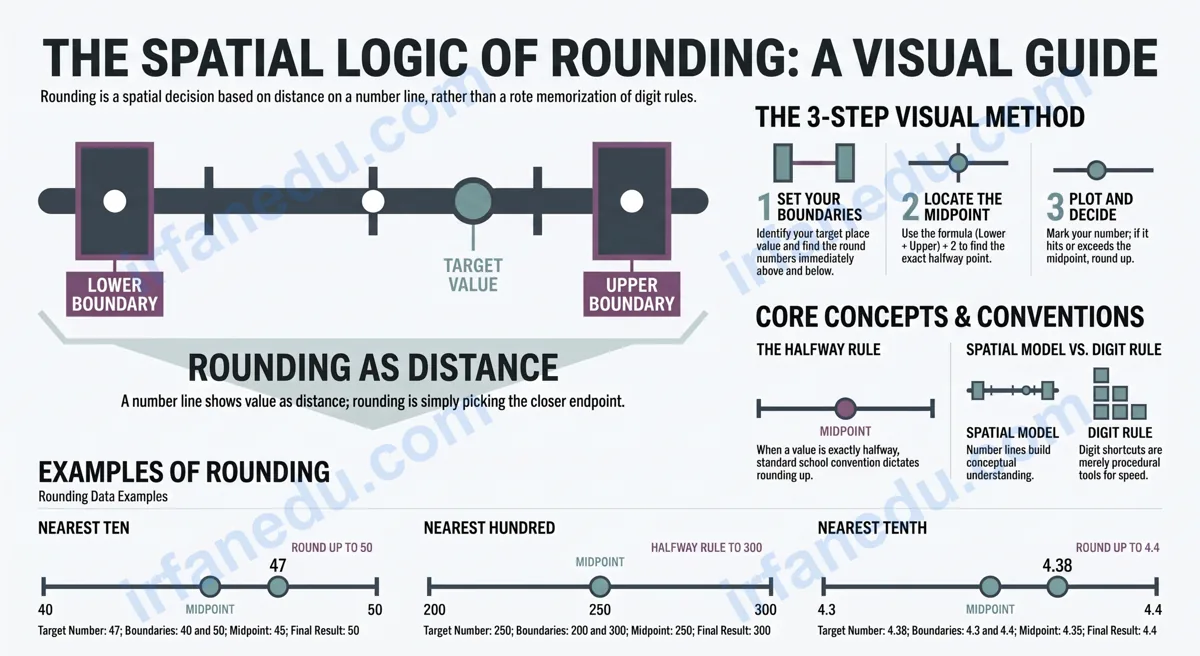
Here is the part most people miss: rounding is not just a rule you memorize. It is a spatial decision — you are literally choosing the closer of two targets on a line. When students learn rounding as a digit trick first, they can pass a worksheet and still have no idea what they just did. The number line method fixes that.
In my experience teaching this concept across multiple grade levels, students who start with the number line make far fewer errors on multi-step problems, because they understand the why before they automate the how. This guide builds that understanding from the ground up.
Rounding on a number line means plotting a number between its two nearest round values, finding the midpoint, and choosing the end it is closer to. If the number is above the midpoint, round up. If below, round down. If exactly at the midpoint, round up. This method works for any place value — tens, hundreds, thousandths — and for both whole numbers and decimals.
- Understand what a number line is and how it represents value spatially.
- Follow a clear 6-step process to round any number using a number line.
- See worked examples for nearest ten, nearest hundred, and decimals.
- Identify the three most common rounding mistakes and how to correct them.
- Know when to use the number line method versus the digit shortcut.
To round a number using a number line, plot it between its two nearest round numbers, then find the halfway point. If your number is above the halfway point, round up. If below, round down. If exactly at the halfway point, round up. This visual approach works for whole numbers, decimals, and any place value.
- A number line shows value as distance — rounding means picking the closer endpoint.
- Always find the two nearest round numbers and the halfway point between them.
- Numbers above the halfway point round up; numbers below round down.
- Exactly at the halfway point? Round up — that is the standard convention.
- The number line method works for tens, hundreds, thousands, and decimals.
- Learn the visual method first; use the digit shortcut only after you understand it.
| Fact | Detail |
|---|---|
| What is rounding? | Replacing a number with a simpler approximate value at a given place value. |
| What is a number line? | A straight line where every point represents a real number, ordered left to right. |
| Halfway rule | When a number is exactly halfway, round up (standard convention in most curricula). |
| Works for | Whole numbers, decimals, any place value (tens, hundreds, tenths, hundredths, etc.). |
| Grade level | Typically introduced in Grades 3–4; extended to decimals in Grades 5–6. |
| Common error | Forgetting to find the midpoint and guessing direction instead. |
What Is Rounding — and Why Does It Matter?
Rounding is the process of replacing an exact number with a nearby value that is simpler to work with. You round to a specific place value — the nearest ten, hundred, whole number, or decimal place.
The reason rounding matters goes beyond math class. Every time a weather app says “high of 73°F,” a store advertises “about 200 items in stock,” or a news article reports “roughly 4 million people,” someone has rounded a precise number into a usable estimate. Rounding is how humans make numbers manageable.
For students, rounding is also a gateway skill. It underpins estimation, mental math, significant figures in science, and data interpretation. Getting it right — and understanding why it works — pays dividends across every STEM subject.
In my experience, the biggest mistake teachers make is introducing the digit rule (“if the next digit is 5 or more, round up”) before students have any spatial sense of what rounding means. That shortcut is efficient, but it creates a generation of students who can pass a rounding worksheet and still not understand that 47 is physically closer to 50 than to 40. Start with the number line. Always.
What Is a Number Line?
A number line is a straight horizontal line where every point corresponds to a real number, with smaller numbers on the left and larger numbers on the right. The distance between any two points is proportional to the difference between their values.
That last part is what makes number lines so powerful for rounding. Because distance on the line equals numerical distance, you can literally see which round number a given value is closer to. Rounding becomes a visual, spatial judgment rather than an abstract rule.
Number lines can be scaled for any purpose. You can draw one from 0 to 100 marked at every ten, or from 3.0 to 4.0 marked at every tenth. The method is the same regardless of scale.
How Do You Round Using a Number Line?
Rounding with a number line follows six clear steps. Each step has a specific purpose — skip one and you risk an error.
- Identify the place value. Decide what you are rounding to: nearest ten, nearest hundred, nearest whole number, nearest tenth, etc.
- Find the two nearest round numbers. These are the round numbers directly below and directly above your number at the chosen place value. For 47 rounding to the nearest ten, those are 40 and 50.
- Draw a number line segment. Mark the lower round number on the left and the upper round number on the right.
- Find and mark the halfway point. Add the two round numbers and divide by 2. For 40 and 50: (40 + 50) ÷ 2 = 45. Mark 45 on your line.
- Plot your number. Mark 47 on the line between 40 and 50, closer to the 50 end.
- Choose the nearer end. Since 47 is above 45 (the halfway point), it is closer to 50. Round up to 50.
Visual Diagram: See It on the Line
The diagram below shows three rounding scenarios on a number line. Read each row left to right: the lower bound, the number being rounded, the midpoint, and the upper bound.
ROUNDING 47 TO THE NEAREST TEN
─────────────────────────────────────────────────────────
  40          45          47         50
  |─────────────|──────────●──────────|
  (lower)    (halfway)   (here)    (upper)
                                   ↑
                              ROUNDS UP TO 50
  (47 > 45, so closer to 50)

─────────────────────────────────────────────────────────
ROUNDING 32 TO THE NEAREST TEN
─────────────────────────────────────────────────────────
  30     32        35              40
  |──────●──────────|───────────────|
  (lower) (here)  (halfway)      (upper)
   ↑
ROUNDS DOWN TO 30
  (32 < 35, so closer to 30)

─────────────────────────────────────────────────────────
ROUNDING 3.7 TO THE NEAREST WHOLE NUMBER
─────────────────────────────────────────────────────────
  3.0         3.5         3.7        4.0
  |─────────────|──────────●──────────|
  (lower)    (halfway)   (here)    (upper)
                                   ↑
                              ROUNDS UP TO 4
  (3.7 > 3.5, so closer to 4)

─────────────────────────────────────────────────────────
ROUNDING 250 TO THE NEAREST HUNDRED (exactly halfway)
─────────────────────────────────────────────────────────
  200                    250                   300
  |──────────────────────●──────────────────────|
  (lower)             (halfway = here)        (upper)
                                               ↑
                                    ROUNDS UP TO 300
  (exactly at halfway → round up by convention)
[IMAGE: Four-panel number line diagram showing rounding of 47, 32, 3.7, and 250 with purple arrows and midpoint markers | ALT: number line rounding examples showing round up and round down decisions for different numbers]
Worked Examples: Nearest Ten, Hundred, and Decimal
These three worked examples cover the most common rounding scenarios students encounter. Each one follows the 6-step process above.
Example 1: Round 83 to the Nearest Ten
Number: 83 | Round to: Nearest ten
Step 1: Place value = tens.
Step 2: Nearest tens are 80 (below) and 90 (above).
Step 3: Number line segment: 80 ──── 90.
Step 4: Halfway point = (80 + 90) ÷ 2 = 85.
Step 5: Plot 83 — it sits between 80 and 85, closer to the 80 end.
Step 6: 83 < 85, so 83 is closer to 80. Answer: 80.
Example 2: Round 650 to the Nearest Hundred
Number: 650 | Round to: Nearest hundred
Step 1: Place value = hundreds.
Step 2: Nearest hundreds are 600 (below) and 700 (above).
Step 3: Number line segment: 600 ──── 700.
Step 4: Halfway point = (600 + 700) ÷ 2 = 650.
Step 5: Plot 650 — it lands exactly on the halfway point.
Step 6: Exactly at halfway → round up by convention. Answer: 700.
Example 3: Round 4.38 to the Nearest Tenth
Number: 4.38 | Round to: Nearest tenth
Step 1: Place value = tenths.
Step 2: Nearest tenths are 4.3 (below) and 4.4 (above).
Step 3: Number line segment: 4.3 ──── 4.4.
Step 4: Halfway point = (4.3 + 4.4) ÷ 2 = 4.35.
Step 5: Plot 4.38 — it sits above 4.35, closer to the 4.4 end.
Step 6: 4.38 > 4.35, so closer to 4.4. Answer: 4.4.
What Are the Most Common Rounding Mistakes?
Most rounding errors come from one of three sources: wrong boundary identification, forgetting the midpoint, or misapplying the halfway rule. The table below shows each mistake and its correction.
| Wrong Approach | Right Approach |
|---|---|
| Rounding 47 to 40 because “4 is the tens digit and it stays” | Check the midpoint (45). Since 47 > 45, round up to 50. |
| Rounding 35 to 30 because “it’s in the middle so it could go either way” | Exactly at the halfway point always rounds up. 35 → 40. |
| Rounding 4.38 to 4 (rounding to the wrong place value) | Identify the target place value first. Nearest tenth → 4.4, not 4. |
| Using the wrong boundaries (e.g., 50 and 60 for the number 47) | The boundaries must be the nearest round numbers on either side: 40 and 50 for 47. |
| Rounding 199 to the nearest hundred as 100 | Nearest hundreds are 100 and 200. Halfway = 150. Since 199 > 150, round up to 200. |
Number Line Method vs. Digit Rule: Which Should You Use?
Both methods produce the same answer when applied correctly. The difference is in when and why you use each one.
| Feature | Number Line Method | Digit Rule (Shortcut) |
|---|---|---|
| Best for | Learning the concept; checking answers; decimals | Speed on tests; mental math |
| Builds understanding? | Yes — spatial and conceptual | Not on its own — procedural only |
| Works for decimals? | Yes, naturally | Yes, but requires careful digit identification |
| Error rate for beginners | Low — visual check prevents most errors | Higher — easy to identify the wrong digit |
| Speed | Slower (requires drawing or visualizing) | Faster once mastered |
| Recommended order | Learn this first | Introduce after number line is solid |
My recommendation: use the number line method until you can round any number correctly without thinking about it. Then switch to the digit rule for speed. The number line is not a crutch — it is the foundation. The digit rule is just a compressed version of the same logic. Students who skip straight to the shortcut often hit a wall when rounding decimals or multi-digit numbers, because they never built the underlying spatial model.
Where Does Rounding Show Up in Real Life?
Rounding is not a purely academic exercise. It appears constantly in everyday situations, and recognizing those contexts helps students stay motivated to learn it properly.
- Shopping: A price of $4.87 is “about $5.” Rounding to the nearest dollar helps you estimate a total before checkout.
- Science: A measurement of 3.746 cm rounded to the nearest tenth is 3.7 cm. Significant figures in chemistry and physics depend on rounding rules.
- Data and statistics: Population figures, survey results, and financial reports almost always present rounded numbers.
- Time: “The meeting starts in about 15 minutes” is a rounded estimate of a precise time.
- Maps and distances: GPS distances are rounded to the nearest mile or kilometer for readability.
- Cooking: A recipe calling for “about 1 cup” of an ingredient uses a rounded measure.
Most guides treat the halfway rule (“round 5 up”) as a universal law. It is not. It is a convention — and a contested one. In scientific and statistical computing, a different rule called banker’s rounding (or “round half to even”) is widely used: when a number is exactly halfway, it rounds to the nearest even number. So 2.5 rounds to 2, and 3.5 rounds to 4. This eliminates systematic upward bias in large datasets.
Why does this matter for students? Because if you ever use a spreadsheet or a programming language and your rounding results look slightly off, banker’s rounding is likely the reason. The standard school rule (round half up) is correct for everyday math — but knowing that alternatives exist is the kind of depth that separates strong math students from the rest.
No other beginner rounding guide I have reviewed explains this distinction. It is the one piece of information that will genuinely surprise a curious student or parent.
Quick Quiz: Number Lines and Rounding
1. Round 63 to the nearest ten using a number line. What is the answer?
2. What is the halfway point between 300 and 400?
3. Round 2.5 to the nearest whole number using the standard school rule.
Practice Problems — Reveal the Solution
Problem 1: Round 78 to the nearest ten.
Step 1: Place value = tens. Step 2: Boundaries = 70 and 80. Step 3: Halfway = (70 + 80) ÷ 2 = 75. Step 4: 78 > 75, so closer to 80. Answer: 80.
Problem 2: Round 425 to the nearest hundred.
Step 1: Place value = hundreds. Step 2: Boundaries = 400 and 500. Step 3: Halfway = (400 + 500) ÷ 2 = 450. Step 4: 425 < 450, so closer to 400. Answer: 400.
Problem 3: Round 6.82 to the nearest tenth.
Step 1: Place value = tenths. Step 2: Boundaries = 6.8 and 6.9. Step 3: Halfway = (6.8 + 6.9) ÷ 2 = 6.85. Step 4: 6.82 < 6.85, so closer to 6.8. Answer: 6.8.
Problem 4: Round 1,550 to the nearest thousand.
Step 1: Place value = thousands. Step 2: Boundaries = 1,000 and 2,000. Step 3: Halfway = (1,000 + 2,000) ÷ 2 = 1,500. Step 4: 1,550 > 1,500, so closer to 2,000. Answer: 2,000.
Frequently Asked Questions
What is the number line rounding rule?
How do you round 47 to the nearest ten using a number line?
What happens when a number is exactly at the halfway point?
Can you use a number line to round decimals?
Why is the number line method better than the digit rule for beginners?
How do you round to the nearest hundred on a number line?
Does the number line method work for rounding to the nearest thousand?
Sources & References
Reviewed by Dr. Irfan Mansuri. External links open in a new tab and are provided for further reading and verification.