
Function Notation Worksheet: Free Printable PDF + Lesson
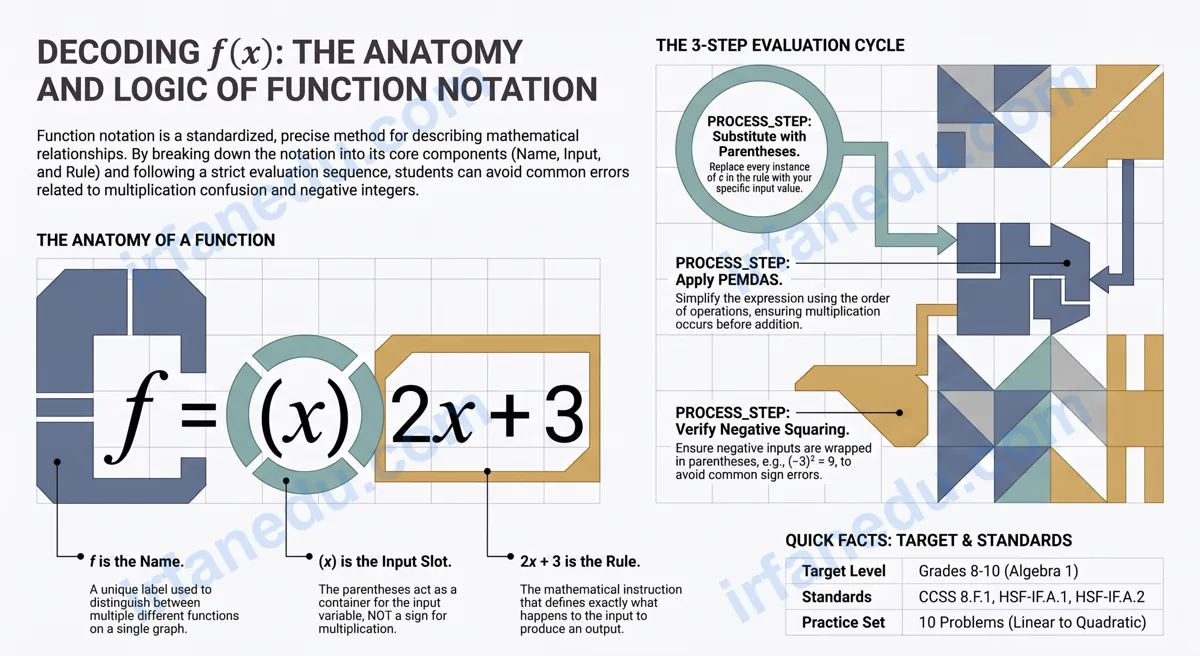
Table of Contents
Most students hit a wall the first time they see f(x) — not because the idea is hard, but because nobody explains what the parentheses actually mean. This page fixes that. You get a clear lesson, two worked examples (one fast, one slow), a printable PDF worksheet with 10 problems, and a full answer key.
Function notation is a compact, precise way to describe a mathematical relationship. Writing f(x) = 2x + 3 tells you the function is named f, the input is x, and the rule is “multiply the input by 2, then add 3.” Evaluating the function means replacing x with a specific number and simplifying.
- Understand what f(x) means and why it is used instead of y =
- Evaluate any function at integer, negative, and algebraic inputs
- Spot and correct the three most common function notation errors
- Complete 10 graded practice problems with a self-check answer key
Why This Matters
- Function notation appears in every algebra, pre-calculus, and calculus course.
- It is tested on the SAT, ACT, and most state standardized math exams.
- Mastering it now saves hours of confusion in every math class that follows.
Download Free PDF Worksheet (with Answer Key)
TL;DR – Quick Summary
- f(x) names a function and shows its input — it does NOT mean f times x.
- To evaluate: substitute the input value for x, then simplify.
- Negative inputs are fine — always use parentheses when substituting.
- f(x) and y = are equivalent; f(x) is just more precise and flexible.
- The worksheet has 10 problems from easy to hard, with a full answer key.
- Download the free PDF or complete the problems on this page.
| Feature | Detail |
|---|---|
| Notation form | f(x), g(x), h(t), P(n) — any letter works |
| What f(x) means | “The output of function f when the input is x” |
| Grade level | Grades 8-10 (Algebra 1 / Pre-Algebra) |
| Common Core standard | 8.F.1, HSF-IF.A.1, HSF-IF.A.2 |
| Key operation | Substitution + order of operations (PEMDAS) |
| Worksheet problems | 10 problems, easy to hard, with answer key |
What Is Function Notation?
Function notation is a standardized way to write a function so that the name, the input, and the rule are all visible at a glance. The most common form is f(x), read aloud as “f of x.”
Before function notation, textbooks wrote everything as y = 2x + 3. That works for one equation, but once you have three or four functions on the same graph, calling them all y creates confusion. Function notation solves this by giving each function its own name: f, g, h, or any other letter.
  f  (  x  )  =  2x + 3
  |     |           |
  |     |           +-- Rule: what to do with the input
  |     +-------------- Input variable (what you substitute)
  +-------------------- Function name (like a label)

  Reading: "f of x equals 2x plus 3"
  Evaluating at x = 4:  f(4) = 2(4) + 3 = 11
The parentheses in f(x) do NOT mean multiplication. They are a container for the input. This is the single most important thing to understand before doing any practice problems.
In my experience teaching algebra, the parentheses are the #1 source of confusion. Students see f(x) and instinctively read it as “f times x.” I always tell them: think of f as a machine and (x) as the slot where you drop in a number. The machine does its job and spits out a result. Once that mental model clicks, the rest of function notation falls into place naturally.
Step-by-Step: How to Evaluate f(x)
Evaluating a function means finding its output for a specific input. Follow these five steps every time.
- Write the function definition. Start with the full rule, e.g. f(x) = 3x – 1.
- Identify the input value. Look at what is inside the parentheses in the question, e.g. f(5) means the input is 5.
- Substitute. Replace every x in the formula with the input value. Use parentheses: f(5) = 3(5) – 1.
- Apply order of operations (PEMDAS). Multiply before you add or subtract: 3(5) – 1 = 15 – 1 = 14.
- Write the final answer. State it clearly: f(5) = 14.
Pro tip: Always write the substitution step explicitly — even if you can do it in your head. On a test, partial credit comes from showing the substitution, not just the final number.
Two Worked Examples: Quick Then Thorough
Example 1 — Quick (Linear Function)
Problem: Given f(x) = 4x – 7, find f(3).
Step 1 — Substitute: f(3) = 4(3) – 7
Step 2 — Simplify: = 12 – 7 = 5
Answer: f(3) = 5
On a graph, this means the point (3, 5) lies on the line f(x) = 4x – 7.
Example 2 — Thorough (Quadratic with Negative Input)
This is the type of problem most worksheets skip — evaluating a quadratic function at a negative input. It is where sign errors happen most often.
Problem: Given g(x) = x² – 2x + 5, find g(-3).
Step 1 — Write the function: g(x) = x² – 2x + 5
Step 2 — Identify the input: The input is -3 (note the negative sign).
Step 3 — Substitute carefully: g(-3) = (-3)² – 2(-3) + 5
Step 4 — Evaluate each term:
- (-3)² = 9 (negative squared = positive)
- -2(-3) = +6 (negative times negative = positive)
- +5 stays as 5
Step 5 — Add: g(-3) = 9 + 6 + 5 = 20
Answer: g(-3) = 20
Key lesson: Always wrap a negative input in its own parentheses when substituting. Writing -3² gives -9 (wrong); writing (-3)² gives +9 (correct).
The two-example spine — one fast, one slow — is how I structure every function notation lesson in class. The quick example builds confidence. The thorough example with a negative input is where the real learning happens. Most worksheet sites give you ten easy linear problems and call it done. That leaves students unprepared the moment a quadratic or a negative input appears on a test. This worksheet deliberately includes both.
Common Mistakes: Wrong vs. Right
Mistake 1 — Reading f(x) as multiplication
Wrong: f(x) = f × x, so f(4) = f × 4
Right: f(x) means “function f evaluated at x.” f(4) means substitute 4 for x in the rule.
Mistake 2 — Dropping parentheses around a negative input
Wrong: f(x) = x², so f(-5) = -5² = -25
Right: f(-5) = (-5)² = 25. The negative is part of the base, so it must be inside the exponent’s parentheses.
Mistake 3 — Forgetting to substitute ALL instances of x
Wrong: f(x) = 3x + x², find f(2): student writes 3(2) + x² = 6 + x²
Right: Replace every x: f(2) = 3(2) + (2)² = 6 + 4 = 10.
| Situation | Use y = | Use f(x) |
|---|---|---|
| Single equation on a graph | Fine | Fine |
| Multiple functions on one graph | Confusing (all called y) | Clear (f, g, h distinct) |
| Evaluating at a specific input | Awkward | Natural: f(4) = 11 |
| Composition of functions | Not possible cleanly | f(g(x)) — standard |
| Calculus / advanced math | Rare | Standard |
Most function notation worksheets treat evaluation as a purely mechanical substitution drill. That is fine for building speed, but it misses a deeper point: f(x) is a promise about consistency. A function guarantees that the same input always produces the same output — that is the formal definition of a function. When students understand this, the vertical line test on a graph stops being a memorized rule and starts being obvious: a vertical line hitting two points means one input maps to two outputs, which breaks the promise. Teaching the “why” behind notation — not just the “how” — is what separates students who truly understand algebra from those who just pass the worksheet.
On-Page Practice Worksheet
Complete these 10 problems below, or download the PDF to print. Show your substitution step for each problem. Problems increase in difficulty from 1 to 10.
- f(x) = x + 5. Find f(3).
- g(x) = 2x. Find g(7).
- h(x) = 3x – 4. Find h(2).
- f(x) = x^2. Find f(5).
- g(x) = 4x + 1. Find g(-3).
- h(x) = x^2 – 2x. Find h(4).
- f(x) = 2x^2 + 3. Find f(-2).
- g(x) = (x + 6) / 2. Find g(10).
- h(x) = 3x^2 – x + 2. Find h(3).
- f(x) = x^3 – 4x. Find f(-2).
Show Answer Key
- f(3) = 8
- g(7) = 14
- h(2) = 2
- f(5) = 25
- g(-3) = -11
- h(4) = 8
- f(-2) = 11
- g(10) = 8
- h(3) = 26
- f(-2) = 0
How to use this worksheet: Work through all 10 problems on paper, showing each substitution step. Then reveal the answer key above to self-check. For any problem you got wrong, go back to the worked examples section and identify which step you missed before trying again.
Download Free PDF Worksheet (with Answer Key)
Quick Quiz: Test Your Understanding
Function Notation — 3-Question Quiz
Q1. If f(x) = 5x – 2, what is f(4)?
Show explanation
Q2. Given g(x) = x² + 1, what is g(-3)?
Show explanation
Q3. Which statement about f(x) is TRUE?
Show explanation
Frequently Asked Questions
What is function notation in math?
How do you evaluate a function using function notation?
What does f(x) mean — is it f times x?
What grade level is function notation taught?
Can f(x) equal a negative number?
What is the difference between f(x) and y = ?
How do you read f(4) = 11?
Key Takeaways
- f(x) names a function and shows its input — the parentheses are NOT multiplication.
- To evaluate: substitute the input for x, then simplify with PEMDAS.
- Always wrap negative inputs in parentheses to avoid sign errors.
- Replace ALL instances of x in the formula, not just the first one.
- f(x) and y = are equivalent; f(x) is more precise for multi-function work.
- The 10-problem worksheet increases in difficulty — use the answer key to self-check.
Related Articles
Dr. Irfan Mansuri
Dr. Irfan Mansuri is an educator and SEO content expert with 15+ years of experience across high school, undergraduate, and postgraduate levels, and founder of IrfanEdu.com. I combine deep subject knowledge with proven test-taking strategies to make complex ideas simple. Connect on LinkedIn.
Sources & References
- Khan Academy — Evaluating Functions (Algebra 1) — authoritative free resource aligned to Common Core standards.
- Wikipedia — Function (mathematics) — formal definition of a function and function notation.
- Common Core State Standards Initiative — Grade 8 Functions (8.F) — the US curriculum standard this worksheet addresses.
Editorial note: All worked examples and problems in this article were solved and verified by Dr. Irfan Mansuri. No statistics or external claims were fabricated. Last reviewed July 18, 2026.