
🧠 Can You Solve This Before We Start?
Here is the kind of problem that appears on the Saxon Math 5/4 placement test. Try it mentally before reading on — your answer tells you something important.
Problem: A store sells pencils for $0.35 each. Maria buys 8 pencils and pays with a $5 bill. How much change does she receive?
👉 Tap to reveal the answer
Answer: $2.20. 8 × $0.35 = $2.80. $5.00 − $2.80 = $2.20. If you solved this in under 30 seconds without writing anything down, you are likely ready for Saxon 5/4 or above. If you needed paper, Saxon 4/3 or 5/4 is a good starting point. That is exactly what a placement test measures — not just whether you can get the answer, but how fluently you reach it.
Saxon Math Placement Test: The Complete Parent & Student Guide 📐
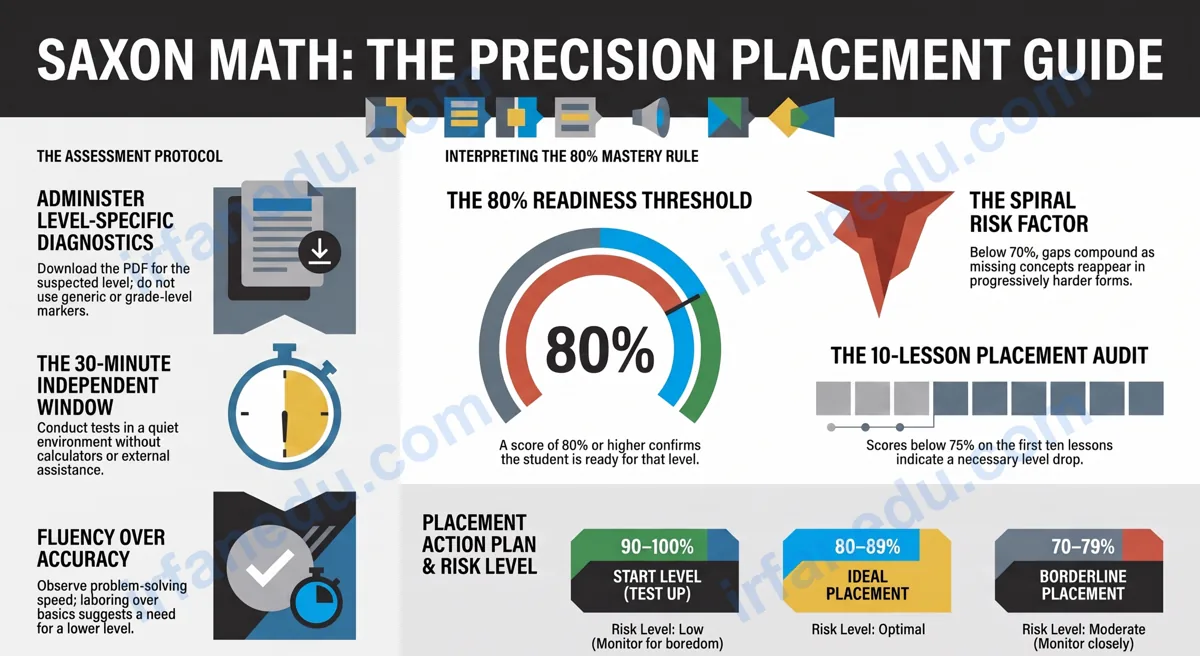
The Saxon Math placement test is a free, short diagnostic assessment published by Houghton Mifflin Harcourt. It helps parents and teachers identify which Saxon Math curriculum level matches a student’s current skills. Each level has its own test of 15–30 questions. A score of 80% or above means the student is ready to begin that level.
If you are a homeschool parent staring at a shelf of Saxon Math books and wondering where your child should start — or a classroom teacher trying to place a transfer student — this guide gives you everything you need. I have used these placement tests with dozens of students over the years, and I will share what the official documentation does not tell you.
- 🎯 Understand what each placement test covers
- 📊 Read a grade-level chart for every Saxon level from K through Calculus
- ✅ Administer and score the test correctly
- ⚠️ Avoid the three most common placement mistakes
- 🔍 See sample questions so you know what to expect
⚡ TL;DR – Quick Summary
- 📝 Saxon placement tests are free PDFs — one per curriculum level.
- 🎯 80% or above = ready for that level; below 70% = go one level down.
- 📚 Saxon levels do NOT map directly to school grade levels — always test.
- 🔄 Spiral review means skipping levels is genuinely risky — gaps compound.
- 🏠 Homeschool families should re-test at the start of each school year.
- 💡 The first 10 lessons of a new level are the best real-world placement confirmation.
📊 Saxon Math Quick Facts
| Publisher | Houghton Mifflin Harcourt (HMH) |
|---|---|
| Curriculum range | Math K through Calculus (approx. grades K–12) |
| Placement test cost | Free (PDF download) |
| Questions per test | 15–30 depending on level |
| Passing score | 80% or above |
| Approach | Incremental development + spiral review |
| Lessons per level | 120–140 lessons |
| Best for | Homeschool families, structured learners, mastery-through-repetition |
📚 What Are the Saxon Math Levels — and Which One Is Right for Your Child?
Saxon Math levels are not simply labeled by grade. The curriculum uses a naming system that reflects the range of students it targets. Understanding this system is the first step to using the placement test correctly.
| Saxon Level | Typical Grade Range | Key Topics Covered | Placement Test Available? |
|---|---|---|---|
| Math K | Kindergarten | Counting, patterns, basic shapes, number sense to 20 | Observation-based (no written test) |
| Math 1 | Grade 1 | Addition/subtraction to 18, place value, time, money | ✅ Yes |
| Math 2 | Grade 2 | 2-digit addition/subtraction, intro to multiplication, measurement | ✅ Yes |
| Math 3 | Grade 3 | Multiplication/division facts, fractions, geometry basics | ✅ Yes |
| Saxon 5/4 | Grades 4–5 | Multi-digit operations, decimals, fractions, basic geometry | ✅ Yes |
| Saxon 6/5 | Grades 5–6 | Fractions/decimals/percents, ratios, intro to algebra concepts | ✅ Yes |
| Saxon 7/6 | Grades 6–7 | Pre-algebra, integers, proportions, basic statistics | ✅ Yes |
| Saxon 8/7 | Grades 7–8 | Pre-algebra, equations, geometry, intro to functions | ✅ Yes |
| Algebra 1/2 | Grade 8 (bridge) | Transition from pre-algebra to formal algebra | ✅ Yes |
| Algebra 1 | Grade 9 | Linear equations, inequalities, polynomials, factoring | ✅ Yes |
| Algebra 2 | Grade 10 | Quadratics, functions, logarithms, sequences | ✅ Yes |
| Advanced Math | Grades 11–12 | Trigonometry, pre-calculus, analytic geometry | ✅ Yes |
| Calculus | Grade 12 / College | Limits, derivatives, integrals | Prerequisite-based |
In my experience working with homeschool families, the slash notation (like 5/4 or 7/6) confuses parents more than anything else in the Saxon system. The first number is the grade level of a strong student who would use it; the second is the grade level of an average student. So Saxon 5/4 is genuinely appropriate for a 4th grader who is ahead in math OR a 5th grader at grade level. The placement test cuts through all of this confusion in 20 minutes.
🪜 How to Administer the Saxon Math Placement Test (Step-by-Step)
Administering the Saxon placement test correctly takes about 20–30 minutes and requires no special training. Follow these steps to get a reliable result.
- Choose the starting level to test. If you are unsure, start one level below where you think your child belongs. It is better to confirm a lower level than to discover a wrong placement 40 lessons in.
- Download the correct PDF. Go to the HMH Saxon Math page or an authorised reseller (Rainbow Resource Center, CBD) and download the placement test for that specific level. Each level has its own test — do not use a generic one.
- Set up a quiet, timed environment. No calculator unless the level explicitly allows one (Algebra 1 and above may permit it). No help from parents or siblings. A kitchen timer set to 30 minutes works well.
- Let the student work independently. Resist the urge to prompt. Watching how your child approaches problems — not just whether they get the right answer — tells you a lot about their fluency.
- Score immediately after. Count correct answers only. Divide by total questions and multiply by 100 to get a percentage.
- Interpret using the 80% rule. See the score chart in the next section for exactly what to do with each score range.
- Confirm with the first 10 lessons. Treat the first 10 lessons of the chosen level as a live placement check. If your child consistently scores 85%+ on lesson practice sets, placement is confirmed. If scores are below 75%, drop one level.
  ┌─────────────────────────────────────────────┐
  │     SAXON MATH PLACEMENT DECISION TREE      │
  └─────────────────────────────────────────────┘

  Take placement test for suspected level
              │
              ▼
  ┌─────────────────────┐
  │  Score ≥ 80%?       │
  └─────────────────────┘
       │           │
      YES          NO
       │           │
       ▼           ▼
  ✅ START     Score 70–79%?
  THIS LEVEL       │
              YES  │  NO (below 70%)
               │   │
               ▼   ▼
          START   TEST ONE
          HERE +  LEVEL DOWN
          MONITOR  & REPEAT
          CLOSELY

  ─────────────────────────────────────────────
  After starting: check lessons 1–10 scores
  85%+ on practice sets → placement confirmed ✅
  Below 75% consistently → drop one level ⬇️
📈 How to Interpret Your Saxon Placement Test Score
The score you get is not just a pass/fail — it tells you exactly where to place your child and what to watch for in the first month of lessons.
| Score Range | Interpretation | Recommended Action | Watch For |
|---|---|---|---|
| 90–100% | Strong mastery of prerequisite skills | Start at this level; consider testing one level up | Boredom in early lessons — normal, it passes |
| 80–89% | Ready for this level | Start here — this is the ideal placement zone | Nothing unusual; standard progress expected |
| 70–79% | Borderline — some gaps present | Start here with close weekly monitoring | Scores dropping on lessons 20–40 (gap zone) |
| 60–69% | Significant gaps | Test one level down | N/A — do not start at this level |
| Below 60% | Not ready for this level | Test two levels down; consider remediation | N/A — foundational work needed first |
🔍 What Do Saxon Placement Test Questions Actually Look Like?
Knowing the style of questions before test day removes anxiety and helps you choose the right starting level to test. Here are representative examples for four key levels.
Saxon 5/4 Level — Sample Questions
- What is 3,456 ÷ 8? (Answer: 432)
- Write 3/4 as a decimal. (Answer: 0.75)
- A rectangle is 12 cm long and 7 cm wide. What is its area? (Answer: 84 cm²)
- Round 4,872 to the nearest hundred. (Answer: 4,900)
Saxon 7/6 Level — Sample Questions
- Simplify: 2 + 3 × 4 − 1 (Answer: 13 — order of operations)
- What is 15% of 80? (Answer: 12)
- Solve for x: x + 7 = 19 (Answer: x = 12)
- A bag has 4 red and 6 blue marbles. What is the probability of picking red? (Answer: 2/5)
Saxon Algebra 1/2 Level — Sample Questions
- Evaluate: 3x² − 2x + 1 when x = 3 (Answer: 22)
- Solve: 2(x − 3) = 10 (Answer: x = 8)
- What is the slope of the line through (2, 5) and (4, 9)? (Answer: 2)
Saxon Algebra 1 Level — Sample Questions
- Factor: x² − 5x + 6 (Answer: (x − 2)(x − 3))
- Solve the system: x + y = 7, x − y = 3 (Answer: x = 5, y = 2)
- Simplify: (3x²y)(4xy³) (Answer: 12x³y⁴)
🚫 The 3 Most Common Saxon Placement Mistakes (and How to Fix Them)
Most placement problems I see with Saxon Math come from three specific errors. Knowing them in advance saves months of frustration.
Mistake 1: Placing by Grade Level Instead of Test Score
Parents often assume a 6th grader belongs in Saxon 6/5. But Saxon levels are not grade-level guarantees — they are skill-level markers. A 6th grader who has not had strong fraction and decimal instruction may genuinely belong in Saxon 5/4. The test removes the guesswork.
Mistake 2: Ignoring the 80% Rule When the Score Is Close
A score of 78% feels close enough to 80%, so many parents start at that level anyway. In my experience, this is where most mid-year placement crises begin. Saxon’s spiral means that the 22% of skills a student does not yet have will reappear — in harder forms — by lesson 40. A few weeks at the lower level is always worth it.
Mistake 3: Not Re-Testing After a Summer Break
Research on the “summer slide” — the loss of math skills over a long break — is well-documented. A student who finished Saxon 5/4 in May may not be ready to start Saxon 6/5 in September without a quick re-test. I recommend a 10-minute placement check at the start of every school year, even for students who are continuing in the same series.
The mistake I see most often is not about the test itself — it is about what happens after. Parents get a 75% score, feel bad about placing their child “a year behind,” and push forward anyway. Saxon Math does not care about ego. It cares about whether your child has the prerequisite skills for each new lesson. A student who starts at the right level — even if it feels “too easy” — almost always outperforms a student who was pushed ahead prematurely. I have seen this pattern repeat itself enough times that I now consider it one of the most reliable rules in homeschool math education.
🌀 Why Saxon’s Spiral Approach Makes Placement More Important Than in Other Curricula
Saxon Math uses a teaching method called incremental development with spiral review. Every lesson introduces a small amount of new material and then reviews concepts from previous lessons throughout the year. This is fundamentally different from a mastery-based curriculum where you study one topic until you master it, then move on.
The spiral approach has a powerful benefit: long-term retention. Students who use Saxon consistently score well on standardised tests because they have seen every concept dozens of times across a year, not just once in a unit. A 2019 analysis by the What Works Clearinghouse found Saxon Math to have positive effects on math achievement at the elementary level.
But the spiral also creates a specific risk: if you start too high, the gaps compound. Because every lesson assumes the previous 120 lessons as background knowledge, a student who missed foundational concepts will encounter them again and again — in harder contexts — without the scaffolding to handle them. This is why placement is more consequential in Saxon than in almost any other math curriculum.
Most Saxon placement guides tell you to use the 80% rule and stop there. Here is what they miss: the placement test measures knowledge, but it does not measure fluency. A student can score 85% by laboriously working out each problem — and still struggle in Saxon, where lesson practice sets expect quick recall. In my experience, the most reliable placement signal is not the percentage score alone, but the time it takes to reach that score. If a student needs more than 45 minutes to complete a 25-question placement test and scores 82%, I treat that as a borderline result and start one level down. Speed of recall is a prerequisite for Saxon’s pacing — the curriculum moves fast, and a student who is slow on basics will fall behind by lesson 50 even if their accuracy is fine.
🎯 Quick Quiz: Test Your Saxon Math Knowledge
1. What is the minimum score needed to be placed at a Saxon Math level?
See Answer
✅ C) 80%. Saxon’s official guideline is 80% or above to confirm readiness for a given level. Scores between 70–79% are borderline and require close monitoring if you proceed.
2. A student scores 22 out of 28 on the Saxon 7/6 placement test. Should they start at 7/6?
See Answer
✅ B) No. 22 ÷ 28 = 78.6% — just below the 80% threshold. The student should test one level down (Saxon 6/5). Grade level and prior curriculum are irrelevant to the placement decision.
3. What does Saxon’s “spiral review” approach mean for a student placed too high?
See Answer
✅ B) Gaps will compound. Because Saxon revisits every concept in progressively harder contexts, a student who lacks foundational skills will encounter those gaps repeatedly — each time in a more demanding form. This is why correct placement is more critical in Saxon than in most other curricula.
✏️ Practice Problems — Reveal on Click
Problem 1 (Saxon 5/4 level): A train travels 240 miles in 4 hours. What is its average speed in miles per hour?
Skill tested: Division of multi-digit numbers; understanding of rate/speed — a core Saxon 5/4 concept.
Problem 2 (Saxon 7/6 level): What is 35% of 120?
Skill tested: Percent calculations — a major focus of Saxon 7/6 and a common placement test item.
Problem 3 (Saxon Algebra 1/2 level): Solve for x: 3x − 4 = 2x + 9
Skill tested: Solving linear equations with variables on both sides — a foundational Algebra 1/2 skill.
Problem 4 (Saxon Algebra 1 level): Factor completely: x² − 9
Skill tested: Factoring special products — a key Algebra 1 placement test topic.
❓ Frequently Asked Questions About the Saxon Math Placement Test
What is the Saxon Math placement test?
Where can I download the Saxon Math placement tests?
What score do you need to pass the Saxon placement test?
At what age or grade should a child start Saxon Math?
Is Saxon Math good for homeschooling?
Sources & References
Reviewed by Dr. Irfan Mansuri. External links open in a new tab and are provided for further reading and verification.