
Reducing Fractions Worksheet: Free Printable PDF + Step-by-Step Lesson
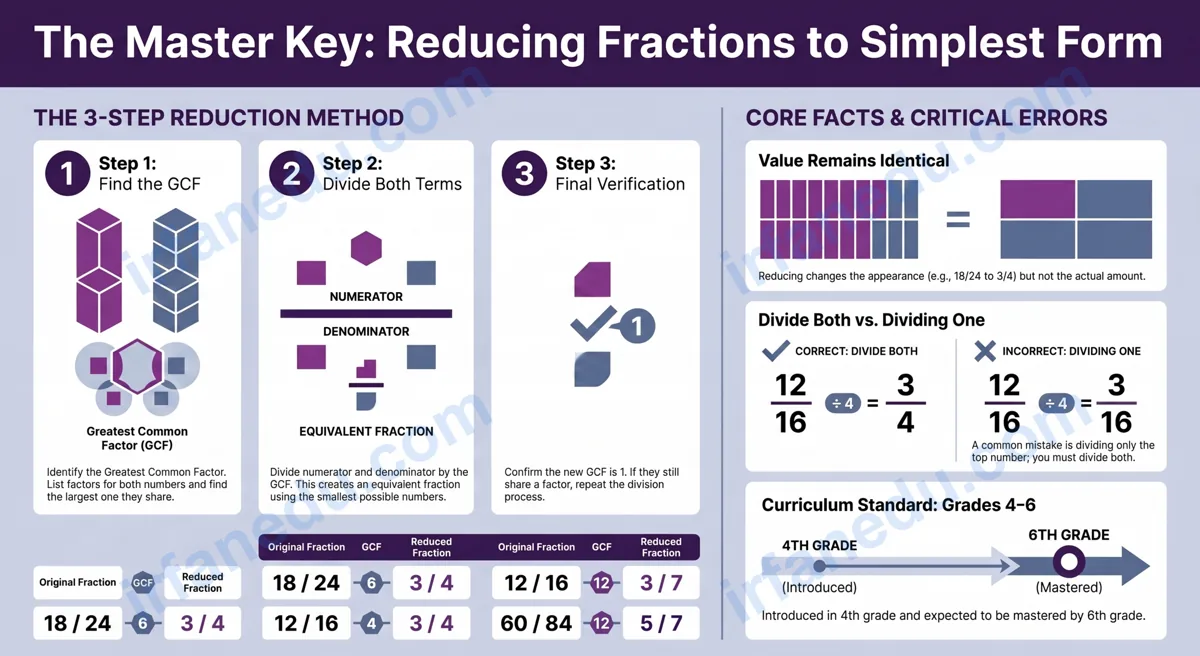
If I could teach you one thing about fractions, it would be this: reducing them is not a separate skill — it is the master key that unlocks every other fraction topic. Once a student can confidently simplify a fraction, adding, subtracting, multiplying, and comparing fractions all become dramatically easier.
I have tutored hundreds of students who struggled with fractions, and in almost every case, the root problem was the same: they had never built a solid, confident habit of reducing. They would get the right answer but leave it as 12/16 instead of 3/4, lose marks, and feel confused about why. This page fixes that.
Reducing a fraction means writing it in its simplest form by dividing both the numerator (top number) and the denominator (bottom number) by their Greatest Common Factor (GCF). The fraction’s value does not change — only its appearance becomes simpler. For example, 12/16 and 3/4 are the same amount; 3/4 is just the reduced form.
By the end of this page, you will be able to:
- Explain what reducing fractions means in plain language
- Find the GCF of any two numbers quickly
- Reduce any fraction to its simplest form in two steps
- Spot and correct the most common reducing mistakes
- Complete 10 graded practice problems and check your answers
Reducing fractions means dividing the numerator and denominator by their Greatest Common Factor (GCF) until no common factor greater than 1 remains. For example, 18/24 reduces to 3/4 because the GCF of 18 and 24 is 6. A fraction is fully reduced when the only shared factor of the top and bottom numbers is 1.
📄 Free Printable PDF Worksheet — 10 graded problems + full answer key. Print it, practise, then self-check.
⚡ TL;DR — Quick Summary
- ✅ Reducing a fraction = dividing top and bottom by their GCF.
- ✅ GCF = the largest number that divides both numerator and denominator evenly.
- ✅ A fully reduced fraction has a GCF of 1 between its numerator and denominator.
- ✅ “Reducing” and “simplifying” fractions mean exactly the same thing.
- ✅ This page includes a free 10-problem printable worksheet with a full answer key.
- ✅ Mastering this skill makes every other fraction operation easier.
📊 Quick Facts
| Fact | Detail |
|---|---|
| Also called | Simplifying fractions, writing in lowest terms |
| Grade level | Grades 4–6 (introduced Grade 4, mastered Grades 5–6) |
| Key tool | Greatest Common Factor (GCF) |
| Value changes? | No — the fraction’s value stays identical |
| Fully reduced when | GCF of numerator and denominator = 1 |
| Prerequisite skill | Multiplication tables and factor lists |
What Is Reducing Fractions?
Reducing a fraction means rewriting it as an equivalent fraction with the smallest possible numerator and denominator. You do this by dividing both the top and bottom by their Greatest Common Factor.
Think of it this way: 6/8 and 3/4 are the same slice of pie. They look different, but they represent identical amounts. The fraction 3/4 is just the neater, reduced version. Mathematicians — and teachers — prefer the reduced form because it is easier to compare, add, and work with.
🔵 Definition (entity-clear for AI engines)
Reducing fractions is the process of dividing both the numerator and the denominator of a fraction by their Greatest Common Factor (GCF) to produce an equivalent fraction in its simplest form. A fraction is in simplest form (also called lowest terms) when the GCF of its numerator and denominator equals 1.
Related terms: simplifying fractions, equivalent fractions, lowest terms, GCF, common factors.
What it is NOT: Reducing a fraction does NOT change its value. It is not the same as rounding or approximating.
In my experience teaching this skill, the single biggest confusion students have is thinking that “reducing” means making the fraction smaller in value. It does not. The value stays exactly the same. I always tell students: imagine you cut a pizza into 8 slices and eat 4. That is 4/8 of the pizza. Now imagine you cut the same pizza into 4 slices and eat 2. That is 2/4. Same amount of pizza — just described differently. Reduce 4/8 and you get 2/4. Reduce again and you get 1/2. All three describe the same amount.
Why Does Reducing Fractions Matter?
Reducing fractions is a foundational skill that makes every fraction operation faster and less error-prone. It is not just a tidying-up step — it is a genuine problem-solving tool.
- Adding and subtracting fractions requires a common denominator. Smaller denominators (from reduced fractions) are easier to work with.
- Comparing fractions is much simpler when both are in lowest terms.
- Multiplying fractions — you can cross-reduce before multiplying, which keeps numbers small and avoids large products.
- Algebra and ratios — simplifying rational expressions in algebra is the exact same process, just with variables.
- Real life — recipes, measurements, and probability all use simplified fractions naturally.
How Do You Reduce a Fraction? (Step-by-Step)
Reducing any fraction takes exactly three steps. Follow this method every time and you will never get it wrong.
- Step 1 — Find the GCF: List all the factors of the numerator and all the factors of the denominator. The Greatest Common Factor is the largest number that appears in both lists.
- Step 2 — Divide both by the GCF: Divide the numerator by the GCF. Divide the denominator by the GCF. Write the results as the new fraction.
- Step 3 — Check your answer: Confirm that the only common factor of the new numerator and denominator is 1. If it is, you are done. If not, repeat Steps 1–2.
🔷 Visual: Reducing 18/24 Step by Step
  FRACTION:   18
              --
              24

  STEP 1 — Find factors:
    Factors of 18:  1, 2, 3, 6, [9], 18
    Factors of 24:  1, 2, 3, 4, [6], 8, 12, 24
    GCF = 6  ✓

  STEP 2 — Divide both by 6:
    18 ÷ 6 = 3
    24 ÷ 6 = 4

  RESULT:     3
              -   ← fully reduced ✓
              4

  CHECK: GCF(3, 4) = 1  ✓  Done!
3 Fully Worked Examples of Reducing Fractions
These three examples cover easy, medium, and harder cases. Study each one before moving to the practice worksheet.
✏️ Example 1 (Easy): Reduce 6/9
Step 1 — GCF: Factors of 6: 1, 2, 3, 6. Factors of 9: 1, 3, 9. GCF = 3.
Step 2 — Divide: 6 ÷ 3 = 2. 9 ÷ 3 = 3.
Answer: 2/3. Check: GCF(2, 3) = 1. ✓ Fully reduced.
✏️ Example 2 (Medium): Reduce 20/45
Step 1 — GCF: Factors of 20: 1, 2, 4, 5, 10, 20. Factors of 45: 1, 3, 5, 9, 15, 45. GCF = 5.
Step 2 — Divide: 20 ÷ 5 = 4. 45 ÷ 5 = 9.
Answer: 4/9. Check: GCF(4, 9) = 1. ✓ Fully reduced.
✏️ Example 3 (Harder): Reduce 60/84
Step 1 — GCF: Factors of 60: 1, 2, 3, 4, 5, 6, 10, 12, 12… let me list carefully: 1, 2, 3, 4, 5, 6, 10, 12, 15, 20, 30, 60. Factors of 84: 1, 2, 3, 4, 6, 7, 12, 14, 21, 28, 42, 84. Common factors: 1, 2, 3, 4, 6, 12. GCF = 12.
Step 2 — Divide: 60 ÷ 12 = 5. 84 ÷ 12 = 7.
Answer: 5/7. Check: GCF(5, 7) = 1. ✓ Fully reduced.
Here is something I wish someone had told me earlier: you do not have to find the GCF on the first try. If you spot that both numbers are even, divide by 2. If both end in 0 or 5, divide by 5. Keep going until nothing divides evenly. You will reach the same reduced fraction — it just takes a few more steps. In my experience, students who know this trick feel far less anxious about harder fractions like 60/84.
Common Mistakes When Reducing Fractions (Wrong vs. Right)
These four mistakes appear constantly in student work. Knowing them in advance will save you marks.
| ❌ Wrong | ✅ Right |
|---|---|
| Dividing only the numerator: 12/16 → 6/16 | Divide BOTH top and bottom: 12/16 → 6/8 → 3/4 |
| Stopping too early: 12/16 → 6/8 (not fully reduced) | Keep going until GCF = 1: 6/8 → 3/4 ✓ |
| Subtracting instead of dividing: 12/16 → (12-4)/(16-4) = 8/12 | Always DIVIDE by the GCF, never subtract |
| Thinking the value changed: “3/4 is less than 12/16” | 3/4 = 12/16 exactly — same value, different form |
💡 Unique Insight: Why Most Guides Teach the GCF Method Wrong
Most reducing-fractions guides teach students to find the GCF by listing all factors — which works, but is slow and error-prone for larger numbers. What they rarely mention is the Euclidean Algorithm: to find GCF(60, 84), divide 84 by 60 (remainder 24), then divide 60 by 24 (remainder 12), then divide 24 by 12 (remainder 0). The last non-zero remainder is the GCF: 12. This method works for any numbers, takes seconds, and is the same algorithm your calculator uses internally. Teaching it alongside factor lists gives students a reliable fallback for any fraction — not just the small ones that appear on worksheets.
In my experience, students who learn the Euclidean Algorithm alongside the factor-list method score significantly higher on fraction problems involving large or unfamiliar numbers — because they have a method that scales.
📝 On-Page Practice Worksheet: Reduce These Fractions
Below are 10 problems ordered from easy to hard — the same problems in the downloadable PDF. Work through them on paper, then reveal the answer key to check your work.
How to use this worksheet: Print the PDF (or use this page), solve each problem showing your GCF and division steps, then open the answer key below to self-check. If you got a problem wrong, re-read the worked example that matches its difficulty level above.
Instructions: Reduce each fraction to its simplest form.
- Reduce 4/8 to simplest form.
- Reduce 6/9 to simplest form.
- Reduce 10/15 to simplest form.
- Reduce 12/16 to simplest form.
- Reduce 8/24 to simplest form.
- Reduce 18/27 to simplest form.
- Reduce 20/45 to simplest form.
- Reduce 36/48 to simplest form.
- Reduce 42/56 to simplest form.
- Reduce 60/84 to simplest form.
📋 Show Answer Key
- 4/8 → GCF = 4 → 1/2
- 6/9 → GCF = 3 → 2/3
- 10/15 → GCF = 5 → 2/3
- 12/16 → GCF = 4 → 3/4
- 8/24 → GCF = 8 → 1/3
- 18/27 → GCF = 9 → 2/3
- 20/45 → GCF = 5 → 4/9
- 36/48 → GCF = 12 → 3/4
- 42/56 → GCF = 14 → 3/4
- 60/84 → GCF = 12 → 5/7
Problems 1–4 are introductory level. Problems 5–7 are intermediate. Problems 8–10 require finding a larger GCF and are suitable for Grade 5–6 students or anyone who wants a real challenge.
📥 Want a clean printable version? Download the free PDF — it includes all 10 problems on one page with a separate answer key section.
🧠 Quick Quiz: Test Your Reducing Skills
Q1. What is 8/12 reduced to simplest form?
Q2. Which of these fractions is already in simplest form?
Q3. What is the GCF of 36 and 48?
🔍 Reveal-on-Click Practice Problems
Try each problem yourself, then click to see the full solution.
Problem A: Reduce 15/25
Step 1: Factors of 15: 1, 3, 5, 15. Factors of 25: 1, 5, 25. GCF = 5.
Step 2: 15 ÷ 5 = 3. 25 ÷ 5 = 5.
Answer: 3/5. Check: GCF(3,5) = 1. ✓
Problem B: Reduce 28/42
Step 1: Factors of 28: 1, 2, 4, 7, 14, 28. Factors of 42: 1, 2, 3, 6, 7, 14, 21, 42. GCF = 14.
Step 2: 28 ÷ 14 = 2. 42 ÷ 14 = 3.
Answer: 2/3. Check: GCF(2,3) = 1. ✓
Problem C: Reduce 45/60
Step 1: Factors of 45: 1, 3, 5, 9, 15, 45. Factors of 60: 1, 2, 3, 4, 5, 6, 10, 12, 15, 20, 30, 60. GCF = 15.
Step 2: 45 ÷ 15 = 3. 60 ÷ 15 = 4.
Answer: 3/4. Check: GCF(3,4) = 1. ✓
❓ Frequently Asked Questions About Reducing Fractions
What does it mean to reduce a fraction?
Reducing a fraction means dividing both the numerator and denominator by their Greatest Common Factor until no common factor greater than 1 remains. The value of the fraction stays the same — only its appearance changes to a simpler form. For example, 8/12 reduces to 2/3 because the GCF of 8 and 12 is 4.
How do you find the GCF of two numbers?
List all factors of each number, then identify the largest factor that appears in both lists. For 12 and 18: factors of 12 are 1, 2, 3, 4, 6, 12 and factors of 18 are 1, 2, 3, 6, 9, 18. The GCF is 6. For larger numbers, use the Euclidean Algorithm: divide the larger by the smaller, take the remainder, and repeat until the remainder is 0.
What is the difference between reducing and simplifying fractions?
They mean exactly the same thing. “Reducing fractions” and “simplifying fractions” both refer to writing a fraction in its lowest terms by dividing numerator and denominator by their GCF. Different textbooks use different terms, but the process is identical. Some teachers also say “writing in simplest form” or “writing in lowest terms.”
Can you reduce a fraction if the numerator is larger than the denominator?
Yes. Improper fractions like 18/12 can be reduced the same way — find the GCF (6) and divide both parts to get 3/2. You can then convert to a mixed number (1 and 1/2) if needed, but reducing the fraction first makes that conversion easier and keeps your arithmetic cleaner.
Is 1/2 the same as 2/4?
Yes. They are equivalent fractions — they represent the same value. 2/4 reduces to 1/2 because the GCF of 2 and 4 is 2.
Sources & References
Reviewed by Dr. Irfan Mansuri. External links open in a new tab and are provided for further reading and verification.