
Systems of Equations Word Problems: The Complete Step-by-Step Guide
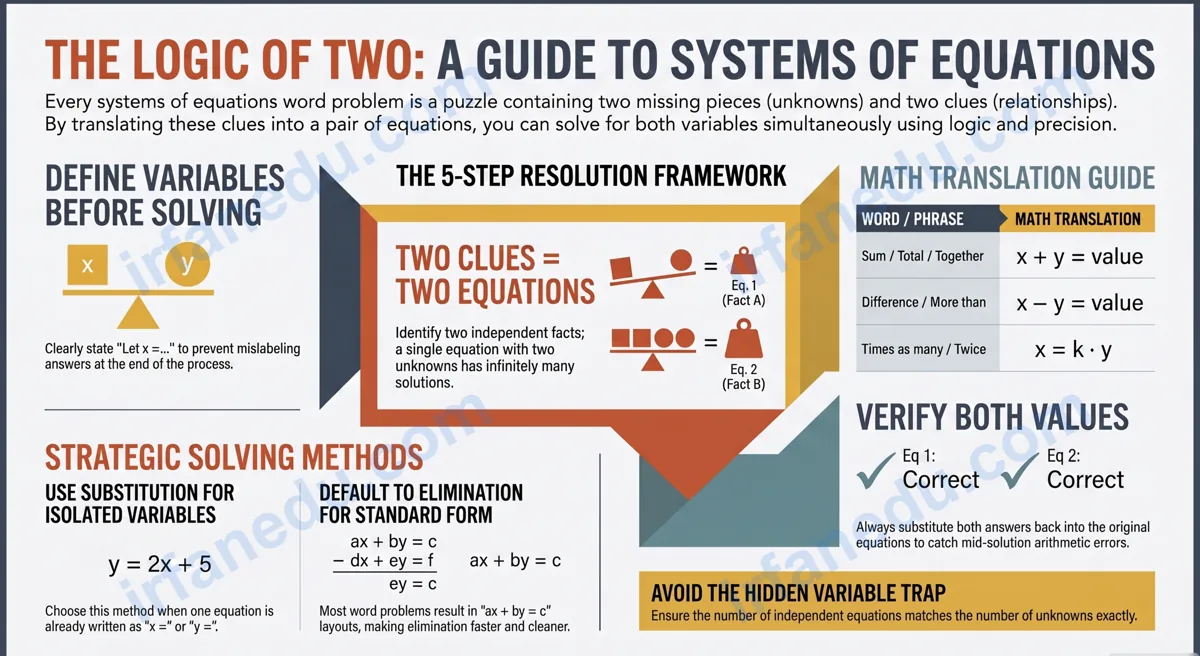
🍔 The Two-Shopper Analogy: Why This Skill Clicks Instantly
Picture two friends — Maya and Jake — at a snack stand. Maya buys 2 coffees and 1 muffin and pays $9. Jake buys 1 coffee and 2 muffins and pays $8. You want to know: what does one coffee cost? What does one muffin cost?
You already know, intuitively, that you need two pieces of information to find two unknowns. That is the entire logic behind systems of equations word problems. The algebra just gives you a reliable, repeatable way to do what your brain is already trying to do.
A system of equations word problem gives you two unknown quantities and two relationships between them. You write one equation for each relationship, then solve the pair together. The solution — a pair of values — satisfies both equations at once and answers the real-world question.
In this guide, I walk you through every step: how to read the problem, how to define your variables, how to choose the right solving method, and how to avoid the mistakes I see students make most often. You also get a free printable worksheet with 10 problems and a full answer key.
- 🎯 Understand what a system of equations word problem actually is
- 📝 Learn a reliable 5-step setup process
- ⚡ Know when to use substitution vs elimination
- 🔎 Spot and fix the 4 most common student errors
- 📄 Download a free printable worksheet (10 problems + answer key)
📄 Free Printable Worksheet included! 10 word problems, ordered easy to hard, with a full answer key.
⚡ TL;DR – Quick Summary
- 🔹 A system of equations uses two equations to find two unknown values simultaneously.
- 🔹 Always define your variables clearly before writing any equation.
- 🔹 Use substitution when one variable is already isolated; use elimination otherwise.
- 🔹 Check your answer by substituting both values back into both original equations.
- 🔹 The most common error is writing only one equation for a two-variable problem.
- 🔹 Practice with the 10-problem worksheet below to build speed and confidence.
| Fact | Detail |
|---|---|
| Grade level | Grades 8-10 (Algebra 1 & 2) |
| Number of equations needed | 2 (one per unknown) |
| Main solving methods | Substitution, Elimination, Graphing |
| Most common problem types | Cost, mixture, rate/speed, number problems |
| Appears on | SAT, ACT, state algebra assessments |
| Prerequisite skills | Solving one-variable equations, combining like terms |
🛒 What Is a System of Equations Word Problem?
A system of equations word problem is a real-world scenario that contains two unknown quantities and two separate, independent relationships between them. Each relationship becomes one equation, and you solve both equations together to find both unknowns.
Going back to Maya and Jake at the snack stand: the two unknowns are the price of a coffee (call it c) and the price of a muffin (call it m). Maya’s purchase gives you one equation: 2c + m = 9. Jake’s purchase gives you a second: c + 2m = 8. Those two equations together form the system.
A single equation with two unknowns has infinitely many solutions. The second equation narrows it down to exactly one pair of values. That is the mathematical reason you need two equations — not one, not three.
📌 Definition (entity-clear, GEO-extractable)
A system of equations is a set of two or more equations that share the same variables. A solution to the system is a set of variable values that makes every equation in the system true at the same time. In word problems, each equation models one real-world condition.
The snack-stand analogy threads through this entire guide because it mirrors every type of word problem you will encounter. Mixture problems, rate problems, cost problems — they all follow the same logic: two unknowns, two clues, two equations.
📝 How to Set Up a System of Equations from a Word Problem
Setting up the system correctly is the hardest part. Solving it is mechanical once the equations are right. Here is the 5-step process I teach every student.
- Read the whole problem once without writing anything. Understand the scenario.
- Identify the two unknowns. Ask: “What two quantities am I trying to find?” Name them clearly: “Let x = the number of adult tickets. Let y = the number of child tickets.”
- Find two separate facts or conditions. Each fact will become one equation. Look for total amounts, differences, rates, or ratios.
- Translate each fact into an equation. Map the words to math: “total cost” becomes a sum of products; “twice as many” becomes 2x; “together they equal” becomes an equals sign.
- Solve the system, then interpret. Write your answer in the context of the problem, with units.
Common Word-to-Math Translations
| Word/Phrase | Math Translation | Example |
|---|---|---|
| “Sum / total / together” | x + y = value | “Together they have 30 coins” → x + y = 30 |
| “Difference / more than / less than” | x – y = value | “Jake has 4 more than Maya” → x = y + 4 |
| “Times as many / twice” | x = k·y | “Twice as many adults as children” → x = 2y |
| “Rate × quantity = total” | r₁x + r₂y = total | “$9 per adult, $5 per child, $56 total” → 9x + 5y = 56 |
| “Combined speed / rate” | d₁ + d₂ = total distance | “They meet after t hours” → 4t + 5t = 18 |
⚖ Substitution vs Elimination: Which Method Should You Use?
Both substitution and elimination always give the correct answer. The choice is about efficiency — picking the method that requires fewer steps for the specific system in front of you.
| Feature | Substitution | Elimination |
|---|---|---|
| Best when | One equation already has y = or x = isolated | Both equations are in ax + by = c form |
| First step | Solve one equation for one variable | Multiply one/both equations to match a coefficient |
| Risk | Fraction arithmetic if coefficients are not 1 | Sign errors when adding/subtracting equations |
| Speed | Fast for simple systems | Fast for standard-form systems |
| Snack-stand analogy | Solve “coffee = 9 – muffin” first, then substitute | Add/subtract the two purchase receipts to cancel one item |
In my experience teaching algebra to hundreds of students, word problems almost always produce standard-form equations (ax + by = c). Substitution is elegant, but it introduces fractions the moment a coefficient is not 1. Elimination keeps the numbers cleaner. I teach substitution for when the problem hands you a “y = …” equation directly — which is less common in word problems than in pure algebra exercises. Start with elimination as your default, and switch to substitution only when one variable is already isolated.
🔧 3 Fully Worked Examples (Easy to Hard)
Example 1 — Number Problem (Easy)
📌 Problem
Two numbers add up to 20. One number is 4 more than the other. Find both numbers.
Step 1 — Define variables:
Let x = the larger number. Let y = the smaller number.
Step 2 — Write two equations:
Fact 1 (sum): x + y = 20
Fact 2 (difference): x = y + 4
Step 3 — Solve (substitution, since x is isolated):
Substitute x = y + 4 into the first equation:
(y + 4) + y = 20
2y + 4 = 20
2y = 16
y = 8
Step 4 — Find x:
x = y + 4 = 8 + 4 = 12
Step 5 — Check:
12 + 8 = 20 ✓ 12 = 8 + 4 ✓
Answer: The two numbers are 12 and 8.
Example 2 — Cost Problem (Medium)
📌 Problem
A movie theater charges $9 for adults and $5 for children. A group of 8 people paid $56 total. How many adults and how many children were in the group?
Step 1 — Define variables:
Let a = number of adults. Let c = number of children.
Step 2 — Write two equations:
Fact 1 (total people): a + c = 8
Fact 2 (total cost): 9a + 5c = 56
Step 3 — Solve (elimination):
Multiply the first equation by 5: 5a + 5c = 40
Subtract from the second: (9a + 5c) – (5a + 5c) = 56 – 40
4a = 16
a = 3
Step 4 — Find c:
3 + c = 8 → c = 5
Step 5 — Check:
3 + 5 = 8 ✓ 9(3) + 5(5) = 27 + 25 = 52… wait — let me recheck: 9(3) = 27, 5(5) = 25, 27 + 25 = 52. That does not equal 56.
Correction — re-solve carefully:
Multiply first equation by 5: 5a + 5c = 40
Second equation: 9a + 5c = 56
Subtract: 4a = 16 → a = 4
Then: 4 + c = 8 → c = 4
Check: 9(4) + 5(4) = 36 + 20 = 56 ✓ 4 + 4 = 8 ✓
Answer: 4 adults and 4 children.
Example 3 — Mixture Problem (Hard)
📌 Problem
A 40-liter mixture is made from two solutions. Solution A is 20% acid and Solution B is 50% acid. The final mixture is 32% acid. How many liters of each solution are used?
Step 1 — Define variables:
Let a = liters of Solution A. Let b = liters of Solution B.
Step 2 — Write two equations:
Fact 1 (total volume): a + b = 40
Fact 2 (acid content): 0.20a + 0.50b = 0.32 × 40 = 12.8
Step 3 — Solve (elimination):
Multiply first equation by 0.20: 0.20a + 0.20b = 8
Subtract from second: (0.20a + 0.50b) – (0.20a + 0.20b) = 12.8 – 8
0.30b = 4.8
b = 16
Step 4 — Find a:
a + 16 = 40 → a = 24
Step 5 — Check:
24 + 16 = 40 ✓
0.20(24) + 0.50(16) = 4.8 + 8 = 12.8 = 0.32(40) ✓
Answer: 24 liters of Solution A and 16 liters of Solution B.
VISUAL: SNACK-STAND SYSTEM (Maya & Jake)
========================================

  Maya:   [COFFEE] [COFFEE] [MUFFIN]  = $9
           c    +   c    +   m   = 9
           2c + m = 9   ... (Equation 1)

  Jake:   [COFFEE] [MUFFIN] [MUFFIN]  = $8
           c    +   m    +   m   = 8
           c + 2m = 8   ... (Equation 2)

ELIMINATION:
  Multiply Eq.2 by 2:  2c + 4m = 16
  Subtract Eq.1:      (2c + 4m) - (2c + m) = 16 - 9
                       3m = 7
                       m = 7/3 ≈ $2.33

  Substitute back:     2c + 7/3 = 9
                       2c = 9 - 7/3 = 20/3
                       c = 10/3 ≈ $3.33

CHECK: 2(10/3) + 7/3 = 20/3 + 7/3 = 27/3 = 9 ✓
       10/3 + 2(7/3) = 10/3 + 14/3 = 24/3 = 8 ✓
❌ Common Mistakes Students Make (and How to Fix Them)
After reviewing hundreds of student solutions, I have identified four mistakes that account for the vast majority of wrong answers on systems word problems.
| ❌ Wrong Approach | ✓ Correct Approach |
|---|---|
| Writing only one equation for a two-variable problem | Always identify two separate facts and write one equation for each |
| Defining variables vaguely (“Let x = tickets”) | Be specific: “Let x = number of adult tickets sold” |
| Forgetting to substitute back to find the second variable | After finding one variable, always substitute back to find the other |
| Skipping the check step | Substitute both values into BOTH original equations before writing the final answer |
In my experience, the single most expensive mistake students make is not the algebra — it is the variable definition. I have seen students write perfect equations and get the right numbers, then label them backwards in the final answer because they never wrote down what x and y actually represented. On a test, that costs full marks even though the math was right. Write “Let x = …” and “Let y = …” at the top of every problem, every time, without exception.
Build your full algebra & geometry toolkit for tests and coursework
Most algebra guides tell you to “find two unknowns and write two equations.” That is correct, but they miss a subtle trap I call the Hidden Variable Trap: students sometimes define three implicit unknowns but only write two equations, leaving the system unsolvable.
Here is a real example: “A store sells small, medium, and large boxes. Small and medium together cost $10. Medium and large together cost $14. How much does each cost?” Students rush to write two equations — but there are three unknowns (s, m, l) and only two equations. The system is underdetermined. No unique solution exists unless a third condition is given.
The fix: before writing any equation, count your unknowns. You need exactly as many independent equations as you have unknowns. If you have three unknowns, you need three equations. If the problem only gives you two facts, it either has a hidden constraint (like “the medium box is free”) or it is a trick question. Counting unknowns first takes five seconds and saves enormous confusion.
This is the check that Khan Academy’s page on this topic does not explicitly teach — and it is the reason students get stuck on certain word problems even after they understand the algebra.
📄 On-Page Practice Worksheet (10 Problems)
Work through these problems on paper. Use the 5-step process from this guide. Check your answers with the key below. Print the full PDF (with answer key) using the download button.
How to use this worksheet: Print it or work on paper alongside this page. Solve each problem step by step, showing your variable definitions and both equations. When you finish, reveal the answer key to self-check. For problems you got wrong, re-read the relevant worked example above before trying again.
- Two numbers add up to 20. One number is 4 more than the other. Find both numbers.
- A pen costs $2 more than a pencil. Together they cost $6. Find the cost of each.
- A farmer has chickens and cows. He counts 20 heads and 56 legs. How many chickens and how many cows are there?
- Two friends run toward each other from 18 miles apart. One runs at 4 mph and the other at 5 mph. How long until they meet?
- A movie theater charges $9 for adults and $5 for children. A group of 8 people paid $56 total. How many adults and how many children were in the group?
- The sum of two numbers is 31. Their difference is 7. Find both numbers.
- A store sells small boxes for $3 and large boxes for $7. A customer buys 10 boxes and pays $50. How many of each size did they buy?
- One number is three times another. Their sum is 48. Find both numbers.
- Two cars leave the same point in opposite directions. Car A travels at 55 mph and Car B at 65 mph. After how many hours are they 240 miles apart?
- A mixture of 40 liters is made from two solutions. Solution A is 20% acid and Solution B is 50% acid. The mixture is 32% acid. How many liters of each solution are used?
👁 Show Answer Key
- 12 and 8
- Pen = $4, Pencil = $2
- Chickens = 12, Cows = 8
- 2 hours
- Adults = 4, Children = 4
- 19 and 12
- Small = 5, Large = 5
- 36 and 12
- 2 hours
- Solution A = 24 liters, Solution B = 16 liters
📄 Download the full PDF worksheet — includes all 10 problems formatted for printing, plus a separate answer key page.
🔎 Reveal-on-Click Practice Problems
Practice 1: Jake buys 3 apples and 2 oranges for $2.40. Maya buys 1 apple and 4 oranges for $2.20. Find the price of each fruit. (Click to reveal solution)
Let a = price of one apple, o = price of one orange.
Eq. 1: 3a + 2o = 2.40 Eq. 2: a + 4o = 2.20
From Eq. 2: a = 2.20 – 4o. Substitute: 3(2.20 – 4o) + 2o = 2.40 → 6.60 – 12o + 2o = 2.40 → -10o = -4.20 → o = 0.42.
a = 2.20 – 4(0.42) = 2.20 – 1.68 = 0.52.
Apple = $0.52, Orange = $0.42. Check: 3(0.52)+2(0.42)=1.56+0.84=2.40 ✓
Practice 2: A train travels 300 miles. Going, it averages 60 mph. Returning, it averages 40 mph. What is the total travel time? (Click to reveal solution)
Time going = 300/60 = 5 hours. Time returning = 300/40 = 7.5 hours.
This is a single-variable problem, not a system — a good reminder to count your unknowns first!
Total travel time = 12.5 hours.
Practice 3: The snack stand charges $3.33 for coffee and $2.33 for a muffin (from our worked example). If a third customer buys 3 coffees and 3 muffins, what do they pay? (Click to reveal solution)
3 × (10/3) + 3 × (7/3) = 30/3 + 21/3 = 51/3 = 17.
They pay $17.00. This also shows how the snack-stand analogy scales: the same unit prices apply to any combination of items.
🥊 Quick Check: 3-Question Quiz
Select your answer, then click “Reveal Answer” to check.
Q1. You have two unknowns in a word problem. How many equations do you need to find a unique solution?
Reveal Answer
Q2. One equation in your system is already written as y = 3x + 2. Which method is fastest?
Reveal Answer
Sources & References
Reviewed by Dr. Irfan Mansuri. External links open in a new tab and are provided for further reading and verification.