
Periodic Table With Real Elements: Stop Making These 5 Reading Mistakes 🔬
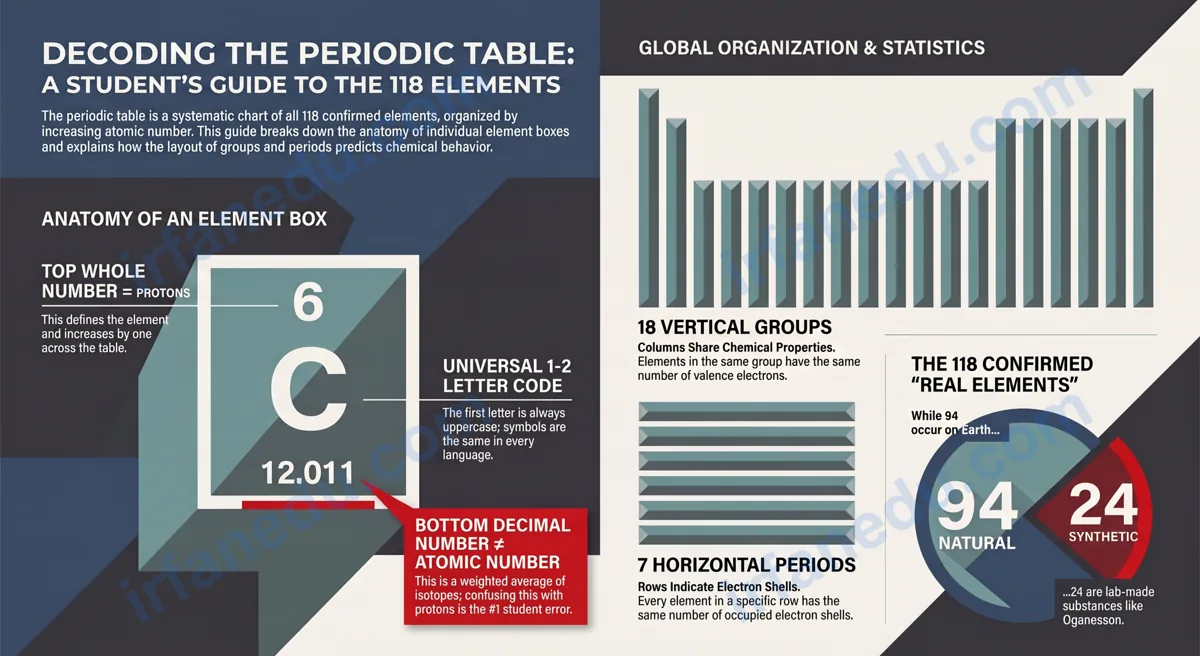
Here is something I see constantly in my chemistry classes: a student stares at the periodic table and reads the bottom decimal number as the atomic number. They then build an electron configuration using the wrong value — and every answer that follows is wrong. One small misread, one cascade of errors.
The periodic table with real elements is the single most powerful tool in chemistry. Every element that exists — from hydrogen in the sun to oganesson made in a lab for milliseconds — lives on this chart. Once you know how to read it correctly, it unlocks chemical formulas, reactions, bonding rules, and exam questions that once seemed impossible.
The periodic table lists all 118 known elements arranged by atomic number. Each element box contains four pieces of data: atomic number, chemical symbol, element name, and atomic mass. Elements in the same vertical column (group) share similar chemical properties. Reading the table correctly means knowing exactly which number is which — and most students get this wrong at least once.
- How to read every piece of information inside an element box
- The difference between groups, periods, and element families
- The 5 most common periodic table mistakes — and exactly how to fix them
- How to use the table to predict element behavior without memorizing facts
Periodic table with real elements: The periodic table lists all 118 confirmed elements arranged by increasing atomic number. Each element box shows the atomic number (top), chemical symbol (center, 1-2 letters), element name (bottom), and atomic mass (decimal, below the name). Elements in the same column share similar properties. There are 7 periods (rows) and 18 groups (columns) in the standard layout.
⚡ TL;DR – Quick Summary
- 🔢 The periodic table has 118 real elements, arranged by atomic number (not mass).
- 📦 Each box shows: atomic number (top), symbol (center), name, and atomic mass (decimal).
- ↕️ Groups (columns 1-18) = same valence electrons = similar behavior.
- ↔️ Periods (rows 1-7) = same number of electron shells.
- ❌ Biggest mistake: confusing atomic number with atomic mass — they are NOT the same.
- 🧪 94 elements occur naturally; 24 are synthetic (lab-made).
| Fact | Detail |
|---|---|
| Total elements | 118 confirmed |
| Natural elements | 94 (found on Earth) |
| Synthetic elements | 24 (lab-made) |
| Number of periods (rows) | 7 |
| Number of groups (columns) | 18 |
| Lightest element | Hydrogen (H), atomic number 1 |
| Heaviest natural element | Uranium (U), atomic number 92 |
| Most recently confirmed | Oganesson (Og), atomic number 118 |
| Arranged by | Increasing atomic number (proton count) |
| Original arrangement (Mendeleev, 1869) | By atomic mass — later corrected to atomic number |
What Is the Periodic Table With Real Elements?
The periodic table is a systematic chart of every known chemical element, organized so that elements with similar properties line up in the same column. “Real elements” simply means the actual 118 confirmed elements — not hypothetical ones — as recognized by the International Union of Pure and Applied Chemistry (IUPAC).
Russian chemist Dmitri Mendeleev published the first widely accepted periodic table in 1869. He arranged elements by atomic mass and noticed repeating (periodic) patterns in their properties. Today’s table arranges elements by atomic number — the number of protons in the nucleus — which is more fundamental and eliminates the anomalies Mendeleev had to work around.
The table is split into four main blocks based on which electron subshell is being filled: the s-block (Groups 1-2), p-block (Groups 13-18), d-block (transition metals, Groups 3-12), and f-block (lanthanides and actinides, shown separately at the bottom).
How Do You Read One Element Box on the Periodic Table?
Reading an element box correctly means knowing the exact position and meaning of each of the four data points inside it. Here is the anatomy of a standard element box, using iron (Fe) as the example:
Fe
Iron
55.845
- 26 → Atomic Number: number of protons (and electrons in a neutral atom)
- Fe → Chemical Symbol: from Latin “Ferrum” (iron)
- Iron → Element Name: full English name
- 55.845 → Atomic Mass: weighted average of all iron isotopes, in amu
Step-by-Step: How to Read Any Element Box
- Look at the top number. This is always the atomic number — the number of protons. It is always a whole number and increases by 1 from one element to the next.
- Read the central symbol. One or two letters. The first letter is always uppercase; the second (if present) is always lowercase. This symbol is the same in every language worldwide.
- Read the element name below the symbol. Useful when you don’t yet know symbols by memory. Some names look nothing like their symbols (e.g., Gold = Au, from Latin Aurum).
- Note the decimal number at the bottom. This is the atomic mass in atomic mass units (amu). It is NOT the atomic number. It is a decimal because it averages across all naturally occurring isotopes.
- Check the column (group) and row (period). The group number (1-18, read from the column header) tells you the valence electron count for main-group elements. The period number (1-7, the row) tells you how many electron shells the atom has.
The Full Periodic Table: All 118 Real Elements 📊
Below is a complete, color-coded periodic table with all 118 real elements. Each cell shows the atomic number, symbol, name, and atomic mass. Hover over any cell on desktop to highlight it. The color coding matches the legend above the table.
Hydrogen
Alkali Metals
Alkaline Earth
Transition Metals
Post-Transition
Metalloids
Nonmetals
Halogens
Noble Gases
Lanthanides
Actinides
| 1HHydrogen1.008 | 2HeHelium4.003 | ||||||||||||||||
| 3LiLithium6.941 | 4BeBeryllium9.012 | 5BBoron10.81 | 6CCarbon12.01 | 7NNitrogen14.01 | 8OOxygen16.00 | 9FFluorine19.00 | 10NeNeon20.18 | ||||||||||
| 11NaSodium22.99 | 12MgMagnesium24.31 | 13AlAluminum26.98 | 14SiSilicon28.09 | 15PPhosphorus30.97 | 16SSulfur32.07 | 17ClChlorine35.45 | 18ArArgon39.95 | ||||||||||
| 19KPotassium39.10 | 20CaCalcium40.08 | 21ScScandium44.96 | 22TiTitanium47.87 | 23VVanadium50.94 | 24CrChromium52.00 | 25MnManganese54.94 | 26FeIron55.85 | 27CoCobalt58.93 | 28NiNickel58.69 | 29CuCopper63.55 | 30ZnZinc65.38 | 31GaGallium69.72 | 32GeGermanium72.63 | 33AsArsenic74.92 | 34SeSelenium78.97 | 35
Sources & ReferencesReviewed by Dr. Irfan Mansuri. External links open in a new tab and are provided for further reading and verification. | |