
Balancing Chemical Equations PhET: Step-by-Step Guide + Free Worksheet
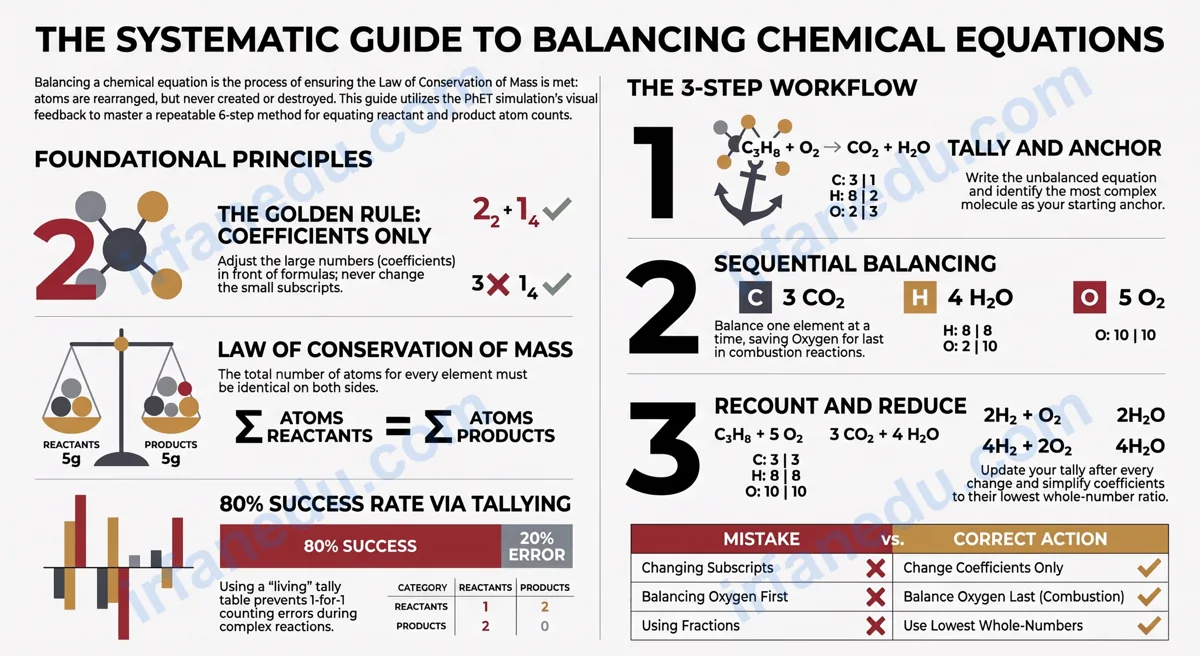
Balancing a chemical equation means placing whole-number coefficients in front of each chemical formula so that the number of atoms of every element is equal on both the reactant and product sides. The PhET Balancing Chemical Equations simulation makes this visual and interactive, showing a live atom count on both sides so you can see exactly when the equation is balanced.
If you have ever stared at an equation like H2 + O2 → H2O and wondered why the numbers feel arbitrary, you are not alone. In my experience teaching chemistry, most students struggle not because the concept is hard, but because no one shows them a clear, repeatable method. This guide fixes that. I will start with a fully solved example, extract the general rules from it, and then give you a printable worksheet to practice on your own.
Download the free printable PDF worksheet (with answer key)
TL;DR – Quick Summary
- Balancing equations means making atom counts equal on both sides using coefficients only.
- Never change subscripts — only change the large coefficients in front of formulas.
- The PhET simulation gives instant visual feedback: green numbers = balanced, red = not yet.
- Start with the most complex molecule; balance C and H before O in combustion reactions.
- Always reduce coefficients to the lowest whole-number ratio at the end.
- The 10-problem worksheet below covers easy to hard, matching the worked examples.
| Feature | Detail |
|---|---|
| Skill name | Balancing chemical equations |
| Grade level | Grades 8-11 (middle school through high school chemistry) |
| Core law | Law of Conservation of Mass |
| What you adjust | Coefficients only (never subscripts) |
| PhET simulation | Free at phet.colorado.edu — runs in any browser |
| Developed by | University of Colorado Boulder |
| Key PhET feature | Live atom counter + smiley/frowning face feedback |
| Worksheet problems | 10 problems, easy to hard, with answer key |
Start Here: A Fully Solved Example — Balancing H2 + O2 → H2O
Before I explain any rules, look at this complete solution. Read it once, then I will explain every decision.
Worked Example 1: Water Formation
Unbalanced: H2 + O2 → H2O
Step 1 — Count atoms (unbalanced):
- Reactants: H = 2, O = 2
- Products: H = 2, O = 1
- Problem: Oxygen is 2 on the left, 1 on the right. Not balanced.
Step 2 — Fix oxygen first (it appears in only one product):
Put a coefficient of 2 in front of H2O: H2 + O2 → 2H2O
- Products now: H = 4, O = 2. Oxygen is balanced.
- But hydrogen: Reactants H = 2, Products H = 4. Not balanced yet.
Step 3 — Fix hydrogen:
Put a coefficient of 2 in front of H2: 2H2 + O2 → 2H2O
- Reactants: H = 4, O = 2
- Products: H = 4, O = 2
Balanced equation: 2H2 + O2 → 2H2O
Every element matches. The equation is balanced.
  REACTANTS                    PRODUCTS
  ---------                    --------
  2H2  +  O2                   2H2O

  H: 2x2 = 4          =        H: 2x2 = 4   [OK]
  O: 1x2 = 2          =        O: 2x1 = 2   [OK]

  Result: BALANCED
Now that you have seen a complete solution, let me explain what each step means and why it works.
What Is Balancing a Chemical Equation?
Balancing a chemical equation is the process of adjusting coefficients so that the total number of atoms of each element is identical on both sides of the reaction arrow. This reflects the law of conservation of mass: atoms are rearranged in a chemical reaction, but they are never created or destroyed.
A coefficient is the large number placed in front of a chemical formula. In 2H2O, the coefficient is 2, meaning two molecules of water. A subscript is the small number inside a formula — the 2 in H2O means each water molecule contains two hydrogen atoms. You must never change subscripts because doing so changes the identity of the substance.
How to Use the PhET Balancing Chemical Equations Simulation
The PhET simulation from the University of Colorado Boulder is the best free tool available for practicing equation balancing. Here is exactly how to use it.
- Go to phet.colorado.edu/en/simulations/balancing-chemical-equations and click the green Play button. No download or account is needed.
- Choose the “Introduction” tab to start with guided practice, or “Balancing Game” for timed challenge mode.
- Look at the equation displayed. Below each formula, you will see an atom counter panel showing how many of each atom exist on each side.
- Use the up/down arrows next to each formula to change its coefficient. The atom counters update in real time.
- When all atom counts match, the simulation displays a smiley face and the word “Balanced” in green. Mismatched counts show a frowning face and red numbers.
- Use the “Check” button in game mode to score your answer and move to the next equation.
[IMAGE: Screenshot of PhET Balancing Chemical Equations simulation showing the atom counter panel with green balanced indicators | ALT: PhET balancing chemical equations simulation interface showing live atom count feedback]
Step-by-Step Method for Balancing Any Chemical Equation
This 6-step method works for every equation you will encounter in grades 8-11. I derived it from the worked example above and from years of watching students make the same fixable errors.
- Write the unbalanced equation with correct formulas. Do not change any subscripts.
- Count atoms of each element on both sides. Make a small tally table — this prevents counting errors.
- Identify the most complex molecule (most elements or largest subscripts) and treat it as your anchor with coefficient 1.
- Balance one element at a time. For combustion reactions: balance carbon first, hydrogen second, oxygen last. For other reactions: start with elements that appear in only one reactant and one product.
- Recount all atoms after each change. A coefficient change on one molecule affects every element in that molecule.
- Reduce to lowest whole-number coefficients. If all coefficients are even (e.g., 2, 4, 2), divide by 2. Coefficients must be whole numbers, never fractions.
In my experience teaching this to hundreds of students, step 5 is where most people go wrong. They balance carbon, feel satisfied, and forget to recount hydrogen after they adjust the CO2 coefficient. The fix is simple: treat the tally table as a living document, not a one-time snapshot. Update every row after every coefficient change.
Three More Fully Worked Examples
Worked Example 2: Ammonia Synthesis (N2 + H2 → NH3)
Unbalanced: N2 + H2 → NH3
Atom count (unbalanced): N: 2 vs 1 | H: 2 vs 3
Balance N: Put 2 in front of NH3: N2 + H2 → 2NH3
Now: N: 2 = 2 (OK) | H: 2 vs 6 (not yet)
Balance H: Put 3 in front of H2: N2 + 3H2 → 2NH3
Now: N: 2 = 2 (OK) | H: 6 = 6 (OK)
Balanced: N2 + 3H2 → 2NH3
Worked Example 3: Combustion of Methane (CH4 + O2 → CO2 + H2O)
Unbalanced: CH4 + O2 → CO2 + H2O
Atom count (unbalanced): C: 1 vs 1 | H: 4 vs 2 | O: 2 vs 3
Balance C: Already 1 = 1. No change needed.
Balance H: Put 2 in front of H2O: CH4 + O2 → CO2 + 2H2O
H: 4 = 4 (OK) | O: 2 vs 4 (not yet)
Balance O: Put 2 in front of O2: CH4 + 2O2 → CO2 + 2H2O
O: 4 = 4 (OK)
Balanced: CH4 + 2O2 → CO2 + 2H2O
Worked Example 4: Iron Oxide Formation (Fe + O2 → Fe2O3)
Unbalanced: Fe + O2 → Fe2O3
Atom count (unbalanced): Fe: 1 vs 2 | O: 2 vs 3
Strategy: O2 gives oxygen in pairs; Fe2O3 needs oxygen in groups of 3. The LCM of 2 and 3 is 6, so aim for 6 oxygen atoms on each side.
Balance O: Put 3 in front of O2 and 2 in front of Fe2O3:
Fe + 3O2 → 2Fe2O3
O: 6 = 6 (OK) | Fe: 1 vs 4 (not yet)
Balance Fe: Put 4 in front of Fe: 4Fe + 3O2 → 2Fe2O3
Fe: 4 = 4 (OK)
Balanced: 4Fe + 3O2 → 2Fe2O3
The iron oxide example is the one I use to introduce the LCM strategy. Most guides skip it and just say “try different numbers until it works.” That is not a method — it is guessing. When oxygen appears in a diatomic molecule (O2) on one side and in a compound with an odd subscript on the other, find the LCM of those two numbers and use it as your target oxygen count. It cuts the trial-and-error time in half.
Common Mistakes When Balancing Equations (Wrong vs. Right)
These are the four errors I see most often. Each one has a clear fix.
Wrong: H2 + O2 → H2O2 (changed the product to hydrogen peroxide — a different substance)
Right: 2H2 + O2 → 2H2O (adjusted coefficients only)
Wrong: Balancing carbon in CH4 combustion, then not recounting oxygen after adjusting CO2.
Right: After every coefficient change, update your full tally table before moving to the next element.
Wrong: H2 + 1/2 O2 → H2O (technically valid in thermochemistry, but not acceptable in introductory chemistry)
Right: 2H2 + O2 → 2H2O (multiply through by 2 to clear the fraction)
Wrong: Starting with O2 in CH4 + O2 → CO2 + H2O. Oxygen appears in two products, so balancing it first forces you to go back and redo everything.
Right: Balance C first, then H, then O last. Oxygen is always last in combustion.
The Coefficient Trap: What Most Guides Get Wrong
Most balancing guides teach you to “try coefficients until it works.” That is fine for simple equations, but it breaks down on equations like 4Fe + 3O2 → 2Fe2O3 or C3H8 + 5O2 → 3CO2 + 4H2O.
The insight most guides miss: treat balancing as a constraint satisfaction problem, not a guessing game. Each element gives you one constraint equation. For CH4 + aO2 → bCO2 + cH2O, carbon gives b = 1, hydrogen gives 2c = 4 so c = 2, and oxygen gives 2a = 2b + c = 2 + 2 = 4 so a = 2. You solve it algebraically in three lines. This is the same approach used in university-level stoichiometry and it works on every equation, no matter how complex.
In the PhET simulation, this means you can predict the correct coefficients before you even touch the sliders — then use PhET purely to verify. That is a much stronger study habit than clicking randomly until the smiley face appears.
Practice Worksheet: 10 Balancing Problems
Use this worksheet to practice the method from the worked examples above. Try each problem on paper first, then check your answers with the key below. The problems go from easy to hard.
Instructions: Balance each chemical equation by writing the correct coefficient in front of each formula. Do not change the subscripts. Show your atom counts for each element.
- H2 + O2 → H2O
- N2 + H2 → NH3
- Fe + O2 → Fe2O3
- CH4 + O2 → CO2 + H2O
- Na + Cl2 → NaCl
- Al + HCl → AlCl3 + H2
- C3H8 + O2 → CO2 + H2O
- KClO3 → KCl + O2
- Mg + HCl → MgCl2 + H2
- Fe + CuSO4 → FeSO4 + Cu
Show Answer Key
- 2H2 + O2 → 2H2O
- N2 + 3H2 → 2NH3
- 4Fe + 3O2 → 2Fe2O3
- CH4 + 2O2 → CO2 + 2H2O
- 2Na + Cl2 → 2NaCl
- 2Al + 6HCl → 2AlCl3 + 3H2
- C3H8 + 5O2 → 3CO2 + 4H2O
- 2KClO3 → 2KCl + 3O2
- Mg + 2HCl → MgCl2 + H2
- Fe + CuSO4 → FeSO4 + Cu (already balanced — coefficients all 1)
Download the free printable PDF worksheet (with answer key)
How to use this worksheet: Print the PDF (or work from the screen), attempt each problem without looking at the answer key, then self-check using the key. For any problem you get wrong, go back to the worked examples and identify which step you missed. One round of self-correction is worth three rounds of passive reading.
Quick Quiz: Test Your Understanding
Q1. In the balanced equation 2H2 + O2 → 2H2O, what is the coefficient in front of O2?
Q2. Which of the following is NOT allowed when balancing a chemical equation?
Q3. In a combustion reaction, which element should you balance last?
Reveal-on-Click Practice Problems
Practice: Balance Na + Cl2 → NaCl — Click to reveal solution
Unbalanced atom count: Na: 1 vs 1 | Cl: 2 vs 1
Balance Cl: Put 2 in front of NaCl: Na + Cl2 → 2NaCl. Cl: 2 = 2 (OK). Na: 1 vs 2 (not yet).
Balance Na: Put 2 in front of Na: 2Na + Cl2 → 2NaCl.
Final check: Na: 2 = 2, Cl: 2 = 2. Balanced.
Practice: Balance C3H8 + O2 → CO2 + H2O — Click to reveal solution
Unbalanced atom count: C: 3 vs 1 | H: 8 vs 2 | O: 2 vs 3
Balance C: Put 3 in front of CO2: C3H8 + O2 → 3CO2 + H2O. C: 3 = 3 (OK).
Balance H: Put 4 in front of H2O: C3H8 + O2 → 3CO2 + 4H2O. H: 8 = 8 (OK).
Balance O: Products have 3×2 + 4×1 = 10 oxygen atoms. Put 5 in front of O2: C3H8 + 5O2 → 3CO2 + 4H2O.