
This guide teaches you exactly how to do that, then gives you 10 graded problems and a free printable PDF to prove it.
Periodic Table Worksheet: Free Printable PDF + Answer Key
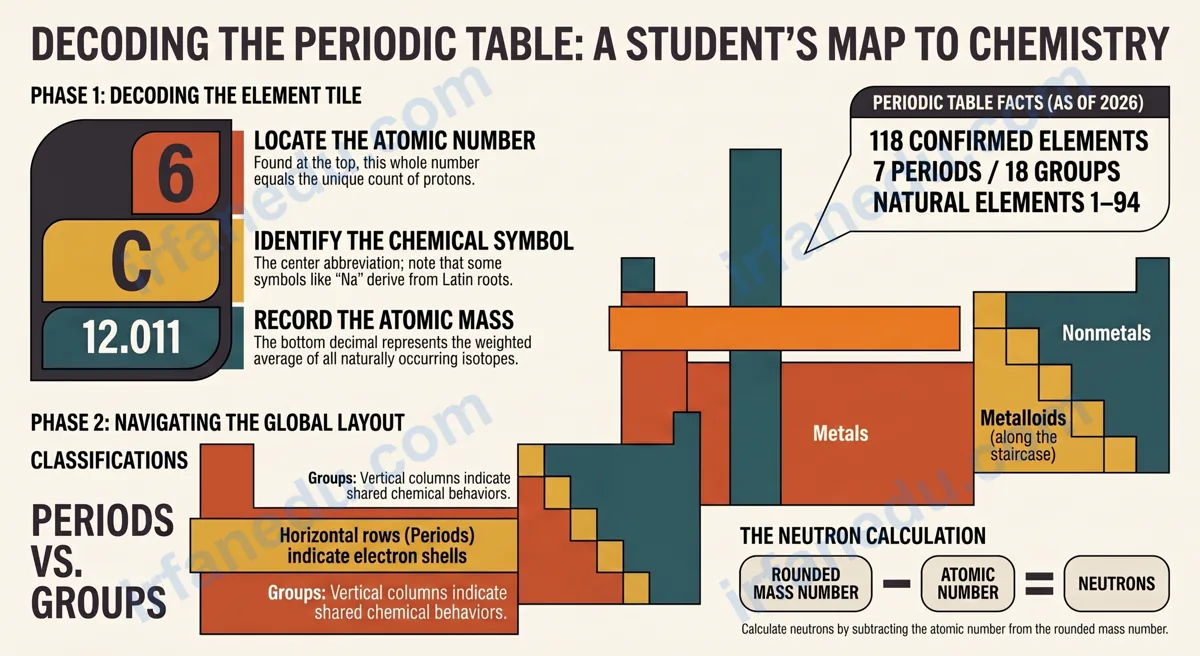
A periodic table worksheet is a structured chemistry practice sheet that trains students to locate and interpret element data — atomic number, symbol, name, atomic mass, period, and group — directly from the periodic table. It is the standard first-assessment tool in middle and high school chemistry, targeting grades 6 through 10.
If you have ever stared at a periodic table and felt overwhelmed by the grid of numbers and letters, you are not alone. In my experience teaching chemistry fundamentals, the periodic table looks complicated until a student understands that each tile follows one consistent layout. Once you see that pattern, the whole table opens up.
- Understand the four pieces of data on every element tile
- Locate any element by its period and group
- Calculate the number of neutrons from the periodic table alone
- Classify elements as metals, nonmetals, or metalloids
- Complete the 10-problem worksheet and self-check with the answer key
A periodic table worksheet is a structured practice sheet that tests students on element symbols, atomic numbers, atomic masses, periods, groups, and element classification. It covers the layout and language of the periodic table — the foundational tool of all chemistry. Most worksheets target grades 6-10 and take 20-30 minutes to complete.
Free Printable PDF: Download the full 10-problem periodic table worksheet with a separate answer key — ready to print and use in class or at home.
⚡ TL;DR – Quick Summary
- Every element tile shows atomic number, symbol, name, and atomic mass.
- Atomic number = number of protons; this uniquely identifies the element.
- Neutrons = mass number minus atomic number.
- Rows are periods; columns are groups — both predict element behavior.
- Metals sit left, nonmetals right, metalloids along the staircase line.
- This page includes 10 graded problems, worked examples, and a free PDF.
| Fact | Detail |
|---|---|
| Total elements (2026) | 118 confirmed |
| Naturally occurring | Elements 1-94 |
| Number of periods (rows) | 7 |
| Number of groups (columns) | 18 |
| Heaviest natural element | Uranium (U), atomic number 92 |
| Most abundant element in Earth’s crust | Oxygen (O), atomic number 8 |
| Worksheet grade level | Grades 6-10 |
| Estimated completion time | 20-30 minutes |
What Is the Periodic Table and Why Does It Matter?
The periodic table is a systematic arrangement of all known chemical elements, ordered by increasing atomic number and grouped by similar chemical properties. It is the single most important reference tool in chemistry — every formula, reaction, and property prediction starts here.
Dmitri Mendeleev published the first widely recognized version in 1869. He arranged elements by atomic mass and noticed that properties repeated in a predictable pattern — what chemists call “periodicity.” The modern table, ordered by atomic number, was established in the early 20th century and has been extended to 118 elements since.
For a student, the periodic table matters for one practical reason: it gives you the data you need to answer chemistry questions without memorizing every element. You just need to know how to read it.
How to Read an Element Tile on the Periodic Table
Reading an element tile correctly is the core skill this worksheet tests. Every tile follows the same layout: atomic number at the top, chemical symbol in the center, element name below the symbol, and atomic mass at the bottom.
  ┌─────────────────────┐
  │   6                 │  ← Atomic Number (protons)
  │                     │
  │        C            │  ← Chemical Symbol
  │                     │
  │      Carbon         │  ← Element Name
  │                     │
  │     12.011          │  ← Atomic Mass (amu)
  └─────────────────────┘

  Period 2  |  Group 14 (IVA)  |  Nonmetal
Figure: Standard element tile layout using Carbon as the example.
-
Find the atomic number. The whole number at the top of the tile. It equals the number of protons in the nucleus. Carbon has 6 protons, so its atomic number is 6. No two elements share an atomic number.
-
Read the chemical symbol. The one- or two-letter abbreviation in the center. The first letter is always a capital; the second (if present) is always lowercase. Carbon = C. Calcium = Ca. Chlorine = Cl.
-
Note the element name. The full English name below the symbol. Some symbols look nothing like the name (Na = Sodium, Fe = Iron) because they come from Latin roots.
-
Record the atomic mass. The decimal number at the bottom, in atomic mass units (amu). This is a weighted average of all naturally occurring isotopes. Round it to the nearest whole number to get the mass number for neutron calculations.
-
Identify the period and group. Count the row from the top — that is the period. Count the column from the left — that is the group. Carbon is in Period 2, Group 14. Period tells you the number of electron shells; group tells you the number of valence electrons (for main-group elements).
Worked Examples: Solving Periodic Table Problems
These three worked examples match the style and difficulty of the worksheet problems below. Read through each one before you attempt the practice sheet.
Solution: Find “Sodium” on the periodic table. Its tile shows the symbol Na (from the Latin Natrium) and the atomic number 11. Answer: Na, atomic number 11.
Solution:
Step 1: Neutrons = Mass number – Atomic number
Step 2: Neutrons = 35 – 17 = 18 neutrons
Step 3: Atomic number 17 = Chlorine (Cl). Answer: Chlorine has 18 neutrons.
Solution:
Step 1: Go to row 3 (Period 3) on the periodic table.
Step 2: Move to column 1 (Group 1, also called Group IA).
Step 3: The element is Sodium (Na).
Step 4: Group 1 elements are alkali metals. Answer: Sodium, a metal.
Common Mistakes Students Make on Periodic Table Worksheets
These are the four errors I see most often when marking periodic table worksheets. Knowing them in advance saves points.
| Wrong Approach | Correct Approach |
|---|---|
| Confusing atomic number with atomic mass (e.g., writing Carbon’s atomic number as 12) | Atomic number is the small whole number at the TOP of the tile. Atomic mass is the decimal at the BOTTOM. |
| Writing element symbols with both letters capitalized (e.g., CL for Chlorine) | Only the first letter is capitalized. Correct: Cl, not CL. |
| Using atomic mass directly as the number of neutrons (e.g., saying Carbon has 12 neutrons) | Neutrons = mass number – atomic number. For Carbon: 12 – 6 = 6 neutrons, not 12. |
| Counting groups incorrectly when transition metals are present (off by 10) | Groups 3-12 are transition metals. Group 13 (IIIA) starts after them. Count all 18 columns carefully. |
Most generic worksheets ask students to fill in atomic numbers and symbols — and stop there. That trains lookup skills, not chemical thinking. The real information gain comes from connecting the table’s structure to behavior: why do Group 1 elements all react violently with water? Because they each have one loosely held valence electron, which the group column directly encodes. In my teaching, I add one “why” question to every worksheet — for example, “Why is Silicon (Si) used in computer chips but Carbon (C) is not, even though they are in the same group?” The answer (Silicon’s intermediate conductivity as a metalloid) requires students to use the table’s classification system, not just read a number. That single question type produces measurably deeper retention than five extra symbol-lookup questions.
| Property | Metals (left side) | Metalloids (staircase) | Nonmetals (right side) |
|---|---|---|---|
| Appearance | Shiny, lustrous | Dull to semi-shiny | Dull, varied |
| Conductivity | Good conductors | Semiconductors | Poor conductors |
| Malleability | Malleable | Brittle | Brittle or gaseous |
| Examples | Iron (Fe), Gold (Au), Sodium (Na) | Silicon (Si), Arsenic (As) | Oxygen (O), Chlorine (Cl), Sulfur (S) |
| Location on table | Left and center | Along the staircase line | Upper right |
On-Page Periodic Table Worksheet (10 Problems)
Use a periodic table to answer each question below. Problems progress from basic recall (Q1-4) to applied thinking (Q7-10). Print this page or download the PDF for a clean copy.
How to use this worksheet: Work through all 10 questions with a periodic table open beside you. Write your answers on paper. When you finish, expand the Answer Key below to check your work. For the PDF version with a clean printable layout and a separate answer-key page, use the download button.
- What is the chemical symbol for Gold?
- What is the atomic number of Carbon?
- Which element has the symbol “Na” and what is its atomic mass (rounded to the nearest whole number)?
- How many protons does an atom of Oxygen have?
- Name the element in Period 2, Group 17 (VIIA).
- Which element has atomic number 26? State its symbol and classify it as metal, nonmetal, or metalloid.
- List the elements in Group 1 (IA) from Period 2 through Period 5 — give the name and symbol for each.
- An element has 17 protons and its mass number is 35. How many neutrons does it have? Name the element.
- Arrange these elements in order of increasing atomic number: Neon, Helium, Argon, Krypton. What pattern do you notice about their group?
- Element X is in Period 3, Group 14 (IVA). It is a metalloid widely used in computer chips. Identify it and give its atomic number and atomic mass.
Show Answer Key
- Au
- 6
- Sodium (Na); atomic mass = 23
- 8 protons
- Fluorine (F)
- Iron (Fe); metal
- Lithium (Li), Sodium (Na), Potassium (K), Rubidium (Rb)
- 35 – 17 = 18 neutrons; Chlorine (Cl)
- He (2), Ne (10), Ar (18), Kr (36) — all are in Group 18 (noble gases)
- Silicon (Si); atomic number 14; atomic mass approximately 28
Want a clean printable copy? Download the PDF — it includes all 10 problems on one page and a separate answer key page, formatted for printing.
Quick Quiz: Test Your Periodic Table Knowledge
3-Question Check
Q1. The atomic number of an element tells you the number of:
Show Answer
Q2. An element has atomic number 11 and mass number 23. How many neutrons does it have?
Show Answer
Q3. Which group on the periodic table contains the noble gases?
Show Answer
Reveal-on-Click Practice Problems
Practice: Which element is in Period 4, Group 2? Is it a metal?
Practice: Element Y has 16 protons and a mass number of 32. Name it and find its neutrons.
Practice: Why do Lithium, Sodium, and Potassium all react similarly with water?
Frequently Asked Questions
What is a periodic table worksheet?
What grade level is this periodic table worksheet for?
How do you find the number of neutrons from the periodic table?
What is the difference between atomic number and atomic mass?
What are the main groups on the periodic table?
How many elements are on the periodic table?
What is the difference between a period and a group on the periodic table?
Key Takeaways
- Every element tile shows four values: atomic number (top), symbol (center), name, and atomic mass (bottom).
- Atomic number = protons; this number uniquely identifies the element.
- Neutrons = mass number – atomic number.
- Rows are periods (7 total); columns are groups (18 total).
- Metals are on the left, nonmetals on the upper right, metalloids along the staircase.
- Symbols from Latin names (Na, Fe, Au, Pb) are the most common source of errors — learn the short list.
- The periodic table is a reading task, not a memorization task.