
Science Classes in High School: The Complete Guide for Students and Parents
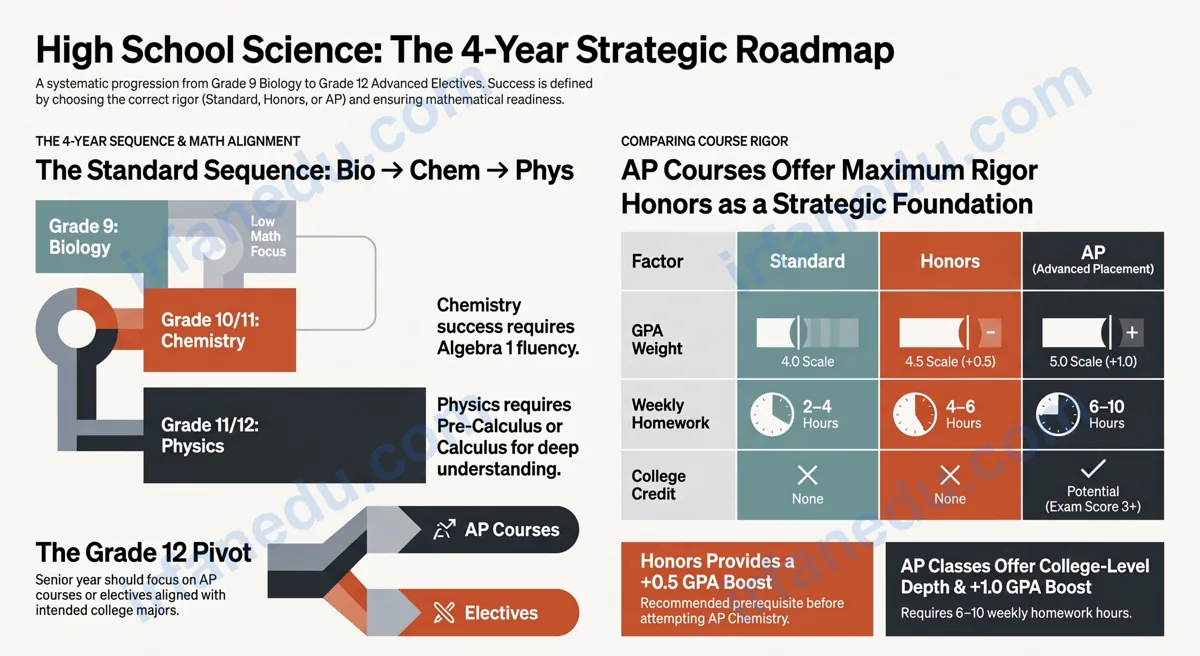
High school science classes form the backbone of a student’s STEM education. From a first biology course in Grade 9 to calculus-based AP Physics in Grade 12, the science curriculum builds systematically — each course adding new tools for understanding the natural world. Choosing the right courses, in the right order, at the right level, can shape both your GPA and your college options.
Whether you are a student picking classes for next year or a parent helping plan a four-year path, this guide covers everything: the standard sequence, what each course actually teaches, how honors and AP differ, which electives matter, and the mistakes that cost students the most. I have taught and advised students across all four years of high school science, and I will share what the generic course-catalog descriptions leave out.
- The standard 4-year science sequence and why the order matters
- What biology, chemistry, and physics actually cover at the high school level
- How to choose between standard, honors, and AP sections
- Which electives strengthen a college application
- The most common course-selection mistakes and how to avoid them
⚡ TL;DR – Quick Summary
- The standard sequence is Biology → Chemistry → Physics → Advanced/Elective.
- Most states require 2–3 science credits; colleges prefer 4 years with labs.
- AP courses can earn college credit but demand strong math and study time.
- Honors is the smarter first step if you are new to a subject.
- Electives like Environmental Science and Anatomy boost applications for specific majors.
- Math readiness — especially algebra and pre-calculus — is the hidden gatekeeper for chemistry and physics.
What Are High School Science Classes?
High school science classes are structured, lab-based courses that teach students how the natural world works — from living cells to chemical reactions to the forces that govern motion. They are not just about memorizing facts; they train students to form hypotheses, design experiments, analyze data, and draw evidence-based conclusions.
In the US, high school science courses fall into four broad categories:
- Core required courses — Biology, Chemistry, Physics (most students take all three)
- Honors sections — same content, faster pace, more depth, weighted GPA
- AP (Advanced Placement) courses — college-level content, optional exam for college credit
- Electives — Environmental Science, Anatomy and Physiology, Astronomy, Earth Science, Forensic Science
Each category serves a different purpose. Core courses meet graduation requirements. Honors and AP courses signal academic rigor to colleges. Electives let students explore interests and align their transcript with a future major.
A Grade 9 student in a standard Biology class might spend a week studying cell structure: reading the textbook, labeling a cell diagram, and looking at onion cells under a microscope. The goal is to understand what cells are and why they matter.
A Grade 11 student in AP Biology covers the same cell structure topic but goes deeper: analyzing how the sodium-potassium pump maintains membrane potential, interpreting a graph of enzyme activity at different pH levels, and writing a free-response answer explaining how a mutation in a membrane protein could cause disease.
What Is the Standard 4-Year High School Science Sequence?
The standard US high school science sequence is Biology in Grade 9, Chemistry in Grade 10, Physics in Grade 11, and an advanced or elective science in Grade 12. This order is not arbitrary — it reflects a deliberate build in mathematical and conceptual complexity.
GRADE 9          GRADE 10         GRADE 11         GRADE 12
┌─────────────┐  ┌─────────────┐  ┌─────────────┐  ┌──────────────────┐
│  BIOLOGY    │  │  CHEMISTRY  │  │  PHYSICS    │  │  ADVANCED /      │
│             │→ │             │→ │             │→ │  ELECTIVE        │
│ Standard    │  │ Standard    │  │ Standard    │  │                  │
│ Honors      │  │ Honors      │  │ Honors      │  │ AP Bio / AP Chem │
│ AP Bio*     │  │ AP Chem*    │  │ AP Phys 1   │  │ AP Physics C     │
│             │  │             │  │ AP Phys 2   │  │ Env. Science     │
│             │  │             │  │             │  │ Anatomy & Phys.  │
└─────────────┘  └─────────────┘  └─────────────┘  └──────────────────┘
  * AP Bio/Chem sometimes offered in Grade 11 or 12 after standard course
Here is why the sequence is ordered this way:
- Biology first — requires the least math, introduces scientific method, lab skills, and vocabulary. Accessible to all Grade 9 students regardless of algebra level.
- Chemistry second — requires basic algebra (solving for x, unit conversions, stoichiometry). Students who took algebra in Grade 8 or 9 are ready.
- Physics third — requires algebra and ideally pre-calculus. Concepts like velocity, force, and energy demand comfort with equations and graphing.
- Advanced science in Grade 12 — by this point, students have the math, vocabulary, and lab skills to handle college-level material.
In my experience advising students, the single biggest mistake I see is taking Chemistry before completing Algebra 1. The chemistry content is manageable, but the math — mole calculations, gas laws, solution concentrations — becomes a wall. I have watched capable students earn C’s in chemistry not because they lacked science ability, but because they were solving two new problems at once: new chemistry concepts AND new algebra skills. Sequence your math and science courses together.
What Do You Actually Learn in Each Core Science Course?
Each core science course has a distinct focus, skill set, and type of thinking. Here is what students at both the standard and advanced level encounter in each.
Biology
Biology is the study of living organisms — their structure, function, growth, and interaction with the environment. At the standard level, topics include cell biology, genetics, evolution, ecology, and human body systems. At the AP level, students add biochemistry (enzyme kinetics, cellular respiration, photosynthesis), population genetics (Hardy-Weinberg), and experimental design at a college depth.
Key skills: microscopy, data interpretation, Punnett squares, reading scientific diagrams, writing lab reports.
Chemistry
Chemistry covers the composition, structure, and properties of matter and the changes it undergoes. Standard topics include atomic structure, the periodic table, chemical bonding, stoichiometry, acids and bases, and reaction types. AP Chemistry adds thermodynamics, electrochemistry, kinetics, and equilibrium at a much deeper mathematical level.
Key skills: balancing equations, unit conversion (dimensional analysis), interpreting spectroscopy data, titration lab technique.
Physics
Physics explains how forces, energy, and matter interact. Standard physics covers kinematics (motion), Newton’s laws, energy and work, waves, electricity, and magnetism. AP Physics 1 focuses on algebra-based mechanics and waves. AP Physics C uses calculus and is the closest to a first-year university physics course.
Key skills: vector analysis, free-body diagrams, graph interpretation, algebraic problem-solving, experimental design.
Honors vs. AP Science: Which Should You Take?
Honors and AP are both rigorous options, but they serve different purposes and carry different risks. Choosing the wrong level can hurt your GPA and your confidence.
Honors science covers the same core curriculum as the standard course but moves faster, goes deeper, and assigns more challenging problems. It typically earns a GPA boost (e.g., a B in Honors = 3.5 instead of 3.0). There is no external exam, so your grade is entirely school-based.
AP science is a college-level course designed by the College Board. It ends with a standardized AP exam scored 1–5. A score of 3, 4, or 5 may earn college credit, depending on the university. The workload is significantly heavier than Honors.
My recommended path for most college-bound students:
- Take the standard or Honors version of a course first if you have no prior background.
- Use that course to build vocabulary, lab habits, and math fluency.
- Take the AP version of the same subject the following year, or take AP in a different subject where you already have strong preparation.
- Aim for 2–3 AP sciences total by graduation, not 5 — depth beats breadth.
High School Science Course Comparison: Standard vs. Honors vs. AP
Use this table to compare the three course levels side by side across the factors that matter most for students and parents.
| Factor | Standard | Honors | AP |
|---|---|---|---|
| Curriculum depth | Core concepts, broad survey | Core + extended topics, faster pace | College-level, full depth |
| GPA weight (typical) | 4.0 scale | +0.5 boost (4.5 scale) | +1.0 boost (5.0 scale) |
| External exam | None | None | AP Exam (May) — scored 1–5 |
| College credit potential | None | None | Yes, if score ≥ 3 (varies by college) |
| Weekly homework load | 2–4 hours | 4–6 hours | 6–10 hours |
| Lab component | Basic labs | More frequent, more complex | Inquiry-based; design your own experiments |
| Best for | Meeting graduation requirements; non-STEM paths | College-bound students building a foundation | STEM-bound students with strong math and study skills |
| Risk if underprepared | Low | Medium | High — GPA damage is real |
Which Science Electives Are Worth Taking in High School?
Science electives let students explore specialized fields and signal genuine interest to college admissions officers. The best elective is the one that aligns with your intended major — not simply the one with the easiest reputation.
| Elective | Best For | Key Topics | AP Version? |
|---|---|---|---|
| Environmental Science | Pre-med, ecology, policy majors | Ecosystems, climate, pollution, sustainability | Yes — AP Environmental Science |
| Anatomy & Physiology | Pre-med, nursing, kinesiology | Body systems, organ function, disease | No AP (some schools offer honors) |
| Astronomy | Physics enthusiasts, general interest | Solar system, stars, cosmology | No AP |
| Earth Science / Geology | Environmental, civil engineering | Plate tectonics, rocks, weather | No AP (some states offer it as a core) |
| Forensic Science | Criminal justice, chemistry interest | DNA analysis, toxicology, evidence | No AP |
| AP Computer Science Principles | CS, data science, engineering | Algorithms, data, internet, impacts of computing | Yes — this IS an AP course |
I consistently recommend Anatomy and Physiology to any student considering a health-related career. It is one of the few high school courses where the content maps almost directly to what you will study in college — and it gives you a real preview of whether medicine or nursing is actually for you. Students who take it and still love it are far more confident in their major choice. That clarity is worth more than an extra AP credit.
What Are the Most Common Mistakes Students Make Choosing Science Classes?
These are the course-selection errors I see most often — and the corrections that would have saved those students time, stress, and GPA points.
| Mistake | Why It Hurts | The Fix |
|---|---|---|
| Taking AP Chemistry without completing Honors Chemistry first | AP Chem assumes fluency in stoichiometry and atomic theory — gaps cause early failure | Take Honors Chemistry in Grade 10, AP Chemistry in Grade 11 |
| Skipping Physics to take a second biology course | Most STEM colleges require physics; skipping it creates a gap in your transcript | Take Physics in Grade 11; add a biology elective in Grade 12 if desired |
| Loading up on 4–5 AP sciences in one year | Burnout, lower scores, lower GPA — colleges prefer consistent excellence over overload | Take 1–2 AP sciences per year maximum alongside other AP courses |
| Choosing electives based on “easy A” reputation | Admissions officers recognize padding; an easy elective in a STEM applicant’s transcript raises questions | Choose electives that genuinely connect to your stated interests or major |
| Ignoring lab requirements | Many colleges require lab science credits specifically; a course without a lab component may not count | Confirm with your counselor that each course includes a lab component before registering |
How Do Science Classes Affect College Admissions?
College admissions offices look at your science transcript in two ways: breadth (did you take the required subjects?) and rigor (did you challenge yourself?). Both matter, but rigor matters more for selective schools.
Here is what selective colleges typically expect to see:
- At least 3 years of lab science (Biology, Chemistry, Physics)
- At least 1–2 AP or Honors science courses for STEM applicants
- Consistent grades — a B in AP Chemistry is better than a C in AP Chemistry
- An upward trajectory — improving grades over four years signal growth
For specific majors, the expectations are higher. Pre-med applicants benefit from AP Biology and AP Chemistry. Engineering applicants should have AP Physics C. Environmental science majors benefit from AP Environmental Science and a strong chemistry background.
One thing most guides do not tell you: the AP exam score matters less for admissions than the course grade. Colleges see your grade before they see your AP score (which arrives in July, after decisions are made). A strong grade in AP Biology signals rigor even if your exam score is a 3.
The hidden sequencing problem: math readiness, not science readiness, is what actually gates your science options.
Every course-selection guide tells you to take Biology, then Chemistry, then Physics. What almost none of them explain is that your math course in the same year is the real constraint. Here is the problem I have seen repeatedly: a student is enrolled in Algebra 1 in Grade 9 and Biology simultaneously — that works fine. But then in Grade 10, they are in Geometry and Chemistry simultaneously. Chemistry requires Algebra 1 fluency (solving multi-step equations, proportional reasoning), not Geometry. The student is technically “on track” in math but is one year behind in the algebra skills chemistry actually needs.
The practical fix: if your school allows it, take Algebra 1 in Grade 8 so that by Grade 9 you are in Geometry and by Grade 10 you are in Algebra 2 — perfectly aligned with Chemistry’s demands. Students who do this consistently outperform peers in Chemistry and Physics, not because they are smarter, but because the math is no longer a simultaneous new challenge. In my experience, this single scheduling adjustment is worth more than any tutoring or test-prep investment.
Quick Knowledge Check — Test Yourself
Select the best answer for each question. (CSS-only — no JavaScript required.)
1. In the standard US high school science sequence, which course comes second?
Correct answer: B — Chemistry follows Biology in the standard sequence.
2. Which AP science course requires calculus as a co-requisite?
Correct answer: C — AP Physics C (Mechanics and E&M) uses calculus throughout.
3. A student wants to study nursing in college. Which Grade 12 science elective is most directly relevant?
Correct answer: C — Anatomy and Physiology maps directly to nursing prerequisites.
Practice Problems — Apply What You Know
These scenario-based problems help students and parents think through real course-selection decisions. Click to reveal each answer.
Problem 1: Alex is in Grade 9, currently in Algebra 1, and wants to take AP Chemistry in Grade 10. Should Alex do it?
Answer: No — and here is why.
AP Chemistry requires fluency in Algebra 1 (multi-step equations, proportional reasoning, logarithms for pH). Alex is still building those skills in Grade 9. Taking AP Chemistry in Grade 10 while simultaneously in Geometry means Alex will be learning new algebra concepts at the same time as new chemistry concepts — a double burden that typically results in a lower grade and lower AP exam score.
Better plan: Take Honors Chemistry in Grade 10 (while in Geometry), then AP Chemistry in Grade 11 (while in Algebra 2 or Pre-Calculus). This aligns the math and science timelines correctly.
Problem 2: Jordan wants to apply to engineering programs. She has taken Biology and Chemistry. What should her Grade 11 and Grade 12 science plan look like?
Answer: Physics in Grade 11, AP Physics C in Grade 12 (if calculus-ready).
Engineering programs universally expect Physics on a transcript. Jordan should take Honors or AP Physics 1 in Grade 11 to build the foundation. If she is taking Pre-Calculus or Calculus in Grade 11, she can take AP Physics C in Grade 12 — the most respected physics course for engineering applicants.
If calculus is not available until Grade 12, AP Physics 1 (algebra-based) in Grade 11 is still strong, and she can take AP Physics 2 or AP Chemistry in Grade 12 as a complement. The key is that Physics must appear on the transcript.
Problem 3: A parent asks: “My child’s school only requires 2 science credits. Should they still take 4 years of science?”
Answer: Yes, for any college-bound student — especially for STEM or health-related majors.
Graduation requirements are a floor, not a ceiling. Selective colleges expect to see 3–4 years of lab science. A student who stops after Grade 10 Chemistry will have a noticeable gap on their transcript compared to peers who continued through Grade 12.
Even for non-STEM students, a Grade 12 science elective (Environmental Science, Anatomy, Astronomy) demonstrates intellectual curiosity and breadth. The only exception: a student in Grade 12 who is already overloaded with other rigorous courses and would genuinely benefit from dropping one science for a course more central to their intended major
Sources & References
Reviewed by Dr. Irfan Mansuri. External links open in a new tab and are provided for further reading and verification.