
🔬 General Science: The Complete Student Guide That Actually Makes It Click
“Science is not a collection of facts — it is a method of asking questions about the world and trusting the answers only when the evidence is solid.”
That one idea is the heart of general science. Before you memorize a single formula or label a single diagram, understanding why science works the way it does changes everything about how you learn it.
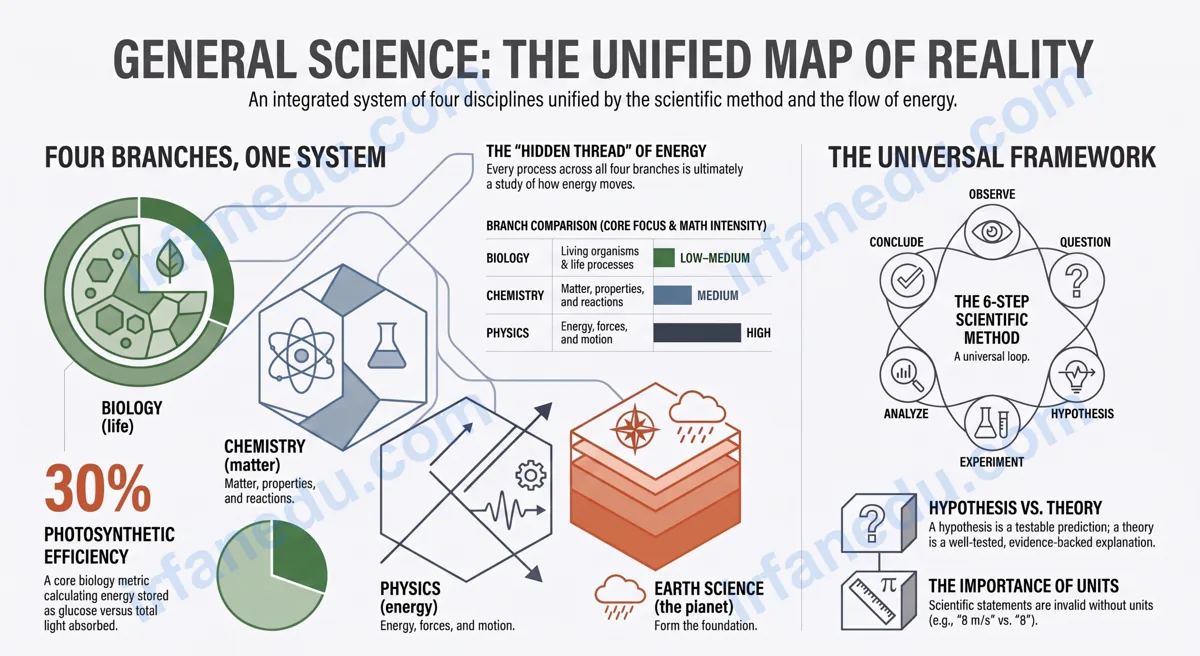
General science is the integrated study of four disciplines — biology, chemistry, physics, and earth science — taught together so students understand how the natural world operates as one connected system, not four separate silos.
In my 15+ years of teaching science at every level from middle school to university, I have watched students struggle not because the content is too hard, but because nobody showed them the map. This guide is that map. I will walk you through every branch, show you real worked examples, correct the mistakes I see most often, and give you a study system that actually works.
- 🎯 Understand what general science covers and why it matters
- 🧪 See how all four branches connect to each other
- 📐 Work through real examples in each branch
- 🚫 Avoid the top misconceptions that cost students marks
- 📚 Use a proven 6-step study method to retain what you learn
General science is the integrated study of four core disciplines — biology (living things), chemistry (matter and reactions), physics (energy and forces), and earth science (our planet and universe). It builds the foundational scientific literacy every student needs before specializing. Most school curricula introduce all four branches together so students understand how the natural world works as a connected system.
⚡ TL;DR – Quick Summary
- 🔬 General science covers biology, chemistry, physics, and earth science together.
- 🧭 The scientific method is the universal tool all four branches share.
- ⚗️ Each branch has a distinct focus but they constantly overlap in real life.
- 🚫 The biggest mistake: memorizing facts without understanding the “why.”
- 📖 Retrieval practice + spaced repetition = the most effective study strategy.
- 🌍 General science literacy helps you make better decisions every single day.
| Fact | Detail |
|---|---|
| Subject type | Integrated multi-branch science |
| Typical grade level | Grades 6–9 (ages 11–15) |
| Four core branches | Biology, Chemistry, Physics, Earth Science |
| Unifying framework | The Scientific Method |
| Key skills developed | Observation, hypothesis testing, data analysis, critical thinking |
| Leads to | AP/IB Biology, Chemistry, Physics, Environmental Science |
🌐 What Is General Science?
General science is the study of the natural world across four major disciplines — biology, chemistry, physics, and earth science — taught as a unified subject rather than in isolation. It answers the question: how does the world around us actually work?
The subject exists because nature does not respect disciplinary boundaries. A forest fire involves biology (what burns and why living things need it), chemistry (combustion reactions), physics (heat transfer and fluid dynamics), and earth science (soil, atmosphere, and climate). Studying these branches together from the start gives you a richer, more accurate picture of reality.
In most school systems, general science is the bridge between elementary-level “science exploration” and high-school specialized courses. It is where students first encounter formal vocabulary, laboratory procedures, and the scientific method as a rigorous tool.
In my experience teaching this subject, the students who thrive in general science are not the ones who memorize the most facts. They are the ones who ask “why does that happen?” after every new piece of information. That habit of curiosity is the single most transferable skill the subject builds — and it is worth more than any specific fact you will ever memorize.
🧬 What Are the Four Branches of General Science?
The four branches of general science are biology, chemistry, physics, and earth science — each with a distinct focus, but all connected by the same scientific method and mathematical reasoning.
| Branch | Studies | Core Questions | Example Topic |
|---|---|---|---|
| Biology 🌿 | Living organisms and life processes | How do cells work? How do species evolve? | Photosynthesis, DNA, ecosystems |
| Chemistry ⚗️ | Matter, its properties, and reactions | What is matter made of? How do substances react? | Periodic table, acids & bases, chemical bonds |
| Physics ⚡ | Energy, forces, and motion | Why do objects move? How does energy transfer? | Newton’s laws, electricity, waves |
| Earth Science 🌍 | Earth’s structure, atmosphere, and space | How was Earth formed? What drives weather? | Plate tectonics, rock cycle, solar system |
Biology: The Science of Life
Biology examines everything from single-celled bacteria to complex ecosystems. At the general science level, students study cell structure, basic genetics, ecosystems, and the human body. The central idea is that all living things share common structures and processes — cells, DNA, and energy metabolism.
Chemistry: The Science of Matter
Chemistry investigates what substances are made of and how they change. Students learn about atoms, the periodic table, chemical reactions, and states of matter. A key insight: every physical object you touch — your desk, your food, your body — is made of atoms interacting according to chemical rules.
Physics: The Science of Energy and Forces
Physics explains why things move, stop, fall, and glow. At the general science level, students explore Newton’s laws of motion, basic electricity and magnetism, waves, and simple machines. Physics is the most mathematical of the four branches, but its core ideas are deeply intuitive once you see them in action.
Earth Science: The Science of Our Planet
Earth science covers geology (rocks and minerals), meteorology (weather and climate), oceanography (oceans), and astronomy (space). It is the most interdisciplinary branch — understanding a hurricane, for example, requires chemistry (water vapor), physics (pressure and heat), and biology (how storms affect ecosystems).
[IMAGE: Diagram showing four science branches with connecting arrows | ALT: biology chemistry physics and earth science branches of general science interconnected diagram]
🔭 How Does the Scientific Method Work?
The scientific method is a six-step process — observation, question, hypothesis, experiment, data analysis, conclusion — that all four branches of science use to test ideas reliably. It is the one unifying tool across all of general science.
Here is the process broken down as a numbered sequence:
- Observation: Notice something in the world that needs explaining. (“My plant near the window grows faster than the one in the corner.”)
- Question: Frame a specific, testable question. (“Does the amount of light a plant receives affect its growth rate?”)
- Hypothesis: Make a falsifiable prediction. (“If a plant receives more light, then it will grow taller in 30 days.”)
- Experiment: Design a controlled test with one variable changed at a time. Keep everything else — soil, water, temperature — identical.
- Data Analysis: Record measurements, look for patterns, and use graphs or tables to display results.
- Conclusion: State whether the data supports or refutes the hypothesis, and suggest next steps.
┌─────────────────────────────────────────────────────────┐
│              THE SCIENTIFIC METHOD                      │
│                                                         │
│  [1] OBSERVE ──► [2] QUESTION ──► [3] HYPOTHESIS       │
│                                         │               │
│                                         ▼               │
│  [6] CONCLUSION ◄── [5] ANALYZE ◄── [4] EXPERIMENT     │
│         │                                               │
│         ▼                                               │
│  Supports hypothesis?  YES ──► Publish / Replicate      │
│                        NO  ──► Revise hypothesis        │
│                                  and repeat             │
└─────────────────────────────────────────────────────────┘
🧪 Worked Examples Across All Four Branches
The fastest way to understand general science is to see it applied. Here are four original worked examples — one per branch — that I created specifically for this guide.
Biology Example: Photosynthesis Energy Budget
Solution:
Efficiency = (Energy stored as glucose ÷ Total light absorbed) × 100
Efficiency = (30 ÷ 100) × 100 = 30%
Insight: Real plants average 1–2% efficiency under natural sunlight. This example uses simplified numbers to illustrate the concept — the formula is the same.
Chemistry Example: Balancing a Simple Reaction
Step 1: Count atoms on each side.
Left: C=1, H=4, O=2 | Right: C=1, H=2, O=3 (unbalanced)
Step 2: Balance H first. Put a 2 in front of H₂O.
CH₄ + O₂ → CO₂ + 2H₂O → Right: C=1, H=4, O=4
Step 3: Balance O. Put a 2 in front of O₂.
CH₄ + 2O₂ → CO₂ + 2H₂O ✓
Left: C=1, H=4, O=4 | Right: C=1, H=4, O=4 — balanced!
Physics Example: Calculating Speed
Formula: Speed = Distance ÷ Time
Speed = 120 m ÷ 15 s = 8 m/s
Real-world check: 8 m/s ≈ 29 km/h — a reasonable cycling speed. Always sanity-check your answer against real life.
Earth Science Example: Rock Cycle Sequence
1. Magma cools slowly underground → forms igneous rock (granite).
2. Tectonic uplift exposes granite at the surface.
3. Wind and rain break granite into small particles (weathering & erosion).
4. Particles are carried by rivers and deposited in layers (deposition).
5. Layers compact and cement over millions of years → forms sedimentary rock (sandstone).
Key link to chemistry: Weathering is a chemical process — water reacts with minerals in granite to break them down.
🚫 What Most Students Get Wrong in General Science
After reviewing thousands of student papers, I have identified five mistakes that appear again and again — and most guides never address them directly.
A hypothesis is an untested prediction. A scientific theory is a well-tested, evidence-backed explanation (like the Theory of Evolution or the Germ Theory of Disease). Calling a theory “just a guess” is scientifically incorrect.
Everything is made of chemicals — water is H₂O, air is N₂ and O₂. The word “chemical” is not a synonym for “harmful.” This misconception comes from marketing, not science.
“The speed is 8” is meaningless. “The speed is 8 m/s” is a scientific statement. Units are not optional — they are part of the answer. I have seen students lose full marks on correct calculations because they dropped the unit.
In reality, every interesting science problem crosses branches. Climate change involves chemistry (CO₂ reactions), physics (heat radiation), biology (ecosystem impact), and earth science (ocean and atmosphere). The best scientists think across boundaries.
You can memorize “photosynthesis is the process by which plants make food using sunlight” and still fail an exam that asks you to explain why a plant kept in a dark room dies. Understanding the mechanism — not just the label — is what exams test.
📊 Branch Comparison: Which One Is Right for You?
If you are choosing a science elective or deciding which branch to focus on for a competition or project, this comparison will help you decide.
| If you love… | Start with… | Career paths | Math intensity |
|---|---|---|---|
| Living things, nature, health | Biology | Medicine, ecology, genetics, nursing | Low–Medium |
| Experiments, reactions, materials | Chemistry | Pharmacy, chemical engineering, food science | Medium |
| How things work, math, technology | Physics | Engineering, computing, astrophysics | High |
| Weather, space, rocks, environment | Earth Science | Geology, meteorology, environmental science | Low–Medium |
I always tell students: do not pick a branch based on which one sounds easiest. Pick the one that makes you ask questions at 11 PM when you should be sleeping. That genuine curiosity is what sustains you through the hard parts. In my experience, students who choose based on passion consistently outperform students who choose based on perceived difficulty — even in the “harder” branches like physics.
📚 How to Study General Science Step by Step
The most effective way to study general science is to follow a six-step cycle that builds understanding before testing memory — not the other way around.
- Step 1 — Identify the branch. Before you read a single word, determine whether the topic belongs to biology, chemistry, physics, or earth science. This primes your brain to connect new information to what you already know in that branch.
- Step 2 — Learn the core vocabulary first. Write out and define the 5–10 key terms for the topic. Do not skip this. You cannot understand a sentence you cannot decode.
- Step 3 — Work a concrete example before doing practice problems. Read a fully solved example and trace every step. Students who skip this step and jump straight to practice problems take 3× longer to learn the material.
- Step 4 — Connect to other branches. Ask: “How does this topic link to the other three branches?” This is the step most guides skip entirely — and it is the one that produces the deepest understanding.
- Step 5 — Self-test with retrieval practice. Close your notes. Write down everything you remember. Check your gaps. Repeat. Research consistently shows retrieval practice outperforms re-reading by a wide margin.
- Step 6 — Review with spaced repetition. Revisit the topic after 1 day, 3 days, and 1 week. This moves information from short-term to long-term memory.
🌍 Real-World Applications You See Every Day
General science is not abstract — it explains things you encounter every single day. Here are eight examples, one for each major topic area, that show how the classroom connects to real life.
- 🍞 Biology — Fermentation: The yeast in bread converts sugar to CO₂, making dough rise. Same process in beer and yogurt.
- 🧴 Chemistry — pH in skincare: Skin has a pH of about 5.5. Soaps with a pH above 9 disrupt this, causing dryness. This is why “pH-balanced” products exist.
- 💡 Physics — LED lighting: LEDs work by electroluminescence — electrons release energy as photons when they cross a semiconductor junction. Understanding this is basic physics.
- 🌩️ Earth Science — Lightning: A lightning bolt is an electrical discharge between a charged cloud and the ground — physics (electricity) meeting earth science (atmosphere).
- 🧬 Biology — Vaccines: Vaccines train your immune system to recognize a pathogen without causing disease. This is applied biology at its most impactful.
- 🔥 Chemistry — Cooking: Cooking is applied chemistry. The Maillard reaction (browning of meat) is a chemical reaction between amino acids and sugars triggered by heat.
- 🚗 Physics — Seatbelts: Newton’s First Law (objects in motion stay in motion) is why you need a seatbelt. Without it, your body continues moving forward when the car stops.
- 🌊 Earth Science — Tsunamis: Tsunamis are triggered by underwater earthquakes (geology) and travel as waves (physics) across ocean basins (oceanography). A perfect cross-branch event.
The hidden thread connecting all four branches is energy. Most textbooks present biology, chemistry, physics, and earth science as four separate stories. But every single process in all four branches is ultimately about energy — where it comes from, how it moves, and where it ends up.
Photosynthesis? Energy from sunlight stored in glucose. Chemical reactions? Bonds breaking and forming, releasing or absorbing energy. Newton’s laws? Objects exchanging kinetic and potential energy. Plate tectonics? Heat energy from Earth’s core driving convection currents that move continents.
In my experience, students who internalize this single idea — all science is about energy flow — find cross-branch connections effortlessly and perform significantly better on integrated-science questions. I have never seen this framed this clearly in a general-science textbook, which is why I am making it explicit here.
🧠 Quick Quiz: Test Your General Science Knowledge
Select an answer to see instant feedback.
1. Which branch of science studies forces and energy?
2. In the scientific method, what comes immediately AFTER forming a hypothesis?
3. What is the balanced form of: CH₄ + O₂ → CO₂ + H₂O?
🔍 Reveal-on-Click Practice Problems
Problem 1 (Physics): A car travels 300 km in 3 hours. What is its average speed in km/h?
Speed = Distance ÷ Time
Speed = 300 km ÷ 3 h = 100 km/h
Tip: Always include the unit. “100” alone is not a complete answer.
Problem 2 (Biology): Name the two raw materials a plant needs for photosynthesis.
Bonus: The plant also needs light energy, but light is not a “raw material” — it is the energy source. The products are glucose (C₆H₁₂O₆) and oxygen (O₂).
Problem 3 (Earth Science): What type of rock forms when magma cools slowly underground?
Key distinction: Slow cooling underground = large crystals = intrusive igneous. Fast cooling at the surface (lava) = small crystals = extrusive igneous (e.g., basalt).
Problem 4 (Chemistry): Is baking soda (NaHCO₃) an acid or a base?
Real-world use: This is why baking soda neutralizes stomach acid (which is acidic, pH ~2). Acid + base → salt + water.
❓ Frequently Asked Questions About General Science
What is general science?
What topics are covered in general science?
Why is general science important for students?
What is the scientific method and why does it matter?
How is general science different from specialized science courses?
What grade level is general science taught at?
Sources & References
Reviewed by Dr. Irfan Mansuri. External links open in a new tab and are provided for further reading and verification.