
Inferential questions: the complete guide + practice quiz 🔍
✍ Written & fact-checked by
Dr. Irfan Mansuri
| Last Updated: July 2026
Seeing inference in action 🖼️
Picture this: you walk into a classroom and see a student slumped in her chair, staring at the window, pencil untouched. The teacher asks, “Are you okay?” The student says, “I’m fine.” But you notice her eyes are red and her homework is blank.
You did not read a sign that said “this student is upset.” You inferred it — you combined visible clues with what you know about human behaviour to reach a conclusion the student never stated out loud. That is exactly what an inferential question asks you to do with a written text.
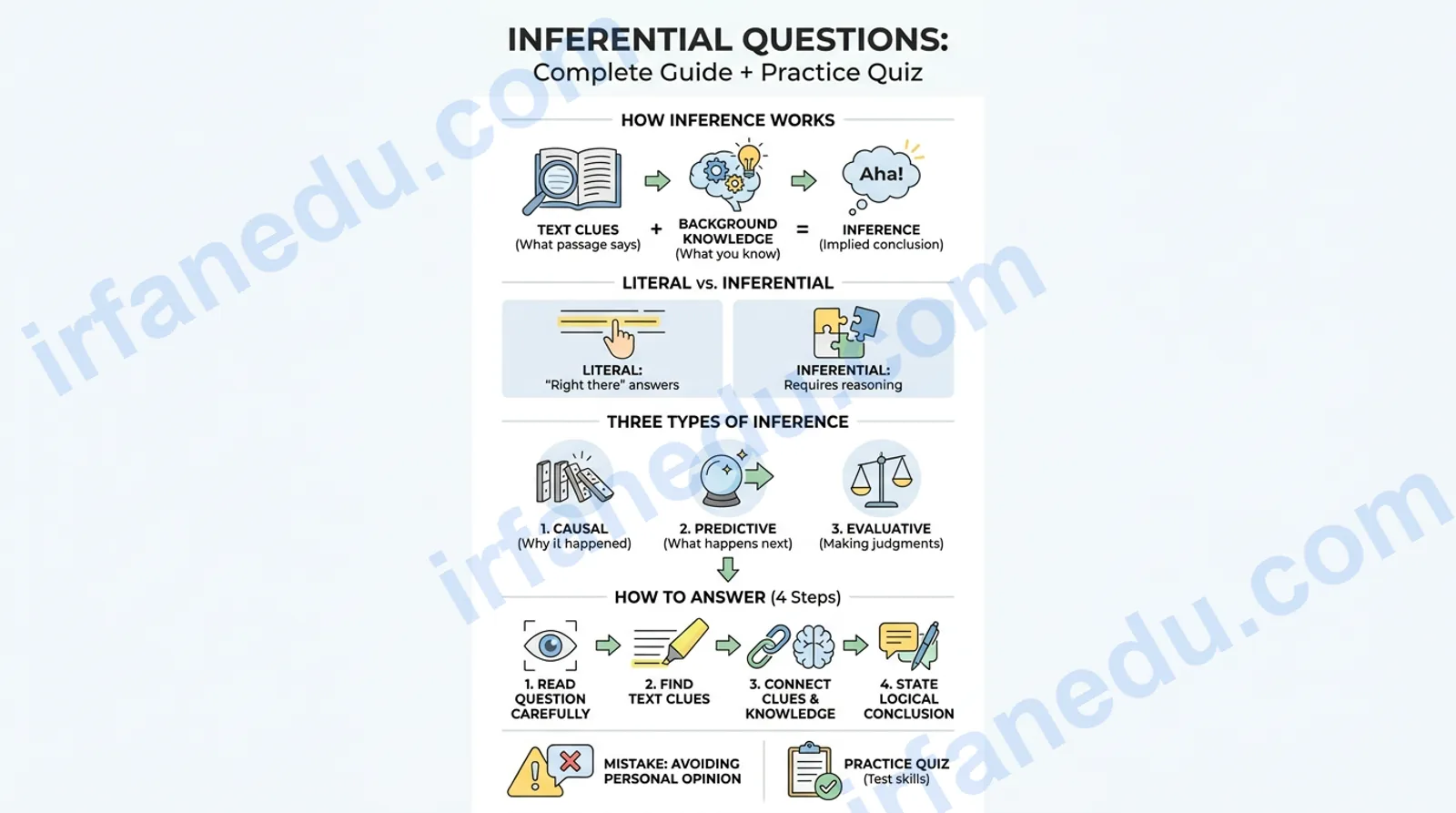
  TEXT CLUES (what the passage says)
  ┌─────────────────────────────────────────────┐
  │  Clue 1: "She hadn't eaten since morning."  │
  │  Clue 2: "Her hands trembled slightly."     │
  │  Clue 3: "She kept glancing at the clock."  │
  └──────────────┬──────────────────────────────┘
                 │  combine clues + background knowledge
                 ▼
  ┌─────────────────────────────────────────────┐
  │  INFERENCE: She is nervous and hungry,      │
  │  waiting anxiously for something.           │
  └─────────────────────────────────────────────┘
  ✗ NOT stated directly in the text
  ✓ Supported by evidence from the text
That gap between “what the text says” and “what the text means” is where inferential questions live. Mastering this skill is one of the highest-value moves you can make in reading comprehension — and this guide gives you everything you need to do it confidently.
What are inferential questions?
An inferential question is a reading comprehension question whose answer is not directly stated in the text. To answer it, you must combine clues from the passage with your own background knowledge and logic to reach a conclusion the author implies but never writes explicitly. Inferential questions test higher-order thinking skills such as concluding, predicting, and interpreting.
The term comes from the word inference — a conclusion reached by reasoning from evidence. In a classroom context, inferential questions sit at the upper levels of Bloom’s Taxonomy (analysis, evaluation, synthesis), which is why they appear heavily on standardized tests and college-readiness assessments.
- Define inferential questions and explain how they differ from literal questions.
- Identify the three main types of inferential questions.
- Apply a 4-step method to answer any inferential question.
- Recognise signal words that flag an inferential question.
- Test your skills with 8 practice questions and full answer explanations.
🎯 The short version
- 🔍 Inferential questions ask for conclusions not written in the text.
- 📖 Literal questions have “right there” answers; inferential ones require reasoning.
- 🧩 Three types: causal, predictive, and evaluative inference.
- 📝 Use 4 steps: read the question, find clues, connect them, state your conclusion.
- ⚠️ The biggest mistake: confusing your personal opinion with a text-supported inference.
- 🏆 Signal words like “implies,” “suggests,” and “most likely” flag inferential questions.
Literal vs. inferential questions: what’s the real difference?
Literal questions have answers you can point to with your finger on the page. Inferential questions require you to think beyond the words. The table below makes this distinction concrete.
| Feature | Literal question | Inferential question |
|---|---|---|
| Answer location | Directly in the text (“right there”) | Must be reasoned from clues in the text |
| Thinking level | Recall / comprehension | Analysis / evaluation / synthesis |
| Example question | “What colour was the dog?” | “Why was the dog hiding under the bed?” |
| Signal words | Who, what, when, where, how many | Why, implies, suggests, most likely, can be inferred |
| Evidence needed | Direct quote from the text | Clue(s) + logical reasoning + background knowledge |
| Bloom’s level | Remember / Understand | Analyze / Evaluate / Create |
In my 15+ years of teaching reading comprehension, I have noticed that students who struggle with inferential questions are not bad readers — they are too literal. They have been trained to hunt for the exact sentence that answers the question. When that sentence does not exist, they freeze. The fix is not more reading; it is permission to reason. Once students understand that an inferred answer is supposed to come from their thinking — not from a highlighted sentence — their confidence jumps immediately.
Three types of inferential questions you need to know
Not all inferential questions are the same. Recognising the type helps you know exactly what kind of reasoning to apply.
1. Causal inference questions
These ask why something happened or what caused a particular outcome. The text gives you the effect; you must infer the cause from surrounding details.
Passage clue: “The streets were empty. Shop windows were boarded up. A siren wailed in the distance.”
Inferential question: “Why are the streets empty?”
Inferred answer: A dangerous event (storm, emergency, or civil unrest) has caused people to stay indoors — none of these words appear in the passage, but the clues point clearly to this conclusion.
2. Predictive inference questions
These ask what will happen next or what a character is likely to do. You use the pattern of events and character traits already shown to project forward.
Passage clue: “Marcus had never missed a deadline in three years. He checked his watch, then ran.”
Inferential question: “What will Marcus most likely do next?”
Inferred answer: He will rush to meet his deadline — his established habit of reliability predicts his next action.
3. Evaluative inference questions
These ask about the author’s purpose, tone, attitude, or implied message — what the author means beyond what the author says.
Passage clue: “The new policy promised efficiency. Within a month, three departments had merged and forty staff had been ‘reassigned’.”
Inferential question: “What is the author’s implied attitude toward the policy?”
Inferred answer: Scepticism or criticism — the word “promised” and the quote marks around “reassigned” signal the author doubts the policy’s stated benefits.
How to answer an inferential question in 4 steps
This step-by-step method works for any inferential question — whether you are reading a short story, a science article, or a standardized-test passage.
-
Read the question carefully. Identify the signal words (implies, suggests, most likely, can be inferred, why, what does the author mean). These tell you what type of inference you need to make.
-
Locate relevant clues in the text. Go back to the passage and find the sentences or phrases that relate to the question. Do not rely on memory — re-read the relevant section.
-
Connect the clues using logic and background knowledge. Ask yourself: “Given these clues, what is the most reasonable conclusion?” Your background knowledge fills the gap between what is written and what is meant.
-
State your conclusion and verify it against the text. A valid inference must be supported by the text — not contradicted by it, and not based purely on personal opinion. If you cannot point to at least one clue, reconsider your answer.
When you see any of these phrases in a question, you are dealing with an inference:
- “What can be inferred from the passage?”
- “What does the author imply?”
- “What is most likely to happen next?”
- “Based on the passage, why did…?”
- “What does the author suggest about…?”
- “What can you conclude about…?”
Worked examples with full explanations
Reading the method is one thing. Watching it applied to real passages is where understanding clicks. Below are two worked examples — one narrative, one expository — with full reasoning shown.
Example 1: Narrative passage
“Lena placed the letter on the kitchen table without opening it. She made herself a cup of tea, sat down, stood up again, and walked to the window. The postmark read: University Admissions Office.”
Inferential question: “What emotion is Lena most likely feeling?”
Step-by-step reasoning:
- Clue 1: She did not open the letter — avoidance behaviour.
- Clue 2: She made tea, sat, stood, walked — restless, unable to settle.
- Clue 3: The sender is a university admissions office — a high-stakes context.
- Background knowledge: University admission letters determine a major life outcome. Avoidance + restlessness in a high-stakes situation = anxiety.
Inferred answer: Lena is feeling anxious and nervous about the admissions decision. The word “anxiety” never appears, but every clue in the passage points to it.
Example 2: Expository passage
“Coral reefs cover less than 1% of the ocean floor, yet they support approximately 25% of all marine species. In the past three decades, half of the world’s coral reefs have been lost. Ocean temperatures have risen by an average of 0.13°C per decade since 1901.”
Inferential question: “What does the passage suggest about the relationship between ocean temperature and coral reefs?”
Step-by-step reasoning:
- Clue 1: Half of coral reefs have been lost in three decades.
- Clue 2: Ocean temperatures have been rising steadily over the same period.
- Clue 3: The two facts are placed together — the author implies a connection.
- Background knowledge: Rising temperatures cause coral bleaching, a known threat to reefs.
Inferred answer: The passage implies that rising ocean temperatures are contributing to the decline of coral reefs. The author never states this directly but places the evidence side by side to lead the reader to this conclusion.
In my experience teaching this skill, the expository example is where students stumble most. They see two separate facts and treat them as unrelated. The key insight I share is this: authors choose what to put next to each other. When two facts appear in the same paragraph, the author is signalling a relationship. Learning to ask “why did the author put these together?” is the single most powerful inferential reading habit I know.
The mistake most guides don’t address: confusing “plausible” with “text-supported.”
Most reading comprehension resources tell students to “use clues from the text.” What they rarely explain is the critical difference between an inference that is plausible and one that is text-supported. A plausible inference feels reasonable based on general knowledge. A text-supported inference is reasonable and can be traced back to specific words or phrases in the passage.
On standardized tests, wrong-answer traps are almost always plausible but not text-supported. For example, if a passage describes a character crying after a sports match, “she is devastated about losing” is plausible — but if the passage also says “her team had just won,” the text-supported inference is that she is crying from joy, not loss. Students who skip the verification step (Step 4) pick the plausible trap every time.
The fix: After forming your inference, ask yourself: “Can I point to a specific word or sentence in the passage that supports this?” If the answer is no, your inference is an assumption — not a valid answer.
Practice quiz: inferential questions (8 questions) 🧠
Read each passage and question, choose your answer mentally, then click Show answer to reveal the correct choice and a full explanation. No sign-up needed.
“Every morning, Daniel checked his phone before getting out of bed. He refreshed his email three times during breakfast. By the time he reached the office, he had already replied to eleven messages.”
What can be inferred about Daniel?
Show answer
“The old bookshop had not changed in forty years. The same bell rang above the door. The same cat slept on the same shelf. The owner greeted every customer by name.”
What does the passage most likely suggest about the bookshop owner?
Show answer
“The scientist published her findings in a peer-reviewed journal. Within a week, three other research teams had requested her raw data. A major pharmaceutical company sent a letter expressing ‘significant interest.'”
What can be inferred about the scientist’s findings?
Show answer
“After the vote, the senator smiled at reporters and said the result was ‘exactly what the people wanted.’ She did not take any questions.”
What does the author most likely imply about the senator?
Show answer
“The children at the back of the bus grew quieter as the bus turned onto the familiar road. Some pressed their faces to the glass. One small boy whispered, ‘We’re almost there.'”
What is the most reasonable inference about the children’s emotional state?
Show answer
“The new restaurant opened to long queues. By the third week, the queues had shortened. By the second month, the tables nearest the window — once the most sought-after — sat empty on Friday evenings.”
What can be inferred about the restaurant’s performance over time?
Show answer
“Maya had studied the map for weeks. She knew every trail, every elevation change, every water source. On the morning of the hike, she checked the weather forecast one last time, packed a first-aid kit, and told her family her exact route.”
What does the passage suggest about Maya’s character?
Show answer
“The city had invested millions in a new public transit system. Ridership in the first year was below projections. City officials announced they were ‘reviewing the data’ and would ‘consider all options going forward.'”
What
Sources & References
Written and fact-checked by Dr Irfan Mansuri. External links open in a new tab and are provided for further reading and verification.