
7 Things Nobody Tells You About Different Types of Savings Accounts 💜
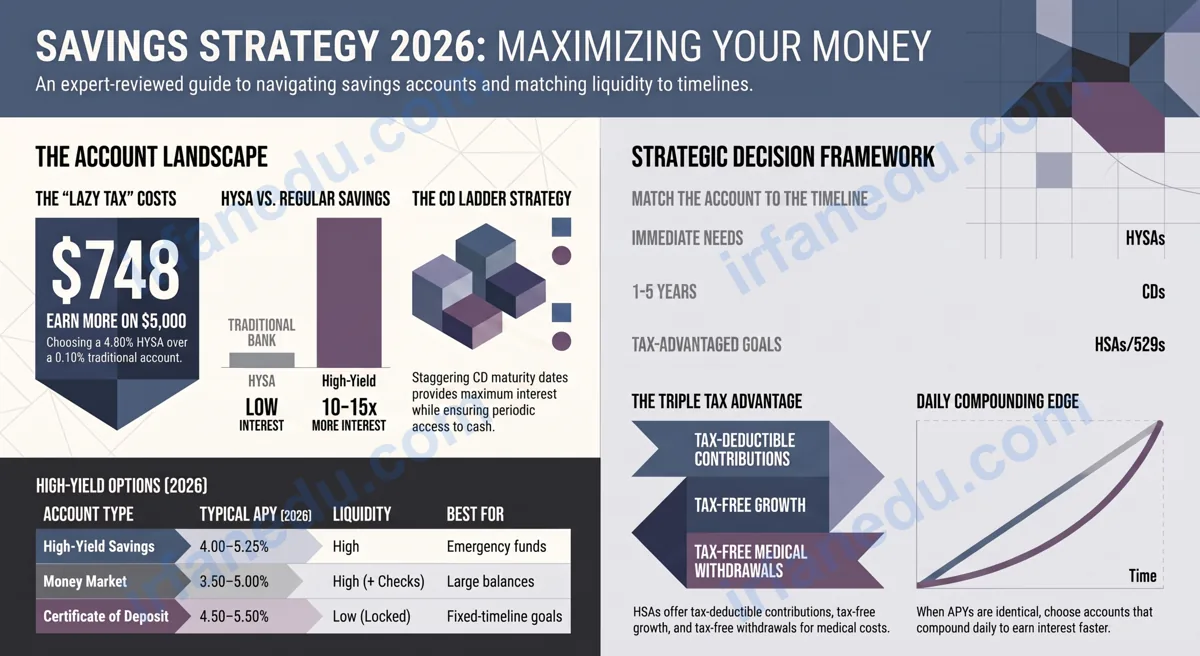
Most personal finance guides hand you a list of account names and call it a day. But the real question — which account actually makes your money grow fastest for your specific situation — almost never gets answered clearly. I’ve watched students park their savings in a 0.01% APY account for years while their peers earned 50 times more interest simply by knowing one extra option existed.
The different types of savings accounts include regular savings accounts, high-yield savings accounts (HYSAs), money market accounts, certificates of deposit (CDs), student savings accounts, and specialty accounts like HSAs and 529 plans. Each type differs in interest rate, liquidity, minimum balance, and tax treatment — and choosing the wrong one can cost you hundreds of dollars in lost interest over just a few years.
- 🎯 Understand what makes each account type genuinely different (not just the name)
- 📊 Compare real APY ranges, access rules, and minimum balance requirements
- 🔍 Spot the 5 most common mistakes students and parents make when choosing an account
- ✅ Follow a 6-step decision process to pick the right account for your goal
- 💡 Learn the non-obvious insight that most finance guides skip entirely
⚡ TL;DR – Quick Summary
- 💜 There are 6+ distinct types of savings accounts — each built for a different purpose.
- 🚀 High-yield savings accounts (HYSAs) pay 10–15× more than standard bank accounts.
- 🔒 CDs offer the highest guaranteed rates but lock your money for a set term.
- 🎓 Student accounts have zero fees and low minimums — perfect for first-time savers.
- 🏥 Specialty accounts (HSA, 529) offer tax advantages regular accounts never will.
- 📐 Match the account to your goal: liquid goal = HYSA; fixed goal = CD; tax goal = specialty.
📊 Quick Facts: Savings Account Types at a Glance
| Account Type | Typical APY (2026) | Liquidity | Best For |
|---|---|---|---|
| Regular Savings | 0.01–0.50% | High | Everyday emergency fund |
| High-Yield Savings (HYSA) | 4.00–5.25% | High | Emergency fund + short-term goals |
| Money Market Account | 3.50–5.00% | High (+ check-writing) | Larger balances, flexible access |
| Certificate of Deposit (CD) | 4.50–5.50% | Low (locked term) | Fixed-timeline goals |
| Student Savings | 0.01–1.00% | High | First savings account, teens |
| HSA (Health Savings) | Varies + tax-free | Medium | Medical expenses, tax savings |
| 529 Education Plan | Market-based | Low (restricted use) | College / education costs |
1️⃣ What Is a Regular Savings Account — and When Is It Actually Useful?
A regular savings account is the most basic deposit account offered by traditional banks and credit unions. It earns a small amount of interest, keeps your money safe and accessible, and is insured by the FDIC (up to $250,000). The interest rate is low — often 0.01% to 0.50% APY — but the account is easy to open, usually with $25–$100.
The honest truth? For most savers in 2026, a regular savings account at a big bank is the worst place to keep money you’re not spending this week. The interest is negligible. But it has two legitimate uses: as a linked account for overdraft protection on a checking account, and as a “starter” account for young children learning to save.
- 💡Nobody tells you: Many big banks deliberately keep regular savings APY near zero because most customers never comparison-shop. The bank profits from the spread between what it pays you and what it earns lending your money out.
2️⃣ What Makes a High-Yield Savings Account Different — and Why Most Students Miss It
A high-yield savings account (HYSA) is a federally insured savings account that pays significantly more interest than a traditional savings account — typically 10 to 15 times more. HYSAs are mostly offered by online-only banks, which have lower overhead (no physical branches) and pass those savings on as higher APY.
Your money is just as safe as in a brick-and-mortar bank — FDIC-insured up to $250,000 — and just as accessible. You can transfer funds to your checking account within 1–3 business days. The main trade-off is that you manage everything online or via an app, with no branch to walk into.
In my experience helping students and parents understand personal finance, the HYSA is the single highest-impact, lowest-effort financial upgrade available to anyone with an emergency fund or short-term savings goal. The switch takes about 15 minutes online. I genuinely can’t think of a reason a student with $500+ in savings should be in a 0.01% APY account in 2026.
The one caveat I always give: check whether the HYSA rate is a promotional teaser rate (common in the first 3–6 months) or the standard ongoing rate. Read the fine print before you commit.
3️⃣ How Does a Money Market Account Work — and Is It Better Than a HYSA?
A money market account (MMA) is a hybrid deposit account that combines features of a savings account and a checking account. It earns interest (often comparable to or slightly above a HYSA), and it typically comes with check-writing privileges and a debit card — something a standard savings account does not offer.
The catch: money market accounts usually require a higher minimum balance — often $1,000 to $10,000 — to open or to avoid monthly fees. If your balance drops below the minimum, you may pay a $10–$25 monthly fee that wipes out your interest earnings entirely.
For students and parents with larger balances who want the flexibility to write a check occasionally (for tuition installments, for example), an MMA can be a smart middle ground between a savings account and a checking account.
4️⃣ What Is a Certificate of Deposit (CD) — and When Should You Use One?
A certificate of deposit (CD) is a time-deposit account where you agree to leave your money untouched for a fixed term — typically 3 months to 5 years — in exchange for a guaranteed, fixed interest rate. The bank rewards your commitment with a higher rate than any liquid savings account.
The defining rule: withdraw early and you pay a penalty, usually 60–180 days of interest depending on the term. This makes CDs ideal for money you know you won’t need until a specific date — a college tuition payment in 18 months, a car purchase in 2 years, or a house down payment in 3 years.
Goal: $4,000 saved, want higher rates but some access each year.

Split into 4 CDs of $1,000 each:

  CD 1 ──── 1-year term ──── matures Year 1 ──→ renew or spend
  CD 2 ──── 2-year term ──── matures Year 2 ──→ renew or spend
  CD 3 ──── 3-year term ──── matures Year 3 ──→ renew or spend
  CD 4 ──── 4-year term ──── matures Year 4 ──→ renew or spend

Result: Every year, one CD matures and you get access to $1,000
        PLUS you earn the higher long-term CD rate on the rest.
        This beats keeping all money in a liquid low-rate account.
5️⃣ What Is a Student Savings Account — and Why Is It the Best First Account?
A student savings account is a savings account designed specifically for people aged 13–24, with features that remove the typical barriers to entry: no monthly fees, no minimum balance requirement, and no overdraft penalties. Most banks offer them as a way to build brand loyalty with young customers early.
Students under 18 typically need a parent or guardian as a joint account holder, which also gives parents visibility into spending habits — a useful teaching tool. Once the student turns 18, the account usually converts to a standard account automatically.
- 💡Nobody tells you: The interest rate on student accounts is usually low (0.01–1%). Once you turn 18 and have $500+, you should move the bulk of your savings to an HYSA while keeping the student account open (it’s free) to maintain your banking relationship and credit history.
6️⃣ What Are Specialty Savings Accounts — HSA, 529, and IRA Explained Simply
Specialty savings accounts are purpose-built accounts that offer tax advantages in exchange for restrictions on how and when you can use the money. They are not general-purpose savings vehicles — but for the right goal, they are dramatically more powerful than any regular savings account.
🏥 Health Savings Account (HSA)
An HSA is available to people enrolled in a high-deductible health plan (HDHP). Contributions are tax-deductible, growth is tax-free, and withdrawals for qualified medical expenses are also tax-free — a triple tax advantage no other account offers. In 2026, the individual contribution limit is $4,300 and the family limit is $8,550 (IRS figures).
🎓 529 Education Savings Plan
A 529 plan is a state-sponsored investment account for education expenses. Contributions grow tax-free, and withdrawals for qualified education costs (tuition, books, room and board) are also tax-free. Parents and grandparents commonly use 529s to save for a child’s college costs. Starting in 2024, unused 529 funds can also be rolled into a Roth IRA (up to $35,000 lifetime), removing the old “what if my child doesn’t go to college?” objection.
💰 Roth IRA (for teens and young adults)
A Roth IRA is a retirement account, but it’s worth mentioning here because anyone with earned income — including a teenager with a part-time job — can contribute. Contributions are after-tax, but all growth and qualified withdrawals in retirement are completely tax-free. Starting a Roth IRA at 16 instead of 26 can mean hundreds of thousands of dollars more at retirement due to compound interest over a longer period.
The 529-to-Roth IRA rollover rule introduced in 2024 changed the calculus for parents who were hesitant to over-fund a 529. In my view, this makes the 529 a much more attractive savings vehicle than it was before — the “trapped money” risk is now capped at $35,000 lifetime, which is manageable. If you’re a parent saving for a child under 10, I’d strongly recommend at least exploring a 529 alongside a regular HYSA.
7️⃣ How Do You Choose the Right Type of Savings Account? (6-Step Process)
Choosing the right savings account comes down to answering six questions in order. Each answer eliminates options until you’re left with the best fit for your situation.
- What is this money for? — Emergency fund, short-term purchase, college, healthcare, or retirement? Each purpose points to a different account type.
- When will you need it? — Within 30 days = liquid account (HYSA or MMA). Within 1–5 years = CD or 529. Retirement = Roth IRA.
- How much are you starting with? — Under $500: student account or HYSA with no minimum. Over $5,000: MMA or CD ladder becomes viable.
- Do you need check-writing or debit access? — Yes: money market account. No: HYSA is simpler and often higher-rate.
- Is there a tax advantage available? — Medical costs: HSA. Education: 529. Retirement: Roth IRA. These beat every regular account when used correctly.
- Is the institution FDIC or NCUA insured? — Always verify before depositing. The FDIC’s BankFind tool at banks.data.fdic.gov lets you check any bank instantly.
📊 Full Comparison: All Types of Savings Accounts Side by Side
| Account Type | APY Range | FDIC Insured | Liquidity | Min. Balance | Tax Advantage | Best Age to Open |
|---|---|---|---|---|---|---|
| Regular Savings | 0.01–0.50% | Yes | High | $25–$100 | None | Any |
| High-Yield Savings (HYSA) | 4.00–5.25% | Yes | High | $0–$100 | None | 18+ (or 13+ jointly) |
| Money Market Account | 3.50–5.00% | Yes | High + checks | $1,000–$10,000 | None | 18+ |
| Certificate of Deposit (CD) | 4.50–5.50% | Yes | Low (locked) | $500–$1,000 | None | 18+ |
| Student Savings | 0.01–1.00% | Yes | High | $0 | None | 13–24 |
| HSA | Varies | Often | Medium | Varies | Triple tax-free | 18+ (with HDHP) |
| 529 Plan | Market-based | No (state-backed) | Low (restricted) | $0–$25 | Tax-free growth | Any (parent opens) |
| Roth IRA | Market-based | No (investment) | Medium | $0 | Tax-free retirement | Any with earned income |
⚠️ 5 Common Mistakes Students Make When Choosing a Savings Account
These are the mistakes I see most often — and every single one is avoidable once you know to look for it.
-
1
Staying in a 0.01% APY account out of inertia. The “lazy tax” is real. A $2,000 emergency fund at 0.01% earns $0.20/year. The same amount in a 4.75% HYSA earns $95. That’s $94.80 lost every year for doing nothing. -
2
Confusing a money market account with a money market fund. One is FDIC-insured and safe. The other is an investment product with (small) risk. The names are nearly identical — always check the account type before depositing. -
3
Putting emergency fund money in a CD. If your car breaks down and your only savings are locked in a 2-year CD, you’ll pay an early-withdrawal penalty on top of the repair bill. Emergency funds must stay liquid — HYSA only. -
4
Ignoring the minimum balance requirement on an MMA. A $15/month fee on a $500 balance = $180/year in fees, which completely wipes out any interest earned and then some. Always check the minimum before opening. -
5
Skipping the 529 because “what if my child doesn’t go to college?” Since 2024, up to $35,000 of unused 529 funds can roll into a Roth IRA. The old objection is largely gone. Missing years of tax-free growth is the bigger risk now.
The APY comparison is only half the story. The real differentiator is “compounding frequency.” Most guides compare annual percentage yields (APY) and stop there. But APY already accounts for compounding — so why does compounding frequency still matter in practice?
Here’s the non-obvious part: when you make additional deposits throughout the year (which most savers do), higher compounding frequency (daily vs. monthly) means each new deposit starts earning interest faster. Over a year of weekly $50 deposits into a 4.75% APY account, daily compounding produces measurably more interest than monthly compounding at the same stated APY — because your mid-year deposits compound more cycles before year-end.
Most HYSA comparison sites show only APY and ignore compounding frequency. When choosing between two accounts with identical APY, pick the one that compounds daily. It’s a small but real edge — and it’s the kind of detail that separates a good financial decision from a great one.
🧠 Quick Quiz: Test Your Savings Account Knowledge
Q1. Which type of savings account typically offers the highest interest rate AND keeps your money fully liquid?
Q2. What happens if you withdraw money from a CD before the term ends?
Q3. Which specialty account offers a “triple tax advantage” — tax-deductible contributions, tax-free growth, AND tax-free withdrawals?
✏️ Practice Problems: Apply What You’ve Learned
Problem 1: Calculate the interest difference between a regular savings account and an HYSA over 2 years.
Regular savings: A = 3000 × (1 + 0.0005/12)^24 ≈ $3,003.00. Interest earned: ~$3.00
HYSA: A = 3000 × (