
Special Right Triangles Worksheet: Free PDF + Lesson (45-45-90 & 30-60-90)
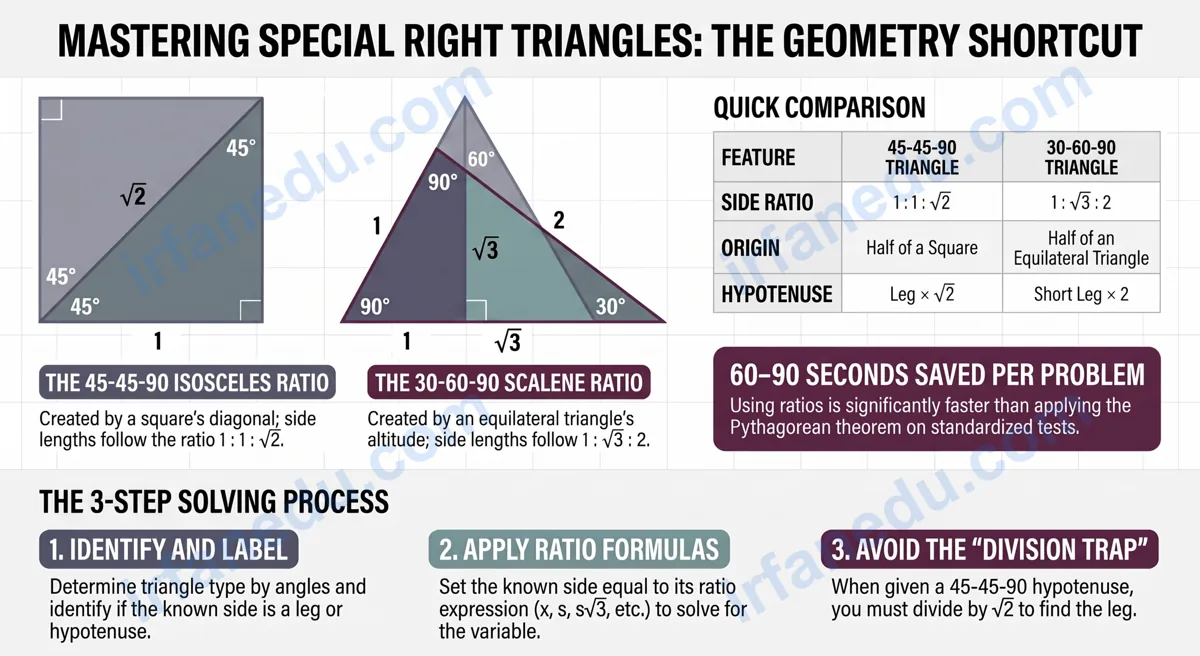
If I could teach you one thing about geometry that pays off in almost every future math class, it would be this: memorise the two special right triangle ratios and you will never need to reach for a calculator for those problems again.
I have tutored hundreds of students over 15 years, and I see the same thing every time — students who know these two ratios cold solve problems in 20 seconds that take others two minutes. That speed advantage alone is worth the effort on any timed test.
Special right triangles are the 45-45-90 and 30-60-90 triangles. Their sides always follow fixed ratios (1:1:√2 and 1:√3:2 respectively), so you can find any missing side with a single multiplication or division — no Pythagorean theorem required.
In this guide you will get a clear lesson, three fully worked examples, a common-mistakes section, and a free printable PDF worksheet with 12 problems and a complete answer key. Let’s build this skill from the ground up.
- ✅ Understand what makes these triangles “special”
- ✅ Apply the 45-45-90 and 30-60-90 ratios confidently
- ✅ Avoid the three most common errors students make
- ✅ Practice with 12 graded problems and check your answers
📄 Free Printable PDF: 12 graded problems (easy to hard) + full answer key. Print it, solve it, self-check.
⚡ TL;DR – Quick Summary
- 🔷 Two special right triangles: 45-45-90 and 30-60-90.
- 🔷 45-45-90 ratio: legs are equal; hypotenuse = leg × √2.
- 🔷 30-60-90 ratio: short leg : long leg : hypotenuse = 1 : √3 : 2.
- 🔷 Identify the triangle type first, then apply the matching ratio.
- 🔷 Both triangles appear on standardised tests and in real-world design.
- 🔷 Download the free PDF worksheet to practise 12 problems with an answer key.
📊 Quick Facts Table
| Feature | 45-45-90 Triangle | 30-60-90 Triangle |
|---|---|---|
| Angles | 45°, 45°, 90° | 30°, 60°, 90° |
| Side ratio | 1 : 1 : √2 | 1 : √3 : 2 |
| Legs | Equal (isosceles) | Unequal |
| Hypotenuse formula | leg × √2 | short leg × 2 |
| Comes from | Half a square (diagonal) | Half an equilateral triangle |
| Trig values defined | sin 45° = cos 45° = √2/2 | sin 30°, cos 60°, sin 60°, cos 30° |
What Are Special Right Triangles?
Special right triangles are right triangles whose angle measures produce side ratios that are always the same, regardless of the triangle’s size. This predictability is what makes them “special” — and incredibly useful.
Every right triangle satisfies the Pythagorean theorem (a² + b² = c²). But for most right triangles, the side lengths are messy decimals. The 45-45-90 and 30-60-90 triangles are the rare exceptions where the ratios stay clean — involving only whole numbers and √2 or √3.
Think of it this way: if I tell you one side of a special right triangle, you can find the other two sides using nothing but multiplication or division. That is a powerful shortcut.
📐 Visual: Side Labels for Both Special Right Triangles
  45-45-90 Triangle          30-60-90 Triangle
  ─────────────────          ─────────────────

        C                          C
       /|                         /|
      / |                        / |
  x√2/  | x                   2s/  | s√3
    /   |                      /   |
   /45° |                   /30°   |
  A─────B                  A───────B
     x                         s

  Legs: AB = BC = x          Short leg: AB = s
  Hypotenuse: AC = x√2       Long leg:  BC = s√3
  Both acute angles = 45°    Hypotenuse: AC = 2s
In my experience teaching geometry, students who struggle with special right triangles almost always have the same problem: they try to memorise the formulas without understanding where they come from. Once I show them that the 45-45-90 is just a square cut in half, and the 30-60-90 is an equilateral triangle cut in half, the ratios stop feeling arbitrary. They become obvious. That geometric origin story is the thing most textbooks skip, and it is the single most useful piece of context I can give you.
Why Do Special Right Triangles Matter for Students?
Special right triangles appear on virtually every standardised geometry test and form the foundation of trigonometry. Knowing these ratios cold makes you faster, more accurate, and more confident.
Here are the specific places you will encounter them:
- 🎯 Standardised tests (SAT, ACT, state geometry exams) — these triangles appear in multiple questions per test.
- 📐 Trigonometry — the exact values of sin/cos/tan at 30°, 45°, and 60° all come directly from these triangles.
- 🏗️ Architecture and engineering — roof pitches, ramp angles, and diagonal bracing all use these ratios.
- 🎮 Computer graphics and game design — vector calculations at 45° and 60° are everywhere.
- 📏 Coordinate geometry — finding distances along diagonal lines at standard angles.
How Do You Solve Special Right Triangle Problems? (Step-by-Step)
Solving any special right triangle problem takes exactly five steps. Follow this process every time and you will not make mistakes.
- Step 1 — Identify the triangle type. Check the given angles. Two 45° angles (or a right isosceles triangle) means 45-45-90. Angles of 30° and 60° mean 30-60-90. If angles are not labelled, look for clues: a square’s diagonal always creates 45-45-90; an equilateral triangle’s altitude always creates 30-60-90.
- Step 2 — Label the known side. Decide whether the given measurement is the short leg, long leg, or hypotenuse. In a 30-60-90, the short leg is always opposite 30°, the long leg is opposite 60°, and the hypotenuse is opposite 90°.
- Step 3 — Write the ratio. 45-45-90: legs = x, hypotenuse = x√2. 30-60-90: short leg = s, long leg = s√3, hypotenuse = 2s.
- Step 4 — Solve for the unknown. Set the known side equal to its ratio expression and solve for x or s. Then substitute back to find the remaining sides.
- Step 5 — Verify with the Pythagorean theorem. Plug your answers into a² + b² = c² to confirm. This takes 10 seconds and catches any arithmetic slip.
Fully Worked Examples: Special Right Triangles
Let me walk you through three worked examples — one straightforward 45-45-90, one 30-60-90, and one real-world application. These match the difficulty range of the worksheet problems below.
✏️ Example 1 — 45-45-90: Find the hypotenuse
Problem: A 45-45-90 triangle has one leg = 8. Find the hypotenuse.
Step 1: Triangle type confirmed — 45-45-90 (two equal angles, right triangle).
Step 2: Known side is a leg. In the ratio, leg = x, so x = 8.
Step 3: Hypotenuse = x√2 = 8√2.
Step 4: Answer: hypotenuse = 8√2 ≈ 11.31.
Verify: 8² + 8² = 64 + 64 = 128. (8√2)² = 128. ✓
✏️ Example 2 — 30-60-90: Given the hypotenuse
Problem: A 30-60-90 triangle has hypotenuse = 20. Find both legs.
Step 1: Triangle type confirmed — 30-60-90.
Step 2: Known side is the hypotenuse. In the ratio, hypotenuse = 2s, so 2s = 20, meaning s = 10.
Step 3: Short leg = s = 10. Long leg = s√3 = 10√3 ≈ 17.32.
Verify: 10² + (10√3)² = 100 + 300 = 400. 20² = 400. ✓
✏️ Example 3 — Real-World: Diagonal of a square
Problem: A square tile has a diagonal of 12 cm. What is the side length?
Step 1: A square’s diagonal cuts it into two 45-45-90 triangles. The diagonal is the hypotenuse.
Step 2: Hypotenuse = x√2 = 12, so x = 12/√2 = 12√2/2 = 6√2 ≈ 8.49 cm.
Insight: This is a classic application — tile installers and carpenters use this calculation constantly when cutting diagonal pieces.
🔍 Reveal: Bonus Practice Problem — 30-60-90 from an equilateral triangle
Problem: An equilateral triangle has side length 10. Find its height.
Solution: Drop an altitude from the top vertex. It bisects the base, creating two 30-60-90 triangles. The hypotenuse of each is 10 (the original side), so 2s = 10, s = 5. The height (long leg) = s√3 = 5√3 ≈ 8.66.
Common Mistakes Students Make with Special Right Triangles
After reviewing thousands of student solutions, I have identified three mistakes that account for the vast majority of wrong answers. Knowing them in advance is half the battle.
Wrong: Assuming the side you are given is always the short leg.
Right: Always check which angle the given side is opposite. The short leg is opposite 30°, the long leg is opposite 60°, and the hypotenuse is opposite 90°. Mislabelling this one side cascades into two wrong answers.
Wrong: Given hypotenuse = 10, writing leg = 10√2.
Right: Hypotenuse = leg × √2, so leg = hypotenuse ÷ √2 = 10/√2 = 5√2. When you know the hypotenuse, you divide — not multiply.
Wrong: Leaving the answer as 12/√2 (a radical in the denominator).
Right: Rationalise: 12/√2 = 12√2/2 = 6√2. Most tests and teachers require simplified radical form.
Mistake 1 is the one that costs students the most points, in my experience. I have seen students who know the ratios perfectly but still get the problem wrong because they labelled the sides without checking the angles first. My fix: before writing anything, draw a quick sketch, label all three angles, then label the sides. That 10-second habit eliminates the most common error entirely.
💡 Unique Insight: Why Most Guides Teach These Triangles Backwards
Almost every textbook and worksheet site teaches special right triangles by presenting the ratios first and the geometric origin second — or never. This is backwards, and it is why students forget the ratios under pressure.
Here is the insight that changes everything: both special right triangles are just familiar shapes cut in half. The 45-45-90 is a square sliced along its diagonal. The 30-60-90 is an equilateral triangle sliced down its altitude. If you forget the ratio on a test, you can reconstruct it in 30 seconds from first principles — just draw the parent shape and apply the Pythagorean theorem once.
Practical consequence: teach yourself the parent shapes, not just the ratios. Students who know the geometric origin score better on novel problems (like “find the diagonal of a rhombus”) because they can see the hidden special right triangle inside the larger figure — something rote memorisation alone will not give you.
📝 On-Page Practice Worksheet: Special Right Triangles (12 Problems)
Work through these problems in order — they start easy and get progressively harder. Leave answers in simplest radical form. Use the step-by-step method from the lesson above.
How to use this worksheet: Print the PDF (button below) or solve directly on paper. After finishing, reveal the answer key to self-check. For each wrong answer, re-read the relevant worked example above before moving on.
- 45-45-90 triangle. One leg = 5. Find the hypotenuse.
- 45-45-90 triangle. Hypotenuse = 10. Find each leg.
- 45-45-90 triangle. One leg = 7√2. Find the hypotenuse.
- 30-60-90 triangle. Short leg = 4. Find the long leg and hypotenuse.
- 30-60-90 triangle. Hypotenuse = 14. Find both legs.
- 30-60-90 triangle. Long leg = 9√3. Find the short leg and hypotenuse.
- 45-45-90 triangle. One leg = 3√2. Find the hypotenuse and the other leg.
- 30-60-90 triangle. Short leg = 5. Find the area of the triangle.
- A square has diagonal = 12. Using 45-45-90 rules, find the side length of the square.
- An equilateral triangle has side = 10. Using 30-60-90 rules, find its height.
- 30-60-90 triangle. Long leg = 6. Find the short leg, hypotenuse, and area.
- 45-45-90 triangle. Hypotenuse = 9√2. Find each leg and the perimeter.
✅ Show Answer Key
- Hypotenuse = 5√2
- Each leg = 5√2
- Hypotenuse = 14
- Long leg = 4√3; Hypotenuse = 8
- Short leg = 7; Long leg = 7√3
- Short leg = 9; Hypotenuse = 18
- Other leg = 3√2; Hypotenuse = 6
- Area = 25√3/2 (≈ 21.65 square units)
- Side = 6√2
- Height = 5√3
- Short leg = 2√3; Hypotenuse = 4√3; Area = 6√3
- Each leg = 9; Perimeter = 18 + 9√2
📄 Want a clean printable version? Download the PDF — same 12 problems, formatted for printing, with a separate answer key section at the end.
🧠 Quick Quiz: Test Your Knowledge
Select the best answer for each question. Answers are highlighted when you choose.
Q1. In a 45-45-90 triangle, one leg = 6. What is the hypotenuse?
Q2. In a 30-60-90 triangle, the hypotenuse = 16. What is the short leg?
Q3. Which geometric shape, when cut along its diagonal, creates two 45-45-90 triangles?
❓ Frequently Asked Questions: Special Right Triangles
What are the two special right triangles?
What is the side ratio of a 45-45-90 triangle?
What is the side ratio of a 30-60-90 triangle?
How do you find the hypotenuse of a 45-45-90 triangle?
How is a 30-60-90 triangle related to an equilateral triangle?
Sources & References
Reviewed by Dr. Irfan Mansuri. External links open in a new tab and are provided for further reading and verification.