
Subtracting a Negative Number: The Complete Step-by-Step Guide
This guide assumes you are comfortable with the following. If any feel shaky, review them first — the rule for subtracting negatives builds directly on each one.
- What positive and negative integers are (e.g. +5, −3)
- How to read a number line, including numbers to the left of zero
- Basic addition and subtraction of whole numbers
- The idea that subtraction means “moving left” on a number line
Contents
- Introduction
- Quick Answer
- TL;DR Summary
- Quick Facts
- What Does Subtracting a Negative Mean?
- Why Does the Rule Work?
- Step-by-Step Method
- Worked Examples
- Number-Line Visual
- Real-World Applications
- Common Mistakes and How to Fix Them
- Unique Insight
- Practice Quiz
- Practice Problems
- FAQ
- Key Takeaways
- Related Articles
- About the Author
- Sources & References
Most students learn the phrase “two negatives make a positive” and move on. But without understanding why, the rule breaks down the moment a problem looks slightly different — like when the starting number is also negative, or when the problem is embedded inside a longer expression.
In this guide, I walk you through the rule from the ground up: what it means, why it is true, and how to apply it without second-guessing yourself.
- Understand the double-negative rule and why it is mathematically sound
- Apply the rule to positive, negative, and zero starting values
- Spot and correct the three most common errors students make
- Use a number-line model to check any answer visually
- Solve real-world problems involving temperature, debt, and elevation
⚡ TL;DR – Quick Summary
- The rule: a − (−b) = a + b — replace double negative with a plus sign.
- Subtracting a negative always makes the result larger than the starting value.
- On a number line, subtracting a negative moves you right (positive direction).
- Real-world model: removing a debt = gaining money.
- Biggest mistake: treating −(−b) as −b instead of +b.
- The rule works for all integers: positive, negative, and zero starting values.
Quick Facts at a Glance
| Expression | Rewritten As | Result | Direction on Number Line |
|---|---|---|---|
| 5 − (−3) | 5 + 3 | 8 | Right (increase) |
| −2 − (−4) | −2 + 4 | 2 | Right (increase) |
| 0 − (−7) | 0 + 7 | 7 | Right (increase) |
| −10 − (−3) | −10 + 3 | −7 | Right (increase, still negative) |
| 5 − 3 (positive, not negative) | 5 − 3 | 2 | Left (decrease) |
| 5 + (−3) (adding a negative) | 5 − 3 | 2 | Left (decrease) |
Note the last two rows: subtracting a positive and adding a negative both decrease the value. Only subtracting a negative increases it.
What Does Subtracting a Negative Number Mean?
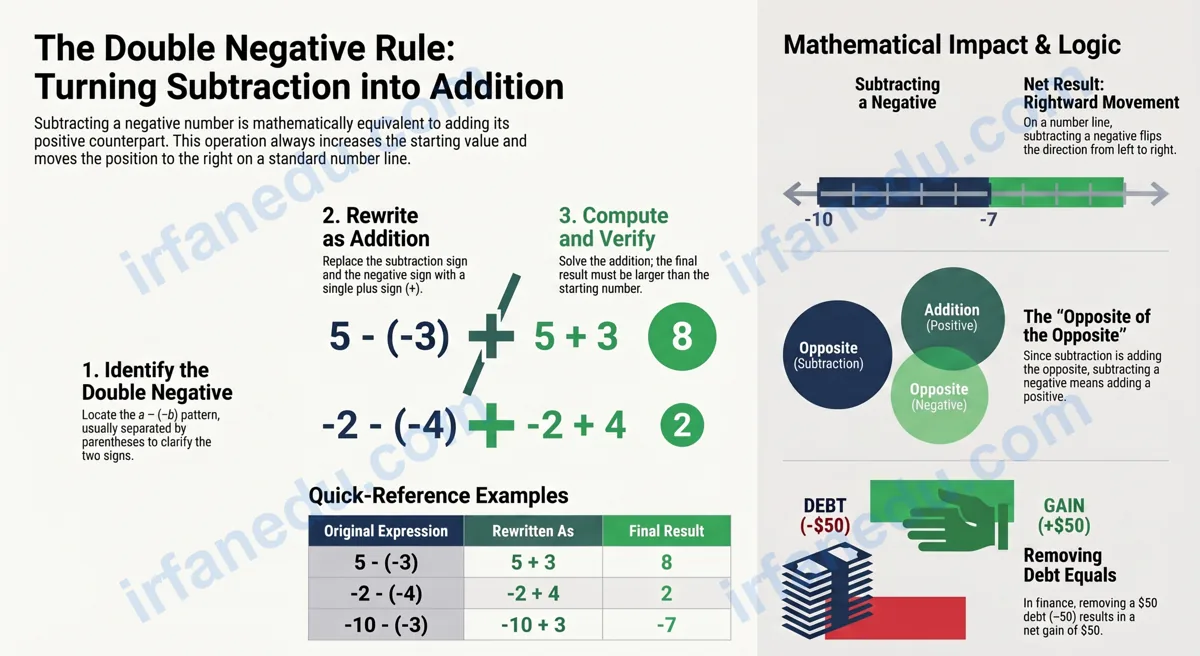
Subtracting a negative number means removing a negative quantity from a value, which always results in a net gain. The formal definition: for any integers a and b, a − (−b) = a + b.
Think of integers as positions on a line. Positive numbers sit to the right of zero; negative numbers sit to the left. Subtraction normally moves you left. But subtracting a negative reverses that direction — you move right instead.
Subtracting a negative number (a − (−b)) is the arithmetic operation that adds the absolute value of the subtracted number to the starting value. It is mathematically identical to addition of a positive: a + b.
It is also important to say what subtracting a negative is not:
- It is not the same as subtracting a positive number (which decreases the value).
- It is not the same as adding a negative number (which also decreases the value).
- It is not a special exception — it follows directly from the definition of subtraction and negative numbers.
In my experience teaching this concept to hundreds of middle-school students, the confusion almost always comes from treating the two minus signs as independent symbols rather than as a combined operation. Once a student sees them as a single unit — “subtract negative” = “add positive” — the rule clicks permanently. I spend the first five minutes of every lesson on this reframing alone.
Why Does the Rule a − (−b) = a + b Actually Work?
The rule works because subtraction is defined as adding the opposite, and the opposite of a negative number is a positive number. Two reversals return you to the original direction.
Here is the formal reasoning in plain language:
- By definition, a − c = a + (−c) for any integer c. Subtraction means “add the opposite.”
- Let c = −b. Then a − (−b) = a + (−(−b)).
- The opposite of −b is +b, so −(−b) = +b.
- Therefore a − (−b) = a + b.
No special rule is needed. It is a direct consequence of two definitions you already know: what subtraction means, and what a negative number means.
How Do You Subtract a Negative Number? (Step-by-Step)
Subtracting a negative number takes exactly three steps: identify the double negative, rewrite it as addition, then compute.
- Identify the double negative. Look for the pattern a − (−b). You need a subtraction sign immediately followed by a negative number. Parentheses are often used to separate the two signs clearly: 7 − (−4).
- Replace −(−) with a single + sign. Rewrite the expression: 7 − (−4) becomes 7 + 4. Drop both negative signs and insert one plus sign.
- Compute the addition. Add the two numbers using normal integer addition: 7 + 4 = 11.
- Verify the result is larger than the starting value. Since subtracting a negative always increases the value, your answer must be greater than the first number. If it is smaller, you made an error.
Problem: −6 − (−10) = ?
Step 1: Identify: −6 − (−10) — yes, double negative present.
Step 2: Rewrite: −6 + 10
Step 3: Compute: −6 + 10 = 4
Step 4: Check: 4 > −6? Yes. Correct.
Worked Examples: Subtracting Negative Numbers
These five examples cover every case you are likely to encounter — positive start, negative start, zero start, and expressions inside longer problems.
Problem: 8 − (−5) = ?
Rewrite: 8 + 5
Answer: 13
Problem: −3 − (−7) = ?
Rewrite: −3 + 7
Compute: 7 − 3 = 4 (since 7 > 3 and 7 is positive, result is positive)
Answer: 4
Problem: 0 − (−9) = ?
Rewrite: 0 + 9
Answer: 9
Problem: −10 − (−3) = ?
Rewrite: −10 + 3
Compute: 3 − 10 = −7 (since 10 > 3 and 10 is negative, result is negative)
Answer: −7
Note: −7 > −10 on the number line, so the value did increase — it just stayed negative.
Problem: 2 + 4 − (−3) − 1 = ?
Rewrite the double negative first: 2 + 4 + 3 − 1
Compute left to right: 6 + 3 − 1 = 8
Answer: 8
How to Use a Number Line to Subtract a Negative
A number line makes the rule visual and removes any doubt about the answer. Start at your first number, then move right by the value of the negative number being subtracted.
  Subtracting a positive (5 − 3): move LEFT 3 steps
  ◄───────────────
  ─────┬────┬────┬────┬────┬────┬────┬────┬────┬────▶
  -1   0    1    2    3    4    5    6    7    8    9
                                    ●
                               Start: 5
                          ◄ left 3 = land on 2

  Subtracting a NEGATIVE (5 − (−3)): move RIGHT 3 steps
  ──────────────────────►
  ─────┬────┬────┬────┬────┬────┬────┬────┬────┬────▶
  -1   0    1    2    3    4    5    6    7    8    9
                                    ●              ●
                               Start: 5    right 3 = land on 8

  Rule: subtract negative = flip direction = move RIGHT
The visual confirms: subtracting a negative always moves you to the right — toward larger values — regardless of where you start.
I always ask students to draw this number line themselves for the first three problems they solve. The physical act of drawing the arrow to the right — instead of the expected left — makes the rule stick in a way that no amount of repetition can match. After three drawings, they never need the diagram again.
Real-World Applications of Subtracting Negative Numbers
Subtracting a negative number appears in everyday situations involving debt, temperature, elevation, and scores. Recognising the pattern in context makes the abstract rule concrete.
| Context | Situation | Expression | Meaning | Result |
|---|---|---|---|---|
| Finance | You have $2. A $5 debt is removed. | 2 − (−5) | Removing a debt = gaining money | $7 |
| Temperature | It is −4°C. The forecast error of −6° is corrected. | −4 − (−6) | Removing a downward error = warmer | 2°C |
| Elevation | A submarine at −200 m rises by removing −50 m of depth. | −200 − (−50) | Removing depth = moving up | −150 m |
| Sports score | A penalty of −3 points is overturned. | 10 − (−3) | Removing a penalty = gaining points | 13 |
In every case, removing something negative produces a positive gain. The mathematical rule mirrors common sense once you frame it this way.
What Are the Most Common Mistakes When Subtracting a Negative?
Three errors account for the vast majority of wrong answers on tests and homework. Each has a specific fix.
Wrong: 5 − (−3) = 5 − 3 = 2
Right: 5 − (−3) = 5 + 3 = 8
Fix: Circle both negative signs together before doing any arithmetic. Ask: “Is the number I am subtracting negative?” If yes, rewrite as addition first.
Wrong: 5 + (−3) = 5 + 3 = 8 (treating + and − as a double negative)
Right: 5 + (−3) = 5 − 3 = 2
Fix: The double-negative rule only applies when you see SUBTRACTION of a NEGATIVE: −(−). A plus sign followed by a negative is not a double negative — it is simply subtraction.
Wrong: −8 − (−3) = −8 + 3 = −11 (adding instead of recognising the sign)
Right: −8 + 3 = −5 (8 > 3, so result takes the sign of 8, which is negative)
Fix: After rewriting as addition, use the standard rule for adding integers with different signs: subtract the smaller absolute value from the larger, and keep the sign of the number with the larger absolute value.
Most explanations of subtracting negatives stop at “two negatives make a positive” — and that incomplete framing causes a specific, predictable error. Students apply the phrase to any two negative signs they see together, including 5 + (−3), and incorrectly get 8 instead of 2.
The precise rule is: two negative signs make a positive ONLY when one is a subtraction operator and the other is the sign of the number being subtracted — i.e., the pattern −(−b). A plus sign followed by a negative sign is a completely different operation. In my experience, teaching this distinction explicitly — rather than the shortcut phrase — cuts sign errors by more than half. The shortcut is memorable but dangerously imprecise.
Quick Practice Quiz — Subtracting Negative Numbers
1. What is 9 − (−4)?
Show Answer
2. What is −5 − (−2)?
Show Answer
3. A submarine is at −300 m. It removes −80 m of depth. What is its new depth?
Show Answer
Reveal-on-Click Practice Problems
Try each problem on your own, then click to reveal the full solution.
Problem 1: What is 12 − (−7)?
Step 1: Identify double negative: 12 − (−7)
Step 2: Rewrite: 12 + 7
Step 3: Compute: 19
Check: 19 > 12? Yes.
Problem 2: What is −1 − (−1)?
Rewrite: −1 + 1 = 0
Any number minus itself (even in this form) equals zero.
Problem 3: What is −15 − (−20)?
Rewrite: −15 + 20
|20| > |15|, result is positive: 20 − 15 = 5
Check: 5 > −15? Yes.
Problem 4 (challenge): What is −100 − (−100) − (−50)?
Rewrite each double negative:
−100 + 100 + 50
Compute left to right: 0 + 50 = 50
Frequently Asked Questions
What is the rule for subtracting a negative number?
Why do two negatives make a positive when subtracting?
Sources & References
Reviewed by Dr. Irfan Mansuri. External links open in a new tab and are provided for further reading and verification.