
Loam calculator: soil volume & weight in seconds
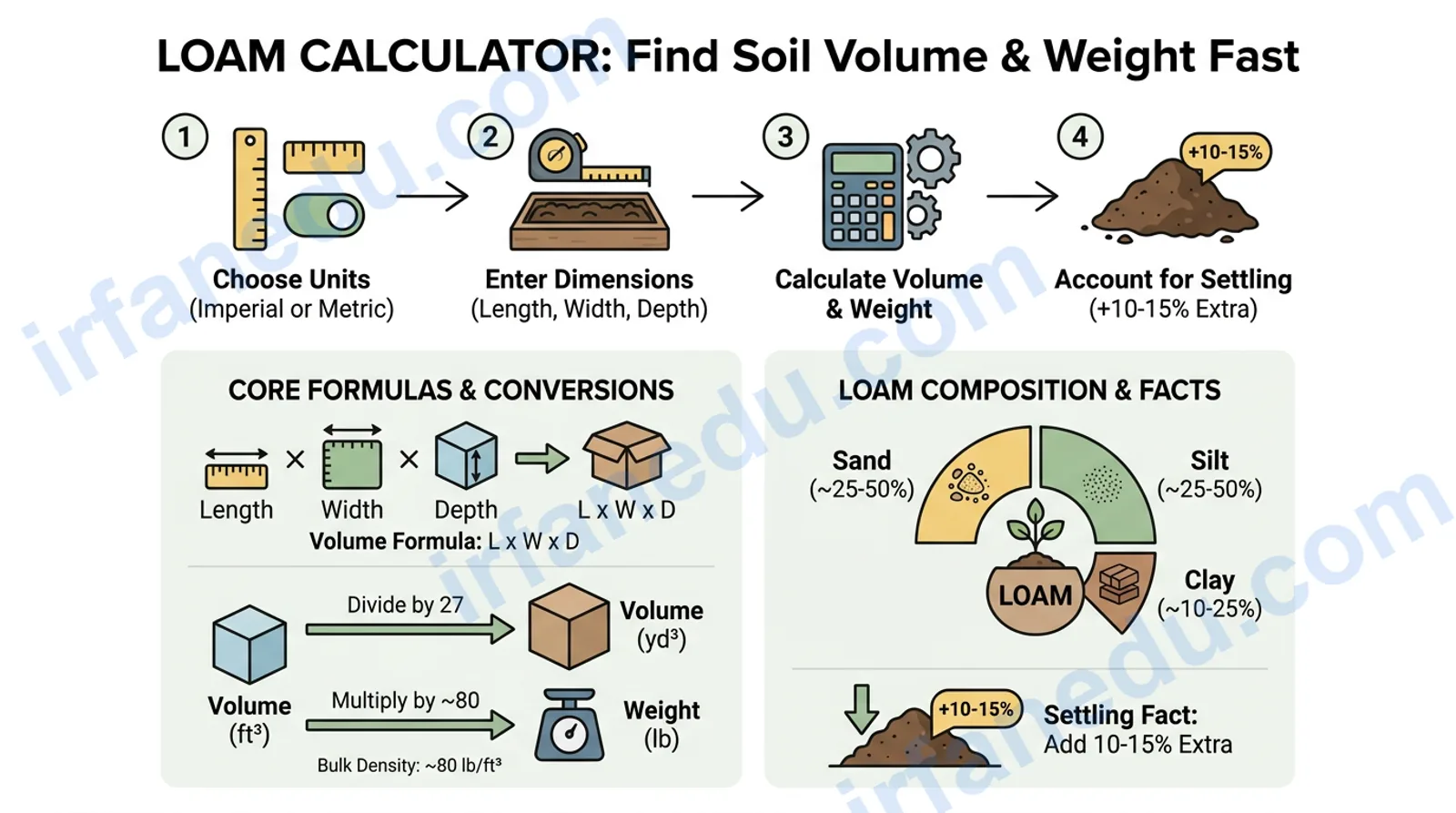
Volume (ft³) = Length (ft) × Width (ft) × Depth (ft)
Volume (yd³) = Volume (ft³) ÷ 27
Weight (lb) = Volume (ft³) × 80 lb/ft³
Weight (kg) = Volume (m³) × 1,300 kg/m³
Loam bulk density: ~80 lb/ft³ (1,300 kg/m³) at typical field moisture. Adjust for very wet or very dry conditions.
⚡ TL;DR
- Volume = Length × Width × Depth (convert depth to feet first).
- Divide cubic feet by 27 to get cubic yards for bulk ordering.
- Loam weighs ~80 lb per cubic foot (1,300 kg/m³).
- Most garden beds need 6-12 inches of loam; lawns need 4-6 inches.
- Always add 10-15% extra to account for settling and compaction.
Contents
Ordering too little loam means a second delivery trip. Ordering too much means a pile of soil you have to move or pay to remove. This calculator eliminates both problems. Enter your area’s dimensions and the depth you want, and it instantly gives you cubic yards, cubic feet, and weight in both pounds and kilograms, plus a numbered step-by-step breakdown so you can see exactly how the number was reached.
A loam calculator computes the volume and weight of loam soil needed for a garden bed, lawn, or landscaping project by multiplying area length by width by depth, then converting to cubic yards and multiplying by loam’s bulk density (approximately 80 lb/ft³ or 1,300 kg/m³).
Loam calculator
ft
ft
in
Step-by-step solution
How to use this calculator
- Choose Imperial (feet/inches) or Metric (metres/centimetres) using the buttons at the top of the widget.
- Enter the length of your area.
- Enter the width of your area.
- Enter the depth of loam you want to apply (in inches for imperial, centimetres for metric).
- Click Calculate. The result card shows cubic yards, cubic feet, cubic metres, pounds, and kilograms instantly.
- Use the “+12% settling” chip to know the safe order quantity. Loam compresses 10-15% after delivery and watering.
What is loam soil?
Loam is a soil texture class defined by its particle-size distribution: roughly 25-50% sand, 25-50% silt, and 10-25% clay. This balance gives loam excellent drainage (from the sand), good water retention (from the silt), and adequate nutrient-holding capacity (from the clay). It is widely considered the ideal growing medium for most plants.
Loam’s bulk density at typical field moisture is approximately 1,300 kg/m³ (80 lb/ft³), which is what this calculator uses. Sandy loam runs slightly lighter (~1,200 kg/m³); clay loam runs heavier (~1,400 kg/m³).
The formula explained
The volume formula is straightforward: multiply the three dimensions. The only step that trips people up is unit consistency.
| Symbol | Meaning | SI unit | Imperial unit |
|---|---|---|---|
| L | Length of area | m | ft |
| W | Width of area | m | ft |
| D | Desired loam depth | m (convert from cm) | ft (convert from in) |
| V | Volume of loam needed | m³ | ft³ or yd³ |
| ρ | Bulk density of loam | 1,300 kg/m³ | 80 lb/ft³ |
| m | Mass (weight) of loam | kg | lb |
Key conversions: 1 cubic yard = 27 cubic feet. 1 cubic foot = 0.0283168 m³. Depth in inches ÷ 12 = depth in feet. Depth in cm ÷ 100 = depth in metres.
Worked examples
Area: 12 ft × 8 ft, depth: 8 inches.
1. Convert depth: 8 in ÷ 12 = 0.6667 ft
2. Volume: 12 × 8 × 0.6667 = 64 ft³
3. Cubic yards: 64 ÷ 27 = 2.37 yd³
4. Weight: 64 × 80 = 5,120 lb (2,322 kg)
5. Order with 12% buffer: 2.37 × 1.12 = 2.65 yd³
Area: 4 ft × 8 ft, depth: 12 inches.
1. Convert depth: 12 in ÷ 12 = 1 ft
2. Volume: 4 × 8 × 1 = 32 ft³
3. Cubic yards: 32 ÷ 27 = 1.19 yd³
4. Weight: 32 × 80 = 2,560 lb (1,161 kg)
5. Order with 12% buffer: 1.19 × 1.12 = 1.33 yd³
Area: 5 m × 4 m, depth: 10 cm.
1. Convert depth: 10 cm ÷ 100 = 0.1 m
2. Volume: 5 × 4 × 0.1 = 2 m³
3. Weight: 2 × 1,300 = 2,600 kg (5,732 lb)
4. Volume in yd³: 2 ÷ 0.7646 = 2.62 yd³
5. Order with 12% buffer: 2.62 × 1.12 = 2.93 yd³
  LOAM VOLUME — VISUAL DIAGRAM
  ─────────────────────────────────────────────────
       ←────── Length (L) ──────→
  ↑    ┌──────────────────────────┐
  │    │                          │
  W    │   Area = L × W           │
  │    │                          │
  ↓    └──────────────────────────┘
       ↓ depth (D) applied on top
       ┌──────────────────────────┐
       │░░░░░░░░ LOAM ░░░░░░░░░░░│  ← D (inches or cm)
       └──────────────────────────┘

  Volume (ft³) = L(ft) × W(ft) × D(ft)
  Volume (yd³) = Volume(ft³) ÷ 27
  Weight (lb)  = Volume(ft³) × 80
  ─────────────────────────────────────────────────
Common mistakes when ordering loam
| Wrong approach | Right approach |
|---|---|
| Measuring depth in inches but multiplying directly with feet | Always convert depth to feet first (divide by 12) |
| Ordering exactly the calculated volume | Add 10-15% for settling; loam compresses after delivery |
| Assuming all “topsoil” is loam | Ask the supplier for screened loam with a particle-size spec |
| Ignoring wet weight for delivery | Wet loam can reach 100 lb/ft³; check truck weight limits |
| Using one bulk density for all soil types | Sandy loam ~1,200 kg/m³; clay loam ~1,400 kg/m³ |
Loam vs other soils: comparison
| Soil type | Bulk density | Drainage | Water retention | Best use |
|---|---|---|---|---|
| Sandy loam | ~1,200 kg/m³ | Excellent | Low | Root vegetables, drought-tolerant plants |
| Loam | ~1,300 kg/m³ | Good | Good | General gardening, lawns, raised beds |
| Clay loam | ~1,400 kg/m³ | Poor | Very high | Moisture-loving plants, erosion control |
| Silt loam | ~1,250 kg/m³ | Moderate | High | Vegetable gardens, orchards |
| Topsoil (generic) | 1,100-1,500 kg/m³ | Varies | Varies | Filling, grading (quality varies widely) |
Most guides tell you to add 10% for settling. In my experience, that is not enough. Freshly delivered loam is loose and aerated. After the first heavy rain and initial watering, it can compress by 15-20%, especially if you are filling a raised bed over a weed barrier (which traps air underneath). For raised beds, I always recommend ordering 20% extra and tamping lightly in 3-inch layers as you fill. This single habit eliminates the need for a second delivery on almost every project.
I have helped dozens of students and homeowners plan garden projects, and the single most common error I see is forgetting to convert depth units before multiplying. Someone measures a 10 ft × 10 ft bed and wants 6 inches of loam. They multiply 10 × 10 × 6 and get 600 – then order 600 cubic feet of soil. That is 22 cubic yards, enough to fill a small room. The correct answer is 18.5 cubic feet (0.69 yd³). Always convert depth to the same unit as length and width before you multiply.
Explore more calculators on IrfanEdu
Practice problems
Try these yourself, then click to reveal the solution.
Problem 1: A 15 ft × 20 ft lawn area needs 4 inches of loam. How many cubic yards?
1. Convert depth: 4 in ÷ 12 = 0.333 ft
Sources & References
Written and fact-checked by Dr Irfan Mansuri. External links open in a new tab and are provided for further reading and verification.