
Texas DMV Permit Practice Test
What is in this test
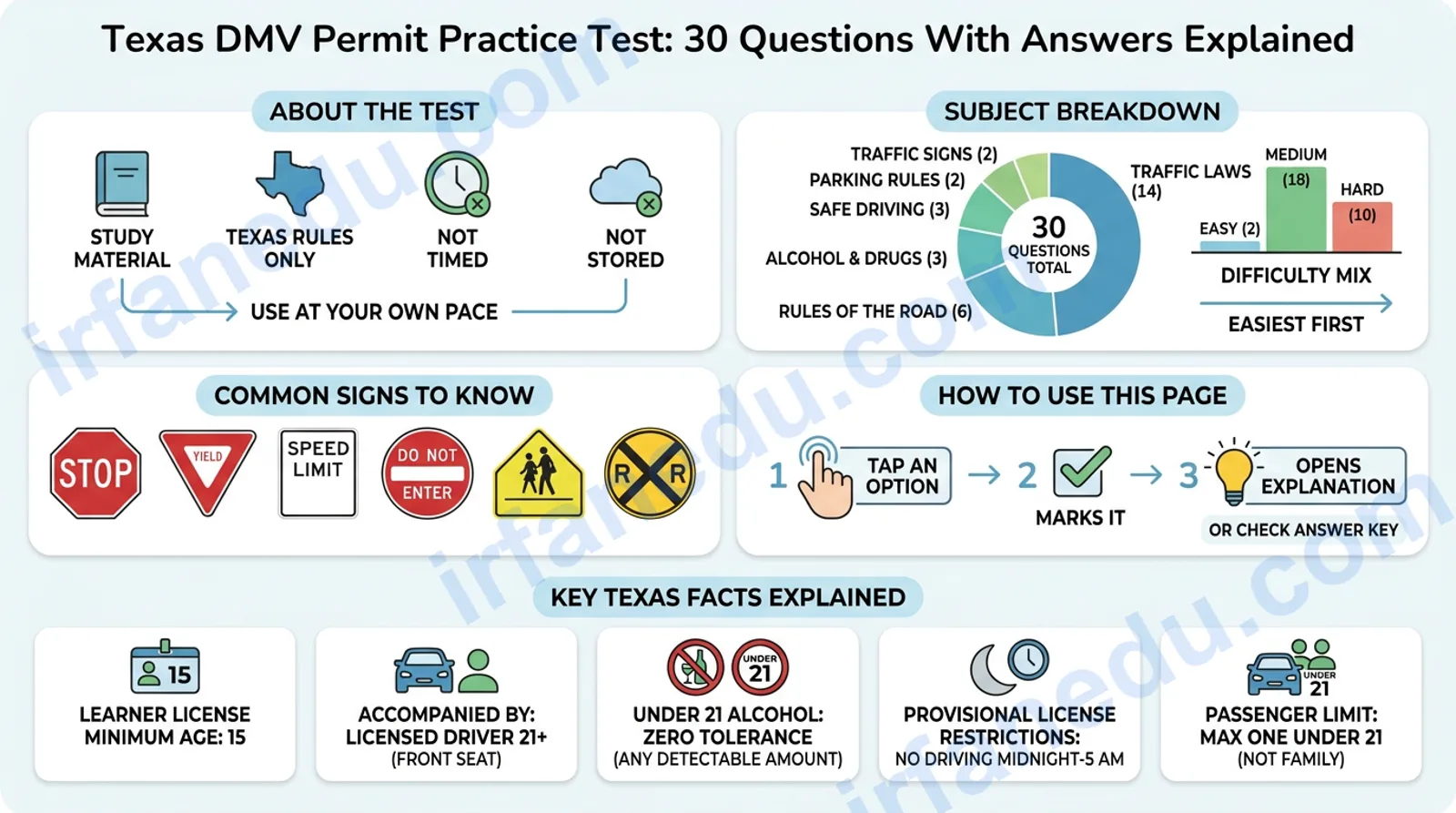
Tap an option and the page marks it and opens the explanation. Nothing is timed and nothing is stored, so you can work through it in one sitting or come back to it. If you would rather not tap through, every answer is also listed in the answer key at the bottom.
| Subject | Questions |
|---|---|
| Traffic laws | 14 |
| Rules of the road | 6 |
| Alcohol and drugs | 3 |
| Safe driving | 3 |
| Parking rules | 2 |
| Traffic signs | 2 |
Difficulty mix: 2 easy, 18 medium, 10 hard. The questions run easiest first.
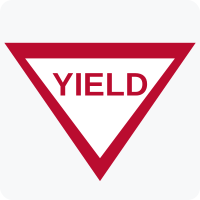
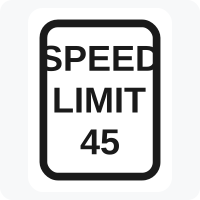
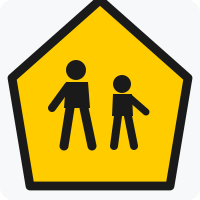
Signs come up on every state paper. These six account for more of them than any others:



The 30 questions
The minimum age to apply for a Texas learner license is:
Show the answer
Correct answer: B. 15
Texas issues a learner license from age 15, once the applicant is enrolled in a driver education course and has passed the written knowledge test and vision screening.
In Texas, a driver under 21 with any detectable alcohol in their system commits:
Show the answer
Correct answer: D. Driving Under the Influence by a Minor, at any detectable amount
Texas takes a genuinely zero tolerance position: any detectable alcohol in a driver under 21 is an offense, bringing a license suspension, a fine, community service, and an alcohol awareness course.
A Texas learner license holder must be accompanied by:
Show the answer
Correct answer: C. A licensed driver at least 21 years old, seated in the front passenger seat
The supervising driver must be 21 or older, hold a valid license, and sit in the front passenger seat where they can see the road and reach the controls if needed.
During the first 12 months of a Texas provisional license, a driver under 18 may not:
Show the answer
Correct answer: A. Drive between midnight and 5 a.m., or carry more than one passenger under 21 who is not family
Texas restricts provisional drivers from driving between midnight and 5 a.m. except for work, school, or a medical emergency, and limits them to one non-family passenger under 21. Wireless device use is also banned outright.
Unless otherwise posted, the speed limit in a Texas urban district is:
Show the answer
Correct answer: B. 30 mph
Thirty miles per hour is the default in an urban district, 15 mph in an alley, and 70 mph on numbered highways outside urban districts unless a different limit is posted.
Texas requires headlights to be turned on:
Show the answer
Correct answer: C. From 30 minutes after sunset until 30 minutes before sunrise, and whenever visibility is under 1,000 feet
The same rule covers fog, smoke, rain, and dust storms: if you cannot clearly see a person or vehicle 1,000 feet ahead, your headlights must be on. Low beams are the correct choice in fog.
Under Texas law, an open container of alcohol in the passenger area of a vehicle on a public highway is:
Show the answer
Correct answer: D. A criminal offense, whether the vehicle is moving or parked on the roadway
The Texas open container law applies to the driver and passengers alike, and whether the vehicle is moving, stopped, or parked on a public highway. Store open containers in the trunk or a locked glove box.
In Texas, when a school bus stops with its red lights flashing and stop arm extended on an undivided road, you must:
Show the answer
Correct answer: A. Stop and remain stopped until the arm retracts and the lights stop flashing
Passing a stopped school bus in Texas carries a fine of up to $1,250 for a first offense and can lead to license suspension. You are not required to stop if the bus is on the opposite side of a divided highway with a physical median.
The Texas Move Over or Slow Down law applies when passing a stopped vehicle with flashing lights. You must:
Show the answer
Correct answer: A. Move to a non-adjacent lane, or slow to 20 mph below the posted limit if you cannot
Texas requires you to vacate the lane nearest the stopped vehicle, or if that is not possible, slow to 20 mph below the limit. Where the limit is 25 mph or less, slow to 5 mph. It covers police, fire, EMS, tow trucks, and TxDOT vehicles.
Texas child passenger safety law requires a child restraint system for children:
Show the answer
Correct answer: C. Younger than 8 years old, unless taller than 4 feet 9 inches
Children under 8 must ride in an appropriate child seat or booster unless they are already taller than 4 feet 9 inches. The safest place for any child under 13 is the back seat.
In Texas, you may not park within how many feet of a fire hydrant?
Show the answer
Correct answer: B. 15 feet
Fifteen feet is the Texas clearance. You also may not park within 20 feet of a crosswalk at an intersection, 30 feet of a stop sign or signal, or 50 feet of a railroad crossing.
You are approaching an intersection in Texas where the traffic signal is not working. You must:
Show the answer
Correct answer: C. Treat it as a four-way stop
A dark signal is treated as a stop sign on every approach. Stop, then proceed in the order vehicles arrived, yielding to the driver on your right when two arrive together.
Texas roads flood quickly during heavy storms. If you encounter water across the road, you should:
Show the answer
Correct answer: A. Turn around and find another route, because you cannot judge depth or whether the road beneath is intact
Six inches of moving water can knock a person off their feet and twelve inches can carry away a car. The roadway underneath may also have washed out. Turn around and do not drown is the standard Texas guidance.
In Texas, a solid white line on the right edge of the roadway marks:
Show the answer
Correct answer: D. The right edge of the travel lane, separating it from the shoulder
The white edge line shows where the travel lane ends. It is especially useful at night and in fog, when looking toward it helps you hold your lane position without staring at oncoming headlights.
Texting while driving in Texas is:
Show the answer
Correct answer: D. Prohibited statewide for all drivers
Texas bans reading, writing, or sending electronic messages while driving for every driver. Drivers under 18 may not use a wireless device at all, and phone use is banned in school zones.
When following a vehicle in Texas at highway speed in good conditions, the recommended minimum gap is:
Show the answer
Correct answer: C. Three to four seconds
Three to four seconds gives room for perception, reaction, and braking at highway speed. Add more time when following a large vehicle, in rain, or at night.
In a Texas school zone during posted hours, you must:
Show the answer
Correct answer: A. Obey the reduced limit and refrain from using a handheld phone
Texas bans handheld phone use in active school zones in addition to the reduced speed limit, and fines in school zones are increased. Watch for crossing guards, whose signals you must obey.
At a Texas intersection with a yield sign, you must:
Show the answer
Correct answer: B. Slow down and give way to traffic and pedestrians, stopping only if necessary
Yield means give way. Slow to a speed from which you could stop, scan for traffic and pedestrians, and enter only when you will not force anyone else to slow or swerve.
A Texas highway sign showing a black-on-white rectangle with a number and the word MINIMUM means:
Show the answer
Correct answer: A. The lowest speed at which you may lawfully travel in normal conditions
A minimum speed limit prevents unusually slow vehicles from obstructing traffic. If a mechanical problem or conditions force you below it, use hazard lights and leave the highway at the first safe opportunity.
Texas requires a driver to yield to a pedestrian:
Show the answer
Correct answer: B. In any marked or unmarked crosswalk, and when the pedestrian is on the driver’s half of the roadway
Drivers must yield in marked and unmarked crosswalks, and to any pedestrian close enough to be in danger. Pedestrians who are blind and using a white cane or guide dog always have the right-of-way.
In Texas, the default speed limit in an alley is:
Show the answer
Correct answer: B. 15 mph
Fifteen miles per hour applies in alleys, where sight lines are short and pedestrians can appear from doorways with no warning.
In Texas you must report a crash to law enforcement immediately when:
Show the answer
Correct answer: A. Someone is injured or killed, or the vehicles cannot be safely driven away
Texas requires immediate notice when a crash causes injury, death, or damage that makes a vehicle undrivable. Leaving the scene of an injury crash is a felony offense.
Texas law requires drivers to carry proof of financial responsibility, meaning:
Show the answer
Correct answer: B. Liability insurance at or above the state minimum, or an approved alternative
Driving without proof of financial responsibility in Texas brings fines that escalate on repeat offenses, plus an annual surcharge and possible suspension of license and registration.
On a Texas highway with an improved shoulder, a slower driver may move onto the shoulder to let others pass:
Show the answer
Correct answer: C. Only where it can be done safely and is permitted, and not as a regular travel lane
Texas permits limited shoulder use in specific circumstances, including allowing an overtaking vehicle to pass, but only when it can be done safely. The shoulder is never a general travel or passing lane.
In Texas, when may you pass another vehicle on the right?
Show the answer
Correct answer: A. When the vehicle ahead is turning left, or on a road with two or more lanes in your direction, and only using a paved lane
Passing on the right is lawful only when there is a paved lane to use. Driving off the pavement or onto the unpaved shoulder to pass is prohibited.
In Texas, a first DWI conviction for a driver 21 or over can bring:
Show the answer
Correct answer: D. A fine up to $2,000, up to 180 days in jail, and license suspension up to a year
A first DWI in Texas is a Class B misdemeanor with a minimum jail term, a substantial fine, license suspension, and an annual state surcharge to keep the license. Penalties rise sharply for repeat offenses or a high BAC.
Your vehicle starts to skid on a wet Texas road. You should:
Show the answer
Correct answer: D. Ease off the accelerator and steer smoothly toward where you want to go
Look and steer where you want the vehicle to go, and be ready for the rear to swing back the other way as grip returns, which needs a gentle correction rather than a second sharp input.
In Texas, parking is prohibited within how many feet of a railroad crossing?
Show the answer
Correct answer: C. 50 feet
Fifty feet keeps sight lines clear for other drivers checking the track, and keeps your vehicle outside the overhang of a passing train, which extends several feet beyond the rails.
You are entering a Texas freeway and the acceleration lane is short. You should:
Show the answer
Correct answer: B. Accelerate as briskly as the lane allows and merge into the first safe gap, adjusting speed to traffic
Stopping at the end of a ramp is one of the most dangerous things you can do on a freeway, because following traffic does not expect it. Use the whole lane to build speed and blend into a gap.
In Texas, refusing a breath or blood test after a lawful DWI arrest results in:
Show the answer
Correct answer: D. An automatic license suspension of at least 180 days for a first refusal
Under the Texas implied consent law, refusal triggers an administrative suspension of at least 180 days on a first refusal and two years on a repeat, regardless of the outcome of the criminal case.
Answer key
Every answer in one place, in question order.
| No. | Ans | The correct option |
|---|---|---|
| 1 | B | 15 |
| 2 | D | Driving Under the Influence by a Minor, at any detectable amount |
| 3 | C | A licensed driver at least 21 years old, seated in the front passenger seat |
| 4 | A | Drive between midnight and 5 a.m., or carry more than one passenger under 21 who is not family |
| 5 | B | 30 mph |
| 6 | C | From 30 minutes after sunset until 30 minutes before sunrise, and whenever visibility is under 1,000 feet |
| 7 | D | A criminal offense, whether the vehicle is moving or parked on the roadway |
| 8 | A | Stop and remain stopped until the arm retracts and the lights stop flashing |
| 9 | A | Move to a non-adjacent lane, or slow to 20 mph below the posted limit if you cannot |
| 10 | C | Younger than 8 years old, unless taller than 4 feet 9 inches |
| 11 | B | 15 feet |
| 12 | C | Treat it as a four-way stop |
| 13 | A | Turn around and find another route, because you cannot judge depth or whether the road beneath is intact |
| 14 | D | The right edge of the travel lane, separating it from the shoulder |
| 15 | D | Prohibited statewide for all drivers |
| 16 | C | Three to four seconds |
| 17 | A | Obey the reduced limit and refrain from using a handheld phone |
| 18 | B | Slow down and give way to traffic and pedestrians, stopping only if necessary |
| 19 | A | The lowest speed at which you may lawfully travel in normal conditions |
| 20 | B | In any marked or unmarked crosswalk, and when the pedestrian is on the driver’s half of the roadway |
| 21 | B | 15 mph |
| 22 | A | Someone is injured or killed, or the vehicles cannot be safely driven away |
| 23 | B | Liability insurance at or above the state minimum, or an approved alternative |
| 24 | C | Only where it can be done safely and is permitted, and not as a regular travel lane |
| 25 | A | When the vehicle ahead is turning left, or on a road with two or more lanes in your direction, and only using a paved lane |
| 26 | D | A fine up to $2,000, up to 180 days in jail, and license suspension up to a year |
| 27 | D | Ease off the accelerator and steer smoothly toward where you want to go |
| 28 | C | 50 feet |
| 29 | B | Accelerate as briskly as the lane allows and merge into the first safe gap, adjusting speed to traffic |
| 30 | D | An automatic license suspension of at least 180 days for a first refusal |
More permit test practice
Everything on this site tagged DMV lives in the DMV category.
Sources