
Weathering, Erosion, and Deposition: The Complete Student Guide
✍ Written & fact-checked by
Dr. Irfan Mansuri
| Last Updated: August 2026
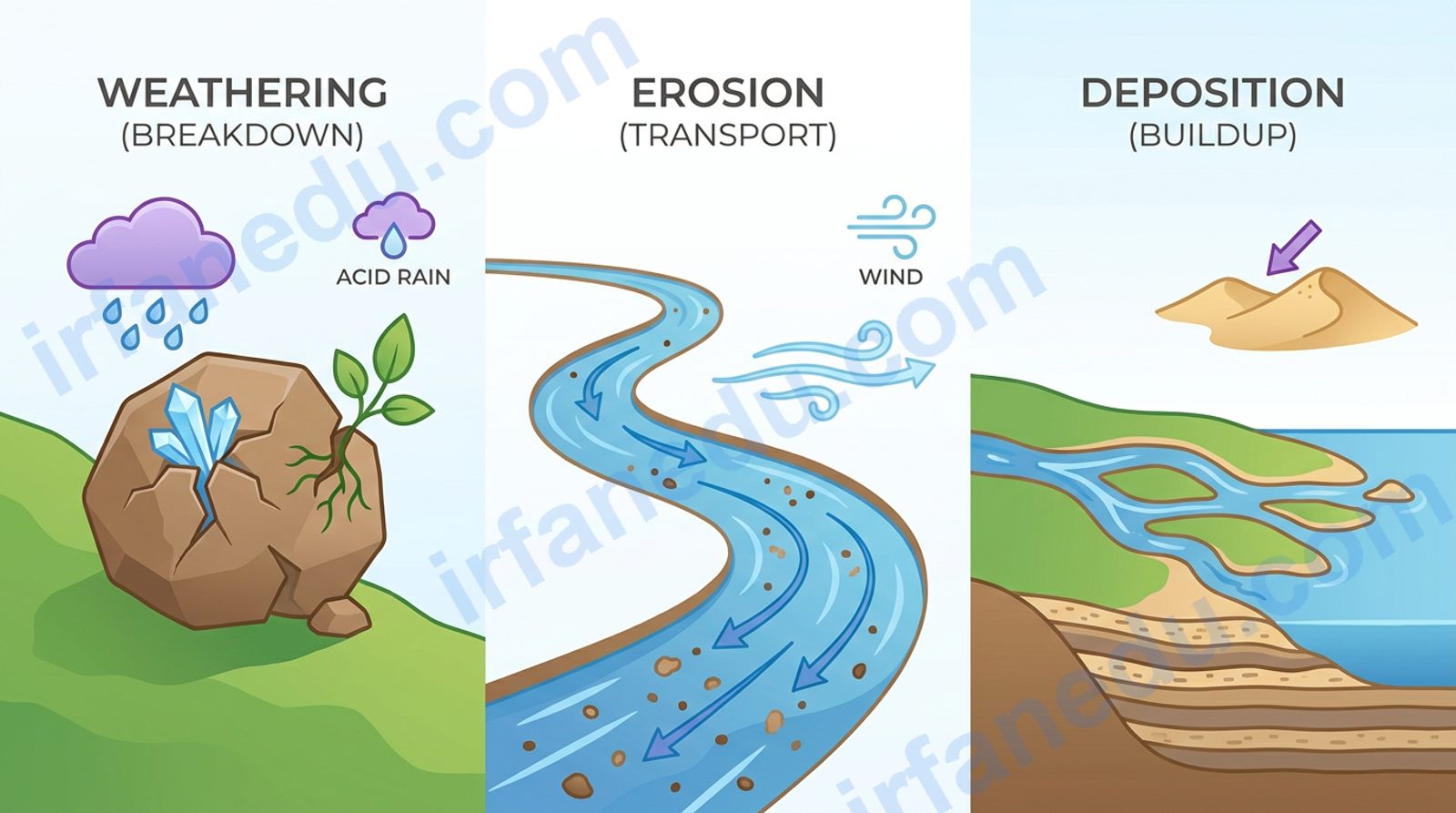
📚 The first time I taught this topic, I drew a boulder on the board and asked my class: “What happens to this rock over the next thousand years?” Half the students said “it erodes.” They weren’t wrong — but they were skipping two steps. That single confusion, I’ve found, is the root of almost every test mistake students make on this topic.
Weathering, erosion, and deposition are three linked Earth-surface processes. Weathering breaks rock apart in place. Erosion picks up and transports those fragments. Deposition drops them somewhere new. Together, they are the engine behind every canyon, beach, delta, and sand dune on the planet.
By the end of this guide, you will be able to tell the three processes apart, name every major type of weathering, trace the path sediment takes from a mountain to the sea, and avoid the three most common mistakes students make on exams.
- Define weathering, erosion, and deposition in your own words
- Distinguish mechanical, chemical, and biological weathering with examples
- Name four agents of erosion and the landforms deposition creates
- Correct the three most common student misconceptions about these processes
Weathering is the breakdown of rock in place by water, ice, chemicals, or living things. Erosion is the transport of those broken pieces by wind, water, ice, or gravity. Deposition is when transported sediment loses energy and settles in a new location. Together, these three processes continuously reshape every landform on Earth.
⚡ TL;DR
- 📌 Weathering = rock breaks down in place (no movement yet)
- 📌 Three types: mechanical, chemical, biological
- 📌 Erosion = broken material is transported by water, wind, ice, or gravity
- 📌 Deposition = sediment drops when energy decreases
- 📌 These three steps feed the rock cycle and build landforms
- 📌 Biggest exam trap: confusing weathering with erosion — they are NOT the same
One boulder’s journey: a worked example
Before I define anything formally, let me walk you through a concrete scenario. This is the example I use in class because it makes the sequence impossible to forget.
Step 1 — Weathering (breakdown in place): Over winter, rainwater seeps into a crack in the boulder. It freezes, expands by about 9%, and widens the crack. This is freeze-thaw weathering, a type of mechanical weathering. The boulder has not moved. It has simply been broken into smaller pieces.
Step 2 — Erosion (transport): Spring snowmelt sends a fast-moving stream down the mountain. The stream picks up the broken granite fragments and carries them downhill. The fragments are now sediment being eroded by water.
Step 3 — Deposition (settling): The stream reaches a flat valley floor. It slows down. It no longer has enough energy to carry the heavy granite pieces, so it drops them. A layer of sediment builds up on the valley floor. That is deposition.
What happens next? Over millions of years, more layers pile on top. Pressure and cementation turn the sediment into sedimentary rock — completing a full loop of the rock cycle.
Notice the order: breakdown first, transport second, deposit third. That sequence never changes, and it is the single most important thing to remember about this topic.
Definitions: what exactly are weathering, erosion, and deposition?
Now that you have seen the process in action, the formal definitions will stick much better.
Weathering is the physical, chemical, or biological breakdown of rock and minerals at or near Earth’s surface. The key word is in place — the material does not travel during weathering.
Erosion is the detachment and transport of weathered material (sediment, soil, or rock fragments) by a moving agent: water, wind, ice, or gravity. Erosion requires movement.
Deposition is the process by which eroded material is dropped and accumulates in a new location when the transporting agent loses energy. Deposition builds landforms.
⚠ Common confusion: Many students use “erosion” as a catch-all for all three processes. On an exam, that costs marks. Erosion is specifically the transport step — not the breakdown, not the settling.
Types of weathering explained
Weathering comes in three forms. Each one breaks rock down differently, and knowing the difference is a standard exam question.
Mechanical (physical) weathering
Mechanical weathering breaks rock into smaller pieces without changing its chemical composition. The rock type stays the same; it just gets smaller.
- Freeze-thaw (frost wedging): Water enters cracks, freezes, expands, and splits the rock. Common in cold climates.
- Abrasion: Rock fragments grind against each other as they are carried by water or wind, wearing each other smooth.
- Exfoliation (pressure release): When overlying rock is removed by erosion, the pressure on deeper rock drops. It expands and peels off in sheets, like an onion.
- Thermal expansion: Repeated heating and cooling causes rock surfaces to expand and contract, eventually cracking.
Chemical weathering
Chemical weathering changes the mineral composition of rock through chemical reactions. The rock does not just get smaller — it becomes a different material.
- Oxidation: Oxygen reacts with iron-containing minerals to form iron oxide (rust). Red-colored soils and rocks show this process at work.
- Carbonation: Carbon dioxide dissolves in rainwater to form weak carbonic acid. This acid dissolves limestone and chalk, creating caves and sinkholes.
- Hydrolysis: Water reacts with minerals like feldspar to produce clay minerals. This is one of the most common chemical weathering reactions on Earth.
- Dissolution: Some minerals, especially halite (rock salt), dissolve directly in water.
Biological weathering
Biological weathering is caused by living organisms. It can be mechanical (roots physically splitting rock) or chemical (organisms secreting acids).
- Root wedging: Tree roots grow into cracks and exert enough pressure to split solid rock over time.
- Lichens: These organisms secrete weak acids that slowly dissolve rock surfaces.
- Burrowing animals: Worms, rodents, and insects break up soil and expose fresh rock surfaces to air and water.
Look at any old stone wall or pavement. The cracks filled with moss and small plants? Those plants are actively widening those cracks through root wedging and acid secretion. In my experience, students are always surprised to learn that something as small as a lichen can split a granite boulder given enough time.
How erosion moves material across the landscape
Erosion is driven by four main agents. Each one picks up, carries, and eventually deposits sediment in a characteristic way.
- Water (rivers, rain, waves): The most powerful erosion agent on Earth. Rivers carry sediment in suspension, roll large particles along the bed, and dissolve soluble minerals. Coastal waves erode cliffs through hydraulic action and abrasion.
- Wind: Effective in dry, open landscapes. Wind picks up fine particles (dust, sand) and carries them long distances. Wind-driven sand abrades rock surfaces like sandpaper.
- Ice (glaciers): Glaciers are slow but enormously powerful. As a glacier moves, it plucks rock from the bedrock below and carries it, carving U-shaped valleys and leaving behind scratched rock surfaces called striations.
- Gravity (mass movement): Landslides, rockfalls, and soil creep all move material downhill under gravity. This is the fastest form of erosion and can be triggered by earthquakes, heavy rain, or loss of vegetation.
📈 Visual: Erosion agents and their characteristic landforms
AGENT        PROCESS              LANDFORM CREATED
-----------  -------------------  -------------------------
Water        River transport      Canyon, river valley, delta
Water        Wave action          Sea arch, sea stack, cliff
Wind         Saltation/abrasion   Sand dune, desert pavement
Ice          Glacial plucking     U-shaped valley, moraine
Gravity      Mass movement        Alluvial fan, talus slope
Where deposition builds new landforms
Deposition happens whenever an erosion agent loses energy. The heavier the sediment particle, the more energy is needed to keep it moving — so large boulders drop first, fine clay settles last.
This size-sorting during deposition is called graded bedding, and it is one of the most useful clues geologists use to reconstruct ancient environments from rock layers.
- River delta: Formed where a river meets a standing body of water (lake or sea) and slows abruptly. The Nile Delta and the Mississippi Delta are classic examples.
- Alluvial fan: Formed where a fast mountain stream reaches flat land. Sediment fans out in a cone shape.
- Sand dunes: Wind drops sand when it hits an obstacle or loses speed. Dunes migrate in the direction of the prevailing wind.
- Moraines: Ridges of rock debris deposited at the edges and front of a glacier as it melts.
- Floodplain: Fine sediment deposited by a river when it overflows its banks. Floodplain soils are among the most fertile on Earth because of this regular sediment input.
In my experience, deposition is the most under-taught of the three processes. Most textbooks spend pages on weathering types and erosion agents, then give deposition a single paragraph. That is a mistake. Deposition is where the story ends — and it is the step that directly creates the fertile soils, beaches, and river valleys that human civilizations were built on. Understanding deposition is not just geology; it is understanding why cities exist where they do.
Side-by-side comparison: weathering vs erosion vs deposition
This table is designed to be a quick-reference tool for exam revision. Each row isolates one key distinguishing feature.
| Feature | Weathering | Erosion | Deposition |
|---|---|---|---|
| What happens | Rock breaks down | Material is transported | Material is dropped |
| Does material move? | No — in place | Yes — away from source | Yes — comes to rest |
| Energy required | Low (gradual) | High (active transport) | Decreasing (energy lost) |
| Main agents | Water, ice, chemicals, organisms | Water, wind, ice, gravity | Water, wind, ice, gravity |
| Result | Smaller rock fragments, altered minerals | Sediment in transit | New landforms (delta, dune, moraine) |
| Rock cycle role | Produces sediment | Moves sediment | Builds sedimentary layers |
| Exam example | Rust on iron-rich rock | River carrying sand | Sand bar forming at river mouth |
Common mistakes students make — and how to fix them
After grading hundreds of earth science tests, I have seen the same errors appear again and again. Here are the three that cost students the most marks.
Mistake 1: Using “erosion” to mean all three processes
Students write “the rock eroded” when they mean the rock weathered, then was eroded, then was deposited. Erosion is only the transport step. Fix: always ask yourself — is the material breaking down, moving, or settling?
Mistake 2: Thinking chemical weathering only happens in wet climates
Chemical weathering does slow down in deserts, but it never stops entirely. Even in arid regions, dew and brief rainfall trigger oxidation and hydrolysis. Mechanical weathering dominates in cold/dry climates, but chemical weathering is present everywhere.
Mistake 3: Forgetting that deposition is selective by grain size
Students often write that “all sediment is deposited at once.” In reality, a slowing river drops its heaviest particles first (gravel, then sand) and carries fine clay much farther. This is why river deltas have coarser sediment near the channel and fine mud at the outer edges.
⚠ Exam trap: A question showing a photo of a cracked, rusty boulder on a hillside is asking about weathering, not erosion. The boulder has not moved. If the question shows sediment in a river, that is erosion. If it shows a layered beach or delta, that is deposition.
Weathering and erosion can happen simultaneously — and most guides never tell you this. The standard classroom model presents weathering, then erosion, then deposition as a clean sequence. But in reality, a river actively weathers the rock of its own channel bed through chemical dissolution and abrasion at the same time as it erodes and transports that material downstream. This is called corrasion (mechanical) and corrosion (chemical) in river systems, and it means the river is its own weathering agent.
The practical implication: when you see a river canyon like the Grand Canyon, the Colorado River did not just transport pre-weathered material. It weathered and eroded simultaneously, cutting deeper with every flood. This overlap is why canyon walls show both chemically altered rock faces AND fresh mechanical fractures at the same level — something a simple three-step model cannot explain.
How to identify each process in a real landscape
This is a practical skill that appears on standardized tests and in fieldwork. Follow these four steps when you look at any landscape photo or diagram.
- Look for breakdown in place. Cracked, pitted, crumbling, or discolored rock that has not moved from its original location signals weathering. Rust-colored patches indicate chemical oxidation. Rounded, peeling surfaces suggest exfoliation.
- Trace the transport path. Follow the direction of water flow, prevailing wind, or glacier movement. Any material being carried along that path is undergoing erosion. Look for striations (scratches on bedrock from glaciers) or cross-bedding in sandstone (from wind or water currents).
- Find where material accumulates. Where the flow slows or stops, look for layered sediment, deltas, dunes, or moraines. That accumulation zone is the site of deposition.
- Identify the agent. Rounded, smooth pebbles suggest water transport. Angular fragments suggest recent mechanical weathering or gravity-driven mass movement. Fine, well-sorted sand suggests wind. Scratched and striated boulders suggest glacial transport.
Frequently asked questions
What is the difference between weathering and erosion?
Weathering is the in-place breakdown of rock by physical, chemical, or biological forces — the rock does not move. Erosion is the removal and transport of those broken pieces by water, wind, ice, or gravity. Weathering must happen first; erosion carries the results away. Confusing the two is the most common mistake on earth science tests.
What are the three types of weathering?
The three types are: mechanical (physical) weathering, which breaks rock into smaller pieces without changing its chemistry (e.g., freeze-thaw, abrasion); chemical weathering, which alters the mineral composition through reactions with water, oxygen, or acids (e.g., oxidation, carbonation); and biological weathering, caused by living organisms such as plant roots, lichens, and burrowing animals.
What causes deposition to occur?
Deposition occurs when the agent of erosion loses enough energy to drop the sediment it is carrying. A river slows as it reaches flat land or a lake; wind drops sand when it hits a barrier; a glacier melts and releases debris. Energy loss is the trigger. Heavier particles are deposited first, finer particles travel farther before settling.
Is biological weathering part of the rock cycle?
Yes. Biological weathering is a recognized part of the rock cycle. Organisms like lichens secrete acids that dissolve minerals, and tree roots exert enough pressure to split solid rock. The resulting fragments feed into erosion and eventually become sedimentary rock through compaction and cementation over geological time.
What landforms does deposition create?
Deposition creates river deltas, alluvial fans, floodplains, sand dunes, beaches, moraines (glacial deposits), and stalactites inside caves. Each landform reflects the specific agent of deposition — water, wind, or ice — and the grain size of the sediment dropped. Floodplains built by river deposition are among Earth’s most fertile agricultural soils.
Sources & references
- Khan Academy — Weathering and Erosion (AP Environmental Science). Accessed August 2026.
- United States Geological Survey (USGS) — Erosion and Sedimentation. Accessed August 2026.
- Britannica — Weathering (geology). Accessed August 2026.
Editorial note: This article was written and fact-checked by Dr. Irfan Mansuri. All claims are based on established earth science curriculum standards and authoritative sources listed above. No statistics or quotes have been fabricated. Last reviewed August 7, 2026.