
Science Olympiad Anatomy & Physiology: The Complete Study Guide That Actually Works
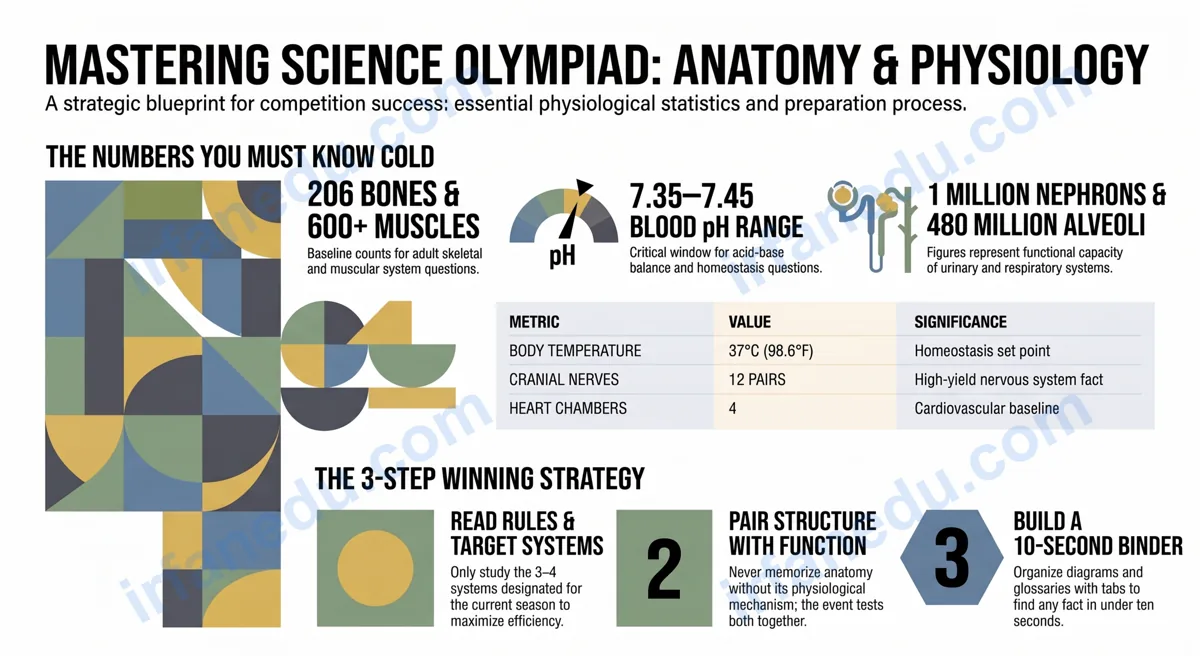
Science Olympiad Anatomy and Physiology is a written-exam event in which two-person teams answer questions on human body systems within 30 minutes. Each season, the official rules designate 3-4 specific systems as the focus. Success requires knowing both the structural details (anatomy) and the functional mechanisms (physiology) of those systems — plus a working understanding of homeostasis, which connects them all.
- Identify the designated body systems for the current season and prioritize them.
- Learn every major structure with its function — never one without the other.
- Understand negative and positive feedback loops as the engine behind every system.
- Practice with real past-test questions under timed conditions.
- Build a well-organized binder that lets you find answers in under 10 seconds.
Science Olympiad Anatomy and Physiology is a Biology event where two-person teams answer written questions on human body systems in 30 minutes. Each season focuses on 3-4 designated systems. Students must know structures, functions, and physiological mechanisms. A binder of notes is typically allowed. Mastering homeostasis and feedback loops gives a cross-system advantage that generic memorization cannot match.
TL;DR – Quick Summary
- Two-person teams, 30-minute written exam, 3-4 designated systems per season.
- Adult human body: 206 bones, 600+ muscles, 11 organ systems, ~37 trillion cells.
- Always pair structure with function — anatomy alone will not win points.
- Negative feedback loops govern most homeostatic processes; know at least three examples.
- Build a binder organized by system with labeled diagrams and key-term glossaries.
- Practice with past invitational tests — question style repeats more than content does.
What Is the Science Olympiad Anatomy and Physiology Event?
Science Olympiad Anatomy and Physiology is a written-test event where two students work together to answer questions about human body systems in exactly 30 minutes. It is one of the most consistently competitive Biology events in the Science Olympiad roster, appearing at invitational, regional, state, and national levels.
The event tests both recall and application. A question might ask you to label a diagram of the nephron, explain how the countercurrent multiplier concentrates urine, or identify which hormone triggers ovulation. The range is wide — which is exactly why a strategic study approach beats brute-force memorization every time.
Each year, Science Olympiad publishes official rules that name the 3-4 body systems in focus for that season. Always read the current-year rules first. Studying the wrong systems is the single most avoidable mistake I see student teams make.
The Numbers You Must Know Cold
High-scoring teams treat key numerical facts as non-negotiable — these appear in questions at every difficulty level and cost easy points when forgotten. Below are the numbers I tell every student to memorize before anything else.
| Fact | Value | Why It Matters |
|---|---|---|
| Bones in adult body | 206 | Skeletal system baseline; infant count (~270-300) is a common trick question |
| Skeletal muscles | ~600-650 | Muscular system; exact count varies by source, so know the range |
| Cranial nerves | 12 pairs | Nervous system; names and functions are high-yield |
| Heart chambers | 4 | Cardiovascular; know atria vs. ventricles and their roles |
| Normal resting heart rate | 60-100 bpm | Cardiovascular physiology baseline |
| Normal body temperature | 37°C / 98.6°F | Homeostasis set point; thermoregulation questions |
| Blood pH range | 7.35-7.45 | Acid-base balance; acidosis vs. alkalosis questions |
| Kidney nephrons (per kidney) | ~1 million | Urinary system; filtration capacity questions |
| Alveoli in lungs | ~480 million | Respiratory system; surface area for gas exchange |
| Human chromosomes | 46 (23 pairs) | Reproductive/genetics crossover questions |
All 11 Body Systems: Structure, Function, and High-Yield Terms
The human body has 11 organ systems. Even when only 3-4 are designated for a given season, understanding all 11 helps because questions often test how systems interact. Here is a concise breakdown of each.
1. Skeletal System
Structure: 206 bones, cartilage, ligaments, joints. Function: Support, protection, movement, mineral storage (calcium, phosphorus), blood cell production (red marrow). High-yield terms: periosteum, osteoblast, osteoclast, compact vs. spongy bone, synovial joint types, axial vs. appendicular skeleton.
2. Muscular System
Structure: ~600-650 skeletal muscles, cardiac muscle, smooth muscle. Function: Movement, posture, heat production. High-yield terms: sarcomere, actin, myosin, sliding filament theory, motor unit, neuromuscular junction, origin vs. insertion, agonist vs. antagonist.
[IMAGE: Sliding filament model diagram showing actin and myosin filaments during muscle contraction | ALT: sliding filament theory diagram for Science Olympiad muscular system study]
3. Nervous System
Structure: Brain, spinal cord (CNS); cranial and spinal nerves (PNS). Function: Rapid communication, sensory processing, motor control. High-yield terms: neuron, axon, dendrite, myelin sheath, action potential, synapse, neurotransmitter, reflex arc, sympathetic vs. parasympathetic, the 12 cranial nerves (mnemonic: “On Old Olympus Towering Tops…”).
  STIMULUS (e.g. hot surface)
        |
        v
  [Sensory Receptor]
        |
  Afferent (sensory) neuron
        |
        v
  [Spinal Cord — Integration Center]
        |
  Efferent (motor) neuron
        |
        v
  [Effector: Muscle]
        |
        v
  RESPONSE (withdrawal)

  Note: Signal bypasses brain for speed.
  Brain receives signal AFTER response occurs.
4. Cardiovascular System
Structure: Heart (4 chambers), arteries, veins, capillaries, blood. Function: Transport of O2, CO2, nutrients, hormones, waste; immune defense; thermoregulation. High-yield terms: systole/diastole, sinoatrial node, AV node, pulmonary vs. systemic circulation, erythrocytes, leukocytes, platelets, plasma, ABO blood types.
5. Respiratory System
Structure: Nasal cavity, pharynx, larynx, trachea, bronchi, bronchioles, ~480 million alveoli. Function: Gas exchange (O2 in, CO2 out), pH regulation, vocalization. High-yield terms: tidal volume, vital capacity, partial pressure, surfactant, diaphragm, pleura, oxyhemoglobin dissociation curve.
6. Digestive System
Structure: Mouth to anus — esophagus, stomach, small intestine (duodenum, jejunum, ileum), large intestine, plus accessory organs (liver, pancreas, gallbladder). Function: Mechanical and chemical digestion, nutrient absorption, waste elimination. High-yield terms: peristalsis, villi, microvilli, bile, amylase, pepsin, chyme, hepatic portal system.
7. Endocrine System
Structure: Hypothalamus, pituitary, thyroid, parathyroid, adrenal glands, pancreas, gonads, pineal gland. Function: Slow, long-lasting chemical communication via hormones. High-yield terms: hormone, target cell, receptor, negative feedback, insulin vs. glucagon, cortisol, ADH, oxytocin, TSH, FSH, LH.
In my experience coaching students for Science Olympiad, the endocrine system is consistently underestimated. Teams spend hours on the skeletal system and then blank on which gland secretes ADH (it’s the posterior pituitary, released from the hypothalamus). The endocrine system connects to every other system through feedback loops — if it’s a designated system, treat it as your highest-priority topic, not an afterthought.
8. Urinary System
Structure: Two kidneys, two ureters, urinary bladder, urethra. Each kidney contains ~1 million nephrons. Function: Filtration of blood, regulation of water/electrolyte balance, blood pressure regulation (renin-angiotensin system), acid-base balance, waste excretion. High-yield terms: glomerulus, Bowman’s capsule, proximal/distal convoluted tubule, loop of Henle, collecting duct, GFR, ADH, aldosterone.
9. Integumentary System
Structure: Skin (epidermis, dermis, hypodermis), hair, nails, sweat glands, sebaceous glands. Function: Protection, thermoregulation, sensation, vitamin D synthesis, water loss prevention. High-yield terms: keratinocyte, melanocyte, Langerhans cell, Meissner’s corpuscle, Pacinian corpuscle, stratum corneum, stratum basale.
10. Lymphatic and Immune System
Structure: Lymph nodes, lymphatic vessels, spleen, thymus, tonsils, bone marrow. Function: Fluid balance, fat absorption (lacteals), immune defense. High-yield terms: lymphocyte, B cell, T cell, antibody, antigen, innate vs. adaptive immunity, MHC, phagocytosis, complement system.
11. Reproductive System
Structure: Male: testes, epididymis, vas deferens, prostate, seminal vesicles. Female: ovaries, fallopian tubes, uterus, vagina. Function: Gamete production, fertilization, fetal development. High-yield terms: meiosis, spermatogenesis, oogenesis, menstrual cycle phases, FSH, LH, estrogen, progesterone, HCG.
How to Prepare for Science Olympiad Anatomy: A 6-Step Strategy
Preparation for this event is a structured skill, not just a reading marathon. Here is the exact sequence I recommend to students starting 8-10 weeks before their first tournament.
- Step 1 — Read the official rules. Download the current-year Science Olympiad rules document. Identify the designated systems. Every hour you spend studying a non-designated system is an hour not spent on the ones that will be tested.
- Step 2 — Build a system-by-system binder. For each designated system, create: (a) a labeled diagram, (b) a function summary in your own words, (c) a key-term glossary with definitions, and (d) one clinical connection (a disease or disorder that involves that system).
- Step 3 — Learn structures and functions together. Never memorize a structure in isolation. For every anatomical term, write its function next to it. The exam tests both, and they reinforce each other in memory.
- Step 4 — Master homeostasis and feedback loops. Understand negative feedback (the dominant mechanism) and positive feedback (rare but important — e.g., childbirth, blood clotting). Be able to trace a complete feedback loop for at least three systems.
- Step 5 — Practice with past invitational tests. Scioly.org hosts past tests from invitationals and nationals. Do at least 5 full past tests under timed conditions. Analyze every wrong answer — not to memorize the answer, but to find the gap in your understanding.
- Step 6 — Quiz your partner daily. Cover the labels on a diagram and have your partner point to structures. Then switch. Verbal explanation to another person is the single most effective retrieval practice method I know.
What Most Students Get Wrong in Science Olympiad Anatomy
After reviewing hundreds of student binders and post-event debriefs, I have identified the five mistakes that cost teams the most points. These are not obvious errors — they are the subtle gaps that separate good scores from great ones.
The single biggest performance gap I observe is between students who understand feedback loops conceptually and those who have only memorized isolated facts. A student who genuinely understands negative feedback can answer a question about any system — even one they have not specifically studied — by reasoning through the mechanism. That is the difference between a 70th-percentile score and a top-10 finish. Teach yourself the principles, not just the vocabulary.
Anatomy vs. Physiology: What Is the Difference and Why Does It Matter?
Anatomy and physiology are two distinct but inseparable disciplines. Understanding the difference helps you study more efficiently and answer exam questions more precisely.
| Dimension | Anatomy | Physiology |
|---|---|---|
| Definition | Study of body structures and their locations | Study of how body structures function |
| Key question | “What is it and where is it?” | “How does it work and why?” |
| Example (heart) | The heart has 4 chambers: 2 atria, 2 ventricles | The left ventricle pumps oxygenated blood into the aorta at systole |
| Example (kidney) | Each kidney contains ~1 million nephrons | The loop of Henle creates an osmotic gradient to concentrate urine |
| Exam question type | Label a diagram; identify a structure | Explain a mechanism; trace a feedback loop; predict a response |
| Study tool | Labeled diagrams, flashcards | Flowcharts, feedback loop diagrams, clinical scenarios |
| Point value at events | Lower-difficulty questions (1-2 pts) | Higher-difficulty questions (3-5 pts); tiebreakers |
Homeostasis and Feedback Loops: The Unifying Thread Across All Systems
Homeostasis is the body’s ability to maintain a stable internal environment — temperature, pH, blood glucose, blood pressure — despite constant external changes. It is the single concept that ties every body system together, and it appears in Science Olympiad questions at every difficulty level.
A negative feedback loop has four components: a stimulus, a receptor (sensor), a control center, and an effector. The effector’s response opposes the original stimulus, returning the variable to its set point. This is the most common type of homeostatic mechanism in the body.
  NEGATIVE FEEDBACK (most common — stabilizing)
  -----------------------------------------------
  Stimulus: Variable RISES above set point
       |
       v
  Receptor detects change
       |
       v
  Control Center (e.g. hypothalamus, pancreas)
       |
       v
  Effector REDUCES the variable
       |
       v
  Variable returns to set point --> loop ends

  Example: High blood glucose --> insulin release
           --> glucose uptake --> glucose falls

  -----------------------------------------------
  POSITIVE FEEDBACK (rare — amplifying)
  -----------------------------------------------
  Stimulus: Variable changes
       |
       v
  Response AMPLIFIES the change (not opposes it)
       |
       v
  Continues until a specific endpoint is reached

  Examples: Childbirth contractions (oxytocin loop)
            Blood clotting (platelet activation)
Positive feedback loops are rare because they are inherently destabilizing — they amplify a change rather than correct it. The body uses them only when a rapid, all-or-nothing response is needed (like delivering a baby or sealing a wound). Knowing this distinction is a reliable tiebreaker question at nationals.
Building a Winning Binder for Science Olympiad Anatomy
Your binder is your external memory during the event. A well-built binder can add 10-15 points to your score — not because you look everything up, but because knowing your binder is organized correctly reduces anxiety and speeds up recall.
Binder Structure I Recommend
- Tab 1 — Quick Reference: The 10 key numbers table (from this guide), normal lab values, and a one-page homeostasis cheat sheet.
- Tab 2-N — One tab per designated system: Labeled diagram (front), function summary (back), key-term glossary, clinical connections, and one worked feedback loop.
- Tab N+1 — Past test answers: Organized by system. When you get a question wrong in practice, add the correct answer here with a brief explanation.
- Tab N+2 — Cross-system connections: A one-page table showing how each system interacts with at least two others (e.g., respiratory affects cardiovascular pH; endocrine regulates urinary water balance).
Almost every Science Olympiad prep resource tells students to “study all the systems.” That advice is technically correct but practically harmful. The real insight is this: depth on the designated systems beats breadth across all 11 — but the depth must include cross-system physiology, not just deeper anatomy of the designated systems. The questions that separate 1st from 5th place almost always involve a mechanism that crosses two designated systems (e.g., how the nervous system controls heart rate, or how the endocrine system regulates kidney function). Build your binder to explicitly map these intersections. No other prep guide I have reviewed does this systematically.
Quick Quiz: Test Your Science Olympiad Anatomy Knowledge
Select the correct answer for each question
1. How many bones does the adult human body have?
2. Which type of feedback loop is responsible for blood glucose regulation after a meal?
3. The sinoatrial (SA) node is best described as:
Practice Problems: Reveal-on-Click
Work through each problem before revealing the answer. These are modeled on real Science Olympiad question styles.
Problem 1: A patient has a blood pH of 7.28. Is this acidosis or alkalosis? Which two systems are primarily responsible for correcting this?
Answer: A blood pH of 7.28 is below the normal range of 7.35-7.45, so this is acidosis.
The two primary corrective systems are:
- Respiratory system: Increases breathing rate to exhale more CO2, which reduces carbonic acid in the blood and raises pH (fast response, minutes).
- Urinary system: Kidneys excrete more H+ ions and reabsorb more bicarbonate (HCO3-) to raise blood pH (slow response, hours to days).
Problem 2: Trace the path of a red blood cell from the right atrium to the left atrium, naming every structure it passes through.
Answer (pulmonary circuit):
- Right atrium
- Tricuspid valve (right atrioventricular valve)
- Right ventricle
- Pulmonary semilunar valve
- Pulmonary trunk
- Left and right pulmonary arteries
- Pulmonary capillaries (gas exchange in alveoli — CO2 out, O2 in)
- Pulmonary veins (4 total)
- Left atrium
Note: Pulmonary arteries carry deoxygenated blood — the only arteries in the body that do so. This is a common trick question.
Sources & References
Reviewed by Dr. Irfan Mansuri. External links open in a new tab and are provided for further reading and verification.