
Anatomy and Physiology Study Guide: Master A&P Faster Than You Think 🧠
📋 Table of Contents
- Meet Maya: The A&P Student Who Almost Quit
- What Is Anatomy and Physiology?
- Quick Answer
- TL;DR – Quick Summary
- Quick Facts Table
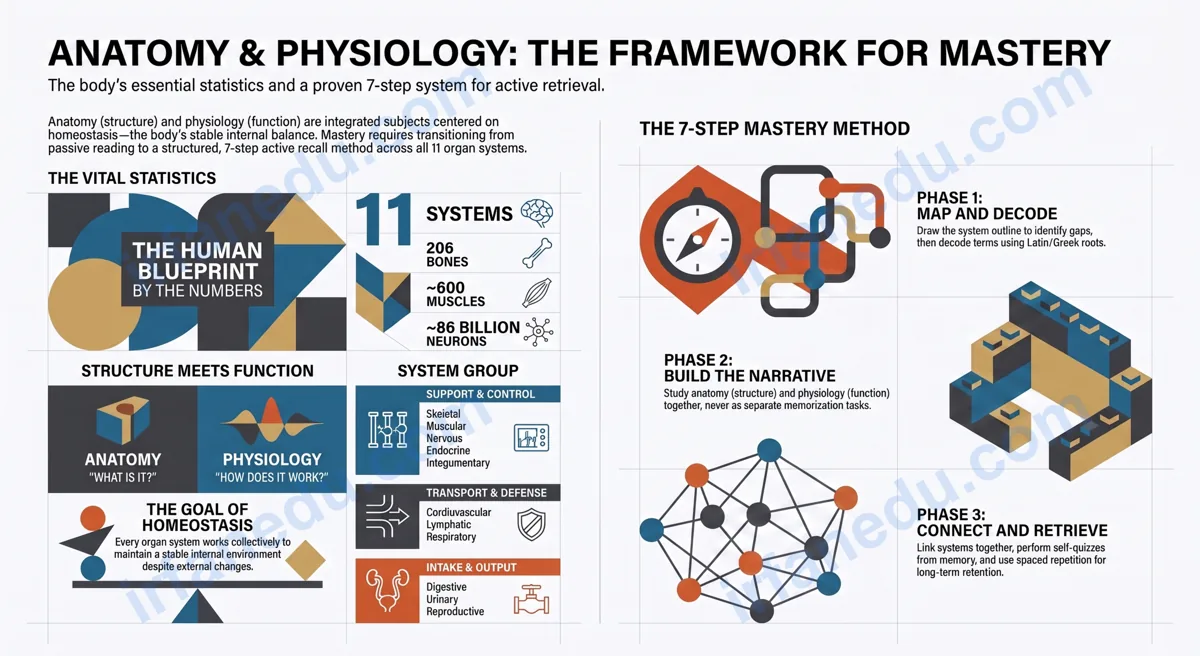
- The 11 Organ Systems at a Glance
- How to Crack Medical Terminology Fast
- The 7-Step A&P Study Method
- Best Memory Tricks for A&P
- Common Mistakes Students Make (and How to Fix Them)
- Anatomy vs. Physiology: What’s the Real Difference?
- 💡 Unique Insight
- Quick Quiz
- Practice Problems
- FAQ
- Key Takeaways
- Related Articles
- About the Author
- Sources & References
📖 Case Study: Meet Maya
Maya is a 17-year-old student who signed up for her school’s anatomy and physiology course with genuine excitement. Three weeks in, she was drowning. Her notes looked like a foreign language — sartorius, myelin sheath, glomerular filtration rate. She failed her first quiz on the skeletal system. She told me: “I read the chapter three times. I still couldn’t remember anything.”
Sound familiar? Maya’s problem was not effort. It was method. By the end of this guide, you will see exactly how she turned a 58% into an 89% — and you can use the same system.
Anatomy and physiology is one of the most rewarding science courses a student can take. It is also one of the most commonly failed — not because the content is impossibly hard, but because most students approach it the wrong way. They re-read. They highlight. They hope the information sticks.
In my experience teaching A&P concepts to hundreds of students over 15 years, the single biggest shift is moving from passive review to active retrieval. This guide gives you the exact framework to do that, system by system.
An anatomy and physiology study guide helps students master the structure (anatomy) and function (physiology) of the human body’s 11 organ systems through organized note-taking, memory strategies, visual diagrams, and active recall practice — the proven combination that turns confusion into confidence.
- What anatomy and physiology actually covers (and why the distinction matters)
- A 7-step study method that works for any organ system
- The best memory tricks, including ones most guides skip
- Common mistakes that tank exam scores — and how to fix them
- A visual map of all 11 body systems
- Practice questions and a self-check quiz
What Is Anatomy and Physiology? 🔬
Anatomy is the study of the body’s structure — the names, locations, and physical relationships of every part, from bones and muscles to individual cells. Physiology is the study of how those structures function — the chemical reactions, electrical signals, and mechanical processes that keep you alive.
Together, A&P forms the foundation of every health science: nursing, medicine, physical therapy, dentistry, and sports science all build on it. Even if you are not heading into healthcare, understanding how your own body works is genuinely useful knowledge.
The subject is organized around the concept of homeostasis — the body’s ability to maintain a stable internal environment despite external changes. Every organ system you study contributes to homeostasis in some way. Once you understand that thread, the whole subject starts to make sense as a connected story rather than a pile of disconnected facts.
⚡ TL;DR – Quick Summary
- 🧬 A&P covers the body’s 11 organ systems — structure (anatomy) + function (physiology).
- 📚 Active recall and spaced repetition beat passive re-reading every time.
- 🔤 Learning Latin/Greek roots unlocks medical terminology without brute-force memorization.
- 🗺️ Drawing and labeling diagrams from memory is the single most effective visual technique.
- ⚠️ The #1 mistake: studying anatomy and physiology as two separate subjects instead of one integrated story.
- ✅ A 7-step weekly system (map → roots → anatomy → physiology → connect → quiz → review) covers any system efficiently.
Quick Facts: Anatomy & Physiology at a Glance 📊
| Feature | Detail |
|---|---|
| Number of organ systems | 11 |
| Number of bones in adult body | 206 |
| Number of muscles (approximate) | ~600 skeletal muscles |
| Number of neurons in the brain | ~86 billion |
| Average A&P course length | 2 semesters (~30 weeks) |
| Recommended daily study time | 60–90 minutes |
| Most failed unit (commonly reported) | Nervous system |
| Most effective study technique | Active recall + spaced repetition |
| Best free resource | Khan Academy (Biology section) |
What Are the 11 Organ Systems? (Visual Map) 🗺️
The human body contains exactly 11 organ systems. Each system has a primary function, but no system works in isolation — they constantly communicate and depend on each other. Here is the complete map:
🖼️ Visual: 11 Human Body Systems at a Glance
┌─────────────────────────────────────────────────────────────────┐
│              THE 11 ORGAN SYSTEMS OF THE HUMAN BODY             │
├────────────────────┬────────────────────────────────────────────┤
│  SYSTEM            │  PRIMARY FUNCTION                          │
├────────────────────┼────────────────────────────────────────────┤
│  1. Integumentary  │  Protection, temperature regulation        │
│  2. Skeletal       │  Support, movement, mineral storage        │
│  3. Muscular       │  Movement, posture, heat production        │
│  4. Nervous        │  Rapid communication, sensation, control   │
│  5. Endocrine      │  Slow hormonal regulation, homeostasis     │
│  6. Cardiovascular │  Transport O₂, nutrients, waste removal    │
│  7. Lymphatic      │  Immunity, fluid balance, fat absorption   │
│  8. Respiratory    │  Gas exchange (O₂ in / CO₂ out)           │
│  9. Digestive      │  Nutrient breakdown and absorption         │
│ 10. Urinary        │  Waste filtration, fluid/pH balance        │
│ 11. Reproductive   │  Hormone production, reproduction          │
├────────────────────┴────────────────────────────────────────────┤
│  🔗 All 11 systems work together to maintain HOMEOSTASIS        │
└─────────────────────────────────────────────────────────────────┘
Back to Maya: when I showed her this map on day one of our tutoring sessions, she said “nobody ever showed me the big picture first.” That is exactly the problem with most A&P textbooks — they dive straight into bone names without giving students the 30,000-foot view. Always start with the map.
In my experience, the students who struggle most with A&P are not the ones who lack intelligence — they are the ones who never got the overview. I always spend the first 20 minutes of any A&P tutoring session drawing this systems map together. Once a student sees how the cardiovascular system feeds the muscular system, which is controlled by the nervous system, the whole subject transforms from a list into a story. Start with the map. Always.
How to Crack Medical Terminology Without Brute-Force Memorization 🔤
Medical terminology is the biggest barrier for most A&P students — and it is also the most fixable. The secret is that roughly 90% of A&P terms are built from a small set of Latin and Greek roots, prefixes, and suffixes.
Once you know these building blocks, you can decode a word you have never seen before. Here is a practical starter set:
| Root/Prefix | Meaning | Example Term | Decoded Meaning |
|---|---|---|---|
| cardio- | heart | cardiomyopathy | disease of heart muscle |
| osteo- | bone | osteoblast | bone-forming cell |
| myo- | muscle | myocardium | heart muscle |
| neuro- | nerve | neurotransmitter | nerve signal carrier |
| hepato- | liver | hepatocyte | liver cell |
| nephro- | kidney | nephron | kidney filtering unit |
| -itis | inflammation | arthritis | joint inflammation |
| -ectomy | surgical removal | appendectomy | removal of appendix |
| -plasty | surgical repair | rhinoplasty | nose repair surgery |
| hyper- | above/excess | hypertension | excess blood pressure |
| hypo- | below/deficient | hypothyroidism | underactive thyroid |
How Do You Study Anatomy and Physiology Effectively? (7-Step Method) 📋
The most effective way to study A&P is to follow a structured weekly system for each organ system, combining visual learning, terminology work, and active recall. Here is the exact 7-step method I used with Maya — and with every A&P student I have tutored:
-
Map the system (Day 1, 20 min)
Before reading a single page, draw a blank outline of the system and write down everything you already know. This activates prior knowledge and shows you exactly where your gaps are. -
Learn the key terminology (Day 1–2, 30 min)
Identify the 15–20 most important terms for the system. Break each one into its roots. Create Anki flashcards immediately — do not wait until the night before the exam. -
Study the anatomy (Day 2–3, 45 min)
Focus purely on structure: what parts exist, where they are, and how they connect. Use labeled diagrams. After reading, close the book and draw the diagram from memory. -
Study the physiology (Day 3–4, 45 min)
Now ask: how does each structure function? What processes happen here? What would go wrong if this part failed? Connecting structure to function is the core skill of A&P. -
Connect to other systems (Day 4, 20 min)
Ask: which other systems does this system interact with? For example, the respiratory system delivers oxygen to the cardiovascular system, which delivers it to the muscular system. These connections appear constantly on exams. -
Self-quiz (Day 5, 30 min)
Cover your notes and answer 10–15 practice questions from memory. Write out answers, do not just think them. Writing forces deeper processing. -
Spaced review (Day 7, 15 min)
Review your Anki cards and redraw the system diagram one more time. This spaced repetition session is what moves information from short-term to long-term memory.
Day 1 Map: Draw a heart outline. Write: “pumps blood, four chambers, arteries and veins.” That is your starting point.
Day 1–2 Terminology: cardio (heart), vascular (vessels), atrium (upper chamber), ventricle (lower chamber), systole (contraction), diastole (relaxation). Build 15 Anki cards.
Day 2–3 Anatomy: Label the four chambers, four valves (tricuspid, pulmonary, mitral, aortic), major vessels (aorta, pulmonary artery/vein, vena cava). Draw from memory.
Day 3–4 Physiology: Trace blood flow: right atrium → right ventricle → pulmonary artery → lungs → pulmonary vein → left atrium → left ventricle → aorta → body. Understand why the left ventricle has thicker walls (higher pressure needed).
Day 4 Connections: Cardiovascular delivers O₂ to muscles (muscular system), carries hormones (endocrine system), filtered by kidneys (urinary system).
Day 5 Quiz: “Trace a red blood cell from the right atrium to the big toe.” Write it out without notes.
Day 7 Review: Anki cards + redraw the heart from memory. Check against your diagram.
What Are the Best Memory Tricks for Anatomy and Physiology? 🧠
Memory tricks work in A&P because the subject is heavily terminology-driven. The best techniques are those that create strong, distinctive mental hooks for each term or concept.
1. Acronyms and Mnemonics
For ordered lists, create an acronym from the first letters. For the carpal bones of the wrist: “Some Lovers Try Positions That They Can’t Handle” (Scaphoid, Lunate, Triquetrum, Pisiform, Trapezium, Trapezoid, Capitate, Hamate). Ridiculous mnemonics are more memorable than sensible ones.
2. Body Mapping (Draw-and-Label)
After every study session, take a blank sheet of paper and redraw the system you just studied from memory. This is not just a review technique — it is a retrieval practice technique, which research consistently shows produces stronger long-term retention than re-reading.
3. The “What Happens If It Breaks?” Test
For every structure you learn, ask: what disease or condition results when this structure fails? For example: the myelin sheath insulates nerve fibers — when it degrades, you get multiple sclerosis. This clinical connection makes the anatomy memorable and also prepares you for application-level exam questions.
4. Teach It Aloud
Explain the concept out loud as if you are teaching a 12-year-old. If you stumble, you have found a gap. This technique — sometimes called the Feynman Technique — is one of the most powerful learning tools available and costs nothing.
5. Spaced Repetition with Anki
Anki is a free flashcard app that uses an algorithm to show you cards just before you are about to forget them. For A&P, create cards immediately after each study session. Review within 24 hours, then at 3 days, 7 days, and 21 days. This schedule is not arbitrary — it mirrors how human memory consolidates.
The technique I see students underuse most is the “teach it aloud” method. I have had students who could recognize the correct answer on a multiple-choice question but completely fell apart on short-answer questions that asked them to explain a process. Recognition and recall are different cognitive skills. If you can teach the cardiac cycle to an imaginary student in plain language, you genuinely understand it. If you can only recognize it in a list, you do not — and the exam will expose that difference.
What Are the Most Common A&P Study Mistakes? ⚠️
Most A&P exam failures trace back to a small set of avoidable mistakes. Here is the wrong-vs-right breakdown:
| ❌ What Most Students Do | ✅ What Actually Works |
|---|---|
| Re-read the chapter 3 times | Read once, then quiz yourself from memory |
| Highlight everything | Summarize in your own words after each section |
| Cram the night before | Study 60–90 min daily with spaced review sessions |
| Memorize anatomy and physiology separately | Always link structure to function in the same session |
| Skip diagrams and go straight to text | Start with the diagram; use text to fill in details |
| Make flashcards with only name → definition | Add function, location, and one clinical connection per card |
| Study each system in isolation | Actively connect each new system to previously learned ones |
Anatomy vs. Physiology: What Is the Real Difference? 🔍
Anatomy is the study of structure — what the body is made of and where everything is located. Physiology is the study of function — how the body’s parts work and interact. The two are inseparable in practice.
| Aspect | Anatomy | Physiology |
|---|---|---|
| Definition | Study of body structure and form | Study of body function and processes |
| Key question | “What is it and where is it?” | “How does it work?” |
| Example (heart) | Four chambers, four valves, muscle walls | Pumps blood via electrical signals, ~70 beats/min at rest |
| Example (kidney) | Bean-shaped, cortex + medulla + pelvis | Filters ~180 L of blood per day, regulates pH and fluid |
| Study approach | Diagrams, labeling, spatial memory | Process diagrams, flowcharts, cause-and-effect chains |
| Exam question type | “Label this diagram” | “Explain what happens when blood pressure drops” |
Back to Maya’s case: her original mistake was studying anatomy (memorizing bone names) and physiology (how bones produce blood cells) in completely separate sessions, never connecting them. When I had her study both together — “this is what the bone looks like AND here is why it looks that way” — her retention improved dramatically within two weeks.
💡 Unique Insight: Why “System-by-System” Studying Creates a Hidden Blind Spot
Every A&P textbook and most study guides (including popular ones) teach the 11 organ systems one at a time, in isolation. This creates a dangerous blind spot: students ace individual system quizzes but fail integrative exam questions that ask how two or more systems interact.
In my experience, the highest-yield A&P exam questions are almost always integrative: “A patient has low blood oxygen. Trace the physiological response across the respiratory, cardiovascular, and nervous systems.” Students who only studied each system separately cannot answer this fluently.
The fix: After every two systems you study, spend 20 minutes writing a “systems dialogue” — a short paragraph describing how those two systems communicate during a specific event (exercise, infection, dehydration). This is not in any standard textbook. It is the technique that consistently separates A-students from B-students in A&P, and it is the insight Maya used to go from a 58% to an 89%.
🧪 Quick Quiz: Test Your A&P Knowledge
Q1. How many organ systems does the human body have?
Not quite — there are 11 organ systems, not 9.
✅ Correct! The human body has exactly 11 organ systems, from integumentary to reproductive.
Not quite — the correct answer is 11 organ systems.
Q2. What does the prefix “nephro-” refer to?
Close — “hepato-” refers to the liver. “Nephro-” refers to the kidney.
✅ Correct! “Nephro-” comes from Greek and refers to the kidney (e.g., nephron = kidney filtering unit).
Not quite — “neuro-” refers to nerves. “Nephro-” refers to the kidney.
Q3. Which study technique produces the strongest long-term retention for A&P?
Re-reading feels productive but produces weak retention compared to active recall.
Highlighting is passive and produces minimal long-term retention on its own.
✅ Correct! Active recall (retrieving information from memory) combined with spaced repetition is consistently the most effective study method for high-volume content like A&P.
🏋️ Practice Problems: Reveal-on-Click
Problem 1: Trace the path of a breath of air from the nose to the alveoli. Name each structure in order.
Problem 2: A patient’s blood pressure drops suddenly. Describe the physiological response across at least two organ systems.
Problem 3: What is the difference between an osteoblast and an osteoclast? Why does the body need both?
Sources & References
Reviewed by Dr. Irfan Mansuri. External links open in a new tab and are provided for further reading and verification.