
🧬 DNA Sequencing: Reading Life’s Recipe Book
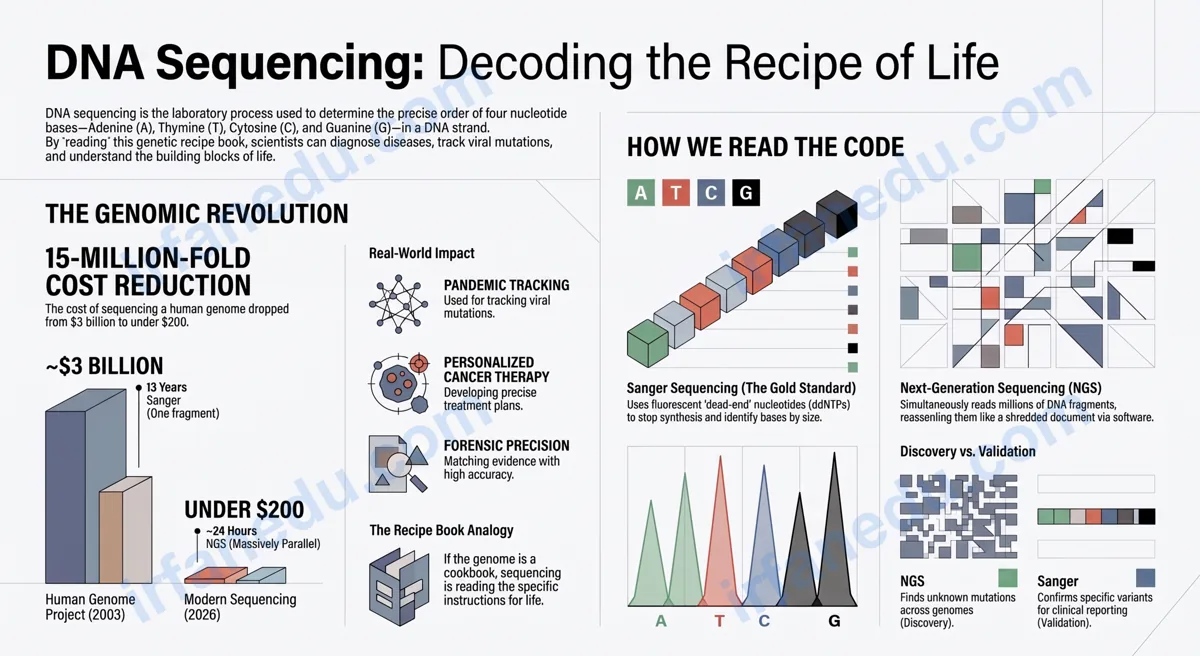
🍳 Imagine DNA as a Recipe Book — and Sequencing as Reading It Aloud
Picture a massive recipe book with 3 billion characters, written in an alphabet of just four letters: A, T, C, and G. Every cell in your body carries this book. The recipes inside tell your cells how to build proteins, run your metabolism, and even determine your eye color. DNA sequencing is the process of reading that book, letter by letter, so scientists can understand, compare, and use its instructions.
DNA sequencing is the laboratory process of determining the precise order of nucleotide bases — adenine (A), thymine (T), cytosine (C), and guanine (G) — along a strand of DNA. Just as reading a recipe tells you what ingredients to use and in what order, reading a DNA sequence tells a cell which amino acids to assemble and how. Scientists use sequencing to study genes, diagnose inherited diseases, track viral mutations, and develop new medicines.
I have been teaching genetics to students for over 15 years, and the single biggest insight I can give you is this: DNA sequencing is not magic — it is clever chemistry combined with smart software. Once you understand the analogy of the recipe book, every concept in sequencing clicks into place. I will carry that analogy through every section of this guide.
- 🎯 Understand what DNA sequencing is and why it matters
- 🔬 Follow the exact steps of Sanger sequencing (with a worked example)
- ⚡ Compare Sanger vs Next-Generation Sequencing clearly
- 🌍 See real-world applications from medicine to forensics
- ✅ Avoid the most common exam mistakes on this topic
⚡ TL;DR – Quick Summary
- 🧬 DNA sequencing reads the A, T, C, G order in a DNA strand.
- 🔬 Sanger sequencing uses chain-terminating nucleotides to read one fragment at a time.
- ⚡ NGS reads millions of fragments simultaneously — far faster and cheaper.
- 💊 Applications include disease diagnosis, cancer genomics, and forensic identification.
- 📉 Whole-genome sequencing cost fell from $3 billion (2003) to under $200 (2026).
- 🍳 Think of it as reading a recipe book — sequencing reveals the exact ingredient list for life.
📊 Quick Facts at a Glance
| Fact | Detail |
|---|---|
| What it reads | Order of A, T, C, G bases in a DNA strand |
| First method | Sanger chain-termination (Frederick Sanger, 1977) |
| Human genome size | ~3.2 billion base pairs |
| First human genome cost | ~$3 billion (completed 2003, 13 years) |
| Cost today (2026) | Under $200 for a whole human genome |
| Fastest modern platform | Illumina NovaSeq X / Oxford Nanopore |
| Key output file | FASTQ (raw reads) → aligned to reference genome |
| Recipe book analogy | Sequencing = reading the recipe; genome = the full cookbook |
🔍 What Is DNA Sequencing?
DNA sequencing is the method scientists use to determine the precise linear order of nucleotide bases in a DNA molecule. Each base — adenine (A), thymine (T), cytosine (C), or guanine (G) — is one “letter” in the genetic code. Knowing the order of these letters in a gene or an entire genome is the starting point for almost all of modern molecular biology.
Going back to the recipe book analogy: your genome is a 3.2-billion-letter cookbook. Individual genes are individual recipes. A single wrong letter (a mutation) in a critical recipe can cause the cell to produce a faulty protein — just as a typo in a recipe that says “add 1 cup of salt” instead of “1 teaspoon of salt” ruins the dish. Sequencing lets scientists find those typos.
Imagine you have a recipe card that reads: ATGCGTAACTTGCA. Each letter is an instruction. If the card gets damaged and one letter changes — say the 5th letter flips from G to A — the recipe produces a different protein. DNA sequencing is the process of reading that card accurately enough to spot the change.
DNA is a double-stranded molecule. The two strands run antiparallel and are held together by complementary base pairing: A pairs with T, and C pairs with G. Sequencing typically reads one strand (the template strand) and reports the sequence of the complementary (coding) strand in the 5′ to 3′ direction.
The core entity here is the nucleotide sequence — the specific string of bases that encodes genetic information. Related concepts include: the genome (the complete set of DNA in an organism), genes (specific sequences that encode proteins), mutations (changes in the sequence), and SNPs (single nucleotide polymorphisms — single-letter variations between individuals).
🌍 Why Does DNA Sequencing Matter?
DNA sequencing matters because it converts invisible genetic information into readable data that scientists, doctors, and researchers can act on. Without it, modern medicine, evolutionary biology, and forensic science would be working blind.
Here are the five biggest reasons sequencing changed science:
- Disease diagnosis: Sequencing identifies mutations in genes like BRCA1 (breast cancer risk) or CFTR (cystic fibrosis) that standard blood tests miss entirely.
- Pandemic response: During COVID-19, sequencing tracked SARS-CoV-2 variants (Alpha, Delta, Omicron) in near-real-time, informing vaccine updates.
- Forensic identification: DNA sequencing (and related profiling) can match a suspect’s DNA to evidence with a probability of error of less than 1 in a trillion.
- Evolutionary biology: Comparing genome sequences across species reveals how organisms are related — the recipe books of humans and chimpanzees are about 98.7% identical.
- Drug development: Knowing the sequence of a cancer gene allows pharmaceutical companies to design drugs that target only the mutant protein, sparing healthy cells.
In my experience teaching this topic, students consistently underestimate how fast sequencing technology has moved. The price of sequencing a human genome dropped by a factor of 15 million between 2001 and 2026 — that is faster than Moore’s Law for computer chips. I tell my students: if cars had improved at the same rate, a vehicle that cost $30,000 in 2001 would now cost about $0.002. That speed of change is why sequencing now shows up in everything from your ancestry kit to your oncologist’s office.
🔬 How Does Sanger Sequencing Work? (Step-by-Step)
Sanger sequencing — invented by Frederick Sanger in 1977 — works by using specially modified nucleotides called dideoxynucleotides (ddNTPs) that stop DNA synthesis at a specific base. Think of ddNTPs as “dead-end ingredients” that, when added to a recipe mid-way, cause the cooking to stop immediately — producing fragments of every possible length, each ending at a known base.
Here is the exact process, step by step:
-
Extract and isolate the target DNA. Scientists isolate the DNA region of interest from cells. This is like pulling the specific recipe page out of the cookbook.
-
Amplify with PCR. Polymerase Chain Reaction (PCR) makes millions of identical copies of the target fragment. You need many copies to get a readable signal — like printing many copies of the recipe page before marking them up.
-
Set up the sequencing reaction. Mix the DNA with a short primer (a starting point), DNA polymerase (the enzyme that builds new DNA), normal dNTPs (the regular ingredients), and a tiny amount of fluorescently labeled ddNTPs (the chain terminators). Each of the four ddNTPs carries a different fluorescent color.
-
Chain termination creates fragments of every length. As DNA polymerase reads the template and builds the new strand, it occasionally incorporates a ddNTP instead of a dNTP. When it does, synthesis stops. Because this happens randomly at every position, you end up with millions of fragments — one ending at every single base position in the sequence.
-
Separate by capillary electrophoresis. The fragments are injected into a thin capillary filled with a polymer gel. Shorter fragments move faster through the gel toward a positive electrode. Fragments separate by size — one base at a time.
-
Detect fluorescence and read the sequence. A laser shines on the fragments as they pass a detector. Each color identifies the terminal base. The software records the color order and outputs the sequence as a chromatogram — a series of colored peaks, one per base.
  DNA Template:   5'–A–T–G–C–G–T–A–A–C–T–T–G–C–A–3'
                      |
              [PCR Amplification]
                      |
         [Sequencing Reaction + ddNTPs]
                      |
      Fragments produced (shortest to longest):
        ddA  → A
        ddT  → AT
        ddG  → ATG
        ddC  → ATGC
        ddG  → ATGCG
        ddT  → ATGCGT
        ...and so on for every position
                      |
        [Capillary Electrophoresis — size separation]
                      |
     Detector reads colors in order of fragment size:
        A  T  G  C  G  T  A  A  C  T  T  G  C  A
       (G)(R)(B)(B)(B)(R)(G)(G)(B)(R)(R)(B)(B)(G)
        ↑  ↑  ↑  ↑  ↑  ↑  ↑  ↑  ↑  ↑  ↑  ↑  ↑  ↑
       [Chromatogram peaks — one color per base]

  Color key: A=Green  T=Red  C=Blue  G=Black
⚡ What Is Next-Generation Sequencing (NGS)?
Next-Generation Sequencing (NGS) solves the biggest limitation of Sanger sequencing: speed. Sanger reads one fragment at a time; NGS reads hundreds of millions of fragments simultaneously in a process called massively parallel sequencing. If Sanger is like reading a recipe book one word at a time, NGS is like photographing every page at once and using software to reassemble the full text.
The most widely used NGS platform (Illumina) works like this:
- Fragment the genome into millions of short pieces (150-300 bases each).
- Attach adapters — short DNA sequences that anchor each fragment to a flow cell (a glass chip).
- Bridge amplification — each fragment is copied in place, creating a cluster of identical copies at a fixed spot on the flow cell.
- Sequencing by synthesis — fluorescently labeled nucleotides are added one at a time. A camera photographs the entire flow cell after each addition, recording which base was added at each cluster.
- Bioinformatics assembly — software aligns the millions of short reads back to a reference genome, like reassembling a shredded document.
Oxford Nanopore Technology (ONT) takes a completely different approach: it threads a single DNA strand through a protein pore and measures the electrical current change as each base passes through. This produces very long reads (tens of thousands of bases) in real time — like reading a whole chapter of the recipe book in one pass instead of shredding it first.
📋 Sanger vs NGS: Head-to-Head Comparison
Choosing between Sanger and NGS depends on the question you are asking. Here is a clear side-by-side comparison — the single most useful table for exam prep on this topic.
| Feature | Sanger Sequencing | Next-Generation Sequencing (NGS) |
|---|---|---|
| Year introduced | 1977 | Mid-2000s (Illumina ~2006) |
| Read length | ~700-1000 bases per run | Short reads: 150-300 bp; Long reads (Nanopore): up to 2 Mb |
| Throughput | One fragment at a time | Billions of bases per run |
| Accuracy | ~99.99% (very high) | Short-read: ~99.9%; Long-read: ~99% (improving) |
| Cost per genome | ~$500-$1,000 for a single gene | Under $200 for a whole human genome |
| Time per run | A few hours for one fragment | 24-48 hours for a whole genome |
| Best use case | Confirming a single known mutation | Whole-genome, exome, transcriptome, metagenomics |
| Equipment cost | Low-moderate | High (but falling rapidly) |
| Recipe analogy | Reading one recipe carefully | Photographing the whole cookbook at once |
Here is something most textbooks get wrong: they present Sanger and NGS as competing technologies, implying NGS has replaced Sanger. In practice, clinical labs use both — NGS for discovery (finding unknown mutations across the whole genome) and Sanger for validation (confirming a specific variant before reporting it to a patient). They are complementary tools, not rivals. Knowing this distinction will set your exam answers apart from the average student.
🧪 Worked Example: Reading a Sanger Chromatogram
Reading a chromatogram is a skill tested in AP Biology, IB Biology, and introductory college genetics. Here is a step-by-step worked example I created specifically for this guide — you will not find this exact walkthrough in standard textbooks.
Scenario: A Sanger sequencing run produces the following peak color sequence from a capillary electrophoresis detector (shortest fragment first):
Green — Red — Black — Blue — Black — Red — Green — Green — Blue — Red
Color key: Green = A | Red = T | Black = G | Blue = C
Step 1 — Translate colors to bases:
G(A) — R(T) — B(G) — C(C) — B(G) — R(T) — G(A) — G(A) — C(C) — R(T)
Step 2 — Write the sequence (5′ to 3′):
5’–A–T–G–C–G–T–A–A–C–T–3′
Step 3 — Write the complementary strand (3′ to 5′):
3’–T–A–C–G–C–A–T–T–G–A–5′
Exam tip: The sequence read from a chromatogram is always the new (complementary) strand built by DNA polymerase, reported 5′ to 3′. It is complementary to the template strand, not identical to it.
Notice that the sequence ATG at the start is the universal start codon — it codes for methionine and signals the beginning of a protein-coding region. Spotting start and stop codons in a sequencing result is a common exam question.
⚠️ Common Mistakes Students Make (Wrong vs Right)
These are the five errors I see most often in student answers on DNA sequencing — and the correct thinking that fixes each one.
The chromatogram reports the new strand built by polymerase (5’→3′), which is complementary to the template. Many students write the template strand’s sequence instead. Always ask: which strand is the polymerase reading, and which is it building?
ddNTPs (dideoxynucleotides) lack the 3′-OH group that dNTPs have. Without that hydroxyl group, no new nucleotide can be added — synthesis stops. This is the entire mechanism of Sanger sequencing. The “di” in dideoxy means two oxygens are missing (at both the 2′ and 3′ positions).
NGS produces enormous amounts of data requiring complex bioinformatics pipelines. For confirming a single known mutation in a clinical sample, Sanger is faster, cheaper, and simpler. The best method depends on the question — just like the best recipe depends on what you want to cook.
You cannot sequence a single copy of DNA — the signal would be too weak to detect. PCR amplification is a required prerequisite step in Sanger sequencing. Students often describe sequencing as if it happens directly on extracted genomic DNA.
Sequencing reads the full base-by-base order of a DNA region. Genotyping only checks for known variants at specific positions. Ancestry kits (like 23andMe) use genotyping, not full sequencing — they check ~700,000 known SNP positions rather than reading all 3.2 billion bases.
🌐 Real-World Applications of DNA Sequencing
DNA sequencing has moved out of research labs and into hospitals, courtrooms, farms, and even your kitchen. Here are the most important applications, each one a direct use of the “reading the recipe book” capability.
- 🏥 Clinical genomics: Whole-genome sequencing diagnoses rare genetic diseases in newborns. The NHGRI Undiagnosed Diseases Program uses sequencing to solve cases that stumped doctors for years.
- 🦠 Infectious disease surveillance: During COVID-19, the GISAID database collected over 15 million SARS-CoV-2 genome sequences, enabling real-time tracking of new variants across the globe.
- 🔬 Cancer genomics: Tumor sequencing identifies which specific mutations are driving a cancer, allowing oncologists to choose targeted therapies (e.g., EGFR inhibitors for lung cancer with EGFR mutations).
- 🧑⚖️ Forensic science: DNA sequencing (and STR profiling) can identify individuals from trace evidence at crime scenes with extraordinary precision.
- 🌾 Agriculture: Crop genome sequencing enables breeders to identify genes for drought resistance or disease immunity, accelerating the development of hardier food crops.
- 🦕 Ancient DNA and evolution: Sequencing ancient DNA from fossils (including Neanderthal bones) has revealed that modern humans carry 1-4% Neanderthal DNA.
- 💊 Pharmacogenomics: Sequencing a patient’s genome can predict how they will respond to specific drugs — for example, whether a blood thinner like warfarin will be safe at a standard dose.
[IMAGE: A collage showing a DNA sequencer in a hospital lab, a COVID-19 variant phylogenetic tree, and a forensic DNA gel — illustrating the breadth of sequencing applications | ALT: DNA sequencing applications in medicine forensics and agriculture]
💡 Unique Insight: The Cost Curve Nobody Talks About in Class
Most biology textbooks mention that sequencing costs have fallen dramatically — but they rarely show why this matters for students right now. Here is the non-obvious point: the cost of sequencing a human genome has fallen faster than any other technology in recorded history — roughly 100,000-fold in 20 years, compared to about 100-fold for computing under Moore’s Law. This means that by the time today’s high school students enter the workforce, routine whole-genome sequencing at birth will likely be standard medical practice in many countries. The ethical, legal, and social implications — who owns your genome data, can insurers use it, should parents know their child’s disease risks at birth — are questions your generation will have to answer. Understanding the science is the first step to engaging with those questions responsibly.
🧠 Quick Quiz: Test Your DNA Sequencing Knowledge
1. What is the role of ddNTPs in Sanger sequencing?
Sources & References
Written and fact-checked by Dr Irfan Mansuri. External links open in a new tab and are provided for further reading and verification.