
How to prepare for a maths exam (beginner to advanced guide)
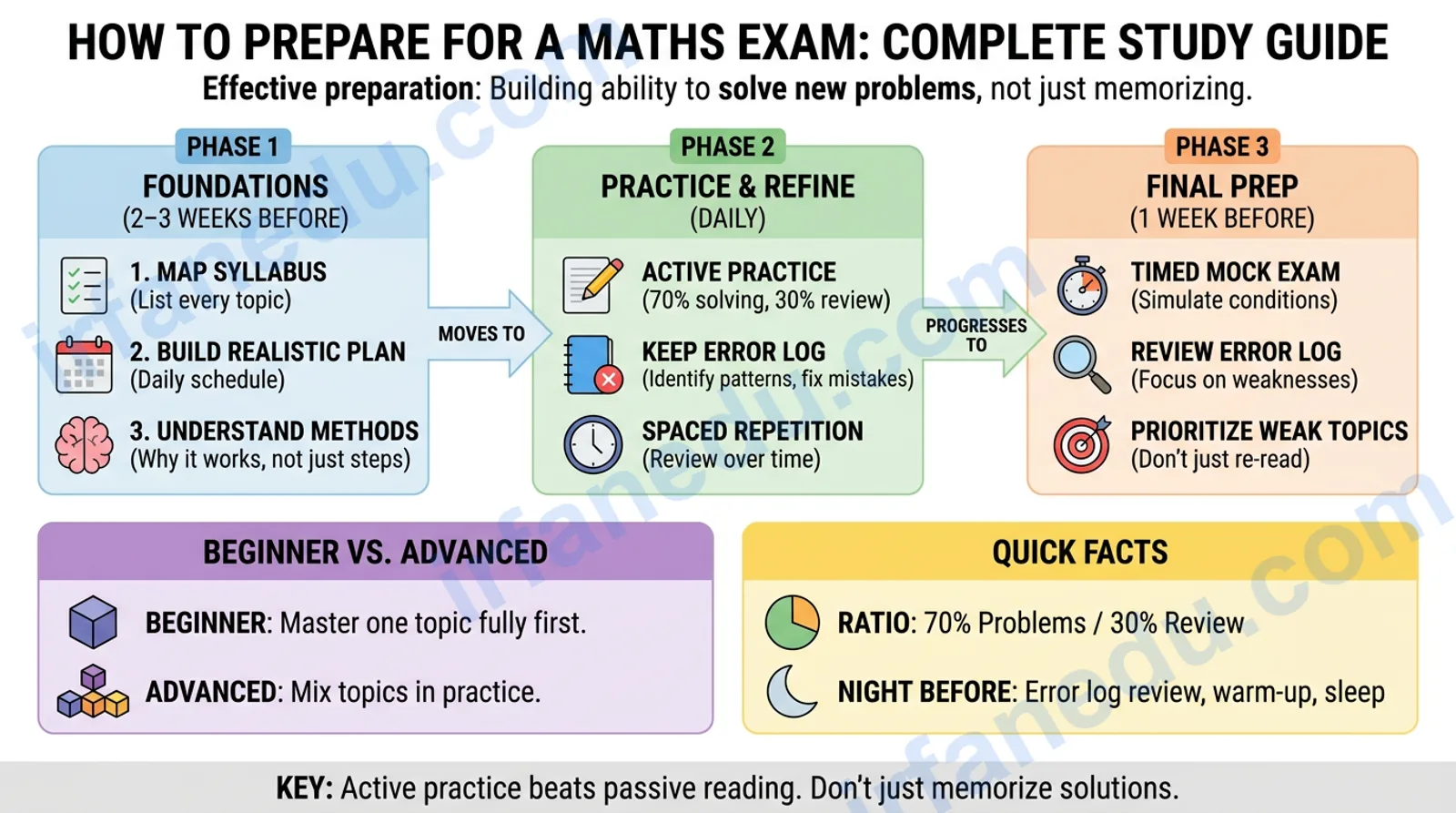
Preparing for a maths exam is different from preparing for any other subject. You cannot pass by reading — you pass by doing. This guide gives you a concrete, level-appropriate plan whether you are starting from scratch or polishing an already-strong foundation.
If you have ever studied hard for a maths test and still blanked on problems you thought you knew, you are not alone. The issue is almost never intelligence — it is study method. I have worked with hundreds of students across middle school, high school, and college-level math, and the gap between students who improve and those who plateau comes down to one thing: how they practice, not how long.
This guide covers both levels in every section:
- Beginner: you are building foundational skills or returning to math after a gap.
- Advanced: you already understand the material and want to maximize your score.
⚡ TL;DR
- Start at least 2 weeks before the exam — 3 weeks is better.
- Spend 70% of study time solving problems, not reading notes.
- Keep an error log; your mistakes follow patterns you can fix.
- Do at least one full timed mock exam before the real test.
- Beginners: master one topic fully before moving on.
- Advanced: mix topics in practice to match real exam conditions.
Quick facts about maths exam preparation
| Factor | Recommended approach |
|---|---|
| Preparation start time | 2–3 weeks before the exam |
| Daily study session length | 45–90 minutes (with breaks) |
| Problem-solving vs. reading ratio | 70% problems / 30% review |
| Mock exams | At least 1 full timed mock, 1 week before |
| Night-before strategy | Error log review + 5 warm-up problems + 8 hrs sleep |
| Most effective recall technique | Spaced repetition + active problem-solving |
| Biggest beginner mistake | Moving on before mastering a topic |
| Biggest advanced mistake | Only practicing easy, familiar problem types |
What does effective maths exam preparation actually mean?
Effective maths exam preparation means building the ability to solve problems you have never seen before — not just reproduce solutions you have memorized. This distinction matters because exam writers deliberately vary problem formats to test understanding, not recall.
Most students prepare by reading through their notes and worked examples. That feels productive, but it is largely passive. Your brain recognizes the material as familiar without actually being able to reproduce it under pressure. Psychologists call this the fluency illusion — the feeling of knowing something because you have seen it, not because you can do it.
Effective preparation has three components:
- Understanding: knowing why a method works, not just the steps.
- Fluency: being able to execute the method quickly and accurately under time pressure.
- Flexibility: recognizing which method to use when a problem looks unfamiliar.
Each of these requires a different type of practice, and I will cover all three below.
Advanced focus: You likely have understanding. Your bottleneck is flexibility — practicing mixed, unfamiliar problem types until you can identify the right approach quickly.
How do you build a maths study plan that works?
A working maths study plan starts with a syllabus audit, not a schedule. Before you write a single date on a calendar, you need to know exactly which topics are on the exam and how confident you are with each one.
Step 1: Syllabus audit (30 minutes, do this today)
List every topic. Rate each one:
- Green: I can solve problems without help.
- Yellow: I understand it but make errors.
- Red: I am not confident at all.
Your red topics get the most time. Your green topics need only brief review. Most students do the opposite — they spend time on what they already know because it feels comfortable.
Step 2: Build the schedule
-
Week 1 (or weeks 1–2 for a 3-week plan): Topic-by-topic review. One topic per session. Work through examples, then solve 10–15 problems from scratch without looking at notes.
-
Week 2 (or week 3): Mixed practice. Combine topics in the same session to simulate real exam conditions. Start timed practice.
-
Final week: One full timed mock exam. Error log review. Light daily practice on weak spots only. No new topics.
-
Night before: Review error log, do 5 warm-up problems, sleep 8 hours.
Suppose your exam covers: Algebra, Geometry, Statistics, and Trigonometry. Your audit gives you: Algebra (green), Geometry (yellow), Statistics (red), Trigonometry (red).
Your allocation:
- Algebra: 1 session (review + 10 problems)
- Geometry: 3 sessions
- Statistics: 4 sessions
- Trigonometry: 4 sessions
- Mixed practice: 2 sessions
- Mock exam + review: 1 session
Total: 15 sessions over 14 days — one session per day with one rest day built in.
Why active practice beats re-reading notes
Active practice means attempting a problem before looking at the solution — not reading a solution and nodding along. The difference in outcome is dramatic.
Research in cognitive science consistently shows that retrieval practice (trying to recall or produce information) strengthens memory far more than re-exposure to the same material. For math specifically, this means: close the textbook, attempt the problem, check your answer, and understand the gap if you got it wrong.
The 4-step active practice loop
- Attempt: Solve the problem without notes. Write every step.
- Check: Compare your answer to the solution.
- Diagnose: If wrong, identify exactly where your working diverged from the correct path.
- Log: Write the error type in your error log (more on this below).
Spaced repetition for math topics
Spaced repetition means revisiting a topic at increasing intervals: day 1, day 3, day 7, day 14. Each time you return to a topic, your brain has to work harder to retrieve it — and that effort is what makes the memory stick. You do not need special software for this. A simple paper schedule works fine.
Beginner vs. advanced: what should each level focus on?
The biggest mistake in generic study guides is treating all students the same. A beginner and an advanced student preparing for the same exam need fundamentally different strategies.
| Preparation element | Beginner approach | Advanced approach |
|---|---|---|
| Topic order | Sequential — master foundations before moving on | Weakness-first — jump to gaps, not start to finish |
| Problem difficulty | Start with straightforward, single-step problems | Prioritize multi-step, mixed-topic problems |
| Time pressure | Untimed at first; add time limits after 1 week | Timed from day one — simulate exam pace |
| Formula sheet | Build and memorize a personal formula card | Practice without the formula sheet to build fluency |
| Error review | Rework every wrong problem immediately | Categorize errors by type; target the most frequent |
| Mock exams | One mock in the final week | Two or three mocks, spaced across the study period |
| Study session length | 45–60 min with a 10-min break | 60–90 min, matching real exam duration |
In my experience teaching math across multiple grade levels, the students who improve the most are not the ones who study the longest — they are the ones who study at the right level of difficulty. Beginners who attempt problems that are too hard too soon get discouraged and quit. Advanced students who only practice easy problems get complacent and miss points on the hard questions that separate scores. Calibrating difficulty is the most underrated skill in exam preparation.
Common mistakes students make when preparing for maths exams
Most exam preparation mistakes are not about effort — they are about method. Here are the ones I see most often, and what to do instead.
Wrong approach (skipping steps):
Solve x² + 5x + 6 = 0
Student writes: “x = -2 or -3” with no working shown.
On the exam, the student makes a sign error and writes x = 2 or 3 — no partial credit.
Right approach (full working):
x² + 5x + 6 = 0
Factor: (x + 2)(x + 3) = 0
Set each factor to zero: x + 2 = 0 → x = -2; x + 3 = 0 → x = -3
Answer: x = -2 or x = -3
Even if the final answer is wrong, full working earns partial credit on most exams.
The error log method: your secret weapon
An error log is a dedicated notebook or document where you record every mistake you make during practice — not just the correct answer, but the type of error and the correct method. It is the single highest-leverage tool I recommend to every student.
How to set up and use an error log
- Create a table with four columns: Date | Problem | My error | Correct method.
- After every practice session, add every wrong answer to the log.
- Categorize the error: arithmetic slip, wrong formula, misread question, skipped step, concept gap.
- Once a week, review the log and count which error type appears most. That is your target for the next week.
- Before the exam, read through the log once — not to memorize, but to remind yourself of your personal traps.
Date: July 14, 2026
Problem: Find the area of a triangle with base 8 cm and height 5 cm.
My error: Wrote Area = base × height = 40 cm² (forgot to divide by 2).
Correct method: Area = (1/2) × base × height = (1/2) × 8 × 5 = 20 cm².
Error type: Formula recall — missing the ½ factor.
After two weeks of logging, most students discover they make 2–3 recurring error types, not 20 random ones. Fixing those 2–3 patterns can move a score up by a full grade.
Every guide tells you to “practice more problems.” Almost none of them tell you which problems to practice — and the difference matters enormously.
The most effective practice problems are the ones that sit just above your current ability level: hard enough that you have to think, but not so hard that you cannot make progress. Cognitive scientists call this the zone of proximal development. Problems that are too easy build false confidence; problems that are too hard build frustration and avoidance.
Here is the non-obvious part: the correct difficulty level feels slightly uncomfortable. If you are solving practice problems without any hesitation, you are not in the right zone — you are rehearsing what you already know. The moment you feel stuck for 3–5 minutes before finding a path forward, that is when real learning happens.
In my experience, students who deliberately seek out problems that make them uncomfortable for a few minutes — and then push through — improve their scores faster than students who grind through large volumes of easy problems. Quality of struggle beats quantity of practice.
  EXAM DAY
     |
  STEP 7 ── Night before: error log review + 5 warm-up problems + sleep
     |
  STEP 6 ── Full timed mock exam under real conditions (1 week out)
     |
  STEP 5 ── Mixed-topic timed practice (combine multiple topics per session)
     |
  STEP 4 ── Error log review: identify your top 2-3 error patterns, target them
     |
  STEP 3 ── Active problem-solving: topic by topic, 10-15 problems per session
     |
  STEP 2 ── Build study schedule: most time on red (weak) topics
     |
  STEP 1 ── Syllabus audit: rate every topic Green / Yellow / Red
     |
  START HERE
What to do on exam day
Exam-day strategy is a skill in itself. What you do in the 60 minutes before and during the exam can add or cost you meaningful points.
Before the exam
- Eat a real meal — your brain needs glucose for sustained concentration.
- Arrive early enough to settle. Rushing raises cortisol and impairs working memory.
- Do not discuss difficult topics with classmates outside the exam room. It introduces doubt without time to resolve it.
During the exam
- Skim the whole paper first (2 minutes). Identify easy, medium, and hard questions. Start with easy wins to build confidence and bank marks.
- Show all working. Most marking schemes award partial credit for correct method even if the final answer is wrong.
- If you are stuck, move on. Come back to hard questions after completing the rest. A question you cannot solve in 5 minutes rarely gets solved by staring at it — but often gets solved after your brain has processed other problems.
- Check units and signs. The two most common sources of lost marks on math exams are sign errors and unit errors. Budget 5 minutes at the end to check these specifically.
- Re-read the question before writing your final answer. Exam questions often ask for something specific (e.g., “give your answer to 2 decimal places”) that students miss when rushing.
Suppose a 60-minute exam has 20 questions worth equal marks.
That is 3 minutes per question. On your first pass, spend no more than 3 minutes on any question. If you are not making progress, mark it and move on.
After completing all questions you can answer, return to marked questions with remaining time. You will often find that your brain has worked on them in the background.
Reserve the final 5 minutes for checking units, signs, and that you answered what was actually asked.
For a deeper look at geometry-specific exam strategies, the Complete Geometry Formula Sheet on IrfanEdu covers the formulas most commonly tested and most frequently forgotten under pressure.
Practice problems (reveal-on-click)
Try each problem before clicking to reveal the solution. Write your full working before checking.
Problem 1 (Beginner): Solve for x: 3x + 7 = 22
Step 1: Subtract 7 from both sides: 3x = 15
Step 2: Divide both sides by 3: x = 5
Check: 3(5) + 7 = 15 + 7 = 22 ✓
Common error: Subtracting 7 from the left side only, giving 3x = 22 − 7 is correct, but students sometimes write 3x + 7 − 7 = 22 and forget to subtract 7 from the right side too.
Problem 2 (Beginner): A rectangle has length 12 cm and width 5 cm. Find its perimeter and area.
Perimeter: P = 2(l + w) = 2(12 + 5) = 2 × 17 = 34 cm
Area: A = l × w = 12 × 5 = 60 cm²
Common error: Confusing the formulas — perimeter uses addition inside the bracket; area uses multiplication only.
Problem 3 (Intermediate): Solve: x² − 7x + 12 = 0
Step 1: Find two numbers that multiply to 12 and add to −7: those are −3 and −4.
Step 2: Factor: (x − 3)(x − 4) = 0
Step 3: Set each factor to zero: x − 3 = 0 → x = 3; x − 4 = 0 → x = 4
Answer: x = 3 or x = 4
Check: (3)² − 7(3) + 12 = 9 − 21 + 12 = 0 ✓; (4)² − 7(4) + 12 = 16 − 28 + 12 = 0 ✓
Problem 4 (Advanced): A train travels 240 km at speed v km/h. If it had traveled 20 km/h faster, the journey would have taken 1 hour less. Find v.
Set up equations using time = distance ÷ speed:
Original time: 240/v
Faster time: 240/(v + 20)
Difference: 240/v − 240/(v + 20) = 1
Multiply through by v(v + 20):
240(v + 20) − 240v = v(v + 20)
240v + 4800 − 240v = v² + 20v
4800 = v² + 20v
v² + 20v − 4800 = 0
Quadratic formula: v = (−20 ± √(400 + 19200)) / 2 = (−20 ± √19600) / 2 = (−20 ± 140) / 2
Taking the positive root: v = (−20 + 140) / 2 = 120/2 = 60 km/h
Check: 240/60 = 4 hours; 240/80 = 3 hours; difference = 1 hour ✓
Frequently asked questions
How many days before a maths exam should I start studying?
Start at least 2 weeks before the exam. The first week is for topic review and filling knowledge gaps; the second week is for timed practice tests and error correction. Starting the night before almost always leads to poor results in math because the subject requires practice, not just reading. Three weeks is better if the exam covers a full year of content.
Is it better to re-read notes or do practice problems for math?
Practice problems are significantly more effective than re-reading notes for math. Re-reading creates a false sense of familiarity. Doing problems forces active recall, which is what the exam actually tests. Aim for at least 70% of your study time on solving problems, not reading. Use notes only to clarify a concept you cannot figure out from a problem alone.
What should I do the night before a maths exam?
Review your error log (the mistakes you made during practice), skim your formula sheet once, and do 3–5 easy warm-up problems to build confidence
Sources & References
Written and fact-checked by Dr Irfan Mansuri. External links open in a new tab and are provided for further reading and verification.