
Fractions Word Problems: Step-by-Step Lesson + Interactive Quiz
✍ Written & fact-checked by Dr. Irfan Mansuri | Last Updated: July 2026
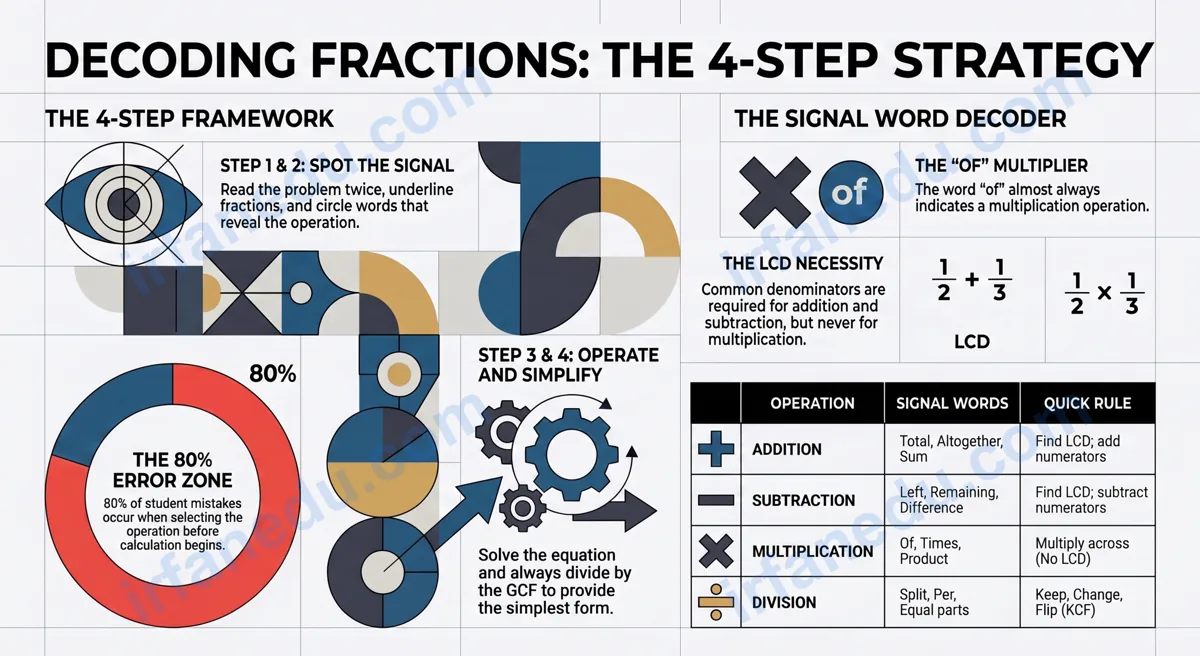
A Fully Solved Example — Before Anything Else
Before I explain any rules, read this problem and watch it get solved from scratch. Every technique in this guide flows from this one example.
Problem: Priya had a bag of trail mix. She ate 3/8 of the bag on Monday and 1/4 of the bag on Tuesday. What fraction of the bag did she eat in total?
- Read and spot the signal word. “In total” means add. The fractions are 3/8 and 1/4.
- Write the equation. 3/8 + 1/4 = ?
- Find a common denominator. The denominators are 8 and 4. The least common denominator (LCD) is 8. Convert 1/4 to eighths: 1/4 = 2/8.
- Add. 3/8 + 2/8 = 5/8.
- Simplify and label. 5/8 is already in simplest form. Priya ate 5/8 of the bag.
Notice the five moves: spot the signal word, write the equation, find the LCD, operate, simplify. That is the entire framework. The rest of this guide just applies it to harder problems.
A fractions word problem is a real-world scenario that requires you to add, subtract, multiply, or divide fractions. The key skill is translating the words into a fraction equation — the math itself is then straightforward.
To solve fractions word problems: (1) identify the signal word to find the operation, (2) write the fraction equation, (3) find a common denominator for addition or subtraction (not needed for multiplication or division), (4) solve, then (5) simplify and label your answer. The word “of” almost always means multiply; “left” means subtract; “total” means add.
Free Printable PDF Worksheet — 10 fractions word problems with a full answer key, ready to print.
Covers all four operations. Ordered easy to hard. Perfect for Grades 4-7.
- “Total” / “altogether” = add fractions; find a common denominator first.
- “Left” / “remaining” = subtract; again, common denominator required.
- “Of” (e.g., 1/2 of 3/4) = multiply; no common denominator needed.
- “Split equally” / “how many portions” = divide; flip the second fraction and multiply.
- Always simplify your final answer and attach the unit (cups, hours, km).
- Mixed numbers must be converted to improper fractions before operating.
| Fact | Detail |
|---|---|
| Grade range | Grades 3-7 (basic to multi-step) |
| Operations covered | Addition, subtraction, multiplication, division |
| Common denominator needed? | Yes for + and – ; No for x and / |
| Signal word for multiply | “of” (e.g., “2/3 of the class”) |
| Signal word for divide | “split into”, “how many equal parts”, “per” |
| Hardest mistake | Adding denominators instead of finding the LCD |
| US curriculum standard | CCSS 4.NF, 5.NF, 6.NS |
What Are Fractions Word Problems?
Fractions word problems are math questions set in a real-world context that require you to work with fractions to find a solution. They appear in every grade from 3 through 7 and test whether a student can translate language into a fraction equation — not just calculate.
The four types map directly to the four operations:
| Type | Example context | Operation |
|---|---|---|
| Combining parts | Two people share a pizza; how much total? | Addition |
| Finding what remains | A ribbon is cut; how much is left? | Subtraction |
| Finding a fraction of a quantity | 2/3 of a 12-litre tank; how many litres? | Multiplication |
| Splitting into equal portions | 3/4 kg of rice shared among 3 people | Division |
Why does this matter? Because the calculation is the easy part. The hard part — and the part that trips most students up — is choosing the right operation. Once you pick the right operation, the arithmetic is just fractions.
How Do You Solve Fractions Word Problems? (The 4-Step Method)
Every fractions word problem, from the simplest Grade 3 addition to a multi-step Grade 7 problem, responds to the same four steps.
- Step 1 — Read twice and underline the fractions. Read the problem once for the story, once for the math. Underline every fraction and circle the signal word.
- Step 2 — Identify the operation from the signal word. “Total” / “together” = add. “Left” / “remaining” = subtract. “Of” = multiply. “Split” / “per” / “how many equal groups” = divide.
- Step 3 — Set up and solve the equation. For addition and subtraction: find the LCD, convert, then operate on the numerators. For multiplication: multiply numerators together and denominators together. For division: keep the first fraction, flip the second, multiply.
- Step 4 — Simplify and label. Divide numerator and denominator by their GCF. Write the unit (cups, metres, hours). If the answer is greater than 1, convert to a mixed number if the context calls for it.
In my experience teaching this to hundreds of students, Step 2 is where 80% of errors happen. Students jump straight to the numbers and ignore the signal word. I now make every student say the operation out loud before writing a single digit. That one habit cuts fraction-word-problem errors in half.
Three More Worked Examples (Subtraction, Multiplication, Division)
Problem: A water bottle holds 5/6 of a litre. After a workout, 1/3 of a litre has been drunk. How much water remains?
- Signal word: “remains” = subtract. Equation: 5/6 – 1/3 = ?
- LCD of 6 and 3 is 6. Convert 1/3 to sixths: 1/3 = 2/6.
- Subtract: 5/6 – 2/6 = 3/6.
- Simplify: 3/6 = 1/2. Answer: 1/2 litre remains.
Problem: A recipe needs 3/4 cup of flour. You want to make 2/3 of the recipe. How much flour do you need?
- Signal word: “of” = multiply. Equation: 2/3 x 3/4 = ?
- Multiply numerators: 2 x 3 = 6. Multiply denominators: 3 x 4 = 12. Result: 6/12.
- Simplify: GCF of 6 and 12 is 6. 6/6 = 1, 12/6 = 2. Answer: 1/2 cup of flour.
Note: No common denominator step — multiplication never needs one.
Problem: A piece of rope is 3/4 m long. It is cut into pieces each 1/8 m long. How many pieces are there?
- Signal word: “cut into equal pieces” = divide. Equation: 3/4 / 1/8 = ?
- Keep, Change, Flip (KCF): Keep 3/4, change / to x, flip 1/8 to 8/1. New equation: 3/4 x 8/1.
- Multiply: (3 x 8) / (4 x 1) = 24/4 = 6.
- Answer: 6 pieces. (A whole number answer is fine — it means the rope divides evenly.)
Rope: |--1/8--|--1/8--|--1/8--|--1/8--|--1/8--|--1/8--|
       piece1  piece2  piece3  piece4  piece5  piece6

Total length = 6 x (1/8) = 6/8 = 3/4 m  [checks out]
Which Operation Should You Use? (Full Comparison Table)
The table below is the single most useful reference for fractions word problems. Bookmark it.
| Signal Words | Operation | Common Denominator? | Quick Rule | Example Phrase |
|---|---|---|---|---|
| total, altogether, combined, sum, in all | Addition | Yes | Find LCD, add numerators | “What fraction did they eat in total?” |
| left, remaining, difference, how much more, after eating/using | Subtraction | Yes | Find LCD, subtract numerators | “How much water is left?” |
| of, times, product, fraction of a group | Multiplication | No | Multiply across | “2/3 of the students passed” |
| split equally, per, how many equal parts, divided into | Division | No | Keep, Change, Flip | “Cut into 1/4 m pieces — how many?” |
When a problem has NO obvious signal word, ask: “Am I combining or separating parts (add/subtract) or finding a fraction of something (multiply/divide)?” That question resolves 95% of ambiguous cases.
Common Mistakes in Fractions Word Problems — Wrong vs. Right
These three errors appear in almost every classroom. Knowing them by name makes them easy to avoid.
Adding the denominators.
1/4 + 1/4 = 2/8 (wrong)
Students treat the denominator like a regular number and add it.
Keep the denominator; add only numerators.
1/4 + 1/4 = 2/4 = 1/2
The denominator tells you the size of each piece — it does not change when you combine same-sized pieces.
Using multiplication’s rule for addition.
1/3 + 1/4 = 2/7 (wrong)
Students multiply across (numerator x numerator, denominator x denominator) for addition too.
Find the LCD first for addition.
1/3 + 1/4: LCD = 12. 4/12 + 3/12 = 7/12
Multiply-across only works for multiplication, never for addition or subtraction.
Forgetting to simplify.
Answer given as 6/12 instead of 1/2.
The answer is technically correct but incomplete — and loses marks on most tests.
Always divide by the GCF.
6/12: GCF = 6. 6/6 = 1, 12/6 = 2. Final answer: 1/2.
Make simplification a non-negotiable last step, every single time.
Mistake 2 — using multiply-across for addition — is the one I see most often with students who learned multiplication first. The fix I use: write the operation sign in a big circle before touching the numbers. If the circle says “+”, you must find an LCD. If it says “x”, you multiply across. That visual cue breaks the habit within a week.
Almost every fraction word problem guide teaches the four operations separately and never addresses the real bottleneck: students can execute the operations but cannot identify which one to use. The reason is that most guides use explicit signal words (“add these fractions”), while real test problems use implicit signals.
For example: “A tank was 5/6 full. After the pump ran, it was 1/3 full. How much water was pumped out?” — the word “pumped out” does not appear in any signal-word list, but it means subtraction. In my experience, the students who score highest are those who ask a second question after reading: “Is the total getting bigger or smaller?” If bigger, it is addition. If smaller, it is subtraction. If you are finding a part of a part, it is multiplication. If you are splitting into equal groups, it is division. That two-question mental check outperforms memorising signal-word lists.
Want a full reference sheet for geometry and math formulas?
Practice Worksheet — Fractions Word Problems (10 Questions)
Work through these problems on paper. Use the 4-step method for each one. The answer key is hidden below — check your work after you finish, not during.
How to use this worksheet: Print the PDF (button below) or work directly on paper. Solve all 10 problems, then reveal the answer key to self-check. For any wrong answer, re-read the worked example that matches that operation type above.
- Mia drank 1/4 of a bottle of juice in the morning and 2/4 of the same bottle in the afternoon. What fraction of the bottle did she drink in total?
- A ribbon is 7/8 m long. Jake cuts off 3/8 m. How much ribbon is left?
- A recipe needs 2/3 cup of sugar. If you want to make half the recipe, how much sugar do you need?
- There are 20 students in a class. 3/5 of them passed the test. How many students passed?
- Leo finished 3/5 of his homework before dinner and 1/4 after dinner. What fraction of his homework did he finish in total?
- A tank holds 5/6 of a litre of water. It leaks 1/3 of a litre. How much water remains?
- A farmer plants wheat on 2/5 of a field and corn on 1/3 of the field. What fraction of the field has crops?
- A bag of flour weighs 3/4 kg. A baker uses 2/3 of the bag. How many kg of flour does the baker use?
- A car journey is 4 and 1/2 hours long. After 1 and 3/4 hours, how much of the journey remains?
- A school garden is 5/6 of an acre. Students have dug up 2/5 of the garden so far. What fraction of the whole garden has been dug?
Show Answer Key
- 3/4
- 4/8 = 1/2 m
- 1/3 cup
- 12 students
- 3/5 + 1/4 = 12/20 + 5/20 = 17/20
- 5/6 – 1/3 = 5/6 – 2/6 = 3/6 = 1/2 litre
- 2/5 + 1/3 = 6/15 + 5/15 = 11/15
- 3/4 x 2/3 = 6/12 = 1/2 kg
- 4 and 1/2 – 1 and 3/4 = 9/2 – 7/4 = 18/4 – 7/4 = 11/4 = 2 and 3/4 hours
- 5/6 x 2/5 = 10/30 = 1/3 of an acre
Take the worksheet with you. Download the free printable PDF — includes all 10 problems and a separate answer key section.
Interactive Quiz — Fractions Word Problems (8 Questions)
Select an answer for each question. You will see instant feedback and an explanation.
1. Sam ate
Sources & References
Written and fact-checked by Dr Irfan Mansuri. External links open in a new tab and are provided for further reading and verification.